
智能影像设备

Search documents
影石创新:公司是以全景技术为基点的全球知名智能影像设备提供商
Zheng Quan Ri Bao Wang· 2026-02-05 12:17
Core Viewpoint - The company, Yingstone Innovation, is a globally recognized provider of intelligent imaging equipment, focusing on panoramic technology and has developed a robust technological system centered around various advanced imaging technologies [1] Group 1: Company Overview - Yingstone Innovation has established a competitive advantage in the imaging technology market due to its deep accumulation of knowledge and continuous innovation [1] - The company emphasizes the originality and advancement of its core underlying technologies, which include panoramic technology, anti-shake technology, AI image processing technology, and computational photography technology [1] Group 2: Investor Relations - The company places a high priority on investor relations management, with the board secretary overseeing this aspect [1] - Yingstone Innovation maintains smooth communication with investors through various channels, including the Shanghai Stock Exchange E-interaction platform, investor hotlines, performance briefings, and institutional research [1]

影石创新:公司属于新一代信息技术产业中的“1.5.2智能消费相关设备制造”
Zheng Quan Ri Bao Zhi Sheng· 2026-01-26 12:44
Core Viewpoint - The company emphasizes its position in the smart imaging equipment industry, which is part of the new generation information technology sector, and asserts that it is not classified as a "traditional backward industry" [1] Industry Insights - The smart imaging equipment industry is positioned at the forefront of consumer electronics, indicating a growth potential driven by technological advancements and market demand [1] Company Strategy - The company focuses on long-term business development, leveraging its deep expertise in imaging technology and continuous innovation to gain a significant competitive advantage in the market [1] - Management prioritizes shareholder interests and aims to create long-term value through core business and product innovation [1] Future Outlook - The company is confident in enhancing its R&D capabilities and brand recognition, committing to ongoing R&D investments and expanding its research team [1] - Plans include developing higher-level technology products/services and establishing new standards to solidify its technological advantages and meet market demands with high-value offerings [1]
家电行业专题研究:拥抱龙头,重视出海
Xin Lang Cai Jing· 2025-12-26 12:24
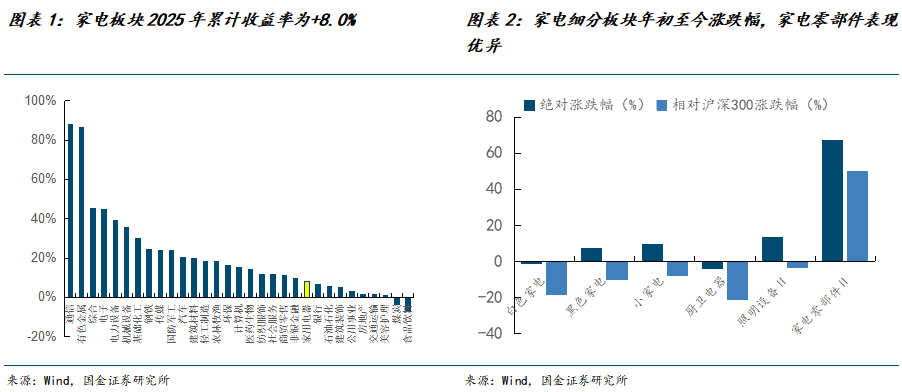
Group 1: Domestic Demand and Market Outlook - The home appliance sector is expected to show a "high first half and stable second half" trend in 2025, driven by policy continuation and consumption peaks [1] - In the first three quarters of 2025, air conditioner shipments increased by 8.4%, refrigerators by 2.4%, and washing machines by 4.1% year-on-year [1][13] - For 2026, the continuation of subsidies is anticipated to mitigate the impact of high base effects and demand pull-forward, with projected declines in overall appliance sales of -4% to -7.3% under various subsidy scenarios [1][16][19] Group 2: Export Performance and Global Market Trends - Home appliance exports have slowed down due to tariff policies and global supply chain adjustments, but still show resilience and structural highlights [2] - In 2025, the export growth rate for air conditioners is expected to be weaker than that of washing machines and refrigerators, primarily due to adverse weather conditions affecting overseas demand [2][39] - The U.S. market is projected to benefit from a rate cut, which may enhance demand for home appliances, while the European market is expected to maintain a slow recovery [42][44][50] Group 3: Investment Themes - The narrative in the black appliance sector is shifting from "market share chasing" to "profit and pricing power," with Chinese brands like Hisense and TCL expected to convert market share into higher profits [3][55] - White appliances are seen as having strong growth potential due to their historical resilience through cycles, with leading brands like Midea and Haier expected to maintain stable growth and generous dividends [3][83] - The global competition in new consumer products, particularly in smart imaging and robotic vacuum cleaners, is expected to favor Chinese brands, highlighting their competitive advantages [3] Group 4: Financial Metrics and Valuation - As of December 22, 2025, the home appliance sector's PE TTM is 16.27 times, remaining below the 10-year average of 32.8% [7] - The white appliance segment's current PE is 11.22, while black appliances stand at 25.94, indicating varying levels of market valuation [9] - The home appliance sector has seen a decline in public fund holdings, with a heavy allocation of only 2.46% in Q3 2025, reflecting concerns over demand in 2026 [9]





国金证券:家电行业内需趋稳 投资聚焦三大主线
智通财经网· 2025-12-26 02:13
Core Viewpoint - The report from Guojin Securities indicates that the home appliance industry will experience a "front high and back stable" trend in domestic demand by 2025, with a focus on volume growth in white goods and structural upgrades in black goods [1][2]. Domestic Demand - In 2025, the home appliance market is expected to show a "front high and back stable" trend driven by policy continuation and seasonal consumption [2]. - For white goods, volume growth is the main focus, with air conditioning performing better than refrigerators and washing machines in the first three quarters of 2025. The shipment growth rates for air conditioners, refrigerators, and washing machines are projected at +8.4%, +2.4%, and +4.1% year-on-year respectively [2]. - Black goods are expected to continue structural upgrades, with Mini LED penetration reaching 33% in Q2 2025, more than doubling year-on-year. Despite a decline in growth due to subsidy reductions in Q3, Mini LED penetration remains high at 28.3% [2]. - For 2026, the continuation of national subsidies may help mitigate pressures from high baselines and overspending. The report estimates potential declines in the overall home appliance market under different subsidy scenarios, with expected declines of -4%, -5.7%, and -7.3% for "same scale subsidy," "half scale," and "no subsidy" respectively [2]. External Demand - From early 2025, home appliance export growth has slowed due to tariff policies and global supply chain adjustments, but it still shows resilience and structural highlights [3]. - The export performance of refrigerators and washing machines is better than that of air conditioners, influenced by weather factors and a high baseline from 2024 [3]. - Black goods have shown resilience, with a notable recovery in TV exports since July 2025, attributed to easing tariffs and replenishment in overseas channels [3]. - The global home appliance demand is expected to remain relatively stable in 2025, with various regional outlooks indicating neutral to negative sentiments [3]. Investment Themes - Investment Theme 1: The global narrative for black goods is shifting from "market share pursuit" to "profit and pricing power." Chinese companies are expected to leverage their integrated supply chain advantages to convert market share into profits, with recommendations for Hisense and TCL [4]. - Investment Theme 2: White goods maintain growth potential due to their historical resilience through cycles, with strong cash flow and high dividend willingness. Recommended companies include Midea Group and Haier Smart Home [4]. - Investment Theme 3: The emerging consumption sector shows significant global competitiveness, particularly in smart imaging and robotic vacuum markets, with recommendations for companies like Roborock and Ecovacs [4].

家电行业 2026 年投资策略:逆风莫摧残,挖掘定价权
Hua Yuan Zheng Quan· 2025-12-19 09:29
Investment Rating - The report rates the home appliance industry as "Positive" for investment, marking it as the first recommendation for 2026 [3]. Core Insights - The report emphasizes that leading companies with strong product capabilities, channel efficiency, cost control, and brand premium are positioned to gain market share during a challenging domestic demand environment. The industry is shifting from "incremental competition" to "stock integration" [4]. - It highlights that while short-term revenue growth may be difficult to expect, leading companies are likely to maintain profit growth due to improved efficiency and cost reduction. A stabilization in demand could lead to a new golden era for these companies [4]. - The report suggests focusing on three main investment themes: companies benefiting from domestic market consolidation, those redefining products for overseas markets, and quality dividend stocks with low valuations [4]. Summary by Sections 1. Market Performance and Fundamentals - The home appliance sector underperformed the CSI 300 index in 2025, with a growth rate of 9.7%, lagging behind the index by 7.8 percentage points, primarily due to external tariffs and domestic policy fluctuations [9]. - The report notes that the home appliance sector's valuation remains low compared to other consumer sectors, with a PE ratio of 14.7X as of November 30, 2025, reflecting the industry's mature phase and pressures from declining domestic real estate demand [19][20]. 2. Main Line One: Opportunities in Market Consolidation - The report identifies opportunities in the smart projection market, where domestic consolidation is occurring, and leading companies are gaining market share. The market is expected to improve as consumer demand recovers [61]. - In the kitchen appliance sector, leading companies are showing resilience in performance despite weak demand, with market shares increasing as smaller competitors exit the market [76]. 3. Main Line Two: Redefining Products for Export Markets - The report discusses the growth potential in the robotic vacuum cleaner market, which is expected to see double-digit growth in the overseas market from 2024 to 2029, driven by product innovation [86]. - It also highlights the potential for growth in the lawn mower robot market, particularly in Europe, where the penetration rate is expected to rise significantly [104]. 4. Main Line Three: Quality Dividend Stocks - The report suggests that companies like Midea Group and Haier Smart Home are positioned well due to their stable cash flows and increasing dividend payouts, making them attractive for long-term investment [85].


深圳大爆的“网红品牌”为何纷纷走向线下?
3 6 Ke· 2025-12-02 02:57
Core Insights - The article discusses the trend of online brands, particularly from Shenzhen, transitioning to offline retail spaces to build brand trust and identity, moving beyond mere sales to establish deeper consumer relationships [1][2][8]. Group 1: Brand Identity and Trust - For these internet-born brands, opening physical stores serves as a "brand coming-of-age ceremony," focusing on identity confirmation rather than immediate sales [2]. - The challenge faced by these brands is the "traffic aftereffect," where online success does not equate to lasting brand recognition, as consumers often remember the product rather than the brand itself [3][21]. - Physical stores are essential for breaking the trust barrier, transforming the brand from a virtual symbol into a tangible entity that consumers can interact with [4][6]. Group 2: Consumer Experience and Engagement - The tactile experience provided by physical stores is crucial for establishing brand loyalty and justifying product pricing, which cannot be replicated online [5][7]. - High-end retail locations serve as significant brand advertisements, indicating a commitment to long-term growth and consumer engagement [6][9]. - These stores act as immersive environments that enhance consumer trust and provide a space for hands-on product experience, addressing personal concerns that online reviews cannot resolve [7][26]. Group 3: Strategic Positioning of Physical Stores - Brands like Insta360,拓竹科技, and徕芬 have distinct strategies for their physical stores, focusing on lowering creative barriers and providing immersive experiences rather than just selling products [10][12][14]. - The stores serve as complex strategic nodes, functioning as brand showrooms, educational spaces, and data collection points, shifting focus from immediate sales to long-term brand value and user relationships [16][20]. - The transition to offline retail is not merely a supplementary strategy but a significant upgrade in brand strategy, emphasizing the importance of physical presence in building consumer trust [21][24]. Group 4: The Shenzhen Manufacturing Advantage - The success of these brands is rooted in Shenzhen's unique manufacturing ecosystem, which allows for rapid prototyping and innovation at lower costs [18][19]. - The ability to quickly iterate on product designs and engage directly with consumers has been pivotal in their rise, enabling them to bypass traditional distribution models [20]. - The article highlights the importance of a strong supply chain and effective online marketing in achieving initial brand recognition, but emphasizes that true brand trust requires a solid offline presence [22][28]. Group 5: Future Trends in Retail - The exploration of offline retail by these brands may signal a broader trend where high-end, complex consumer products increasingly require physical experiences for consumer confidence [24][26]. - As online customer acquisition costs rise and competition intensifies, well-designed physical stores can become valuable assets, generating brand loyalty and driving online engagement [27][28]. - The article concludes that the journey of these Shenzhen brands illustrates a critical shift in the manufacturing sector, moving from product success to brand success, emphasizing the need for tangible consumer experiences [28][29].
中国银河证券:AI价值重心向应用端转移 聚焦半导体、端侧与元件新机遇
Zhi Tong Cai Jing· 2025-11-26 02:00
Core Insights - The electronic industry is undergoing a critical transition driven by AI, shifting from computing infrastructure to application implementation by 2026 [1] - Overall industry valuation is considered high, necessitating a shift in investment logic from valuation expansion to profit realization [1] - Key opportunities are identified in three main areas: semiconductors, consumer electronics, and components [1] Semiconductor Sector - The semiconductor industry is experiencing rapid growth, with expectations for continued trends into 2026 [2] - Key focus areas include the trend of domestic computing power localization, the impact of AI on consumer electronics, and the significant demand for storage chips driven by computing needs [2] - The semiconductor manufacturing sector is entering a new growth cycle due to AI and high bandwidth memory (HBM) demand [2] Consumer Electronics - Major consumer electronics brands are embracing AI, with expectations for accelerated development in AI edge applications by 2026 [3] - Opportunities for valuation enhancement are seen in smartphone manufacturers as AI traffic entry points and in the rapid growth of smart imaging devices [3] - Investment opportunities are also identified in components related to AI glasses, AI headphones, and the upgrade of large-end devices [3] Components and Devices - The demand for printed circuit boards (PCBs) is expected to remain high due to AI, with leading manufacturers actively expanding production [4] - The global CSP manufacturers are increasing investments in AI, driving high demand for multi-layer PCBs and HDI products [4] - Opportunities in passive components focus on chip inductors and tantalum capacitors, while optical components are driven by the upgrade of smart phone optics and the proliferation of new consumer electronics [4]

27位深圳青年才俊上榜!《胡润U40中国创业先锋》出炉
Nan Fang Du Shi Bao· 2025-11-09 11:13
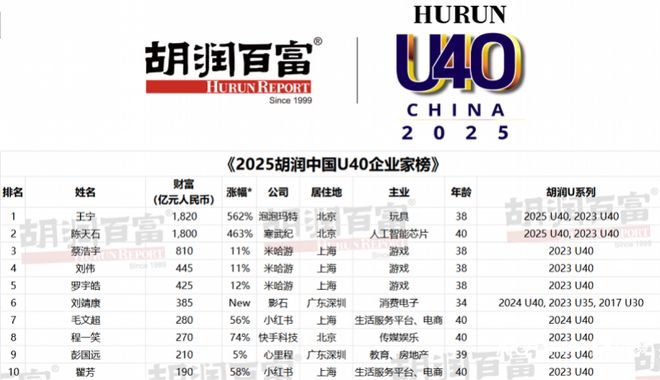
Core Insights - The "2025 Hurun U40 China Entrepreneur Pioneers" list features 195 entrepreneurs under 40 years old, with a significant concentration in the entertainment and new consumption sectors, particularly in software and services [1][3] - Major cities attracting these U40 entrepreneurs include Shanghai, Beijing, and Shenzhen, with Shenzhen having 27 representatives on the list [1][3] - The report also highlights 39 U40 entrepreneurs with personal wealth exceeding 5 billion RMB, with a notable presence in the Greater Bay Area [1][4] Group 1: Entrepreneur Demographics - The list includes entrepreneurs from 53 cities, with a gender distribution of 85% male and 15% female [3] - The average age of these entrepreneurs is 37, and they founded their companies at an average age of 28, with an average of 420 employees per company [3] - 34% of these entrepreneurs have successfully listed their companies, and the average total financing is 100 million RMB [3] Group 2: Industry Focus - The highest representation among the entrepreneurs is in the software and services sector, accounting for 28%, while 72% are involved in selling physical products [3] - B2B companies make up 82% of the list, while B2C companies account for 18% [3] - The life and health sector ranks second with a 14% representation among the entrepreneurs [3] Group 3: Notable Entrepreneurs - The top-ranked entrepreneur is Wang Zhong, with a wealth of 1,820 million RMB, followed by Chen Tianshi at 1,800 million RMB, both from Beijing [2] - Liu Jingkang, founder of Ying Shi, is the highest-ranked entrepreneur from Shenzhen, with a wealth of 385 million RMB [4][5] - Other notable entrepreneurs from Shenzhen include Cheng Guoyuan, with a wealth of 210 million RMB, involved in education and high-precision manufacturing [5]

影石创新:公司子公司完成工商变更登记
Zheng Quan Ri Bao Wang· 2025-10-24 15:11
Core Viewpoint - The company announced plans to use part of its raised funds for capital increase and loans to its wholly-owned subsidiary for project implementation [1] Group 1: Fund Utilization - The company will use 90 million yuan (9,000.00 million) of raised funds to increase capital for its subsidiary, Zhuhai Yingshi Technology Co., Ltd. [1] - The company will also provide a loan of up to 105.43 million yuan (10,543.30 million) to Zhuhai Yingshi for project implementation [1] Group 2: Corporate Actions - The second meeting of the board of directors and the tenth meeting of the supervisory board will be held on July 10, 2025, to review the funding proposals [1] - Zhuhai Yingshi has completed the necessary business registration changes recently [1]

影石创新(688775):发布激励计划,利好长期发展
Changjiang Securities· 2025-09-30 02:45
Investment Rating - The report maintains a "Buy" rating for the company [7]. Core Insights - The company's stock incentive plan is expected to benefit long-term development by binding employee interests and attracting talent [2][11]. - The incentive plan covers 695 key employees, accounting for 21.48% of the total workforce, which includes 20 foreign employees [11]. - The performance targets for the incentive plan are relatively moderate, aiming for revenue growth of 30% in 2025, 15% in 2026, and 10% in 2027 [11]. Summary by Sections Event Description - The company announced a draft for its 2025 stock incentive plan, proposing to grant a total of 1.387146 million restricted shares, representing 0.35% of the total share capital of 40.1 million shares [4]. - The initial grant and reserved grant are 1.155955 million and 231,191 shares, respectively, with a grant price of 148.92 yuan per share, which is approximately 50% lower than the closing price on September 24, 2025 [4]. Financial Projections - The company is projected to achieve net profits of 1.161 billion, 1.838 billion, and 2.700 billion yuan for the years 2025, 2026, and 2027, respectively, with corresponding P/E ratios of 102.25, 64.56, and 43.96 [11][16]. - Revenue forecasts for the same years are 8.567 billion, 12.909 billion, and 18.565 billion yuan [16]. Company Performance - The company has established itself as a leader in the global panoramic and action camera market, driven by a youthful and dynamic organizational structure [11]. - The company is actively expanding its international presence and building a comprehensive channel system, enhancing brand recognition [11].