
服务器DDR5

Search documents
存储价格上涨的趋势远未见顶,瑞银预测Q2再涨40%
傅里叶的猫· 2026-03-03 12:13
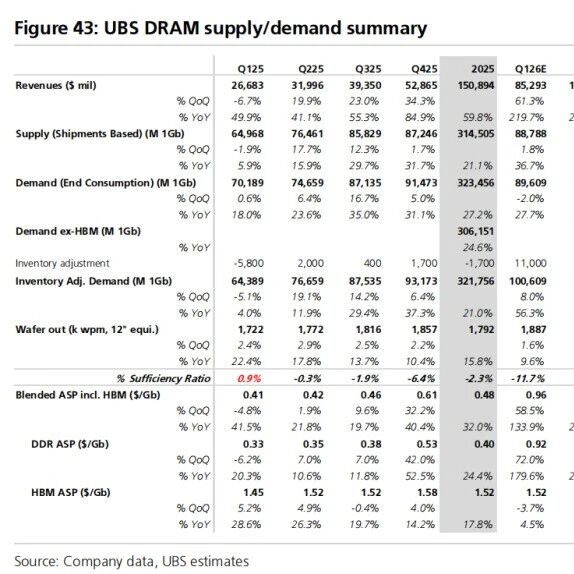
Core Viewpoint - The article discusses the ongoing trends and forecasts in the AI and storage sectors, particularly focusing on DRAM and NAND markets, highlighting significant price increases and supply-demand dynamics. Group 1: Storage Market Trends - The storage sector is expected to face a collective decline, with major companies like SK Hynix and Samsung experiencing stock price drops nearing 10% as of March 3 [2] - UBS has raised its forecast for DDR contract prices, predicting a 72% quarter-on-quarter increase by Q1 2026, up from a previous estimate of 62% [2] - NAND contract prices are also expected to rise by 65% quarter-on-quarter, an increase from the earlier forecast of 40% [2] Group 2: Supply and Demand Dynamics - UBS anticipates that the supply of storage will significantly lag behind demand until at least Q4 2027, with some industry experts suggesting this imbalance may extend into 2028 and beyond [3] - The current cycle peak for NAND has been pushed from Q1 2027 to Q2 2027, indicating a more optimistic outlook from the industry compared to UBS [4] Group 3: Revenue and Production Forecasts - Revenue projections for the storage market show a steady increase, with expected revenues of $202.265 billion in 2026, up from $66.042 billion in 2025 [4] - The demand for DRAM is projected to grow significantly, with end consumption expected to reach 1,458,721 million 1GB by 2027, reflecting a year-on-year growth of 17.2% [4] Group 4: HBM Demand and Production - UBS has revised its HBM demand forecast for 2026 to 31.1 billion Gb, up from 30.9 billion Gb, representing an 80% year-on-year increase [5] - The forecast for 2027 HBM demand has also been increased to 53.9 billion Gb, up from 48.6 billion Gb, indicating a 73% year-on-year growth [5] Group 5: Capacity Expansion Challenges - The pace of capacity expansion for storage manufacturers is constrained by various factors, including space limitations and equipment delivery delays [7] - UBS estimates that Samsung's DRAM wafer capacity can realistically expand by 80,000 wafers per month, with a maximum of 100,000 wafers per month [7] - Capital expenditures for SK Hynix have been adjusted upwards to 41 trillion KRW for 2026 and 47 trillion KRW for 2027, reflecting increased investment in DRAM production [7]

存储大厂业绩创新高,AI驱动存储涨价效应扩散
Xinda Securities· 2026-02-01 11:23
Investment Rating - The industry investment rating is "Positive" [2] Core Insights - The rapid growth in demand for AI model training and inference is the core driver of the current recovery in the storage industry, with high-performance storage products experiencing explosive growth. HBM has become a key component for AI servers, significantly contributing to the performance growth of leading manufacturers. Additionally, the demand for server DRAM and enterprise SSDs has increased, further squeezing the capacity for consumer products and causing price increases in storage, which are expected to continue [4][3][4]. Summary by Sections Industry Performance - The electronic sub-industry has seen adjustments, with the Shenwan Electronics secondary index showing year-to-date changes: semiconductors (+18.04%), other electronics II (+10.31%), components (+0.45%), optical electronics (+6.80%), consumer electronics (-0.76%), and electronic chemicals II (+15.58%). This week, the performance was: semiconductors (-0.90%), other electronics II (-2.87%), components (-2.34%), optical electronics (-4.06%), consumer electronics (-5.74%), and electronic chemicals II (-5.87%) [3][10]. Company Performance - **SK Hynix**: In Q4 2025, SK Hynix reported revenue of 32.83 trillion KRW, a quarter-on-quarter increase of 34% and a year-on-year increase of 66%. The gross margin was 69%, with a net profit of 15.25 trillion KRW, reflecting a 21% quarter-on-quarter and 90% year-on-year increase. The company’s full-year revenue for 2025 reached 97.15 trillion KRW, a 47% year-on-year increase [3][4]. - **Samsung Electronics**: In Q4 2025, Samsung Electronics achieved revenue of 93.8 trillion KRW, a 9% quarter-on-quarter and 24% year-on-year increase. The operating profit reached 20.1 trillion KRW, marking a 208% year-on-year increase, while the net profit was 19.64 trillion KRW. The company expects continued growth in AI and server demand in 2026 [3][4][26]. - **SanDisk**: In FY26Q4, SanDisk reported revenue of $3.025 billion, a 31% quarter-on-quarter and 61% year-on-year increase. The net profit surged by 672% year-on-year, driven by product optimization and increased ASP [4][28]. Price Trends - According to TrendForce, the contract price for general DRAM is expected to rise by approximately 55% to 60% in Q1 2026, while NAND flash prices are projected to increase by 33% to 38%, with consumer-grade QLC products seeing price increases of no less than 40% [4].
三星财报释放行业信号!存储芯片“超级周期”动能不减,AI与消费电子需求分化加剧
Hua Xia Shi Bao· 2026-01-30 13:05
Group 1 - The core viewpoint of the article highlights that the storage industry is currently experiencing a super cycle, driven by a surge in demand for storage chips due to the AI boom, leading to significant revenue and profit growth for major players like Samsung Electronics [2][3][4]. - Samsung Electronics reported a record revenue of 93.8 trillion KRW (approximately 455.9 billion RMB) in Q4 of last year, marking a year-on-year increase of about 24%, with operating profit reaching 20.1 trillion KRW (approximately 9.77 billion RMB), more than doubling year-on-year [2][3]. - The DS (Device Solutions) division, which includes storage chips, generated 44 trillion KRW in revenue, accounting for 47% of Samsung's total revenue, with a 46% year-on-year growth rate, double that of the overall company [3]. Group 2 - Samsung's storage chip business, contributing 37.1 trillion KRW to the DS division, represented 85% of its revenue, with a remarkable 62% year-on-year growth, significantly outpacing the overall revenue growth [3]. - The operating profit from the DS division was 16.4 trillion KRW, accounting for over 80% of Samsung's total operating profit, with a year-on-year increase of approximately 4.6 times [3]. - The strong performance of Samsung's storage chips was further supported by the rising value of high-margin products such as HBM (High Bandwidth Memory) and server DDR5, which are increasingly in demand for AI applications [4]. Group 3 - The strong performance of Samsung Electronics in Q4 was also aided by the strengthening of the US dollar, which positively impacted its operating profit by 1.6 trillion KRW (approximately 78 million RMB) [5]. - The shortage of general DRAM in the consumer electronics market has led to significant price increases, with Samsung and SK Hynix negotiating substantial price hikes for LPDDR supplied to Apple, with Samsung's prices rising over 80% [6][7]. - The increase in memory prices has resulted in higher costs for smartphone manufacturers, leading them to raise product prices, particularly affecting mid-range products more than high-end ones [8]. Group 4 - Samsung Electronics plans to prioritize high-value products for AI applications in Q1, including the mass production of HBM4, indicating a shift in focus towards the AI market rather than traditional consumer electronics [8][9]. - The IDC report noted that manufacturers are reallocating production capacity from consumer electronics to higher-margin AI-specific memory solutions, resulting in a supply shortage for general memory modules [9]. - Companies in the storage industry, such as Jiangbolong, are forecasting significant profit increases for 2025, driven by the rising prices of storage products and the shift in demand towards AI applications [9][10].

存储巨头业绩股价双爆发,年内最高飙涨60%
21世纪经济报道· 2026-01-30 00:49
Core Viewpoint - The storage industry is experiencing significant growth driven by the increasing demand for AI infrastructure, leading to record-high performances from major storage manufacturers like Seagate, SK Hynix, and Samsung Electronics [1][2][3]. Group 1: Financial Performance - SK Hynix reported a record high in Q4 2025 with revenue increasing by 34% to 32.83 trillion KRW and operating profit up 68% to 19.17 trillion KRW, achieving an operating margin of 58% [1]. - Samsung Electronics' storage business achieved sales revenue of 37.1 trillion KRW in Q4, a 39% quarter-on-quarter increase and a 62% year-on-year increase, significantly outperforming the group's overall sales growth of 24% [2]. - For the full year 2025, SK Hynix's revenue reached 97.15 trillion KRW, with operating profit doubling to 47.21 trillion KRW compared to 2024 [3]. Group 2: Market Trends - The storage market is expected to face a severe decline in 2024, but a sudden recovery is anticipated in 2025, as indicated by industry insiders [2]. - The demand for DRAM and NAND products is projected to grow significantly, with DRAM prices increasing by approximately 25% and NAND prices by over 30% in Q4 2025 [3][4]. - The limited supply combined with strong demand from cloud service providers for AI infrastructure is creating a supply-demand imbalance, contributing to the strong financial results of storage giants [4]. Group 3: Capital Expenditure and Expansion - Major storage companies are increasing capital expenditures in response to the robust demand for AI infrastructure, with Micron Technology announcing a $100 billion investment to build multiple semiconductor fabs in the U.S. [6][7]. - Micron also plans to acquire a manufacturing facility in Taiwan for $1.8 billion to enhance its storage supply capabilities [6]. - SK Hynix is cautiously increasing its capital expenditures while focusing on strengthening partnerships to meet customer demands, with plans to enhance production capacity at its facilities in Korea and the U.S. [7][8]. Group 4: Future Outlook - The storage industry is entering a new growth cycle defined by AI, with a focus on high-value products such as high-bandwidth memory and enterprise solid-state drives [9]. - The demand for DRAM is expected to grow by over 20% year-on-year in 2026, while NAND demand is projected to grow by around 20% [8]. - The importance of memory in server markets is increasing, with expectations of over 15% growth in this segment in 2026 [8].


AI引爆存储市场 巨头业绩翻倍开启扩产
2 1 Shi Ji Jing Ji Bao Dao· 2026-01-29 23:42
Core Insights - The storage industry is experiencing record-high performance driven by strong demand for AI-related storage solutions, with major companies like SK Hynix, Samsung Electronics, and Micron reporting better-than-expected earnings for Q4 2025 [1][11] - SK Hynix's operating profit doubled in 2025, highlighting the significant impact of AI on storage demand [1][11] Financial Performance - SK Hynix reported a revenue of 32.83 trillion KRW for Q4 2025, a 34% increase quarter-on-quarter, and an operating profit of 19.17 trillion KRW, up 68% with an operating margin of 58% [14] - Samsung Electronics' storage business achieved sales of 37.1 trillion KRW in Q4 2025, a 39% quarter-on-quarter increase and a 62% year-on-year increase, significantly outpacing the group's overall sales growth of 24% [14] - For the full year 2025, SK Hynix's revenue reached 97.15 trillion KRW, with an operating profit of 47.21 trillion KRW, marking a substantial increase from 2024 [3][15] - Samsung's storage business generated sales of 104.1 trillion KRW in 2025, a 23% year-on-year growth, while its overall DS business saw a 65% increase in operating profit [3][15] Market Trends - The storage market faced challenges in 2024 but saw a significant rebound in 2025, attributed to increased demand from AI infrastructure investments and a supply-demand imbalance [5][16] - The demand for high-performance memory, such as HBM, is expected to continue growing, with SK Hynix reporting over a 100% year-on-year increase in HBM revenue [17] - The overall memory product demand, including server DRAM and NAND, is anticipated to rise as AI applications evolve [17][21] Capital Expenditure and Expansion - Major storage companies are increasing capital expenditures to expand production capacity, with Micron announcing significant investments in new manufacturing facilities in the U.S. and Singapore [7][18][19] - Micron plans to invest $100 billion in a new semiconductor manufacturing complex in New York and $24 billion in a facility in Singapore to meet AI-related NAND demand [18][19] - SK Hynix is cautiously increasing capital expenditures while focusing on strengthening partnerships to meet customer needs, with plans to enhance production capacity in Korea and the U.S. [20] Future Outlook - The DRAM market is expected to grow by over 20% year-on-year in 2026, while NAND growth is projected to be around 20% [21] - The server market's memory demand is becoming increasingly critical, with expectations of over 15% growth in 2026 [21] - The storage industry is entering a new growth cycle defined by AI, shifting from a supporting role to a key component in computing power efficiency [22]
王者归来!三星电子Q4营收93.8万亿韩元创纪录,存储业务营业利润暴增465%,重夺DRAM市场榜首
Hua Er Jie Jian Wen· 2026-01-29 00:42
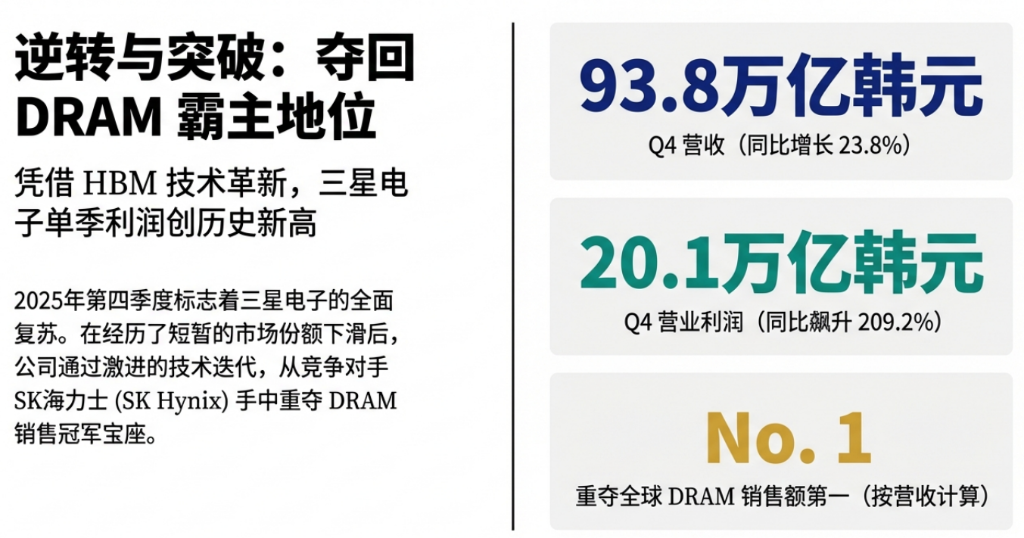
Core Viewpoint - Samsung Electronics has made a strong comeback in the semiconductor market, achieving record quarterly revenue and operating profit in Q4 2025, driven by high bandwidth memory (HBM) technology advancements and rising market prices [1][5][8]. Group 1: Financial Performance - In Q4 2025, Samsung reported revenue of 93.8 trillion KRW, a year-on-year increase of 23.8% and a quarter-on-quarter increase of 9% [1]. - The operating profit for Q4 2025 reached 20.1 trillion KRW, soaring 209.2% year-on-year, marking the highest quarterly record for a Korean company [1]. - For the entire year of 2025, Samsung's revenue was 333.6 trillion KRW, with an operating profit of 43.6 trillion KRW, reflecting year-on-year growth of 10.87% and 33.3% respectively [1]. Group 2: Semiconductor Division Highlights - The semiconductor division contributed 80% of the group's operating profit, with Q4 revenue of 44 trillion KRW, a quarter-on-quarter increase of 33%, and an operating profit of 16.4 trillion KRW, up 465% year-on-year [5]. - Samsung regained the top position in DRAM sales by revenue in Q4 2025 after a comprehensive redesign of HBM technology [8]. - The company successfully delivered HBM3E to Nvidia and entered the supply chains of Google and AMD, indicating a strong competitive position in the HBM market [9]. Group 3: Future Outlook - Samsung plans to continue collaborating closely with customers in 2026, focusing on competitive HBM4 deliveries and expanding sales of AI-related products such as DDR5 and GDDR7 [14]. - The semiconductor division is expected to benefit from the ongoing semiconductor boom and storage supply shortages, with projected operating profit reaching 180 trillion KRW in 2026, a year-on-year increase of 314% [8][29]. - The company aims to lead in the AI era by emphasizing high-performance products and expanding sales of AI-related DRAM and NAND products [26]. Group 4: Challenges in Other Business Segments - The mobile and consumer electronics segments faced challenges, with combined revenue of 29.3 trillion KRW and an operating profit of only 1.9 trillion KRW in Q4, down 8% quarter-on-quarter [16]. - The home appliance and TV business recorded a combined revenue of 14.8 trillion KRW with an operating loss of 0.6 trillion KRW in Q4 [19]. - Despite strong sales of high-end products, the TV business continues to face profitability pressures due to intense market competition [22].
影响市场重大事件:蓝箭航天终极目标是将朱雀三号每公斤发射费用降至2万元内; IDC预计2030年中国具身智能机器人用户支出规模达770亿美元
Mei Ri Jing Ji Xin Wen· 2025-12-09 22:16
Group 1: Aerospace and Robotics - Blue Arrow Aerospace aims to reduce the launch cost of the Zhuque-3 rocket to below 20,000 RMB per kilogram, with costs decreasing by approximately 45% after five launches and approaching marginal costs after 20 launches [1] - IDC forecasts that user spending on embodied intelligent robots in China will exceed $1.4 billion by 2025 and reach $77 billion by 2030, with a compound annual growth rate (CAGR) of 94% [1] Group 2: Technology and AI - Alibaba has established the Qianwen C-end business group, aiming to develop a super app that serves as the primary entry point for users in the AI era, with plans to integrate AI across various devices [2] - The Shanghai Science and Technology Committee has approved funding of 7.25 million RMB for 19 projects, including the establishment of international standards for single-cell spatial molecular pathology diagnosis [3] Group 3: Healthcare and Regulations - The National Medical Products Administration will ban the production of mercury-containing thermometers and blood pressure monitors starting January 1, 2026, due to safety concerns regarding mercury exposure [4] Group 4: Financial Markets - Morgan Stanley Fund indicates that A-shares and Hong Kong stocks are currently at mid-low valuation levels, with structural opportunities in the mid-to-high-end manufacturing sector as profit recovery begins [5] Group 5: Government Budgets and Investments - The South Korean government has approved a budget of 727.9 trillion KRW (approximately 35 trillion RMB) for the 2026 fiscal year, marking an 8.1% increase from the previous year, with significant investments in AI and biotechnology [6] Group 6: Semiconductor Market - CFM Flash Market predicts that DDR5 server memory prices will rise by over 40% in Q1 2026 due to supply shortages, with significant demand shifts towards server applications [7] Group 7: Electric Vehicles and Charging Infrastructure - Jiangsu province has launched its first smart orderly charging pilot communities, utilizing IoT and AI to optimize electric vehicle charging, enhancing efficiency and reducing costs [8] Group 8: Retail Industry - The Ministry of Commerce emphasizes the need for improvement in retail network layout and online-offline balance, advocating for the adoption of successful practices from leading companies to stimulate consumer potential [9]

存储太火了!SK海力士收入利润双双飙升,2026年产能已“全部售罄”|财报见闻
Hua Er Jie Jian Wen· 2025-10-29 01:17
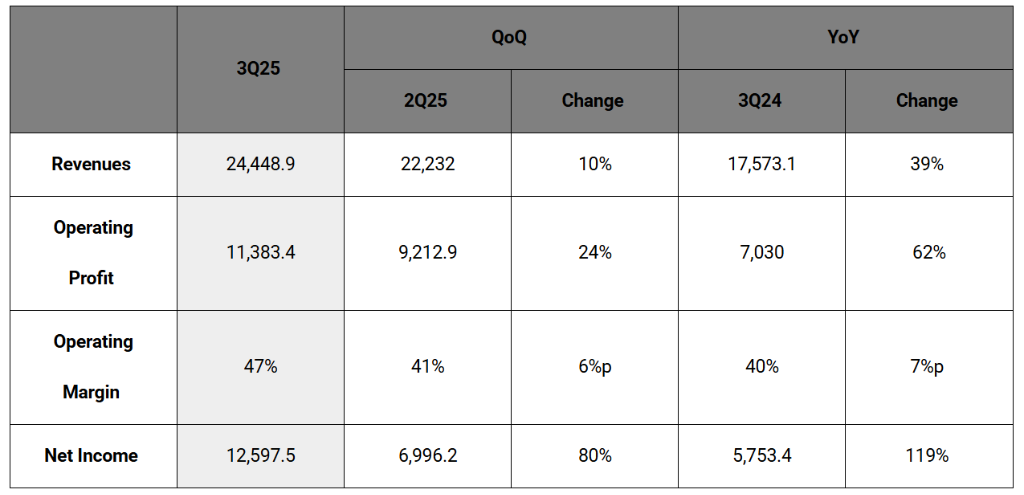
Core Insights - SK Hynix reported impressive Q3 financial results, with operating profit surpassing 10 trillion KRW for the first time, reaching 11.38 trillion KRW, a year-on-year increase of 62% [1][2] - The company's revenue for Q3 was 24.45 trillion KRW (approximately 17.1 billion USD), marking a 39% year-on-year growth [1][2] - Net income reached a record high of 12.6 trillion KRW, reflecting a 119% increase compared to the previous year [2] Financial Performance - Q3 revenue was 24,448.9 billion KRW, up 10% quarter-on-quarter and 39% year-on-year [2] - Operating profit was 11,383.4 billion KRW, a 24% increase from the previous quarter and a 62% increase year-on-year [2] - Net income for Q3 was 12,597.5 billion KRW, showing an 80% quarter-on-quarter increase and a 119% year-on-year increase [2] Market Position - SK Hynix holds a 64% market share in the HBM segment, having secured all DRAM and NAND customer demands for 2026 [2][6] - The company achieved a 38% market share in the DRAM sector in Q2, surpassing Samsung to become the industry leader [2][6] - The competitive landscape is tightening as Samsung and Micron accelerate their efforts in the HBM market [2][6] Future Outlook - DRAM shipment volume is expected to grow by over 20% year-on-year in 2026, with HBM supply constraints anticipated to last until 2027 [3][6] - Capital expenditures for 2026 are projected to exceed those of 2025, with plans to expand capacity through the M15X project [3][9] - The HBM market is expected to grow to $43 billion by 2027, although potential challenges include increased competition and a possible cooling of AI investment [7][8] Business Segments - The HBM business is a key driver of growth, with high-margin products like HBM3E and server DDR5 contributing significantly to performance [5][6] - Traditional memory chip business is also recovering, with improvements in smartphone and PC markets, and rising prices for DRAM chips used in data servers and mobile devices [8]
本轮行情的第四个标志性事件,要出现了吗?
Mei Ri Jing Ji Xin Wen· 2025-09-26 00:27
Group 1 - The article emphasizes that a stable capital market allows investors to earn consistently, which in turn supports the real economy [1] - The capital market plays a crucial role in funding and nurturing emerging industries, exemplified by the active performance of humanoid robots and the semiconductor industry [1][2] - The long-term bull market in the US stock market is driven by technology, with companies like Intel, Apple, and Nvidia converting technological premiums into shareholder returns [1][2] Group 2 - A strong capital market must reflect the direction of economic transformation, with hard technology companies taking on significant roles [2] - The ongoing AI technology revolution is highlighted, with major tech companies investing heavily to stay competitive [2] Group 3 - A-shares showed mixed performance, with the Shanghai Composite Index slightly down by 0.01%, while the Shenzhen Component, ChiNext, and Sci-Tech 50 indices rose by 0.67%, 1.58%, and 1.24% respectively [3] - The total trading volume in the Shanghai and Shenzhen markets reached 23,711 billion, an increase of 443 billion from the previous day [3] Group 4 - The market is expected to consolidate or trend upwards, with a slightly higher probability of an upward trend [4] Group 5 - Small-cap indices like the CSI 1000 and CSI 2000 have been lagging, indicating a shift of funds towards mid and large-cap stocks [6] - The strong performance of the ChiNext index is attributed to key themes such as AI hardware, humanoid robots, and innovative drugs [6] Group 6 - CATL's A-share market value briefly surpassed Kweichow Moutai, marking a significant shift towards advanced manufacturing driven by technological innovation [7][8] - This shift signifies the replacement of traditional consumption models by advanced manufacturing as a new engine for value creation in China's economy [8] Group 7 - AI-related sectors such as IT equipment, internet, and communication devices are leading the market [9] - The AI hardware sector is experiencing a rotation, with some segments showing strong performance while others are in consolidation [9][10] Group 8 - The NAND Flash market is expected to see a price increase of 5%-10% in Q4, indicating a positive outlook for the semiconductor industry [11] - The copper sector is experiencing gains due to external factors, including supply disruptions from major mining companies [11] Group 9 - The domestic photolithography machine industry is entering a critical growth phase, with significant advancements in production capabilities [12] - The market is currently in a normal consolidation phase, with a focus on the performance of the ChiNext and Sci-Tech 50 indices [12]
CFM:预计Q3服务器DDR4、DDR5延续涨价行情
news flash· 2025-06-13 04:34
Core Viewpoint - The CFM flash memory market anticipates continued price increases for server DDR4 and DDR5 products in Q3, with a narrowing growth range for DDR4 and potential price risks for DDR5 in Q4 [1] Summary by Category DDR4 Products - Server DDR4 prices are expected to continue rising in Q3, with an estimated increase of 10%-15% [1] DDR5 Products - Server DDR5 prices are projected to see a slight increase compared to Q2 in Q3 [1] - In Q4, as manufacturers ramp up DDR5 production and improve yield rates, there may be a significant release of supply, leading to potential price risks for DDR5 products [1]