标债远期

Search documents
2026年1月银行间本币市场运行报告
Sou Hu Cai Jing· 2026-02-26 03:02
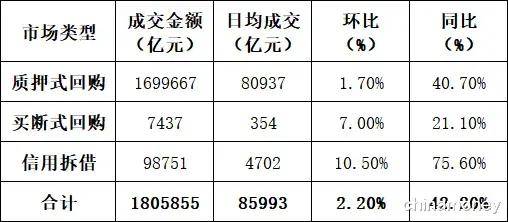
Group 1 - The average daily trading volume and balance in the money market increased in January, with a notable rise in the net lending balance of large commercial banks [2][6] - The total trading volume in the money market for January was 180.6 trillion yuan, with an average daily transaction of 8.6 trillion yuan, reflecting a 2.2% month-on-month increase [2][3] - The People's Bank of China (PBOC) maintained a proactive stance by increasing medium-term lending facility (MLF) operations, resulting in a net injection of 1 trillion yuan into the market [4][5] Group 2 - Bond issuance and trading both saw month-on-month increases, with 4.4 trillion yuan in bonds issued in January, marking a 7.8% increase from the previous month [7] - The bond market's yield mostly declined, with the 10-year government bond yield stabilizing between 1.8% and 1.9%, and credit spreads narrowing [10] - The trading volume in the bond lending market increased significantly, with a total of 3.64 million transactions and an average daily transaction of 2.477 trillion yuan, reflecting a 21.3% month-on-month increase [9] Group 3 - The interest rate swap curve experienced a slight upward shift, with the average daily transaction volume in RMB interest rate swaps increasing by 23% in January [11][12] - The nominal principal amount for interest rate swaps reached 4.4 trillion yuan, with an average daily transaction of 2.076 trillion yuan, indicating a 19% month-on-month increase [12]

1月份资金面充裕 债市收益率多数下行
Jin Rong Shi Bao· 2026-02-26 02:39
Core Viewpoint - The People's Bank of China (PBOC) is implementing a moderately accommodative monetary policy, with a focus on improving policy efficiency and effectiveness while maintaining liquidity in the financial system [1][2]. Group 1: Monetary Policy and Liquidity - In January 2026, the PBOC reduced the rates of various structural monetary policy tools by 0.25 percentage points, resulting in a net injection of 1 trillion yuan into the market [2][3]. - The average daily trading volume in the interbank market was 222.5 trillion yuan, reflecting a 6% month-on-month decrease but a 51% year-on-year increase [1][2]. - The PBOC's actions included a 9,000 billion yuan increase in Medium-term Lending Facility (MLF) and a total of 20,000 billion yuan in reverse repos, effectively countering the impacts of increased government bond issuance and seasonal cash withdrawals [2][3]. Group 2: Bond Market Performance - In January, the issuance of bonds in the interbank market reached 4.4 trillion yuan, a year-on-year increase of 22.1%, with net financing of 1.99 trillion yuan, marking a 136.1% month-on-month increase [4]. - The yields on various bonds mostly declined, with the 10-year government bond yield stabilizing between 1.8% and 1.9%, and the credit spreads narrowing [4][5]. - The yield curve for government bonds showed a mixed performance, with some maturities experiencing slight decreases while others saw minor increases [4]. Group 3: Interest Rate Swaps and Trading Activity - The interest rate swap curve saw a slight upward movement, with 6-month, 1-year, and 5-year Shibor 3M swap rates showing minor increases [6][7]. - The average daily transaction volume for RMB interest rate swaps increased by 23%, with a nominal principal amount of 4.4 trillion yuan [7]. - The trading of interest rate options surged by 280%, indicating a growing interest in hedging strategies within the market [7].
2025年银行间本币市场运行报告
Sou Hu Cai Jing· 2026-01-28 02:45
Group 1: Money Market Overview - In 2025, the total transaction volume in the money market reached 179.92 trillion yuan, an increase of 0.9% year-on-year, with an average daily transaction of 7.25 trillion yuan, up 2.1% year-on-year [2] - The central bank implemented a moderately accommodative monetary policy, utilizing various tools to inject liquidity into the market, resulting in a net liquidity injection of 64,315 billion yuan throughout the year [3] - The average daily balance in the money market increased by 3% year-on-year to 12.2 trillion yuan, while the daily net lending balance of large commercial banks decreased by 12%, and that of money market funds and policy banks increased by 9% and 15.9%, respectively [5] Group 2: Bond Market Dynamics - In 2025, the bond issuance volume reached 54.69 trillion yuan, with 26,000 bonds issued, marking a 14% increase year-on-year, and net financing increased by 31.8% to 20.33 trillion yuan [6] - The average daily transaction in the cash bond market was 15.14 billion yuan, with a total of 907.5 million transactions, reflecting a 2.9% increase year-on-year [7] - The yield curve for government bonds steepened, with the 10-year government bond yield fluctuating between 1.6% and 1.9%, and the overall credit spreads narrowed [8] Group 3: Interest Rate Swap Market - The interest rate swap curve steepened, with significant increases in long-term rates; the average daily transaction volume in the RMB interest rate swap market increased by 18.5% year-on-year, with a nominal principal total of 44.3 trillion yuan [9] - The daily average transaction volume for standard bond forwards and interest rate options also saw year-on-year increases, indicating a growing interest in these financial instruments [9]

流动性充裕 债市收益率震荡抬升
Jin Rong Shi Bao· 2026-01-28 00:51
Core Viewpoint - In 2025, the central bank implemented a moderately accommodative monetary policy to maintain liquidity and support economic stability amid complex domestic and international financial conditions [1][2]. Monetary Policy and Liquidity Management - The central bank reduced the reserve requirement ratio by 0.5 percentage points in May 2025, injecting approximately 1 trillion yuan into the market, and lowered the policy interest rate by 0.1 percentage points [2]. - Throughout 2025, the net liquidity injection from various monetary policy operations totaled 64,315 billion yuan, including 49,405 billion yuan from reverse repos and 11,610 billion yuan from medium-term lending facilities (MLF) [2]. - The weighted average of overnight repo rates decreased, with DR001 and R001 down by 19 basis points to 1.46% and 1.55%, respectively [2]. Bond Market Dynamics - In 2025, the bond issuance and net financing scale increased significantly, with a total of 54.69 trillion yuan in bonds issued, a 14% year-on-year increase, and net financing of 20.33 trillion yuan, up 31.8% [4]. - The secondary bond market shifted from a one-sided upward trend to a more volatile market, with the yield on various government bonds rising by 15 to 36 basis points compared to the previous year [4]. - The yield curve for 10-year government bonds showed a fluctuation range of approximately 31 basis points, indicating a narrowing compared to the previous year [4]. Interest Rate Swap Market - The interest rate swap curve steepened in 2025, with significant increases in long-term rates, such as a 29 basis point rise in the 5-year Shibor 3M swap price [5]. - Daily trading volume in the RMB interest rate swap market increased, with a total nominal principal of 44.3 trillion yuan and an 18.5% year-on-year growth in daily average transactions [6]. - The trading of standard bond forwards and interest rate options also saw substantial increases, with standard bond forwards up by 242.2% year-on-year [6].
2025年11月银行间本币市场运行报告
Sou Hu Cai Jing· 2025-12-30 03:21
Group 1: Money Market Overview - The average daily trading volume in the money market increased to 7.86 trillion yuan in November, a 2.3% month-on-month rise, with total trading volume reaching 157.2 trillion yuan, up 13.7% month-on-month [2] - The central bank conducted a net injection of 600 billion yuan in medium to long-term funds, maintaining a balanced and accommodative liquidity environment, while the main repo rates saw a slight increase [3] - The average daily balance in the money market decreased to 12.5 trillion yuan, down 1.7% month-on-month, with net lending balances from large commercial banks and policy banks also declining by 11.3% and 3% respectively [5] Group 2: Bond Market Activity - The issuance of bonds in the primary market increased to 4.7 trillion yuan in November, a 21.2% month-on-month rise, with net financing reaching 2.18 trillion yuan, up 119.3% month-on-month [6] - The trading volume of bonds also saw an increase, with 30.3 trillion yuan in total transactions, reflecting a 3% month-on-month growth [7] - Long-term bond yields experienced fluctuations, with the 10-year government bond yield mostly ranging between 1.8% and 1.85%, and the yield curve steepening [8] Group 3: Interest Rate Swaps - The interest rate swap curve shifted upward, with the 6-month, 1-year, and 5-year SHIBOR 3M swap rates increasing by 2 and 6 basis points respectively [9] - The average daily transaction volume in the RMB interest rate swap market decreased by 7.8% month-on-month, with a total nominal principal of 3.7 trillion yuan [9]
资金面整体均衡 债券收益率震荡下行
Jin Rong Shi Bao· 2025-11-27 02:22
Core Viewpoint - The external environment remains complex and uncertain as of Q4 2025, necessitating supportive monetary policies to stabilize the financial market and bolster domestic economic recovery [1] Group 1: Monetary Policy and Market Conditions - The People's Bank of China (PBOC) continues to implement a supportive monetary policy stance, utilizing various tools to ensure liquidity arrangements across short, medium, and long terms [1][2] - In October, the PBOC announced the resumption of government bond trading, which temporarily boosted market confidence and contributed to a balanced and loose funding environment [2][3] - The average daily trading volume and balance in the interbank currency market saw a slight increase, with major repo rates declining [1][2] Group 2: Market Transactions and Liquidity - In October, the interbank market recorded a total transaction volume of 172.8 trillion yuan, representing a month-on-month decrease of 18.4% and a year-on-year decrease of 3.3% [1] - The PBOC's open market operations included a net injection of 200 billion yuan from government bond trading and a net injection of 4 trillion yuan from reverse repos [2][3] - The overall funding environment remained loose, with the PBOC's actions ensuring stability despite significant market fluctuations due to tax periods [4] Group 3: Bond Market Dynamics - In October, the bond market saw a total issuance of 3.87 trillion yuan, a month-on-month decrease of 20.6% but a year-on-year increase of 5.2% [5] - Long-term bond yields experienced fluctuations, with the yield curve flattening; specific yields for various maturities showed mixed movements, with some declining and others slightly increasing [5][6] - The resumption of government bond trading is expected to stabilize the yield curve and reduce financing costs for the real economy [3][6] Group 4: Interest Rate Swaps and Trading Activity - The interest rate swap curve shifted downward in October, with significant declines in long-end rates; daily trading volume in interest rate swaps increased [7] - The average daily transaction volume for RMB interest rate swaps reached 186 billion yuan, reflecting a month-on-month growth of 23.4% [7] - The trading of standard bond forwards and interest rate options also saw substantial increases, indicating heightened market activity [7]
资金利率下行 资金面整体均衡
Jin Rong Shi Bao· 2025-10-30 00:25
Group 1: Macroeconomic Environment - The domestic macroeconomic regulation has intensified since the third quarter, with a combination of policies showing gradual effects, creating a favorable monetary and financial environment for economic recovery [1] - The People's Bank of China (PBOC) has maintained a moderately loose monetary policy, injecting liquidity into the market through various tools, including Medium-term Lending Facility (MLF) and reverse repos [2][3] Group 2: Market Performance - In the interbank market, the total transaction volume reached 654.7 trillion yuan, reflecting a quarter-on-quarter increase of 16.3% and a year-on-year increase of 17.7% [1] - The A-share market has shown strong performance, influenced by factors such as the "anti-involution" trend, new tax regulations on bond issuance, and changes in public fund fee structures [1] Group 3: Interest Rates and Liquidity - The overall funding rates have declined in the third quarter, with the weighted average of overnight repo rates dropping by 13 basis points to 1.38% and 14 basis points to 1.43% for different types of repos [3] - The PBOC's net injection of funds in the open market totaled 19,348 billion yuan in the third quarter, with MLF and reverse repos contributing significantly to this liquidity [2] Group 4: Bond Market Dynamics - The bond market saw an issuance of 14.88 trillion yuan in the third quarter, with a quarter-on-quarter growth of 0.7% and a year-on-year growth of 4.7% [4] - Long-term bond yields have experienced fluctuations, with the 10-year government bond yield ranging between 1.64% and 1.9%, reflecting a steepening yield curve [4] Group 5: Interest Rate Swaps - The interest rate swap curve has shifted upward, with significant increases in long-term rates, indicating a growing market for interest rate swaps [7] - The average daily transaction volume for RMB interest rate swaps increased, with a total nominal principal amount of 12.2 trillion yuan in the third quarter [7]
本币市场:资金面整体均衡
Jin Rong Shi Bao· 2025-09-25 02:05
Core Insights - The overall liquidity in the interbank market remained balanced in August 2025, with a decrease in trading volume and balances in the money market, while major repo rates declined [1][2] - The Shanghai Composite Index reached a nearly 10-year high, and the recovery of VAT on government bond interest income contributed to a decrease in bond issuance and trading [1][4] - Long-term bond yields continued to rise, with the yield curve steepening, and the interest rate swap curve shifted upward [1][6] Group 1: Liquidity and Market Operations - The central bank maintained a supportive liquidity stance, with significant net injections in the open market, totaling 446.6 billion yuan for the month [2] - The central bank's MLF and reverse repos saw substantial net injections, with MLF at 300 billion yuan and reverse repos at 300 billion yuan [2] - Major repo rates, including overnight repo rates, saw slight declines, with DR001 and R001 down to 1.35% and 1.40% respectively [2][3] Group 2: Bond Market Dynamics - In August, the interbank market issued bonds totaling 4.72 trillion yuan, a decrease of 10.8% month-on-month and 13% year-on-year [4] - The net financing from bonds was 1.87 trillion yuan, reflecting a month-on-month decrease of 18.7% and a year-on-year decrease of 19.2% [4] - The yields on long-term government bonds fluctuated, with the 10-year bond yield ranging from 1.69% to 1.85%, and the yield curve steepening [4][5] Group 3: Interest Rate Swaps and Trading Activity - The interest rate swap curve shifted upward, with significant increases in long-term swap rates, particularly for 5-year and 10-year swaps [6] - The average daily trading volume for RMB interest rate swaps decreased, with a total nominal principal of 4.1 trillion yuan, reflecting a 3% decline [6][7] - Standard bond futures and interest rate options also saw a decrease in daily trading volume, indicating reduced market activity [7]
债市“吸金”能力爆发!7月净融资2.3万亿元,同比大增86%
Sou Hu Cai Jing· 2025-08-19 06:12
Group 1 - The core viewpoint of the article indicates that the interbank currency market experienced an increase in trading volume while the balance decreased, with most repo rates declining and large commercial banks' average net lending balance falling [1][2][3] Group 2 - In July, the total trading volume in the currency market reached 185.2 trillion yuan, reflecting a month-on-month increase of 12.4%, while the average daily transaction decreased by 2.2% to 8.1 trillion yuan [2] - The central bank intensified liquidity provision, resulting in an overall balanced and slightly loose funding environment, with a net injection of 468 billion yuan in the open market throughout the month [3][4] - The average daily balance in the currency market decreased to 12.8 trillion yuan, down 2.1% month-on-month, while the average net lending balance of large commercial banks fell by 4.0% [5] Group 3 - Bond issuance and average daily trading volume decreased month-on-month, with total bond issuance in July at 5.29 trillion yuan, a decline of 0.6% from the previous month, but a year-on-year increase of 27.6% [6] - The bond market saw a fluctuation in yields, with the 10-year government bond yield ranging between 1.64% and 1.75%, and the yield curve steepening [8] - The interest rate swap curve shifted from inverted to upward sloping, with daily average transaction volume increasing by 44.8% in July [9]
2025年4月银行间本币市场运行报告
Sou Hu Cai Jing· 2025-05-26 02:28
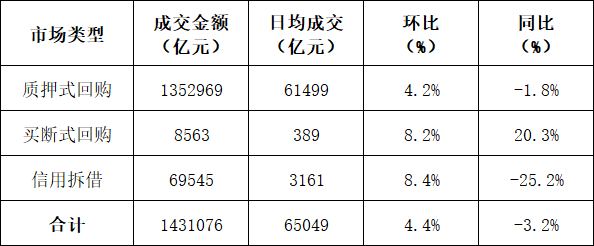
Group 1: Money Market Overview - The average daily trading volume and balance in the money market increased in April, with a significant decline in major repo rates and a rebound in the net lending balance of large commercial banks [2][4][5] - The total trading volume in the money market reached 143.1 trillion yuan, a month-on-month increase of 9.4%, with an average daily transaction of 6.5 trillion yuan, up 4.4% month-on-month [2][3] - The average daily balance in the money market rose to 11.6 trillion yuan, an increase of 3.8% month-on-month, while the net lending balance of large commercial banks increased by 18.4% [5][6] Group 2: Bond Market Dynamics - The total bond issuance in April was 4.96 trillion yuan, a month-on-month increase of 7.8% and a year-on-year increase of 23%, while net financing decreased by 7.9% month-on-month [8] - The trading volume of bonds decreased, with a total of 33 trillion yuan in transactions, reflecting a month-on-month decline of 12.6% [9][10] - Bond yields experienced a downward trend followed by a period of stability, with the 10-year government bond yield fluctuating between 1.62% and 1.81% [11] Group 3: Interest Rate Swap Market - The interest rate swap curve shifted downward overall, with significant decreases in swap rates for various maturities [12][13] - The average daily transaction volume in the interest rate swap market decreased, with a total nominal principal of 3.6 trillion yuan, reflecting a 14.6% month-on-month decline [13]