全球流动性收紧

Search documents
2026年4月宏观季刊:中东地缘风险上升,全球宏观承压
Bao Cheng Qi Huo· 2026-03-30 02:58
1. Report Industry Investment Rating - There is no information provided about the report industry investment rating in the given content. 2. Core View of the Report - In Q1 2026, the Middle East geopolitical crisis that broke out at the end of February was a black - swan event, causing a severe impact on the global macro - economy. It led to shipping disruptions in the Strait of Hormuz, a sharp rise in oil prices, and significant imported inflation pressure in developed economies. Central banks were forced to re - evaluate their monetary policies, leading to tightened global liquidity, which in turn inhibited corporate investment and household consumption, and dragged down global trade and supply chains. Developed economies faced a significant risk of slowdown, and global economic activities were under pressure [1][7][66]. - In Q1 2026, China's domestic macro - economic indicators showed resilience. Exports had strong resilience, while consumption and investment growth were slow. The manufacturing PMI fell below the boom - bust line, inflation recovered moderately but remained weak overall. Social financing data was strong due to policy efforts in Q1, but there was a structural differentiation in new credit between enterprises and residents. The central bank's monetary policy was more inclined to structural easing, and the possibility of a full - scale interest rate cut in the short term was low, but the general tone of moderate easing remained, and there was still a possibility of an interest rate cut in the future [2][27][67]. 3. Summary According to the Directory 3.1 International Macro 3.1.1 United States - Since 2026, the inflation expectation index in the US has weakened, and the consumer confidence index has declined to a relatively low historical quantile level in the past three years. The ISM manufacturing and service PMI have been in an expansion state, but after the US - Iran war, the inflation upward pressure has emerged. In February, the CPI and core CPI data showed a slow - down in price increases, but the recent rise in oil prices may increase the cost of living for US residents. The market has started to unwind long positions in US Treasury futures and is pricing in the possibility of the Fed's emergency interest rate hike. The probability of a 25 - basis - point interest rate hike at the April 29 policy meeting is still low, but there are uncertainties due to the geopolitical situation and the change of the Fed's leadership [8][11][14]. 3.1.2 Europe - On March 19, the European Central Bank maintained the deposit rate at 2%. Due to the Middle East conflict, the policy stance has become more hawkish. The Middle East conflict has increased the uncertainty of the euro - area economic outlook, posing an upward risk to inflation and a downward pressure on economic growth. The ECB will take action if inflation worsens, and may adjust the policy stance as early as the April meeting [21][23]. 3.1.3 Japan - On March 19, the Bank of Japan maintained the benchmark interest rate at 0.75%. One member proposed an interest rate hike, and the central bank listed the Middle East conflict and oil price fluctuations as risks. Japan's economy is moderately recovering, but the inflation expectation has risen moderately. The central bank emphasized the potential impact of external risks on the inflation outlook and warned of the instability in the financial market and the sharp rise in oil prices [24]. 3.2 Domestic Macro 3.2.1 Business Index - In February, the manufacturing PMI was 49.0%, down 0.3 percentage points from the previous month, indicating a weakening of manufacturing prosperity. The production and new order indexes declined, and the employment index was weak. Large enterprises' PMI was in an expansion state, while medium - and small - sized enterprises' PMI declined. The problem of insufficient effective demand still exists, and policy support is needed [28][31]. 3.2.2 Price Index - In February, China's CPI rose to 1.3% year - on - year, and the core CPI rose 1.8%. The PPI was - 0.9% year - on - year, with a narrowing decline. The increase in CPI was due to the Spring Festival effect, and the narrowing decline in PPI was driven by international commodity prices and semiconductor storage demand. After the Spring Festival, the CPI may weaken seasonally, and the PPI may turn positive due to the rise in oil prices [36]. 3.2.3 Social Financing and Credit - In the first two months of 2026, the cumulative increment of social financing scale was 9.6 trillion yuan, showing a moderate increase. The "enterprise - strong, household - weak" structural differentiation in new credit still exists. Enterprise loans increased significantly, especially long - term loans, while household loans decreased. The social financing and credit data are expected to continue to improve with the acceleration of enterprise production and the implementation of policies, but the performance of household credit needs attention [41][42]. 3.2.4 Three - Horse Carriage - From January to February, exports showed strong resilience, with a 19.2% growth. Exports to Belt and Road countries, private enterprises' exports, and exports of mechanical and electrical products all increased significantly. Consumption and investment growth were slow. The growth rate of social consumer goods retail was 2.8%, and the growth rate of fixed - asset investment was 1.8%. Infrastructure investment provided strong support, while real estate development investment was a major drag. Boosting domestic demand and consumption is the policy focus this year [55][57]. 3.2.5 Monetary Policy - On March 20, the central bank announced that the 1 - year and 5 - year LPR remained unchanged at 3% and 3.5% respectively. This is in line with market expectations. The central bank is more inclined to structural policies, and the possibility of a full - scale interest rate cut in the short term is low, but there is still a possibility of an interest rate cut in the future [61].
宏观金融数据日报-20260323
Guo Mao Qi Huo· 2026-03-23 03:51
Report Industry Investment Rating - Not provided Core Viewpoints - The stock index is expected to continue its weak oscillation pattern in the short term due to the continuous escalation of the Middle East conflict, which impacts the equity market, squeezes the profit margins of domestic mid - and downstream high - end manufacturing, and restricts the overseas central banks' rate - cut space. In the long run, with the overall economic tone in line with expectations, multiple policies promoting economic growth, ample macro - liquidity, and capital market policies supporting a "slow - bull" market, the stock index is expected to have an upward space and may resume its upward trend as the external geopolitical situation eases and market risk appetite recovers [8] Summary by Relevant Catalogs Money and Bond Market - **Market Data**: DROO1 closed at 1.32 with a 0.03bp increase, DR007 at 1.42 with a 0.62bp decrease, GC001 at 1.10 with a 20.00bp decrease, GC007 at 1.46 with a 2.50bp decrease, SHBOR 3M at 1.52 with a 0.60bp decrease, LPR 5 - year at 3.50 with no change, 1 - year treasury bond at 1.26 with a 0.21bp increase, 5 - year treasury bond at 1.56 with a 0.77bp increase, 10 - year treasury bond at 1.83 with a 1.67bp increase, and 10 - year US treasury bond at 4.39 with a 14.00bp increase [4] - **Market Review**: Last week, the central bank conducted 242.3 billion yuan of reverse repurchase operations. With 176.5 billion yuan of reverse repurchase maturing, there was a net injection of 65.8 billion yuan. Also, 600 billion yuan of 182 - day term repurchase expired, and the central bank carried out 500 billion yuan of 182 - day term repurchase operations and 250 billion yuan of treasury cash fixed - deposit tenders [4] - **Market Outlook**: This week, 242.3 billion yuan of reverse repurchase will mature, with 137.3 billion, 51 billion, 20.5 billion, 13 billion, and 20.5 billion maturing from Monday to Friday respectively. Additionally, 450 billion yuan of MLF will mature on Wednesday [5] Stock Index Futures Market - **Market Data**: The closing prices of major stock indices and their changes are as follows: the CSI 300 closed at 4567 with a 0.35% decrease, the SSE 50 at 2884 with a 1.11% decrease, the CSI 500 at 7760 with a 1.49% decrease, and the CSI 1000 at 7783 with a 1.59% decrease. The closing prices of corresponding stock index futures and their changes are: IF当月 at 4597 with a 0.2% increase, IH当月 at 2898 with a 0.7% decrease, IC当月 at 7844 with a 0.5% decrease, and IM当月 at 7876 with a 0.6% decrease. The trading volume and open interest of stock index futures also changed, with some increasing and some decreasing [7] - **Market Review**: Last week, the CSI 300 fell 2.19% to 4567, the SSE 50 fell 2.47% to 2883.9, the CSI 500 fell 5.82% to 7760, and the CSI 1000 fell 5.25% to 7783.4. Most industries in the Zhongwan primary industry index declined, with only communication (2.1%) and banking (0.4%) rising, while non - ferrous metals (-11.8%), basic chemicals (-10.5%), steel (-10.3%), comprehensive (-8%), and building materials (-7.9%) led the decline. The market sentiment cooled significantly, and A - share trading volume shrank substantially, with the daily trading volume last week being 2339.9 billion yuan, 2224.6 billion yuan, 2061 billion yuan, 2127.3 billion yuan, and 2302.8 billion yuan respectively, and the average daily trading volume decreasing by 244.62 billion yuan compared with the previous week [7] Stock Index Futures Premium and Discount Situation - The premium and discount rates of IF, IH, IC, and IM contracts in different periods are provided, with specific values for the next - month, current - quarter, and next - quarter contracts [9]
从“两变”与“两不变”视角来看市场
Zhong Guo Yin He Zheng Quan· 2026-03-22 07:50
Market Performance - The A-share market experienced a fluctuation with the overall index declining by 4.13% from March 16 to March 20, 2026[2] - Only the ChiNext index saw an increase of 1.26%, while the North China 50 and CSI 1000 indices dropped over 5%[4] - The average daily trading volume decreased to 22,111 billion yuan, down by 2,875.9 billion yuan from the previous week[13] Fund Flow - The margin trading balance fell to 26,501.11 billion yuan, a decrease of 15.89 billion yuan from the previous week[15] - A total of 30 new equity funds were established, with a total issuance of 21.388 billion units, an increase of 1.564 billion units from the previous week[19] - Global funds saw a net outflow of 12.78 million USD during the period from March 12 to March 18, a decrease from the previous outflow of 36.15 million USD[27] Valuation Changes - The PE (TTM) ratio for the overall A-share index decreased by 3.16% to 22.59 times, placing it at the 91.20 percentile since 2010[35] - The PB (LF) ratio fell by 3.39% to 1.86 times, situated at the 51.45 percentile since 2010[35] Geopolitical and Economic Factors - The ongoing tensions in the Strait of Hormuz due to the US-Iran conflict are causing significant geopolitical changes, impacting global economic conditions[46] - Global liquidity is tightening, with expectations for interest rate cuts diminishing as inflation concerns rise, leading to pressure on risk assets[47] - The market is expected to remain volatile due to external pressures, with a focus on inflation and energy prices as key variables affecting market structure[45]

近4800股下跌
第一财经· 2026-03-20 07:35
Market Overview - The Shanghai Composite Index fell below 4000 points, closing at 3957.05, down 1.24% [3][4] - The Shenzhen Component Index decreased by 0.25%, while the ChiNext Index rose by 1.30% [3][4] - The total trading volume in the Shanghai and Shenzhen markets reached 2.29 trillion [6] Sector Performance - The market showed a general decline across sectors, with notable gains in photovoltaic equipment, electricity, and battery sectors [8] - The photovoltaic equipment sector performed strongly, with companies like Shangneng Electric and Shouhang New Energy hitting the 20% daily limit [8][9] Individual Stock Highlights - Shangneng Electric saw a price increase of 20.01%, with a total market value of 250.1 billion [9] - Shouhang New Energy also increased by 20.00%, with a market value of 248.9 billion [9] - Other notable gainers included Jinlang Technology (+15.04%) and Haiyou New Materials (+13.56%) [9] Decliners - The market experienced significant declines in the computing leasing sector, with companies like Huatian Intelligent dropping by 19.88% [10] - Other notable decliners included Bichuang Intelligent (-14.95%) and Xichuang Data (-14.89%) [10] Capital Flow - Main capital inflows were observed in sectors such as electric power equipment, public utilities, and communications, while outflows were noted in computing, non-bank financials, and defense sectors [11] - Individual stocks with net inflows included Zhongji Xuchuang and Yangguang Electric Power, with inflows of 2.152 billion and 1.874 billion respectively [12] - Conversely, stocks like Dongfang Caifu and Zijin Mining faced significant outflows of 1.967 billion and 1.437 billion respectively [13] Institutional Perspectives - Guosheng Securities indicated a potential tightening of global liquidity, suggesting caution regarding deep adjustments in the stock market [14] - Donghai Securities noted short-term adjustment risks for the Shanghai Composite Index but maintained a long-term positive outlook [15] - Caixin Securities emphasized the need for improved market confidence and suggested controlling positions until a market recovery signal is observed [15]







宝城期货股指期货早报-20260320
Bao Cheng Qi Huo· 2026-03-20 01:38
Group 1: Report Industry Investment Rating - No relevant content Group 2: Core View of the Report - The short - term view of the stock index is range - bound, with the co - existence of macro - recession risks caused by the Middle East geopolitical crisis and continuous policy benefits [1][5] Group 3: Summary by Related Catalogs Variety View Reference - Financial Futures Stock Index Sector - For IH2606, the short - term view is oscillatory, the medium - term view is oscillatory, the intraday view is bullish, and the overall view is range - bound. The core logic is the co - existence of continuous policy benefits and the Middle East geopolitical crisis [1] Main Variety Price Market Driving Logic - Financial Futures Stock Index Sector - The varieties include IF, IH, IC, and IM. The intraday view is bullish, the medium - term view is oscillatory, and the reference view is range - bound. The core logic is that yesterday, each stock index oscillated and declined. The continuous escalation of the Middle East geopolitical crisis has increased risks such as global energy supply shortage, key raw material supply chain interruption, and macro - economic recession. The Fed's interest rate decision in March maintained the interest rate and said it would not cut interest rates before inflation improved, leading to a marginal tightening of the global liquidity environment and a decline in the stock market valuation level. As the Shanghai Composite Index fell to around the 4000 - point mark, the support of continuous policy benefits gradually emerged. The policy focuses on stabilizing corporate profit expectations and developing new - quality productivity. In the short term, the stock index is mainly range - bound [5]
3月议息:美联储的压力测试
Guolian Minsheng Securities· 2026-03-18 12:53
Group 1: Federal Reserve Policy Insights - The Federal Reserve's policy determination is expected to strengthen in the short term, potentially exacerbating global liquidity tightening risks[4] - The geopolitical tensions in the Middle East are likely to keep oil prices and the US dollar strong, complicating the Fed's dual mandate of controlling inflation and stabilizing growth[6] - Market expectations for rate cuts have shifted from two anticipated cuts within the year to less than one, with the timing pushed to the fourth quarter[6] Group 2: Economic and Market Implications - The current liquidity environment is under significant pressure, with major asset classes like stocks, bonds, and gold facing adjustment risks[4] - The Fed is likely to maintain a cautious stance in its March meeting, emphasizing uncertainties from the Middle East and inflationary pressures from rising oil prices[6] - Economic forecasts may be revised downwards for growth and upwards for inflation, reflecting heightened vigilance towards short-term risks[6] Group 3: Market Reactions and Asset Allocation - High-valuation sectors, particularly technology, may face valuation compression, while defensive sectors like energy and utilities are expected to attract more capital[7] - Gold, despite short-term pressures from a strong dollar and rising rates, is anticipated to regain appeal as a hedge against geopolitical and inflation risks in the medium to long term[7] - The overall trend suggests that there remains room for rate cuts within the year, with oil price impacts primarily affecting the timing rather than the overall trend[9]
债券研究周报:美伊冲突下的债市情绪全览-20260309
Guohai Securities· 2026-03-09 14:01
Report Information - Report Title: Bond Research Weekly Report - A Comprehensive Overview of Bond Market Sentiment under the US-Iran Conflict [1][2] - Report Date: March 9, 2026 [1] - Analyst: Yan Ziqi [2] - Contact: Guo Xiyuan [3] Industry Investment Rating - Not provided in the report Core Viewpoints - The bond market is currently influenced by a mix of bullish and bearish factors. After the economic theme press conference during the Two Sessions last week, the market's concerns about fiscal and monetary policies have been alleviated, but inflation remains a negative factor [4]. - The divergence in sellers' views has increased, possibly due to the continuous escalation of the US-Iran conflict, which has further complicated the market's bull-bear judgment [4]. - Most institutions believe that the inflation risk brought by the US-Iran conflict has limited impact on the bond market. Even if it drives up inflation expectations, it can be offset by the "stagflation" impact on the global economy, and it is unlikely to become the main risk for the bond market [4]. Summary by Directory 1. Seller Market Sentiment 1.1 Seller Market Interest Rate Bond Sentiment Index - From March 3 to March 9, the unweighted sentiment index was 0.21, up 0.07 from February 24 to March 2. Some institutions' market views have turned bullish. Currently, institutions generally hold a neutral-bullish view, with 7 bullish, 20 neutral, and 1 bearish [16]. - 25% of institutions hold a bullish attitude, believing that the market will be bullish with oscillations in March, and the interest rate may turn downward in the middle and late March, with a trend opportunity in the second quarter. Certificates of deposit can still decline, and reserve requirement ratio cuts and interest rate cuts are still expected. The net financing of government bonds in March may be lower than last year, with a longer maturity and controllable supply-demand pressure. The low duration of funds, concentrated short positions, and the suppression of risk appetite by geopolitical conflicts, which weaken the stock-bond seesaw effect, are more favorable [5][16]. - 71% of institutions hold a neutral attitude, believing that the loose capital and the decline in certificate of deposit interest rates provide support. The expectation of monetary easing still exists, but the rhythm of reserve requirement ratio cuts and interest rate cuts is still uncertain. Oil prices and geopolitical disturbances drive up inflation, suppressing long-term interest rates. The 10-year bond interest rate may oscillate in the range of 1.75 - 1.85% in March [10][16]. - 4% of institutions hold a bearish attitude, believing that the Middle East conflict drives up oil prices, the inflation risk rises, and the low interest rate and the reduction in central bank bond purchases lead to a short-term correction in the bond market. However, the market is still in a large-range oscillation. Although the fundamentals have marginally improved, the PMI at the beginning of the year was weak, and deflation has eased [10][16]. 1.2 Buyer Market Interest Rate Bond Sentiment Index - From March 3 to March 9, the unweighted sentiment index was 0.20, up 0.25 from February 24 to March 2, with a significant increase in the sentiment index. Currently, institutions generally hold a neutral-bullish view, with 10 bullish, 10 neutral, and 5 bearish [17]. - 40% of institutions hold a bullish attitude, believing that the expectation of reserve requirement ratio cuts and interest rate cuts is rising, the capital demand in March is weak, the capital interest rate center may decline slightly, the geopolitical conflict provides hedging support, and the "waiting for a correction to buy" strategy of institutions makes it difficult for yields to rebound continuously. The interest rate will oscillate downward in a low-volatility range [11][17]. - 40% of institutions hold a neutral attitude, believing that the policy increment is limited, the expectation of easing still exists but has not been fulfilled. The short-term yield will probably "oscillate in a low-volatility and narrow range." The market will be mainly for gaming around the Two Sessions, and the spread space and direction will be observed after the Two Sessions [11][17]. - 20% of institutions hold a bearish attitude, believing that the downward space of interest rates is limited, the yield is likely to rise and difficult to fall, and the volatility may increase again. Inflation and the "stable exchange rate" constraint make reserve requirement ratio cuts and interest rate cuts not inevitable. New policy financial instruments may push up the supply of policy financial bonds and widen the spread [11][18].
星石投资周评:海外影响或逐步减弱
Xin Lang Cai Jing· 2026-02-07 07:57
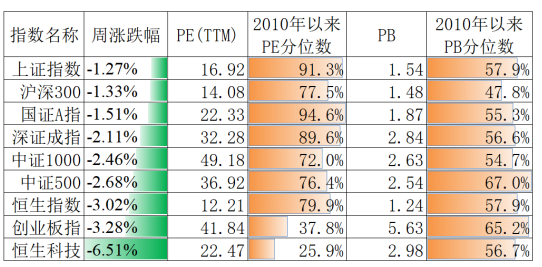
Market Overview - The market exhibited weak fluctuations with continued volume contraction from February 2 to February 6, influenced significantly by global factors, particularly concerns over tightening liquidity and changes in AI narratives, leading to a decline in risk appetite [1][16] - Defensive sectors such as consumer and financial performed relatively well, while previously high-performing technology growth and cyclical sectors experienced corrections, indicating a clear style shift [1][16] Index Performance - Major indices showed the following weekly changes: - Shanghai Composite Index: -1.27%, PE (TTM): 16.92, PB: 1.54 [18] - CSI 300: -1.33%, PE (TTM): 14.08, PB: 1.48 [18] - Shenzhen Component Index: -2.11%, PE (TTM): 32.28, PB: 2.84 [18] - ChiNext Index: -3.28%, PE (TTM): 41.84, PB: 5.63 [18] Sector Performance - The following sectors showed notable weekly performance: - Food and Beverage: +4.31%, PE (TTM): 22.20, PB: 4.03 [20] - Beauty and Personal Care: +3.69%, PE (TTM): 40.37, PB: 3.35 [20] - Power Equipment: +2.20%, PE (TTM): 41.48, PB: 3.45 [20] - Non-bank Financials and Non-ferrous Metals performed well, while traditional industries still need recovery [26] Key Influencing Factors - Earnings forecasts indicate a continued recovery in listed company profits, with 53.6% of 3,057 companies reporting positive forecasts as of January 31 [26] - Leverage funds slightly decreased, with the financing balance at 26,640.54 billion, down by 346 billion from January 30 [26][11] - Expectations of tightening overseas liquidity continue to grow, with the US dollar index rebounding above 97, leading to volatility in risk assets [12][27] - Mixed US economic data was reported, with the ISM manufacturing PMI rising to 52.6 from 47.9, while ADP employment data fell short of expectations, adding to labor market concerns [13][28] Future Outlook - Concerns over global liquidity tightening may have been priced in, with uncertainty remaining about whether the Federal Reserve will actually reduce its balance sheet this year [29] - The overall risk premium in the A-share market has returned to a historically low level, with limited upward space driven by valuations; corporate earnings will be crucial for market upward movement [29]
有色冲高回落:铜铝周报-20260202
Bao Cheng Qi Huo· 2026-02-02 09:11
1. Report Industry Investment Rating - No relevant information provided 2. Core Views - **Copper**: Overseas macro - atmosphere weakened, and copper prices fell from high levels. The recent copper price trend was a typical market driven by macro - sentiment and transmitted through the precious metal market. The sentiment reversed in the second half of last week, likely due to Trump's nomination of "hawkish" Kevin Warsh as a candidate for Fed Chairman, leading to a stronger dollar and a sharp drop in copper prices. In the future, the copper market will present a complex pattern of short - term sentiment fluctuations and medium - to long - term fundamental support [4][58]. - **Aluminum**: Overseas macro - atmosphere weakened, and aluminum prices also fell from high levels. Last week, aluminum prices first rose and then fell. The financial attribute of aluminum is relatively weaker than that of copper, resulting in less price fluctuation. High aluminum prices made downstream buyers generally wait - and - see, and the industrial support may increase as prices drop. Technically, the 24,000 level can be monitored [5][59]. 3. Summary by Directory 3.1 Macro Factors - In the first half of the week, the US dollar index dropped significantly, benefiting the non - ferrous sector. The drop in the US dollar index and the sharp rise in gold reflected the intention of global asset allocation, i.e., "de - dollarization". In the second half of the week, Trump's nomination of Kevin Warsh led to a stronger dollar, which first caused a sharp sell - off in the silver market and then affected the base metal market, causing copper prices to fall from high levels [9]. 3.2 Copper 3.2.1 Quantity and Price Trends - The copper price trend was affected by macro - sentiment. The market was initially optimistic due to the rise of precious metals, but sentiment reversed later, causing copper prices to fall [4]. 3.2.2 Copper Ore Shortage - On January 30, the copper ore port inventory was 523,000 tons, a weekly decrease of 46,000 tons and a year - on - year decrease of 187,000 tons [25]. 3.2.3 Continuous Accumulation of Electrolytic Copper Inventory - On January 29, the Mysteel electrolytic copper social inventory was 335,800 tons, a weekly increase of 600 tons; the COMEX + LME inventory was 751,200 tons, a weekly increase of 23,600 tons. Overseas electrolytic copper inventory continued to accumulate, while the accumulation in China slowed down [27]. 3.2.4 Downstream Initial Processing - According to SMM on January 29, the operating rate of domestic major refined copper rod enterprises from January 23 to January 29 was 69.54%, a month - on - month increase of 1.57 percentage points and a year - on - year increase of 54.9 percentage points [29]. 3.3 Aluminum 3.3.1 Quantity and Price Trends - Last week, aluminum prices first rose and then fell. The main contract once reached the 26,000 level but then dropped rapidly due to the weakening of the commodity market and profit - taking [5][59]. 3.3.2 Upstream Industry Chain - On January 30, the bauxite port inventory was 2,419.07 million tons, a decrease of 309,300 tons from last week and an increase of 649,070 tons compared with the same period in 2025 [42]. 3.3.3 Low Electrolytic Aluminum Inventory - On January 29, the Mysteel electrolytic aluminum social inventory was 800,000 tons, an increase of 32,000 tons from last week; the overseas electrolytic aluminum inventory was 501,900 tons, a decrease of 12,800 tons from last week [46]. 3.3.4 Downstream Initial Processing - Last week, aluminum prices rose, and the processing fees in most regions decreased significantly, reflecting the increasing wait - and - see sentiment of downstream buyers. On January 29, the aluminum rod inventory was 140,500 tons, an increase of 17,200 tons from last week. High aluminum prices may suppress downstream demand, and the inventory accumulation speed can be continuously monitored [52][54].
刚刚,动手了!30年首次。。
Sou Hu Cai Jing· 2025-12-19 04:54
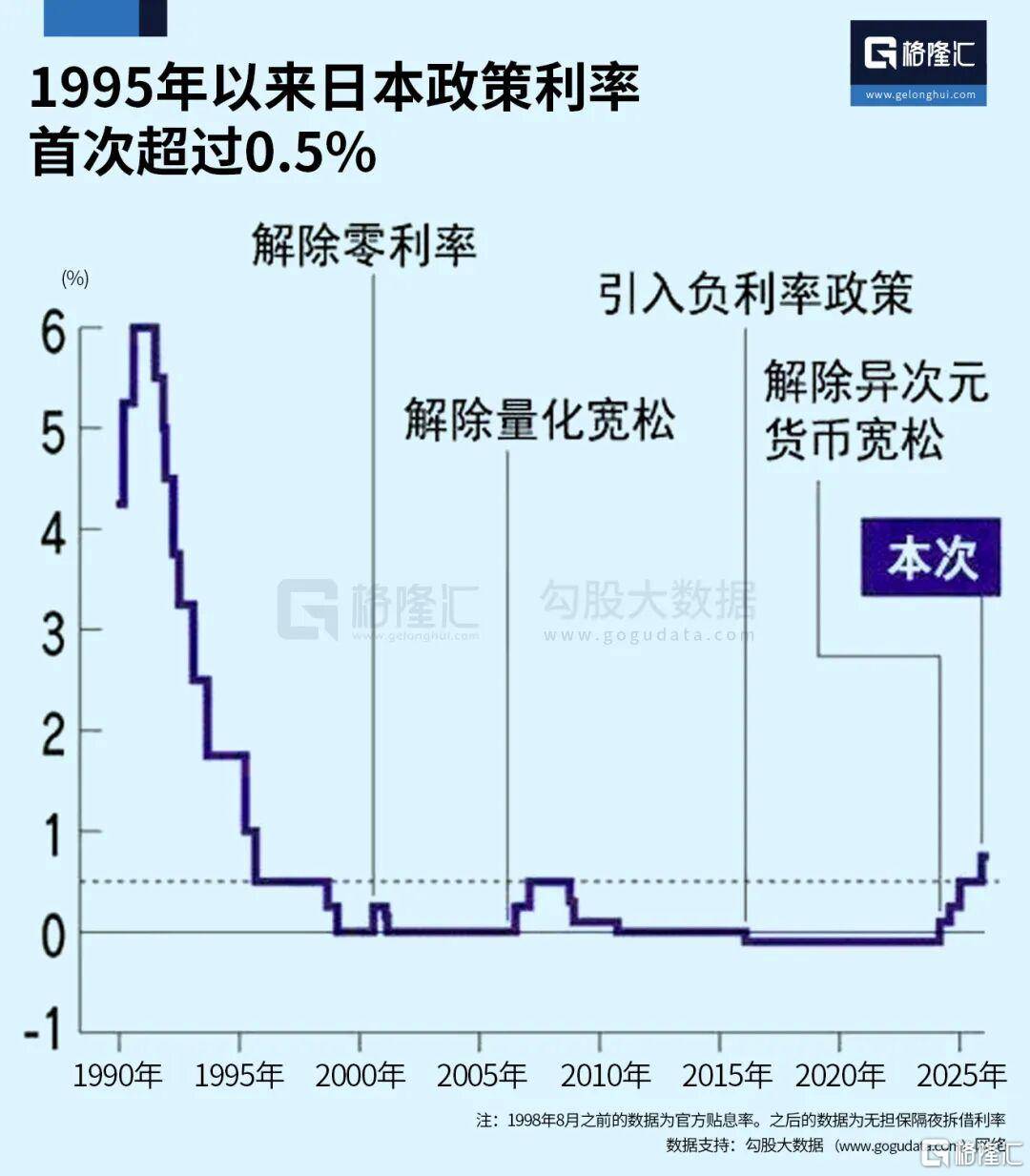
Core Viewpoint - The Bank of Japan has raised its benchmark interest rate from 0.5% to 0.75%, marking the highest level since 1995, which poses a significant stress test for global capital markets [1][30]. Group 1: Impact on Global Markets - The increase in interest rates signifies the end of the "ultra-cheap yen era," which has been a key driver for global asset prices over the past three decades [30]. - The rise in borrowing costs will affect the carry trade strategy, where investors borrow cheap yen to invest in higher-yielding assets globally, potentially leading to a liquidity crunch in the markets [17][30]. - As the cost of borrowing increases, leveraged positions in the carry trade may become unprofitable, prompting a sell-off of assets to cover positions, which could lead to a significant market downturn [19][21]. Group 2: Specific Market Reactions - Japan, being the largest foreign holder of U.S. Treasury bonds with over $1.2 trillion, may reconsider its holdings in U.S. debt as domestic yields rise, potentially leading to selling pressure on U.S. Treasuries [24]. - Emerging markets, which have been popular destinations for yen carry trade funds, are likely to experience capital outflows and currency depreciation as global liquidity tightens [25]. - High-valuation assets, particularly in technology and cryptocurrencies, may face significant corrections as the withdrawal of cheap funds alters risk appetites among investors [26]. Group 3: Implications for Chinese Markets - The direct impact on China's A-shares and bond markets may be limited, but there is a need to be cautious of emotional market reactions stemming from global volatility [27]. - If U.S. markets experience significant fluctuations due to carry trade unwinding, it could create short-term pressure on foreign investment sentiment in China [28]. - Conversely, if global markets enter a risk-off phase, some funds may flow into Chinese government bonds, providing a potential benefit to the domestic bond market [29].