
石蜡

Search documents
中石油,分红457.6亿!
DT新材料· 2026-03-29 16:05
Core Viewpoint - China National Petroleum Corporation (CNPC) reported a decline in revenue and net profit for 2025, primarily due to falling prices of oil and gas products, while also emphasizing its commitment to renewable energy and innovation strategies [2][3][4]. Financial Performance - In 2025, CNPC achieved operating revenue of 28,644.69 billion yuan, a decrease of 2.5% year-on-year [2]. - The net profit attributable to shareholders was 157.3 billion yuan, down 4.5% from the previous year [2]. - The company plans to distribute a cash dividend of 0.25 yuan per share, totaling 45.76 billion yuan [2]. Oil and Gas Production - CNPC's oil and gas equivalent production reached 1,841.9 million barrels, an increase of 2.5% year-on-year [2]. - The company processed 1.376 billion barrels of crude oil and produced 117 million tons of refined oil in 2025 [3]. Renewable Energy Initiatives - CNPC's renewable energy output was 7.93 billion kWh, marking a significant increase of 68.0% [2]. - The company signed contracts for geothermal heating covering over 1 million square meters and utilized 2.664 million tons of carbon dioxide, up 40.3% [2]. Refining and Chemical Business - CNPC's refining and chemical business underwent transformation, with two ethylene projects coming online, pushing ethylene capacity above 10 million tons per year [3]. - Chemical product sales grew, with a total of 40.027 million tons sold, reflecting a year-on-year increase of 2.7% [3]. - The operating profit from refining and chemical sectors was 24.247 billion yuan [3]. Natural Gas Sales - The company sold 3,147.13 billion cubic meters of natural gas, a 7.0% increase year-on-year, with domestic sales reaching 2,475.28 billion cubic meters, up 5.6% [3]. - The operating profit from natural gas sales was 60.802 billion yuan [3]. Innovation and Future Strategy - CNPC is focusing on innovation as its primary strategy, aiming to become a world-class comprehensive energy and chemical company by 2026 [4]. - The company plans to enhance its technological innovation capabilities and adapt to global energy transitions [4]. - Key initiatives include optimizing production operations, improving cost management, and developing new energy and materials sectors [4].


石蜡年产量27.8万吨的突破
Xin Lang Cai Jing· 2026-02-07 22:52
Core Insights - The Daqing Petrochemical Refining Division achieved a record annual production of 278,000 tons of paraffin wax in 2025, marking the highest level in its history, driven by technological advancements, emergency response, and collaborative efforts [1][2] Group 1: Technological Advancements - The refining division focused on three main areas: process optimization, equipment modification, and operational innovation to tackle challenges such as frequent raw material changes and aging equipment [1] - Key process improvements included lowering the feed temperature of critical equipment by 2°C, optimizing the ketone-benzene solvent ratio by 5.8%, and incorporating wax yield into team assessments, resulting in an additional 5,656 tons of paraffin wax [1] - Equipment upgrades included the establishment of a packaging machine testing platform, which reduced downtime by nearly 60 hours and avoided a production loss of 360 tons, saving over 920,000 yuan [1] Group 2: Emergency Response - In May 2025, the division faced a significant drop in viscosity due to raw material issues, leading to a dual approach of "technical adjustment + management optimization," resulting in an additional monthly production of 1,100 tons of semi-refined wax and 700 tons of crude wax, generating over 3.8 million yuan in revenue [2] - An all-weather response system was established, leading to the early elimination of 86 potential hazards and recovering approximately 320 hours of production time [2] - A rapid response to a packaging line failure on December 29, 2024, allowed for a swift restoration of production, ensuring stable operations [2] Group 3: Collaborative Efforts - In response to a surge in paraffin wax inventory, the division implemented a "three-party linkage" mechanism, completing the transportation of 5,700 tons within 18 days to free up storage capacity for continuous production [2] - During the catalyst replacement period from March to April, precise scheduling allowed for the shipment of 34,000 tons of products and the transportation of 11,700 tons, ensuring all six production lines operated at full capacity [2] - The division achieved a total of 251,900 tons of paraffin wax shipped and 35,400 tons transported throughout the year, effectively connecting production to profitability [2]
【石油化工】发挥能源保供“顶梁柱”作用,为建设能源强国努力奋斗——中国石油集团跟踪报告之六(赵乃迪/蔡嘉豪/王礼沫)
光大证券研究· 2026-01-28 23:07
Core Viewpoint - The article discusses the strategic goals and achievements of China National Petroleum Corporation (CNPC) during the 14th Five-Year Plan and outlines the objectives for the 15th Five-Year Plan, emphasizing the company's commitment to high-quality development and becoming a world-class enterprise [4][5][6]. Group 1: Strategic Goals and Achievements - CNPC has successfully navigated significant challenges during the 14th Five-Year Plan, enhancing its comprehensive strength, market competitiveness, and international influence [5]. - The company has maintained strong operational performance, ranking among the top in profits among central enterprises for four consecutive years [5]. - CNPC has made substantial progress in technology independence and self-reliance, contributing to national strategic technological capabilities [5]. Group 2: Future Development Plans - By 2030, CNPC aims to achieve high-quality development and establish itself as a world-class enterprise, focusing on value creation, energy supply security, and technological innovation [6]. - The company plans to enhance its governance system and modernize its management structure to support its strategic objectives [6]. - Emphasis will be placed on intelligent, green, and integrated development within the modern energy and chemical industry [6]. Group 3: Business Transformation and Integration - CNPC is enhancing its integrated advantages across the oil and gas industry, with a focus on increasing reserves and production [7]. - In 2024, the company expects to achieve a domestic crude oil production of 106.15 million tons, a year-on-year increase of 0.3%, and a domestic natural gas production of 158.6 billion cubic meters, a year-on-year increase of 3.8% [7]. - The company is optimizing its product structure in the refining and chemical sectors, with plans to produce over 2 million tons of new materials in 2024 [7].
硫磺价格在博弈中震荡前行,绿色能源开年内外利好共振
Guotou Securities· 2026-01-11 04:03
Investment Rating - The industry investment rating is maintained at "Outperform the Market - A" [4] Core Views - The sulfur price is experiencing fluctuations due to supply-demand dynamics, with a short-term supply guarantee not fundamentally altering the long-term tight resource situation. The expected global sulfur supply-demand gap for 2026 is projected to be -5.13 million tons, indicating a strategic revaluation of sulfur resources in the long term [2][16] - The recent restructuring between Sinopec and China Aviation Oil is expected to enhance the integration of oil refining and distribution, potentially accelerating the commercial use of Sustainable Aviation Fuel (SAF) in China [3][7] Summary by Sections 1. Core Insights of the Week - The market is witnessing a rebound in oil prices, with Brent crude reaching $63.05 per barrel, reflecting a 3.7% increase. This is driven by geopolitical tensions affecting supply expectations [14] - The chemical sector is gaining attention due to a better-than-expected Producer Price Index (PPI) recovery, indicating potential for upward valuation in the sector [15] 2. Chemical Sector Performance - The basic chemical industry index increased by 3.7% in the week, outperforming major indices like the Shanghai Composite and ChiNext [21] - Among 26 sub-sectors, 25 experienced gains, with the top performers being modified plastics (+9.5%) and inorganic salts (+7.2%) [26] 3. Stock Performance in the Chemical Sector - In the basic chemical sector, 373 out of 424 stocks rose, with notable gainers including Prit (42.6%) and Sanfu (32.3%). Conversely, stocks like Evergrande High-Tech saw declines of 13.1% [28][29] 4. Investment Focus Areas - The report suggests focusing on four main investment lines: 1. Upstream resource assets with strong profit certainty, particularly in phosphorus and sulfur [16] 2. Supply-side optimization under "anti-involution" policies, targeting sectors with high concentration and price elasticity [17] 3. Low-valued leading stocks in the sector, as capital expenditure cycles slow down [18] 4. New productivity investments aligned with green energy and advanced materials [20]
2025年11月下旬流通领域重要生产资料市场价格变动情况
Guo Jia Tong Ji Ju· 2025-12-04 01:32
Core Viewpoint - The monitoring of market prices for 50 important production materials across nine categories indicates a mixed trend, with 15 products experiencing price increases, 30 seeing declines, and 5 remaining stable in late November 2025 compared to mid-November 2025 [2][3]. Group 1: Price Changes in Black Metals - Rebar (Φ20mm, HRB400E) price is 3168.4 CNY per ton, up by 29.4 CNY (0.9%) [5] - Wire rod (Φ8-10mm, HPB300) price is 3322.2 CNY per ton, up by 39.6 CNY [5] - Ordinary medium plate (20mm, Q235) price is 3387.4 CNY per ton, down by 6.3 CNY (-0.2%) [5] - Hot-rolled ordinary plate (4.75-11.5mm, Q235) price is 3294.9 CNY per ton, up by 5.9 CNY (0.2%) [5] - Seamless steel pipe (219*6, 20) price is 4068.8 CNY per ton, unchanged [5] - Angle steel (5) price is 3431.4 CNY per ton, up by 8.1 CNY (0.2%) [5] Group 2: Price Changes in Non-Ferrous Metals - Electrolytic copper (1) price is 86638.3 CNY per ton, up by 2.0 CNY [6] - Aluminum ingot (A00) price is 21413.3 CNY per ton, down by 246.7 CNY (-1.1%) [6] - Lead ingot (1) price is 16979.2 CNY per ton, down by 295.8 CNY (-1.7%) [6] - Zinc ingot (0) price is 22398.3 CNY per ton, down by 85.5 CNY (-0.4%) [6] Group 3: Price Changes in Chemical Products - Sulfuric acid (98%) price is 939.5 CNY per ton, up by 72.6 CNY [6] - Caustic soda (liquid, 32%) price is 825.1 CNY per ton, down by 20.9 CNY (-2.5%) [6] - Methanol (first grade) price is 2059.5 CNY per ton, up by 21.0 CNY (1.0%) [6] - Pure benzene (industrial grade) price is 5313.6 CNY per ton, down by 26.0 CNY [6] - Styrene (first grade) price is 6531.0 CNY per ton, up by 100.8 CNY (1.6%) [6] Group 4: Price Changes in Energy Products - Liquefied natural gas (LNG) price is 4213.7 CNY per ton, down by 54.4 CNY (-1.3%) [7] - Liquefied petroleum gas (LPG) price is 4347.0 CNY per ton, up by 13.2 CNY (0.3%) [7] - Gasoline (95 National VI) price is 8022.7 CNY per ton, down by 27.9 CNY (-0.3%) [7] - Diesel (0 National VI) price is 6883.8 CNY per ton, down by 26.2 CNY (-0.4%) [7] Group 5: Price Changes in Agricultural Products - Rice (Japonica) price is 3914.8 CNY per ton, up by 1.5 CNY [8] - Wheat (National Standard Grade 3) price is 2498.3 CNY per ton, up by 10.0 CNY (0.4%) [8] - Corn (Yellow Corn Grade 2) price is 2195.4 CNY per ton, up by 27.3 CNY (1.3%) [8] - Cotton (White Cotton Grade 3) price is 14570.2 CNY per ton, up by 121.4 CNY (0.8%) [8] Group 6: Monitoring Methodology - The monitoring covers over 2000 wholesalers, agents, and dealers across more than 300 trading markets in 31 provinces [12] - Price monitoring methods include on-site price collection, phone inquiries, and electronic communications [13] - The price changes are categorized based on the percentage change [14]
国家统计局:11月中旬生猪(外三元)价格环比下降1.7%
Zhong Guo Xin Wen Wang· 2025-11-24 01:57
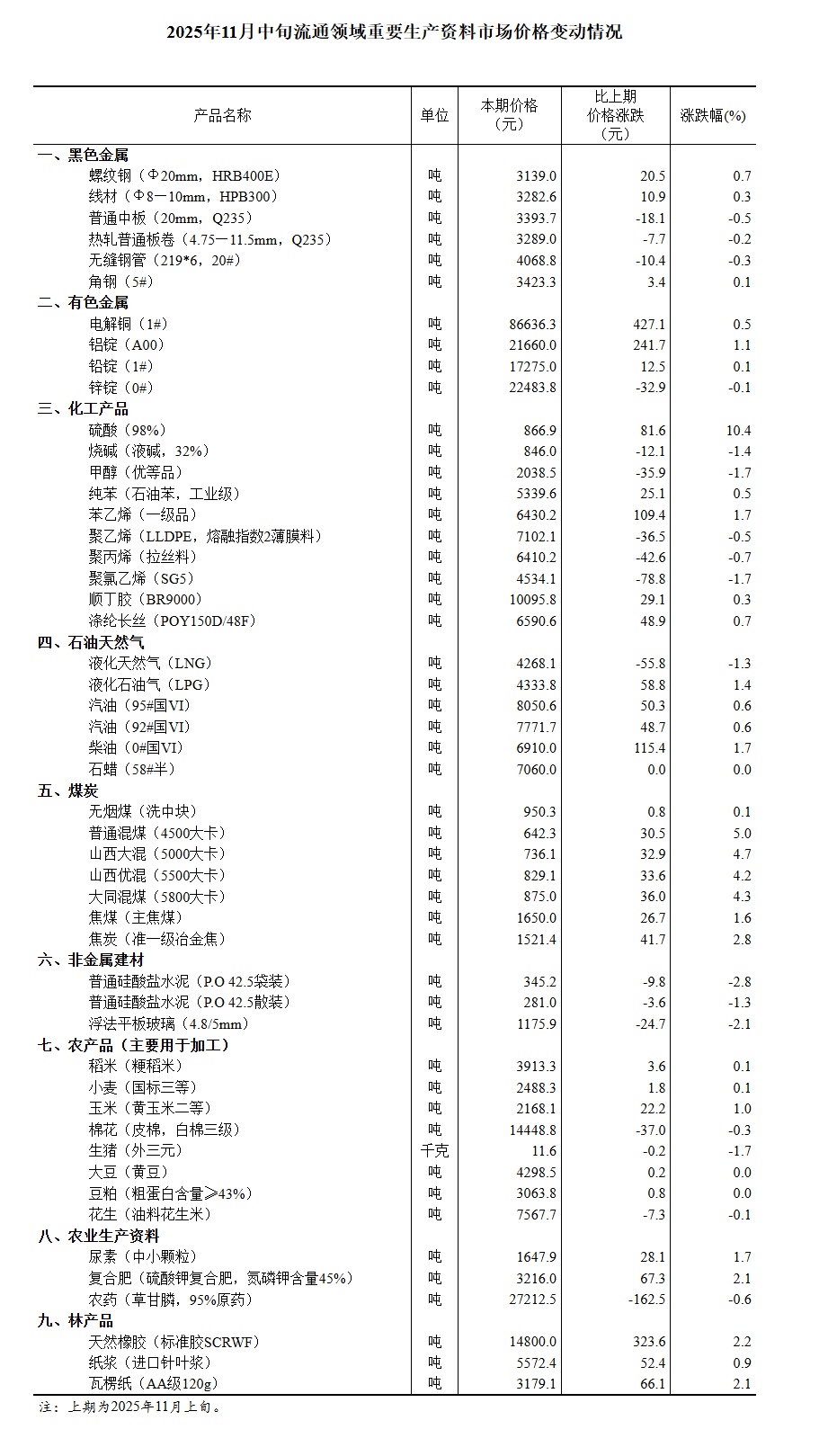
Core Viewpoint - The National Bureau of Statistics reported a 1.7% decrease in the price of live pigs (external three yuan) in mid-November compared to early November 2025, indicating a trend in the livestock market [1]. Price Changes Summary 1. General Price Trends - In mid-November 2025, 30 products saw price increases, while 17 experienced declines, and 3 remained stable compared to early November [1]. 2. Key Product Price Changes - **Black Metals**: - Rebar (Φ20mm, HRB400E) rose by 20.5 CNY to 3139.0 CNY, a 0.7% increase [2]. - Ordinary medium plate (20mm, Q235) fell by 18.1 CNY to 3393.7 CNY, a 0.5% decrease [2]. - **Non-ferrous Metals**: - Electrolytic copper (1) increased by 427.1 CNY to 86636.3 CNY, a 0.5% rise [2]. - Zinc ingot (0) decreased by 32.9 CNY to 22483.8 CNY, a 0.1% drop [2]. - **Chemical Products**: - Sulfuric acid (98%) surged by 81.6 CNY to 866.9 CNY, a 10.4% increase [2]. - Caustic soda (liquid, 32%) dropped by 12.1 CNY to 846.0 CNY, a 1.4% decrease [2]. - **Energy Products**: - Liquefied natural gas (LNG) fell by 55.8 CNY to 4268.1 CNY, a 1.3% decrease [2]. - Gasoline (95 National VI) rose by 50.3 CNY to 8050.6 CNY, a 0.6% increase [2]. - **Agricultural Products**: - Live pigs (external three yuan) decreased by 0.2 CNY to 11.6 CNY/kg, a 1.7% decline [3]. - Corn (yellow corn, second grade) increased by 22.2 CNY to 2168.1 CNY, a 1.0% rise [3]. 3. Agricultural Production Materials - Urea (medium and small particles) increased by 28.1 CNY to 1647.9 CNY, a 1.7% rise [3]. - Compound fertilizer (potassium sulfate compound fertilizer, nitrogen, phosphorus, and potassium content 45%) rose by 67.3 CNY to 3216.0 CNY, a 2.1% increase [3]. 4. Forest Products - Natural rubber (standard rubber SCRWF) surged by 323.6 CNY to 14800.0 CNY, a 22% increase [3]. - Pulp (imported needle pulp) rose by 52.4 CNY to 5572.4 CNY, remaining stable [3].
乙二醇、石蜡——大宗商品热点解读
2025-11-24 01:46
Summary of Key Points from Conference Call Industry Overview - The conference call discusses the ethylene glycol and paraffin wax industries, focusing on production methods, market dynamics, and future forecasts [1][2][3][4][10][11]. Ethylene Glycol Insights - **Production Methods**: Ethylene glycol is produced mainly through oil-based and coal-based routes. The oil-based method is more expensive but mature, while the coal-based method is cheaper but results in lower UV transmittance [1][4]. - **Market Demand**: By 2025, domestic demand for ethylene glycol is expected to saturate, with a projected increase of 1.7 million tons in new capacity. Imports are anticipated to rise by 14.64%, primarily from Saudi Arabia and Taiwan [1][6]. - **Economic Impact**: Macroeconomic factors, including US-China trade tensions and geopolitical issues in the Middle East, significantly affect the ethylene glycol market, leading to market volatility and supply chain instability [1][7]. - **Price Forecast**: For December 2026, prices in East China are expected to range between 3,800-4,300 RMB per ton due to an imbalance in supply and demand [9]. Paraffin Wax Insights - **Market Dynamics**: China is a major player in the paraffin wax market, with a high export ratio. However, high-end wax still relies on imports. From January to September 2025, imports decreased by 25%, while exports fell by 0.66% [1][13][16]. - **Price Trends**: Paraffin wax prices hit a five-year low in September 2025, showing a trend of initial decline followed by a slight recovery, influenced by inventory levels and market conditions [17]. - **Future Supply and Demand**: The supply of paraffin wax in 2026 is expected to exceed that of 2025, but demand for candles is projected to decline due to EU anti-dumping measures, leading to a price trend of initial increase followed by a decrease of approximately 200 to 300 RMB per ton [2][24]. Production Capacity and Key Players - **Major Producers**: Key domestic producers include PetroChina and Sinopec, with significant refining capacities across various plants [14][15]. - **Production Capacity**: The effective capacity for paraffin wax in China is around 1.62 million tons, with a general decline in apparent consumption noted in 2025 [13][16]. Additional Considerations - **Market Influences**: The paraffin wax market is influenced by inventory demand, market conditions, raw material costs, and transportation expenses. The operational status of refineries also plays a crucial role [20]. - **Future Growth Areas**: Despite challenges, growth in high-end applications such as electronic components, automotive lubricants, and pharmaceuticals is expected to stabilize demand [22][23]. This summary encapsulates the critical insights from the conference call regarding the ethylene glycol and paraffin wax industries, highlighting production methods, market dynamics, and future forecasts.
2025年11月中旬流通领域重要生产资料市场价格变动情况
Guo Jia Tong Ji Ju· 2025-11-24 01:30
Core Viewpoint - The monitoring of market prices for 50 important production materials across nine categories shows a mixed trend, with 30 products experiencing price increases, 17 seeing declines, and 3 remaining stable in mid-November 2025 compared to early November 2025 [2][3]. Group 1: Price Changes in Major Categories - In the black metal category, rebar prices increased by 20.5 yuan per ton (0.7%), while ordinary medium plates decreased by 18.1 yuan per ton (-0.5%) [4]. - In the non-ferrous metals category, electrolytic copper rose by 427.1 yuan per ton (0.5%), while zinc ingots fell by 32.9 yuan per ton (-0.1%) [4]. - Chemical products saw significant price fluctuations, with sulfuric acid increasing by 81.6 yuan per ton (10.4%) and methanol decreasing by 35.9 yuan per ton (-1.7%) [4]. Group 2: Energy and Coal Prices - In the petroleum and natural gas sector, liquefied natural gas prices dropped by 55.8 yuan per ton (-1.3%), while gasoline prices increased by 50.3 yuan per ton (0.6%) [4]. - Coal prices showed an upward trend, with ordinary mixed coal increasing by 30.5 yuan per ton (5.0%) and Shanxi premium mixed coal rising by 33.6 yuan per ton (4.2%) [4]. Group 3: Agricultural Products and Inputs - Among agricultural products, corn prices rose by 22.2 yuan per ton (1.0%), while cotton prices fell by 37.0 yuan per ton (-0.3%) [5]. - In agricultural production materials, urea prices increased by 28.1 yuan per ton (1.7%), and compound fertilizer prices rose by 67.3 yuan per ton (2.1%) [5]. Group 4: Monitoring Methodology - The price monitoring encompasses a wide range of products across 31 provinces, involving over 2000 wholesalers and dealers, ensuring comprehensive coverage of the market [8][9]. - The methodology includes on-site price collection, telephone inquiries, and electronic communications to ensure accurate data [9].
百年延长 能源之光——写在延长石油创立一百二十周年之际
Zhong Guo Hua Gong Bao· 2025-11-21 04:00
Core Viewpoint - The article highlights the historical significance and evolution of Yanchang Petroleum, emphasizing its role in China's oil industry and its contributions to national energy security and local economic development over the past century [1][3][11]. Historical Development - Yanchang Petroleum was established in 1905, marking the beginning of China's modern oil industry with the drilling of the first oil well in 1907 [3][4]. - The company survived through various historical challenges, including wars and economic turmoil, and became a symbol of national resilience and industrial development [4][5]. - After the founding of New China, Yanchang Petroleum faced numerous challenges but achieved significant milestones, including surpassing 10,000 tons of crude oil production in 1959 and 1 million tons in 1997 [5][6]. Corporate Growth and Transformation - The company underwent restructuring in 1998 and 2005, leading to a rapid increase in production and revenue, with crude oil production exceeding 10 million tons in 2007 and revenue surpassing 100 billion yuan in 2010 [6][7]. - By 2013, Yanchang Petroleum became the first company in Western China to enter the Fortune Global 500, with revenue growing from 162.1 billion yuan in 2012 to 390 billion yuan in 2024 [7][8]. Industry Position and Achievements - Yanchang Petroleum has established itself as a major player in the oil and gas sector, ranking as the seventh largest oil field in China and the fourth largest gas field, with a gas production of over 12 billion cubic meters [8][9]. - The company has diversified its operations, achieving a historic shift from being oil-dominant to a balanced structure of oil, gas, coal, and chemical products [8][9]. Technological Innovation - Yanchang Petroleum has invested over 60 billion yuan in research and development over the past decade, leading to significant technological advancements in oil and gas exploration and production [9][10]. - The company has established itself as a leader in innovation, with numerous projects filling gaps in the industry and receiving national recognition [9][10]. Social Responsibility and Community Engagement - Yanchang Petroleum has contributed significantly to local economic development, paying over 762.3 billion yuan in taxes from 2006 to 2024 and supporting various community projects [11][12]. - The company has played a crucial role in poverty alleviation and local development, investing in infrastructure and social programs in the Shaanxi region [12][13]. Future Outlook - As Yanchang Petroleum approaches its 120th anniversary, it aims to continue its commitment to high-quality development, focusing on energy security and sustainable practices while expanding into new energy sectors [15].
构建石化行业央企ESG评价体系:核心在于能源环境管理和安全生产:A股央企ESG评价体系白皮书系列报告之十九
Shenwan Hongyuan Securities· 2025-11-11 09:07
Investment Rating - The report does not explicitly state an investment rating for the petrochemical industry or its central enterprises [32]. Core Insights - The petrochemical industry is crucial for national economic stability and is focused on achieving green and sustainable development alongside safe production practices [3][6]. - The report emphasizes the importance of constructing an ESG evaluation system for central enterprises in the petrochemical sector, highlighting energy transition and safety production as core indicators [8][27]. Summary by Sections 1. ESG Policies in the Petrochemical Industry - The industry primarily involves the processing and sale of crude oil and natural gas into various chemical products, with a significant focus on green and sustainable development [3][6]. - Recent government policies aim to guide the industry towards a green low-carbon transition and high-quality development, emphasizing strict energy efficiency constraints and enhanced management [7][8]. 2. Construction of the ESG Evaluation System - The ESG evaluation system for central enterprises in the petrochemical industry includes five additional secondary indicators: New Energy Business Transformation, Oil Leak Risk Management, Public Awareness Investment, Overseas Community Development, and Safety Production [8][10]. - The evaluation system consists of general indicators, environmental indicators, social indicators, and governance indicators, totaling 18 primary indicators and 45 secondary indicators [8][10]. 3. Environmental Indicators - Environmental indicators are designed under the guidance of dual carbon policies, with a focus on new energy business transformation and oil leak risk management as unique indicators for the petrochemical sector [10][12]. - The system includes metrics for waste management, biodiversity protection, and compliance with environmental regulations, reflecting the industry's commitment to ecological sustainability [10][11]. 4. Climate Change Response Indicators - The climate change response indicators assess the commitment of petrochemical central enterprises to global climate change management and domestic dual carbon policies, comprising one primary indicator and four secondary indicators [16][18]. - The report highlights the importance of aligning with national goals for carbon peak and neutrality, urging the industry to transition towards cleaner energy sources [16][18]. 5. Social Responsibility Indicators - Social indicators reflect the responsibilities of petrochemical central enterprises, particularly in public environmental safety awareness and employee training, with three primary indicators and nine secondary indicators [18][19]. - The report emphasizes the need for enterprises to integrate social responsibility into their operations, especially in overseas projects [19][20]. 6. Governance Indicators - Governance indicators are fundamental for sustainable development, focusing on corporate governance structures, mechanisms, and norms, with a total of 34 points available [23][24]. - The report does not introduce specific indicators unique to the petrochemical sector under governance but maintains a focus on overall governance quality [23][24].