碳酸亚乙烯酯

Search documents
泰和科技:碳酸亚乙烯酯项目预计近期完成改造,并准备试生产
Jin Rong Jie· 2026-02-27 03:46
Core Viewpoint - The company is set to complete the transformation of its vinyl carbonate project soon and is preparing for trial production [1] Group 1 - The company announced on February 27 that its vinyl carbonate project is expected to finish modifications shortly [1] - The company is gearing up for trial production following the completion of the project [1]
泰和科技高管变动及项目进展更新
Jing Ji Guan Cha Wang· 2026-02-12 04:38
Group 1: Executive Changes - The company's Vice President, Ren Zhenzhen, has resigned for personal reasons, and the transition has been properly managed, ensuring no impact on normal operations [2][3]. Group 2: Project Progress - The company is currently upgrading equipment for the vinyl carbonate project, with completion expected around the Spring Festival [3]. - The sodium iron phosphate project has completed its pilot test and is undergoing modifications to the original lithium iron phosphate facility, which is expected to achieve an annual production capacity of 10,000 tons upon completion [3]. - The company announced on January 3, 2026, its intention to shift the original lithium iron phosphate project towards NFPP production to optimize its product structure [3].
新能源需求拉动氟化工利润上涨
Zhong Guo Hua Gong Bao· 2026-02-11 04:34
Group 1 - The fluorochemical industry is experiencing a positive outlook due to the demand from the new energy market, leading to increased net profits for several companies in 2025 [1] - Companies like Huasheng Lithium and Ruitai New Materials are expected to see significant profit increases, with Huasheng Lithium projecting a net profit of 12 million to 18 million yuan, a year-on-year increase of 106.87% to 110.30%, and Ruitai New Materials forecasting a net profit of 185 million to 240 million yuan, a growth of 118.67% to 183.68% [1] - Some companies, such as Yongtai Technology, are expected to reduce their losses significantly, with projected revenues of 5 billion to 5.5 billion yuan and a net loss narrowing to 25.6 million to 48.6 million yuan, a reduction of 91.44% to 95.72% compared to the previous year [1] Group 2 - Lithium hexafluorophosphate products are expected to perform poorly in 2025, leading to losses for some companies, with Shenzhen New Star projecting a net loss of 69 million to 46 million yuan, a decrease in losses by 222 million to 245 million yuan compared to the previous year [2] - The company attributes its losses to weak market demand and intensified competition, with prices remaining low despite a price increase starting in October 2025 [2] - The overall fluorochemical industry is facing a demand decline that is not offset by emerging sectors like new energy and semiconductors, with the upstream fluorite market showing weak supply and demand dynamics [2]
2025年氟化工行业年报显示:新能源需求拉动氟化工利润上涨
Zhong Guo Hua Gong Bao· 2026-02-11 02:15
Group 1 - The fluorochemical industry is experiencing a positive outlook due to the rising demand from the new energy market, leading to increased net profits for several companies in 2025 [1] - Companies like Huasheng Lithium and Ruitai New Materials are expected to see significant profit increases, with Huasheng Lithium projecting a net profit of 12 million to 18 million yuan, a year-on-year increase of 106.87% to 110.30%, and Ruitai New Materials forecasting a net profit of 185 million to 240 million yuan, a growth of 118.67% to 183.68% [1] - Some companies, such as Yongtai Technology, are expected to narrow their losses significantly, with projected revenues of 5 billion to 5.5 billion yuan and a net loss reduction of 91.44% to 95.72% [1] Group 2 - Lithium hexafluorophosphate products are expected to perform poorly in 2025, leading to losses for some companies, with Shenzhen New Star projecting a net loss of 46 million to 69 million yuan, a reduction of 222 million to 245 million yuan compared to the previous year [2] - The company attributes its losses to weak market demand and intensified competition, with prices remaining low despite a price increase starting in October 2025 [2] - The overall fluorochemical industry is facing a demand decline, with upstream raw material markets showing weak supply and demand dynamics, leading to a price stalemate [2]
永太科技拟全资控股永太高新 股票停牌前涨停
Mei Ri Jing Ji Xin Wen· 2026-02-09 14:56
Core Viewpoint - The A-share lithium battery sector is set to undergo significant capital operations, with Yongtai Technology planning to acquire the remaining 25% stake in its subsidiary, Shaowu Yongtai High-tech Materials, from CATL, marking a strategic shift in their relationship from subsidiary shareholder to listed company shareholder [1][5]. Group 1: Transaction Details - Yongtai Technology announced plans to issue shares to acquire the remaining 25% stake in Yongtai High-tech, which it currently holds 75% of, aiming for full ownership and improved management efficiency [2][3]. - The transaction is expected to enhance Yongtai Technology's net profit and eliminate minority shareholder impacts, aligning with the company's strategy to strengthen its core business in lithium battery materials [2][3]. Group 2: Financial Performance - Yongtai Technology's 2025 performance forecast indicates a significant reduction in losses, with expected revenues between 5 billion to 5.5 billion yuan and a net loss of 25.6 million to 48.6 million yuan, a reduction of over 90% compared to the previous year's loss of 478 million yuan [3][4]. - The recovery in the electric vehicle and energy storage sectors has driven a substantial increase in sales and prices of lithium battery materials, contributing to the company's improved financial outlook [3][4]. Group 3: Strategic Implications - The acquisition signifies a deeper strategic partnership with CATL, enhancing Yongtai Technology's position in the supply chain and potentially increasing its bargaining power [6][7]. - Both companies share a vision for the future of the energy sector, with Yongtai Technology focusing on expanding its product offerings in lithium salts and additives, while CATL benefits from a more flexible investment in upstream material companies [6][7]. Group 4: Future Prospects - Yongtai Technology is exploring new growth areas, including fluorinated liquid products for semiconductor manufacturing and data center cooling, which could become significant revenue sources as demand in these sectors grows [7]. - The collaboration potential in emerging fields like liquid cooling and energy storage management between Yongtai Technology and CATL is noteworthy, given CATL's position as a leader in the energy storage market [7].


华盛锂电:预计2025年年度净利润为1200万元~1800万元
Mei Ri Jing Ji Xin Wen· 2026-01-30 09:17
Core Viewpoint - The company, Huasheng Lithium Battery, is expected to achieve a net profit attributable to shareholders of 12 million to 18 million yuan in 2025, marking a turnaround from losses in the previous year due to the booming demand in the new energy materials market driven by the growth of the electric vehicle and energy storage industries [1] Group 1 - The significant increase in demand for new energy materials has led to a notable expansion in the market, allowing the company to seize market opportunities and enhance internal control management, ensuring stable production and shipment [1] - The prices of the company's main products, vinylene carbonate and fluorinated ethylene carbonate, have risen significantly, contributing to an increase in the gross profit margin of the main business [1] - The company has seen a substantial increase in the sales volume of its main products, which has significantly improved its operating performance [1] Group 2 - The reduction in the provision for inventory impairment at the end of the reporting period has also contributed to the improvement in net profit [1] - Increased returns from external investment projects have led to a significant rise in investment income compared to the same period last year [1]

华盛锂电:公司“年产6万吨碳酸亚乙烯酯项目(一期3万吨)”的建设正在积极有序的推进中
Zheng Quan Ri Bao Wang· 2026-01-14 13:12
Core Viewpoint - The company is actively progressing with the construction of its "60,000 tons/year ethylene carbonate project (Phase I: 30,000 tons)" and aims to complete it soon to release new production capacity [1]. Group 1 - The project has received the land use certificate, indicating that the necessary legal requirements for construction have been fulfilled [1]. - The company is focused on expediting the completion of the project to enhance its production capabilities [1].
公司问答丨华盛锂电:公司“年产6万吨碳酸亚乙烯酯项目(一期3万吨)”的建设正在积极有序推进中
Ge Long Hui A P P· 2026-01-14 09:11
Group 1 - The company is actively progressing on its annual production capacity of 60,000 tons of vinyl carbonate ester, with the first phase of 30,000 tons under construction [1] - The land certificate for the project has been completed, and the company aims to complete the project as soon as possible to release new production capacity [1] - The company has been asked about the expected shipment volume for 2026, indicating investor interest in future production capabilities [1]
华盛锂电:“年产6万吨碳酸亚乙烯酯项目(一期3万吨)”的建设正在推进中,项目土地证已办理完成
Mei Ri Jing Ji Xin Wen· 2026-01-14 08:34
Core Viewpoint - The company is actively progressing on its new VC capacity project, aiming for significant production output by 2026 [1]. Group 1: Project Development - The company is constructing a "60,000 tons/year ethylene carbonate project (Phase 1: 30,000 tons)" and is making steady progress [1]. - The land certificate for the project has been completed, and the company is striving to complete the project as soon as possible to release new capacity [1]. Group 2: Future Projections - The company has been asked about the expected output in 2026, indicating investor interest in the future production capabilities [1]. - Specific operational information and product shipment details will be disclosed in the company's upcoming periodic reports [1].
【行业研究】电解液:“一超两强”格局的稳固与挑战
Xin Lang Cai Jing· 2026-01-08 11:43
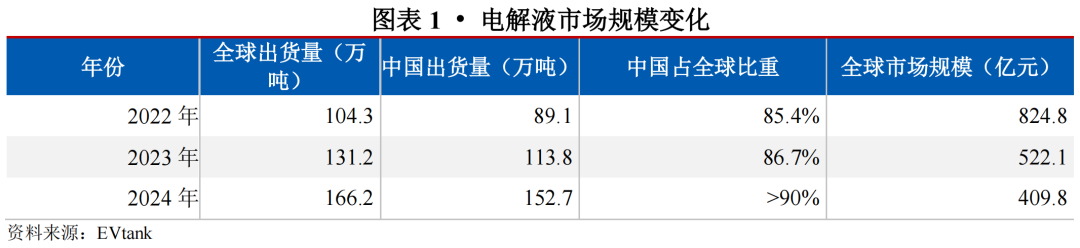
Core Viewpoint - The electrolyte industry is in the midstream of the new energy supply chain, currently experiencing a phase of expansion after destocking, with a focus on cost control as its core competitive advantage. The global market is dominated by China, with a highly concentrated domestic market characterized by a "one super, two strong" structure. Future trends indicate diversification, structural adjustments, and accelerated technological iterations driven by the rapid expansion of the new energy vehicle and energy storage industries [1][36]. Industry Overview - The electrolyte industry is positioned in the midstream of the new energy supply chain, with lithium salts and organic solvents upstream and battery cell manufacturers downstream. The industry is currently in the early stages of expansion following destocking. Compared to other lithium battery materials, the entry barriers in the electrolyte industry are relatively low [2][40]. - Electrolytes are a key component of lithium batteries, responsible for ion conduction, accounting for approximately 10-20% of the manufacturing cost. The main components include lithium salts, organic solvents, and additives, with lithium hexafluorophosphate (LiPF₆) being the mainstream lithium salt [2][37]. - From 2022 to 2024, global shipments of electrolytes are expected to continue growing due to increasing demand from lithium batteries, with Chinese companies' shipment share rising to over 90% by 2024. However, the significant decline in electrolyte prices has led to a contraction in the global market sales scale during this period [2][38]. Production Capacity and Market Dynamics - Between 2022 and 2024, the expansion rate of electrolyte production capacity is expected to exceed market demand growth, resulting in structural overcapacity in the industry. By 2024, China's electrolyte production capacity is projected to exceed 5 million tons, but the average capacity utilization rate is only between 25-35% [8][43]. - The pricing pressure on electrolytes is exacerbated by the strong bargaining power of downstream customers, such as battery manufacturers and automotive companies, leading to prolonged accounts receivable periods. Consequently, electrolyte prices are expected to decline continuously from 2022 to 2024, remaining below 20,000 yuan per ton from 2025 onwards [8][44]. Competitive Landscape - Cost control is the core of competition in the electrolyte industry. Chinese electrolyte companies dominate the global market, with a high concentration in the domestic market. The first-tier companies, including Tianqi Materials, BYD, and Xinzhou Bang, collectively hold about 60% market share [11][49]. - The first-tier companies leverage vertical integration to build competitive advantages, while second-tier companies focus on niche markets or specific regions for differentiated competition. The second-tier includes companies like Ruifeng New Materials and Kunlun New Materials, which face unique structural challenges [11][52]. - By 2024, the first-tier companies are expected to maintain a significant market share, while the second-tier companies are projected to grow their shipments by approximately 40% year-on-year in the first half of 2025, potentially encroaching on the first-tier's market share [11][52]. Financial Performance of Key Companies - In 2024, the total revenue of sample electrolyte companies is expected to decline, with a decrease in profit margins and overall revenue quality. Notably, Xinzhou Bang's revenue is projected to increase due to growth in its electronic information chemical business, while other sample companies are expected to see revenue declines [21][56]. - The asset structure of these companies shows a high proportion of accounts receivable, indicating significant capital occupation, while fixed assets remain high, suggesting potential depreciation pressures in the future [21][56]. - Operating cash flow for these companies is expected to decline in 2024, primarily due to decreased revenue and quality of revenue realization. Tianqi Materials is expected to maintain positive cash flow despite lower revenue quality, while other companies may face cash outflows [23][58]. Future Trends - The rapid expansion of new energy vehicles and energy storage industries is expected to drive diversification and structural adjustments in the electrolyte market. The demand for electrolytes is anticipated to grow, supported by the global electrification process and the explosion of the energy storage market [33][68]. - The rise of solid-state batteries presents structural challenges for the electrolyte industry. In the short term, the demand for gel electrolytes and composite solid-liquid electrolytes is expected to increase, while traditional liquid electrolytes may see stable or declining demand in the medium to long term [34][69].