
美国液化天然气

Search documents
美伊谈判出现转折,油价剧烈波动
Hua Tai Qi Huo· 2026-02-27 05:28
Report Summary 1. Report Industry Investment Rating - Not provided in the given content. 2. Core Viewpoints - The negotiation between Iran and the US in Geneva has shown "significant progress" and is "close to reaching a consensus" in some areas, but the US military deployment in the Middle East continues to escalate, indicating that the fundamental differences between the two sides on core issues are still difficult to bridge. The WTI crude oil fluctuated sharply, and as long as the concerns about the Strait of Hormuz are lifted, the oil price is under downward pressure. The indicators such as the month - spread structure and physical premium have shown weak fundamental signals [2]. 3. Market News and Key Data - The price of light - sweet crude oil futures for April delivery on the New York Mercantile Exchange fell 21 cents to $65.42 per barrel, a decrease of 0.32%; the main SC crude oil contract rose 0.74% to 490 yuan per barrel [1]. - On February 27, Ukraine's state - owned oil and gas company will receive 90 million cubic meters of US liquefied natural gas through the Port of Klaipeda in Lithuania from February to March this year, aiming to diversify energy supply routes and enhance energy security [1]. - On February 26, the price difference between the near - term and longer - term Brent crude oil contracts has narrowed, indicating that the supply situation in the spot market is gradually improving. The oil exports from Kazakhstan through the Caspian Pipeline Consortium terminal have returned to normal, and the scale of floating storage facilities is shrinking. If the US - Iran tension eases and OPEC+ resumes production increase from April, the oil price may decline [1]. - On February 26, after the US Supreme Court's ruling made the long - awaited trade agreement to stop importing Russian oil in exchange for tariff exemptions uncertain, Indian refiners are keeping their Russian oil purchases at a minimum, waiting for the Indian government's guidance [1]. 4. Investment Strategy - In the short term, the oil price is strongly driven, and it is recommended to go long on the diesel crack spread (event - driven), while in the medium term, a short - position allocation is advisable [3].
欧盟7500亿采购承诺形同虚设:对美能源进口不增反减!
Jin Shi Shu Ju· 2025-12-24 09:00
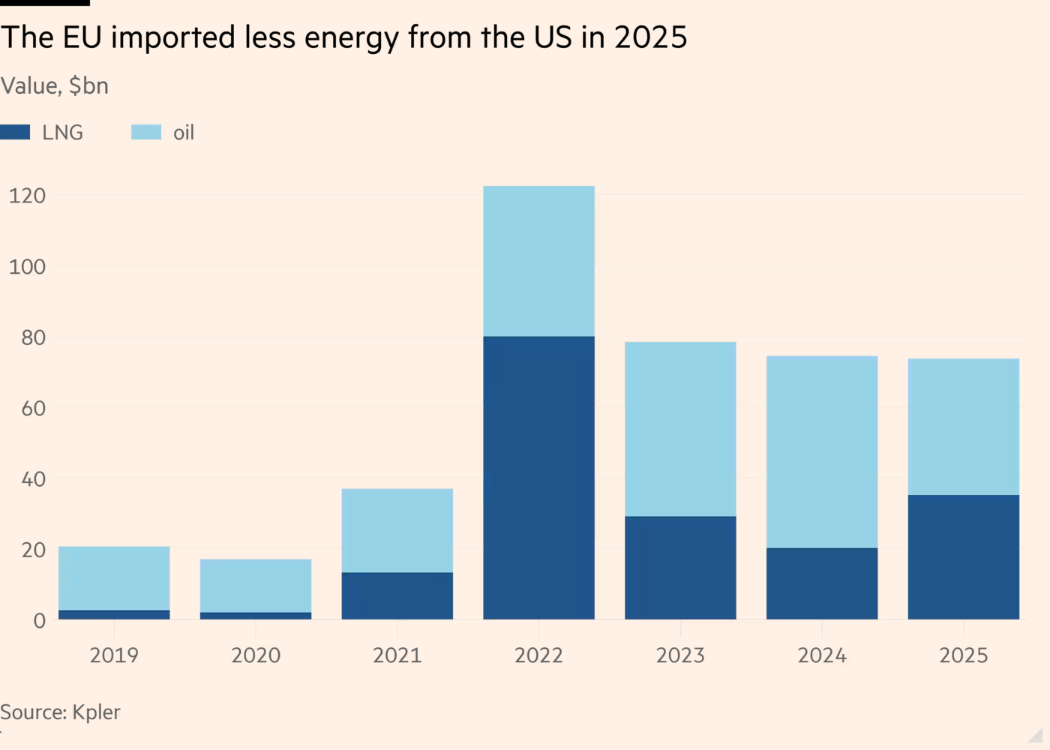
Core Insights - Despite the EU's commitment to purchase $750 billion worth of U.S. energy over the next three years, its spending on U.S. oil and gas has decreased by 7% over the past four months [1][2]. Group 1: Trade Agreement and Spending - Since the trade agreement with the U.S. in August, the EU has increased its imports of U.S. liquefied natural gas (LNG), but overall spending has decreased due to falling oil and gas prices compared to the previous year [2]. - Kpler estimates that from September to December, the total value of U.S. LNG and crude oil imported by the EU was $29.6 billion [3]. - The non-binding trade agreement has had little effect on increasing EU purchases of U.S. energy products, according to Kpler's senior director [4]. Group 2: Economic Viability and Future Projections - The EU's annual energy imports from the U.S. amount to $73.7 billion, which is significantly less than the average annual target of $250 billion set by the agreement for 2026-2028 [5]. - Even if the EU were to replace all Russian gas with U.S. LNG, the average annual import value over the next three years would only be about $29 billion, which is just 23% of the agreement's requirement [8]. - To meet the trade targets by 2028, natural gas prices would need to rise to $37.3 per million British thermal units, a fourfold increase from current levels, which contradicts market expectations [8]. Group 3: Infrastructure and Capacity Challenges - Both the EU and the U.S. lack sufficient import and export infrastructure to significantly expand energy trade [10]. - To fulfill the trade agreement, the EU's import capacity would need to increase by over 50%, while U.S. export capacity would need to more than double [11]. - The agreement appears to lack economic rationale and may serve as a temporary measure for the EU to delay confrontation with the U.S. while strengthening defenses against Russia [11]. Group 4: Current Trends and Future Contracts - The EU has already procured approximately €200 billion ($236 billion) worth of U.S. energy products in the first 11 months of 2025, with an increase in oil and gas imports, particularly U.S. LNG [12]. - At least nine new long-term contracts for LNG have been signed by EU buyers with the U.S. this year, although it remains unclear how much of this future procurement is included in the total data reported [12].

英媒:虽与美达成贸易协议,但欧盟在美能源上的支出有所减少
Xin Lang Cai Jing· 2025-12-24 05:26
Core Insights - Despite the EU's commitment to purchase $750 billion of U.S. energy over the next three years, its spending on U.S. oil and gas imports has decreased by 7% over the past four months [1] - The EU has increased its imports of U.S. liquefied natural gas since the trade agreement in August, but the overall value has declined due to falling oil and gas prices compared to the same period last year [1] - According to Kpler, the total value of EU's liquefied natural gas and oil imports from September to December reached $29.6 billion [1] - Kpler's senior director, Gillian Boccara, stated that the non-binding trade agreement has not significantly driven the EU to purchase more U.S. commodities, as procurement is influenced by economic factors rather than political commitments [1] - The annual import value for the EU is $73.7 billion, which is less than one-third of the amount needed to meet the $750 billion energy procurement commitment for 2026 to 2028 [1]
美国逼土耳其断俄气,欧洲反手加购能源,中间人夹缝生存太尴尬
Sou Hu Cai Jing· 2025-11-13 12:25
Group 1 - The article highlights the geopolitical tension surrounding Turkey's energy procurement from Russia, emphasizing the pressure from the U.S. to cease these imports while European countries continue to rely on Russian gas through Turkey [1][10]. - Hungary's situation is presented as a clear example of selective treatment, where it received a one-year exemption from U.S. sanctions in exchange for purchasing U.S. liquefied natural gas and allowing American companies to participate in its nuclear energy sector [3][10]. - Turkey's heavy reliance on Russian energy is underscored, with Russia being the largest supplier of natural gas and oil, making it challenging for Turkey to completely sever ties without incurring significant costs and operational changes [5][10]. Group 2 - Turkey has been diversifying its energy sources by importing gas from Azerbaijan and Iran, and developing domestic gas reserves, which provides some buffer against sudden supply disruptions [7][10]. - The potential for rising energy costs due to U.S. restrictions is a significant concern, as it could lead to increased electricity and heating expenses for Turkish households [9][10]. - The European Union's goal to eliminate dependence on Russian gas by 2027 poses a long-term threat to Turkey's role as a transit hub, potentially diminishing its bargaining power in international energy negotiations [10][14]. Group 3 - The security of energy transit routes is critical, as evidenced by recent attempts to attack the "TurkStream" pipeline, highlighting the risks associated with geopolitical conflicts [12][14]. - The article concludes that Turkey is caught in a complex geopolitical struggle, needing to balance its relationships with both Russia and the U.S. while navigating the evolving landscape of European energy supply chains [14].
中国不给台阶下,特朗普逼日本接盘,日本服软,未来将付出代价
Sou Hu Cai Jing· 2025-11-09 13:15
Core Viewpoint - The trade war initiated by Trump has not only failed to improve the U.S. economy but has also led to significant domestic backlash, particularly from American farmers who are heavily impacted by reduced soybean exports to China [1][3]. Group 1: U.S. Soybean Industry - The U.S. produces 120 million tons of soybeans annually, with exports accounting for half of this amount. China previously purchased 60% of U.S. soybean exports, approximately 36 million tons, but has now reduced its procurement to 22 million tons [5][7]. - The price of U.S. soybeans at Chinese ports reached $1,026 per ton, while Brazilian soybeans are priced at $580 per ton, making U.S. soybeans less competitive [7]. Group 2: Japan's Response - Japan has committed to increasing its imports of U.S. soybeans and other agricultural products, but its annual soybean import capacity is only around 3.5 million tons, which is insufficient to cover the U.S. export shortfall [14][16]. - The Japanese automotive industry is significantly affected by the 24% tariff imposed by Trump, which could lead to price increases or profit losses for Japanese car manufacturers [9][10]. Group 3: Economic Implications for Japan - The economic outlook for Japan is grim, with over 10,000 companies expected to go bankrupt in the 2024 fiscal year, marking an 11-year high. The GDP may decline by 0.2%, following a mere 0.1% growth the previous year [19]. - Japan's heavy reliance on U.S. agricultural products poses a risk to its food security, as it could become vulnerable to U.S. economic pressures [19][21].
特朗普服软了?全球石油行业巨变,俄罗斯石油出口管制减弱?
Sou Hu Cai Jing· 2025-11-09 09:59
Core Viewpoint - The meeting at the White House on November 7 highlighted the complex geopolitical dynamics surrounding Hungary's energy dependence on Russia, with Trump suggesting a potential exemption for Hungary to continue purchasing Russian oil, which could undermine the collective sanctions imposed by the US and EU against Russia [1][16]. Group 1: Hungary's Energy Dependency - Hungary is heavily reliant on Russian energy, with 74% of its natural gas and 86% of its oil sourced from Russia, making it one of the EU's most dependent countries on Russian energy [3][4]. - The lack of a seaport severely limits Hungary's ability to import alternative energy sources, as its industrial infrastructure is designed to process Russian crude oil, making a switch to other sources technically challenging and costly [3][4]. Group 2: Geopolitical Implications - The recent sanctions imposed by the US and EU on Russian oil and liquefied natural gas have led to a spike in international oil prices, which has not significantly harmed Russia but has put pressure on European allies like Hungary [4][11]. - Trump's comments suggest that Hungary's situation is not unique, with other landlocked countries like Slovakia facing similar dilemmas regarding energy supply and reliance on Russian resources [4][11]. Group 3: Strategic Calculations - Trump's willingness to consider an exemption for Hungary appears to be a strategic move to maintain alliances and pressure other European nations to align with US policies regarding Russian energy [6][7]. - Hungary's energy crisis has prompted it to develop infrastructure that could position it as a key player in the Central European energy market, potentially replacing Austria as a distribution hub for natural gas [7][14]. Group 4: Future Considerations - The exemption for Hungary is not guaranteed, as it may come with conditions, such as purchasing $6 billion worth of US liquefied natural gas, indicating a transactional nature to the arrangement [8][12]. - The potential for other countries to seek similar exemptions could create further fractures in the EU's collective sanctions strategy against Russia, undermining the intended pressure on the Kremlin [12][13].
特朗普下周访日“催投资”,高市早苗拟定一篮子采购计划讨好
Jin Shi Shu Ju· 2025-10-22 09:28
Group 1: Core Insights - Japan's new Prime Minister, Sanae Takaichi, is finalizing a procurement plan that includes American pickup trucks, soybeans, and natural gas, to be presented during the upcoming trade and security talks with President Trump [1] - Takaichi emphasized that the alliance with the U.S. is fundamental to Japan's foreign and security policy, despite not committing to new defense spending targets during the meeting [1][3] - The procurement plan may involve reducing soybean imports from Brazil to increase purchases from the U.S., which already accounts for 70% of Japan's soybean consumption [1] Group 2: Defense Spending and Investments - Japan plans to purchase more U.S. liquefied natural gas (LNG) but will not engage in the Alaskan pipeline project promoted by Trump [3] - A list of candidate investment projects under a $550 billion agreement will be submitted for review before final selection by Trump [3] - Takaichi aims to accelerate defense spending beyond the 2% GDP target set for 2027, indicating a commitment to enhancing Japan's military capabilities [4]
高市早苗政府拟购美大豆、皮卡和天然气,筹备下周与特朗普会谈
Hua Er Jie Jian Wen· 2025-10-22 08:24
Core Points - Japan's new Prime Minister, Sanna Takichi, faces a significant diplomatic challenge with an upcoming meeting with U.S. President Trump, focusing on a procurement package that includes American pickup trucks, soybeans, and natural gas to foster goodwill in trade and security negotiations [1] - Takichi won the election with 237 votes in the first round of the House of Representatives, securing her position as Japan's 104th Prime Minister [1] - The meeting will not include commitments to new defense spending targets, despite U.S. pressure for Japan to increase defense expenditures [1][3] Procurement Focus - The planned procurement package includes the purchase of Ford F150 pickup trucks, a suggestion made by Trump, and an increase in U.S. soybean purchases, which currently account for 70% of Japan's soybean consumption [1][2] - To accommodate U.S. soybeans, Japan may reduce its imports from Brazil [2] - Japan also plans to buy more U.S. liquefied natural gas, but will not include the Alaskan pipeline project promoted by Trump [3] Investment and Defense Cooperation - Japan will submit a list of candidate projects under a $550 billion investment agreement for review, with final selections made by Trump [3] - Takichi previously indicated that the investment agreement was unfair, but has committed to fulfilling it, emphasizing that even a low profit share can be commercially viable if risks are low [3] - Takichi aims to deepen security ties with Washington and plans to accelerate defense spending towards a 2% GDP target by 2027, reviewing strategic documents that underpin Japan's largest military expansion since World War II [3]
特朗普没打算放过印度,中国贵客关键时刻来访,有要事跟莫迪面谈
Sou Hu Cai Jing· 2025-08-18 04:51
Core Points - The U.S. Trade Representative's office unexpectedly canceled a planned visit to New Delhi, coinciding with the imposition of a 25% additional tariff on Indian goods, marking the highest tariffs imposed by the U.S. on a major trading partner [1][15] - The cancellation of the visit dashed India's hopes for last-minute negotiations to alleviate tariff pressures, especially as the U.S. had recently reached a temporary agreement with China [1][3] - Tensions between the U.S. and India have escalated due to unresolved trade negotiations, particularly in agriculture, dairy, and energy sectors, with the U.S. demanding greater market access and a halt to Russian oil imports [3][5] Trade Relations - India's government faces significant challenges in complying with U.S. demands, as nearly 60% of its population relies on agriculture, and energy security is a critical concern due to high dependence on oil imports [5][9] - The Modi administration has initiated a "self-reliant India" strategy, which includes plans for domestic semiconductor production and tax reforms, aiming to bolster its industrial base amid trade tensions [7][11] - Despite these efforts, bureaucratic delays and project setbacks have hindered foreign investment, with an average delay of 18 months for foreign projects [7][9] Economic Impact - The Indian government has developed a three-phase response plan to mitigate the impact of U.S. tariffs, focusing on export tax rebates for heavily affected sectors, retaliatory tariffs on U.S. agricultural products, and potential WTO litigation [9][13] - However, these measures are expected to only alleviate approximately $725 million in losses, which is minimal compared to India's nearly $100 billion annual exports to the U.S. [9][11] - Concurrently, China has increased its engagement with India, highlighting the growing economic interdependence between the two nations, with bilateral trade expected to exceed $136 billion by mid-2025 [11][15] Strategic Considerations - The evolving trade dynamics reveal a shift in India's foreign policy, as it seeks to balance its strategic autonomy while navigating pressures from both the U.S. and China [13][15] - Modi's government is attempting to diversify its energy sources and enhance domestic production capabilities, while also engaging in multilateral discussions to strengthen its position [13][15] - The upcoming UN General Assembly presents a potential opportunity for U.S.-India dialogue, although India remains firm on not initiating discussions unless the U.S. retracts some tariffs [13][15]
美国39%关税刺痛瑞士,瑞士政界人士呼吁取消购买美战斗机协议
Huan Qiu Shi Bao· 2025-08-07 22:43
Core Viewpoint - The United States has imposed a punitive tariff of 39% on Switzerland, making it one of the countries facing the highest tariffs from the U.S. This has led to significant backlash and criticism within Switzerland regarding the negotiation strategies of President Keller-Zuterl [1][2]. Group 1: Tariff Impact - The 39% tariff affects a majority of Swiss industrial exports to the U.S., including luxury watches and medical devices [1]. - Analysts predict that the tariffs could reduce Switzerland's GDP by 0.3% to 1% [1]. - The Swiss government had previously believed they had reached a preliminary agreement for a 10% tariff, which was abruptly changed by President Trump [1]. Group 2: Political Reactions - There is widespread criticism of Keller-Zuterl's negotiation approach, with local media labeling it a significant political failure [2]. - Swiss officials are calling for the cancellation of a multi-billion dollar deal to purchase F-35 fighter jets from the U.S. as a response to the tariffs [1]. - The Swiss government is preparing for an emergency cabinet meeting to discuss future strategies following the tariff imposition [2]. Group 3: Economic Consequences - The tariffs are expected to have a major impact on Switzerland's export-driven economy, with thousands of jobs at risk [2]. - Swiss cheese producers have expressed concerns about the inability to quickly find alternative markets to replace the U.S. market [2]. - The Swiss trade surplus with the U.S. is significant, amounting to $38.5 billion, which has drawn the ire of the Trump administration [2].