
铂金币

Search documents
铂钯期货连续两日跌停 2026年走势预期分歧大
2 1 Shi Ji Jing Ji Bao Dao· 2025-12-30 09:03
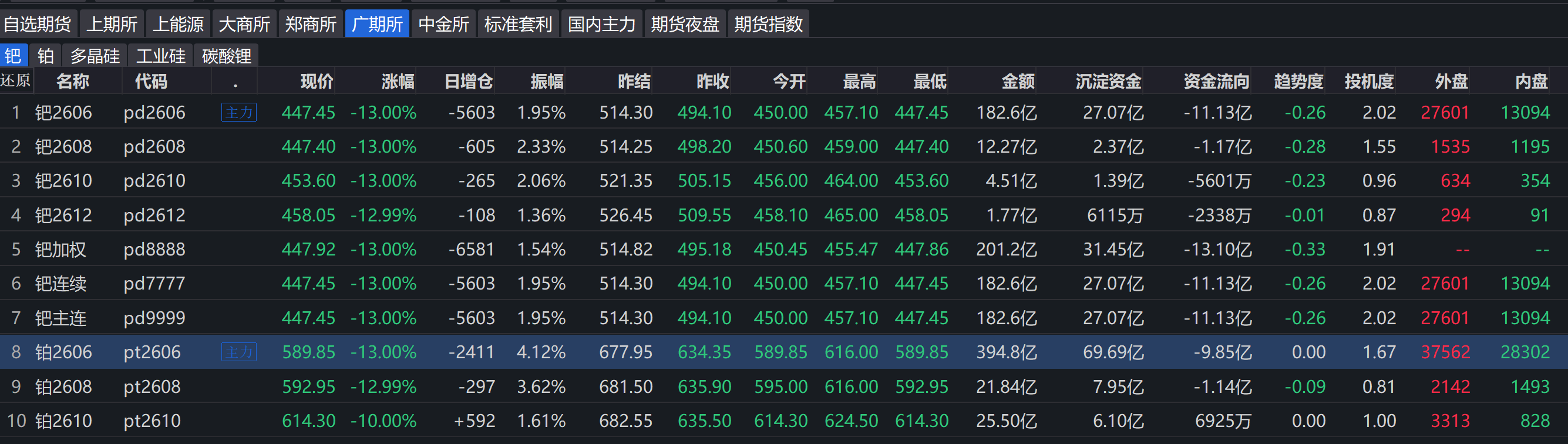
Core Viewpoint - The domestic futures market has experienced significant adjustments, particularly in platinum and palladium, which saw a sharp decline, reflecting short-term pressure on the precious metals market [1][4]. Group 1: Market Performance - On December 30, 2025, the main contracts for platinum and palladium on the Guangxi Futures Exchange hit the daily limit down, with declines of 13% each, marking them as the largest losers in the domestic futures market [1][2]. - Internationally, platinum prices fell by 13.71% and palladium by 15.76% overnight [1]. - Year-to-date, NYMEX platinum futures have increased by 140%, with a volatility of 187.91%, while palladium has risen by 82.85% with a volatility of 138.37% [3][5]. Group 2: Market Dynamics - The recent price surge in platinum and palladium is attributed to a combination of supply constraints, awakened investment demand, and long-term growth expectations, particularly in the Chinese market [6]. - Retail investment demand for platinum has reached historical highs, driven by its perceived value compared to gold and its role in hedging against inflation [6]. - The recent sharp declines in prices are linked to regulatory measures that have increased trading costs and reduced speculative trading activity, leading to a liquidity crunch [9][10]. Group 3: Future Outlook - The global platinum market is expected to face a shortage of 26.4 tons in 2025, despite a 4% year-on-year decline in total demand [11][12]. - There are differing opinions on the outlook for platinum and palladium in 2026, with some analysts predicting strong price increases due to robust automotive demand, while others foresee potential oversupply due to changing market dynamics [13][14]. - Factors such as ongoing central bank gold purchases, persistent inflation, and low real interest rates may support precious metal prices, although industrial demand weakness poses significant downward pressure [14].

铂金暴涨172%远超白银,贵金属暴涨我们该怎么办?(周报327期)
Xin Lang Cai Jing· 2025-12-27 11:31
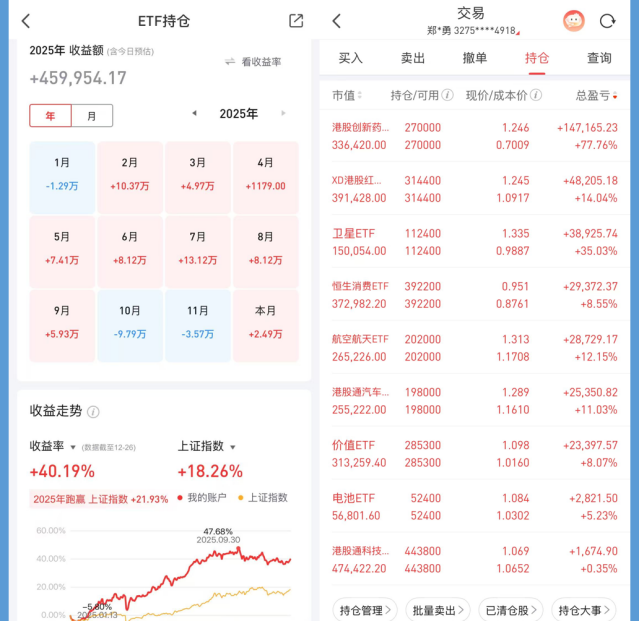
Core Viewpoint - The investment accounts managed by the company have shown a mixed performance this year, with a total profit of 1.9 million yuan, down from a peak of 2.3 million yuan earlier in the year, indicating a drawdown of 400,000 yuan [2][3]. Group 1: Account Performance - The total assets in the on-market ETF account amount to 2.6 million yuan, while the off-market fund account holds 5.4 million yuan, and the advisory portfolio has 1.2 million yuan [7]. - The on-market ETF account has a year-to-date profit of 460,000 yuan, with a current yield of 40.19% [5][6]. - The off-market fund account has a year-to-date profit of 1.338 million yuan, with a yield of 34.21% [15][16]. Group 2: Investment Strategy - The company has shifted its strategy by reducing its position in a value ETF by 100,000 yuan and reallocating that amount to the Hang Seng Consumer ETF, which has seen a decrease in floating profit from 11% to 8% [4]. - The rationale for this shift includes the belief that consumer valuations are at historical lows and that there will likely be consumption stimulus policies next year, which could improve industry sentiment [5]. - The core holdings in the on-market ETF account focus on Hong Kong stocks, with significant investments in sectors such as innovative pharmaceuticals, technology, and consumer goods [8][9]. Group 3: Market Trends - The recent downturn in the Hong Kong stock market has not changed the company's long-term investment logic, which emphasizes the valuation advantages of Hong Kong stocks compared to A-shares [10]. - The company has noted that the recent performance of aerospace and satellite ETFs has been strong, contributing significantly to this week's profits [11]. - The company adheres to a philosophy of avoiding high-risk investments and focusing on undervalued sectors for long-term gains [12]. Group 4: Precious Metals Market - The precious metals market has experienced significant price increases, with platinum prices rising over 172% year-to-date, driven by demand from the aerospace sector [24]. - The company had previously identified platinum as a valuable investment but missed the opportunity to invest heavily at lower prices [21][24]. - The company advises against chasing prices in the current market, emphasizing the importance of strategic investment rather than following trends [25].
2026年铂钯行情展望:双轮驱动:宏观暖意与现货矛盾下的铂钯机遇
Guo Tai Jun An Qi Huo· 2025-12-19 10:34
1. Report Industry Investment Rating No relevant content provided. 2. Core Viewpoints of the Report - In 2026, the elements in the trading logic of platinum and palladium are more numerous than before. The fundamental contradiction in the platinum and palladium spot market and the optimistic macro - loose environment will support the rise of platinum and palladium in the first half of the year. Platinum may have a higher increase than palladium due to better fundamentals and stronger financial attributes. In the second half, if the spot contradiction eases, prices may fall. If US tariffs are implemented, the global supply - chain pattern of platinum and palladium will be reshaped. The expected price range for platinum is $1500 - 2800 per ounce in US dollars and 380 - 730 yuan per gram in RMB; for palladium, it is $1200 - 2250 per ounce in US dollars and 300 - 590 yuan per gram in RMB [2]. - In 2026, it is recommended to focus on cross - market arbitrage opportunities caused by spot structural imbalances. Consider a long - platinum and short - palladium ratio strategy. For the medium - to long - term unilateral strategy, it is advisable to go long on platinum at low prices, and for short - term intraday or weekly bands, consider allocating palladium, that is, go long on palladium when it has a deep correction [3]. 3. Summary by Related Catalogs 3.1 2025 Platinum and Palladium Price Review 3.1.1 Platinum Price Logic Review - In 2025, platinum had a 93% increase by December 15. It broke through the 10 - year oscillation range, with macro - sentiment as the core catalyst and good fundamentals as the support. The price went through different stages including shock - building, explosive growth, callback - oscillation, and secondary growth [6]. 3.1.2 Palladium Price Operation - In 2025, palladium had a unique "oscillation - climbing and long - short game" market, with a 67% increase by December 15. The core driving logic was the triple game of macro - liquidity loosening, supply - demand structural contradiction, and industrial transformation pressure. In the first half, it oscillated, and in the second half, it rose significantly due to macro - liquidity changes and market - structure marginal changes [14]. 3.2 Macroeconomic Sentiment - In 2025, the global macro - environment was characterized by "loose - dominated, resilient growth, and co - existing differentiation". Major economies implemented loose policies, with the global GDP growth rate expected to be in the 2.7% - 3.4% range and inflation gradually falling to 3% - 4.2%. However, trade protectionism and policy uncertainties still posed potential pressures [20]. - In 2026, the global economy will slow down moderately, and the loose cycle will continue with significant differentiation. The attractiveness of anti - inflation assets such as precious metals is expected to increase. In 2025, platinum's price soared due to price - to - return advantages, supply - demand gaps, and growth - type demand, but it cannot truly replace gold due to core shortcomings in liquidity, stability, and lack of currency attributes [21][22]. 3.3 Supply Side in 2026 3.3.1 Primary Mineral Differentiation - South Africa's power supply has improved, but there are still local shortages. In 2026, mines and residents may face stepped power rationing. The production rhythm of core mining enterprises is stable, but there is no obvious growth momentum. The All - In Sustaining Costs (AISC) of core mining enterprises have soared, and Capital Expenditure (CAPEX) has decreased, which will drag down the realization of existing and new production capacities to some extent [26][33][39]. 3.3.2 Recycling Supply - Global platinum and palladium recycling enterprises have sufficient production - capacity reserves. Driven by high prices, they have a strong willingness to increase production. It is expected that in 2026, the global platinum and palladium recycling supply scale will increase significantly, with an expected incremental supply of 15 - 20 tons in China [46][47]. 3.3.3 Spot Structural Contradiction - Affected by the US 232 investigation and the anti - dumping and counter -vailing investigations on palladium, platinum and palladium inventories have been hoarded in the New York Mercantile Exchange (NYMEX), leading to frequent liquidity crises in the New York and London markets and violent fluctuations in the price spread between the two markets. Before the judgment results are announced in the first half of 2026, the spot structural imbalance will remain an "irreconcilable contradiction" [48][50][52]. 3.4 Demand Side in 2026 3.4.1 Hybrid Electric Vehicles Replace Traditional Energy Vehicles - The global automotive market is shifting towards new energy vehicles. It is expected that in 2026, the sales volume of pure - electric and hybrid vehicles will reach 26.1 million. Hybrid electric vehicles have a higher total platinum - palladium load than traditional fuel vehicles, which alleviates the decline in platinum - palladium demand. Globally, platinum demand in the automotive field is expected to increase by 0.91%, while palladium demand is expected to decrease by 0.06% [59][70][71]. 3.4.2 Industrial Demand - In the glass - fiber industry, China's new production capacity is expected to increase platinum demand by 3.3 tons in 2026. In the petrochemical industry, platinum demand has a moderate growth expectation. The promotion of fuel - cell vehicles is declining, and there is no hope of explosive growth in the short term. Overall, platinum and palladium industrial demand is expected to increase by 3% in 2026 [79][84][91]. 3.4.3 Jewelry Demand - China's platinum jewelry demand has declined for two consecutive years, and India has restricted platinum jewelry imports. It is expected that global platinum jewelry demand will decline by 10% in 2026, while palladium jewelry demand is expected to remain stable [92][94][95]. 3.4.4 Investment Demand - Platinum and palladium investment products are niche. In 2026, as prices rise in the first half, ETFs may continue to increase their holdings; when prices reach a high level, there may be profit - taking. It is expected that the investment demand for platinum and palladium will decline by 30% throughout the year [97][103][106]. 3.5 Conclusion and Investment Outlook - On the supply side, in 2026, the global platinum mineral supply is expected to remain stable or increase slightly, while the palladium mineral supply will be stable. The recycling supply will be the core incremental source, with an expected increase of 6 tons of platinum and 10 tons of palladium [107]. - On the demand side, there is significant differentiation. In the automotive exhaust - catalysis field, hybrid vehicles help stop the decline in platinum - palladium demand. In 2026, platinum will be in a tight - supply balance, and palladium will have a slight supply surplus [108][109]. - The platinum and palladium spot market has a significant structural contradiction, which will support price increases in the medium term. Key factors to track include the release of hidden inventories, price differentiation between platinum and palladium, and the change in investment sentiment [111].
国投期货品种手册(上市版):铂钯
Guo Tou Qi Huo· 2025-11-25 11:10
1. Report Industry Investment Rating No relevant content provided. 2. Core Viewpoints of the Report - Platinum and palladium are important precious metals with high demand in various industries, and their supply is highly concentrated, with significant supply - side impacts on prices. The supply - side factors such as production cuts, accidents, and disruptions in recycling channels can cause obvious price fluctuations [15]. - The demand for platinum and palladium is mainly in automotive catalysts, industry, jewelry, and medical fields. In the context of carbon neutrality and carbon peaking, the hydrogen energy industry is expected to become a new growth point for platinum and palladium consumption [37][47]. - China's platinum - group metal resources are extremely scarce, with a high degree of import dependence. The importance of the recycling end is increasing, but the supply of waste materials is tight, and domestic recycling enterprises face fierce competition [32][82]. 3. Summary According to the Directory 3.1 Platinum and Palladium Species Overview - **Natural Attributes**: Platinum and palladium are silver - white metals, belonging to the platinum - group metals (PGMs). Platinum has a crustal content of 0.005 ppm, and palladium has 0.0006 ppm. Platinum has high melting point, good ductility, and stable chemical properties. Palladium can adsorb gases, is corrosion - resistant, and is mainly used in the catalyst field [6][7][8]. - **Resource Distribution and Classification**: Platinum - group metal resources are mainly distributed in South Africa, Russia, the United States, and other regions. The deposits can be divided into primary deposits and exogenous sand deposits, with magma - related processes being the main formation mechanism [10][13]. 3.2 Platinum - Group Metal Industry Chain - **Upstream**: The upstream of the platinum - group metal industry chain is dominated by a few mining and smelting integrated producers. The "oligopoly" structure makes the supply side dominant in price. The mining and extraction of platinum - group metals involve exploration, mining development, ore extraction, processing, and refining [15][16]. - **Supply and Recycling of Platinum - Group Materials**: The separation and purification processes of platinum - group metals vary according to the raw material components. The recycling of platinum - group metals is becoming increasingly important, but the supply of waste materials is tight [19][32]. - **Terminal Applications**: Platinum and palladium are mainly used in automotive catalysts, jewelry, industry, medical, and other fields. Automotive catalysts are the largest consumer area, with platinum's consumption structure being more diversified and over 80% of palladium used in automotive catalysts [37]. - **Investment Channels**: Platinum investment channels include physical investment (platinum bars and coins), platinum ETFs, futures, forwards, and stocks. Palladium investment demand is relatively small [49][50]. 3.3 Global Platinum Supply - Demand Pattern - **Supply**: South Africa, Zimbabwe, and Russia are the main suppliers of global platinum. In 2024, South Africa's platinum output accounted for 71% of the global total. The global platinum output decreased in 2024 due to various factors such as power outages and company restructurings [55]. - **Demand**: The main consumers of global platinum are China, Europe, North America, and Japan. In 2024, the global platinum demand decreased by 1.6% to 198 tons, with a supply gap of 1.98 tons [65]. 3.4 Global Palladium Supply - Demand Pattern - **Supply**: Russia, South Africa, Canada, and the United States are the main suppliers of global palladium. In 2024, Russia and South Africa's palladium output accounted for 43% and 41% of the global total respectively. The global palladium output increased slightly in 2024 [69][71]. - **Demand**: The main consumers of global palladium are China, the United States, Europe, and Japan. In 2024, the global palladium demand decreased by 4% to 254.2 tons, with a supply surplus of 2.4 tons [73][77]. 3.5 China's Platinum - Group Resource Pattern - **Resource Endowment**: China's platinum - group metal resources are extremely scarce, mainly distributed in Gansu, Yunnan, and other regions. In 2022, China's platinum - group metal reserves were 80.9 tons, and the resource reserves are decreasing [82]. - **Import Dependence**: China's platinum and palladium resources have a high degree of import dependence. In 2024, China imported 104.1 tons of platinum and 28.1 tons of palladium [86][88][92]. - **Domestic Demand**: In 2024, China consumed 64.4 tons of platinum and 68.9 tons of palladium. The demand for platinum in the automotive catalyst and chemical industries decreased, while the demand for palladium in the automotive catalyst field decreased significantly [97][101]. - **Import and Export and Taxes**: The import tariffs and value - added taxes of platinum and palladium vary according to the processing state. China's platinum is mainly imported from South Africa, and palladium is mainly imported from Russia and South Africa [110][111][114]. 3.6 Platinum and Palladium Price Review No detailed price review content is provided in the text, only a mention of historical price trends. 3.7 Guangzhou Futures Exchange Platinum and Palladium Futures - **Contract Text**: On November 7, 2025, the GZFE issued announcements on the palladium futures and palladium options contracts and related rules [126]. - **Risk Control System**: No detailed content is provided in the text. 3.8 Platinum and Palladium Options - **Option Contracts**: No detailed content is provided in the text. - **Risk Control System**: No detailed content is provided in the text. 3.9 Delivery Business - **Delivery Time**: No detailed content is provided in the text. - **Delivery Product Form and Premium/Discount**: No detailed content is provided in the text. - **Delivery Unit**: No detailed content is provided in the text. - **Delivery Handling Fee**: No detailed content is provided in the text. - **Warehousing and Out - of - Warehouse Fees**: No detailed content is provided in the text. - **Physical Delivery Method**: No detailed content is provided in the text. - **Delivery Quality Standard**: No detailed content is provided in the text. - **Warehouse Standard Warehouse Receipt Delivery**: No detailed content is provided in the text. - **Factory Warehouse Standard Warehouse Receipt Delivery**: No detailed content is provided in the text. 3.10 Platinum and Palladium Delivery Areas, Factories, and Warehouses - **Platinum Futures Delivery Area Factories**: No detailed content is provided in the text. - **Palladium Futures Delivery Area Factories**: No detailed content is provided in the text. - **Platinum and Palladium Futures Delivery Warehouses**: No detailed content is provided in the text. 3.11 Platinum and Palladium Designated Quality Inspection Institutions and Inspection Fees - **Platinum and Palladium Futures Quality Inspection Institution List**: No detailed content is provided in the text. - **Maximum Limit of Platinum Futures Inspection Fees**: No detailed content is provided in the text. - **Maximum Limit of Palladium Futures Inspection Fees**: No detailed content is provided in the text. 3.12 Platinum and Palladium Delivery Brands - **List of Registered Brands for Platinum Futures (Domestic)**: No detailed content is provided in the text. - **List of Registered Brands for Platinum Futures (Overseas)**: No detailed content is provided in the text. - **List of Registered Brands for Palladium Futures (Domestic)**: No detailed content is provided in the text. - **List of Registered Brands for Palladium Futures (Overseas)**: No detailed content is provided in the text.
价格大涨!“黄金平替”卖爆了!有商家月销四五百公斤
新华网财经· 2025-07-05 01:23
Core Viewpoint - The platinum market is experiencing a significant resurgence, with prices surpassing 300 yuan per gram and a year-to-date increase of over 36%, outpacing gold's growth [1][10]. Group 1: Market Demand and Trends - In the first quarter, China's demand for platinum bars and coins reached nearly 1 ton, marking a 140% year-on-year increase, making it the largest retail platinum investment market globally, surpassing North America [1]. - As gold prices rise, many consumers are shifting towards purchasing platinum, leading to a supply shortage for certain platinum jewelry items [3][5]. - Sales of platinum jewelry have increased significantly, with one jewelry business reporting sales rising from 150-200 kg per month to potentially 400-500 kg during peak periods [5]. Group 2: Supply and Price Dynamics - The price of platinum futures recently exceeded $1300 per ounce, reaching a nearly five-year high, driven by strong demand and supply constraints [10]. - The supply of platinum is primarily from mining (80%) and recycling (20%), with over 70% of global production coming from South Africa, where production has declined, contributing to supply tightness [12]. - Financial factors, including geopolitical tensions and a weak dollar, have also supported platinum prices, as investors seek safe-haven assets [12]. Group 3: Investment Considerations - While platinum prices generally follow gold trends, the smaller market size and lower liquidity of platinum compared to gold present unique investment risks [13]. - Investors are advised to be cautious and consider the differences between platinum and gold, ensuring they purchase from reputable brands to guarantee product quality [13].
全球铂金投资需求一季度大增28%,中国市场买了1吨铂金条
Di Yi Cai Jing Zi Xun· 2025-05-22 11:31
Group 1 - The core viewpoint of the articles highlights a significant surge in platinum prices, driven by strong investment demand and changing consumer preferences, particularly in China [2][3]. - As of May 22, NYMEX platinum futures surpassed $1,089 per ounce, marking a nearly 10% increase over the week, with a notable rise in investment demand [2]. - The World Platinum Investment Council (WPIC) reports a projected 10% year-on-year increase in global platinum demand to 71 tons in Q1 2025, with investment demand in the platinum sector expected to rise by 28% to 14 tons [2][3]. Group 2 - In Q1 of this year, China's platinum investment demand surged, particularly for investment platinum bars under 500 grams, which saw a 140% year-on-year increase to 1 ton, establishing China as the largest retail investment market for platinum [2]. - Despite a record high in April imports of platinum to China at 11.5 tons, the total platinum imports for the year remain down 31% compared to the same period last year [2]. - The WPIC forecasts a 30% increase in global investment in platinum bars and coins to 8 tons by 2025, with a continued growth expectation of 15% in demand for platinum bars of 500 grams and above in China [3]. Group 3 - The global supply of platinum decreased by 10% to 45 tons in Q1, resulting in a 25-ton shortfall, primarily due to seasonal weakness in mine production [3]. - The WPIC anticipates a 4% year-on-year decline in total platinum supply for 2025, projecting it to be at its lowest level in five years at 218 tons [3]. - Speculative trading trends indicate a recent profit-taking phase, with non-commercial long positions in platinum futures decreasing from 45,800 to 43,000 contracts by mid-May [4].