10Y国开债

Search documents
债券研究周报:大行再度出手买长债-20260329
Guohai Securities· 2026-03-29 10:05
Report Information - Report Date: March 29, 2026 [1] - Analysts: Yan Ziqi, Hong Ziyan [2] - Report Title: Bond Research Weekly - Big Banks Step In to Buy Long - Term Bonds Again [3] Industry Investment Rating - Not provided in the report Core Views - This week, the performance of treasury bonds was remarkable. The yields of 10Y treasury bonds, 10Y China Development Bank bonds, and 30Y treasury bonds' active bonds decreased by 2.25bp, 0.6bp, and 1bp respectively. This was closely related to the actions of large - scale banks. Large - scale banks net - bought 51 billion yuan of 10Y treasury bonds this week, compared with a net - selling of 36 billion yuan in the previous week (March 16 - 20). If the current trend of large - scale banks buying bonds continues, there is still about a 2bp downward space for 10 - year treasury bonds, which may stabilize the market before the upcoming special treasury bond issuance plan [6][11]. - Insurance institutions sold a large amount of 30 - year treasury bonds this week but still increased their holdings of the active bond 2500006. They mainly net - sold three old bonds: 210005, 200012, and 190010, possibly for quarter - end statement adjustment and realizing floating profits [6][12]. - For the bond market approaching the quarter - end, the yield curve is likely to remain steep under the influence of inflation expectations. Therefore, investors' mainstream choice is medium - and short - duration coupon assets and cautious attitude towards ultra - long - term bonds. In the short term, this phenomenon will continue. Without a tightening signal from monetary policy, the yield curve is likely to be repaired from short - to long - term, and the next target may be 10Y China Development Bank bonds. For 30 - year treasury bonds, note that the liquidity of 2500002 has significantly improved recently. If the active bond is switched, 2500006 may weaken relatively, and investors can transfer part of their positions from 2500006 to 2500002 and 230023 [6][12]. Section Summaries This Week's Bond Market Review - The performance of treasury bonds was excellent this week. The yields of 10Y treasury bonds, 10Y China Development Bank bonds, and 30Y treasury bonds' active bonds decreased. The actions of large - scale banks were the main reason. Large - scale banks' net - buying of 10Y treasury bonds increased, and if the trend continues, 10 - year treasury bonds may have a 2bp downward space and play a role in stabilizing the market before the special treasury bond issuance [11]. - Insurance institutions sold a large amount of 30 - year treasury bonds but increased their holdings of the active bond 2500006, mainly net - selling three old bonds, possibly for quarter - end adjustment. The bond market yield curve is likely to remain steep, and investors prefer medium - and short - duration coupon assets and are cautious about ultra - long - term bonds. The yield curve may be repaired from short - to long - term, and the next target may be 10Y China Development Bank bonds. Attention should be paid to the liquidity change of 30 - year treasury bonds and the possible active bond switch [12].
机构行为周度跟踪 20260315:机构行为的视角,10Y 国开利差何时能压下去
GUOTAI HAITONG SECURITIES· 2026-03-18 03:05
Group 1: Market Overview - The bond market has shown some recovery this year, with the 10Y government bond yield decreasing from 1.8427% to 1.8143% (-2.84bp) and the 10Y government-backed bond yield falling from 1.9862% to 1.9646% (-2.16bp) [7] - The 10Y government-backed bond and government bond spread widened from 14.35bp to 15.03bp (+0.68bp), remaining at a historical high [7] - Institutional behavior indicates that the compression of the government-backed bond spread is constrained by large banks selling pressure, unstable support from smaller banks, and strong trading activity from funds [7] Group 2: Institutional Behavior - Large banks have net bought approximately 246.5 billion yuan in government bonds and net sold about 139.2 billion yuan in government-backed bonds, creating a cumulative preference gap of -385.8 billion yuan [10] - Smaller banks have net sold about 162.6 billion yuan in government bonds while net buying approximately 34.3 billion yuan in government-backed bonds, indicating a temporary support for the government-backed bond market [10] - Funds have shown a slight net sell of about 34 million yuan in 7-10Y government-backed bonds and a significant net sell of approximately 481 million yuan in 7-10Y government bonds, failing to create sustained allocation to long-term interest rate bonds [14] Group 3: Future Outlook - The ability of the 10Y government-backed bond spread to compress will depend on the supply strength and continuity of support from the government-backed bond market [18] - Historical spread percentiles have decreased significantly, indicating that the spread may enter a "repairable" range, but the 10Y spread remains sensitive to marginal forces [18] - If large banks' selling pressure on government-backed bonds decreases and smaller banks provide more consistent support, the 10Y government-backed bond spread may shift from "dull and repetitive" to a trend of compression [18]
机构行为周度跟踪 20260315:机构行为的视角,10Y 国开利差何时能压下去-20260318
GUOTAI HAITONG SECURITIES· 2026-03-18 02:00
Group 1 - The report indicates that the 10Y National Development Bank (NDB) yield spread is currently under pressure due to large banks selling, unstable support from smaller banks, and strong trading behavior from funds [1][7][10] - Since the beginning of the year (January 4 to March 13), the bond market has shown some recovery, with the 10Y government bond yield decreasing from 1.8427% to 1.8143% (-2.84bp) and the 10Y NDB yield falling from 1.9862% to 1.9646% (-2.16bp), yet the yield spread has widened from 14.35bp to 15.03bp (+0.68bp) [7][10] - The behavior of large banks has been characterized by a preference for buying government bonds while selling policy financial bonds, resulting in a net purchase of approximately 246.5 billion yuan in government bonds and a net sale of about 139.2 billion yuan in policy financial bonds [10][14] Group 2 - The report highlights that the funds have shown a slight net sell of about 34 million yuan in 7-10Y policy financial bonds and a significant net sell of approximately 481 million yuan in 7-10Y government bonds, indicating a lack of sustained allocation to long-term interest rate bonds [14][15] - The report notes that the incremental funds have been concentrated in credit bonds, with net purchases of about 213.2 billion yuan in 3-5Y "other" bonds and approximately 148.5 billion yuan in 1-3Y medium-term notes, reflecting a defensive strategy overall [14][15] - The historical spread data shows that the yield spread has significantly retreated from its peak, indicating that the overall spread may be entering a "repairable" range, although the 10Y spread remains relatively high and sensitive to marginal forces [18][21] Group 3 - In the primary market, the report mentions that the marginal multiples for policy financial bonds have decreased, with the overall multiples and the spread between primary and secondary markets showing differentiation [30][31] - The report indicates that in the secondary market, large banks and smaller banks have shifted to increasing their allocations, while funds and securities companies have predominantly reduced their allocations [41][42] - The report also notes that the trading activity in the current bond market has increased, with significant buying from smaller banks in the long-end and super long-end bonds, while large banks and securities companies have been major sellers [41][42]
机构行为周度跟踪 20260118:关注 30Y 国债借入量大超季节性-20260120
GUOTAI HAITONG SECURITIES· 2026-01-20 09:28
Group 1 - The report highlights a significant increase in the borrowing volume of 30Y government bonds over the past 30 trading days, with a year-on-year growth of 133% to 278% for active and secondary active bonds, indicating a strong demand for long-term bonds as a hedging and position adjustment tool in a volatile market [7][8][10] - The borrowing volume of 10Y government bonds showed a pattern of "year-end increase, early-year decline," with a year-on-year increase of 135.34% in December, followed by a decline of 22.54% in January, suggesting a cooling demand for mid-term bonds [10][12] Group 2 - In the funding market, there is a trend of expanding borrowing and contracting lending, with an overall decrease in leverage ratios across institutions, while overnight trading ratios have increased [14][15] - The primary market for government and policy financial bonds has shown mixed performance, with variations in bidding multiples and spreads between primary and secondary markets [19][20] Group 3 - The secondary market has seen active trading, particularly in 30Y government bonds, with a notable increase in turnover rates, while trading behaviors among different types of institutions have diverged [25][26] - Large banks have shifted to net buying in the interbank certificate of deposit market, while securities companies have significantly increased net selling [27][29]
中美将迎来新一轮经贸磋商:利率周报(2025.10.13-2025.10.19)-20251021
Hua Yuan Zheng Quan· 2025-10-21 11:06
Report Industry Investment Rating No industry investment rating is provided in the report. Report Core Viewpoints - In October, the escalation of Sino-US trade frictions led to increased volatility in global risk assets. The market is waiting for the implementation of tariffs, but the impact may be controllable. After the Sino-US high - level video call on October 18th to restart consultations and the expected APEC summit at the end of October, the short - term emotional pressure on policy gaming may ease, but potential risks such as the results of Sino - US economic and trade consultations and the pressure on China's economic data need attention. The Fed may cut interest rates by 25BP in October, significantly alleviating the inverted Sino - US interest rate spread and opening up room for further loosening of China's monetary policy [2][10][85]. - The domestic economic recovery momentum is weak. Consumption and exports may face pressure. The National Day holiday consumption data shows "volume increase but price slowdown", indicating weak consumer willingness, and the export growth rate in Q4 this year may face pressure [10]. - The current bond market has prominent allocation value, and bond yields may fluctuate downward. The report is bullish on the bond market in October. Considering the domestic fundamentals and external environment, the domestic policy interest rate may be cut by 10 - 20BP in Q4. The preferred bonds for attack are 10Y China Development Bank bonds, 30Y treasury bonds, and 5Y capital bonds. It is predicted that the yield of 10Y treasury bonds will return to around 1.65%, 30Y treasury bonds to 1.9%, and 5Y large - bank secondary capital bonds to 1.9% [4][11][85]. Summary by Directory 1. Macro News - In the first three quarters of 2025, the cumulative increase in social financing scale was 30.09 trillion yuan, 4.42 trillion yuan more than the same period last year. At the end of September, the stock of social financing scale was 437.08 trillion yuan, a year - on - year increase of 8.7%. The net cash injection in the first three quarters was 761.9 billion yuan. At the end of September, the M2 balance was 335.38 trillion yuan, a year - on - year increase of 8.4%, M1 was 113.15 trillion yuan, a year - on - year increase of 7.2%, and M0 was 13.58 trillion yuan, a year - on - year increase of 11.5%. The increase in RMB deposits in the first three quarters was 22.71 trillion yuan, and the balance at the end of September was 324.94 trillion yuan, a year - on - year increase of 8%. The increase in RMB loans in the first three quarters was 14.75 trillion yuan, and the balance at the end of the month was 270.39 trillion yuan, a year - on - year increase of 6.6% [12]. - In September, the CPI was - 0.3% year - on - year, an increase of 0.1 pct from the previous month, mainly dragged down by food and energy prices, and 0.1% month - on - month, an increase of 0.1 pct from the previous month. The year - on - year increase in core CPI expanded to 1.0% in September. The year - on - year decline in PPI narrowed to 2.3% in September, an increase of 0.6 pct from the previous month, and remained flat month - on - month [16]. - In the first three quarters of this year, China's total goods trade imports and exports were 33.61 trillion yuan, a year - on - year increase of 4%. Exports were 19.95 trillion yuan, a year - on - year increase of 7.1%, and imports were 13.66 trillion yuan, a year - on - year decrease of 0.2%. The imports and exports to countries along the "Belt and Road" were 17.37 trillion yuan, a year - on - year increase of 6.2%, accounting for 51.7% of the total imports and exports [21]. - On October 18th, Sino - US economic and trade leaders held a video call and agreed to hold a new round of Sino - US economic and trade consultations as soon as possible [23]. 2. Medium - term High - frequency Data 2.1 Consumption - As of October 12th, the daily average retail volume of passenger car manufacturers increased by 6.7% year - on - year, and the daily average wholesale volume decreased by 0.5% year - on - year. As of October 17th, the total box office revenue of national movies in the past 7 days decreased by 27.3% year - on - year. As of October 10th, the total retail volume of three major household appliances increased by 44.2% year - on - year, and the total retail sales increased by 36.4% year - on - year [24][26]. 2.2 Transportation - As of October 12th, the container throughput of ports increased by 3.4% year - on - year. As of October 17th, the average subway passenger volume in first - tier cities in the past 7 days increased by 2.3% year - on - year. As of October 12th, the postal express pick - up volume decreased by 0.7% year - on - year, and the delivery volume decreased by 5.1% year - on - year. The railway freight volume decreased by 0.2% year - on - year, and the highway truck traffic volume decreased by 15.9% year - on - year [28][35][37]. 2.3 Industrial Operating Rates - As of October 15th, the blast furnace operating rate of major steel enterprises was 78.1%, a year - on - year increase of 2.2 pct. As of October 16th, the average asphalt operating rate remained the same year - on - year, the soda ash operating rate was 84.9%, a year - on - year decrease of 2.5 pct, and the PVC operating rate was 75.6%, a year - on - year decrease of 1.8 pct. As of October 17th, the average PX operating rate was 88.5%, and the average PTA operating rate was 75.5% [42][46]. 2.4 Real Estate - As of October 17th, the total commercial housing transaction area in 30 large and medium - sized cities in the past 7 days decreased by 10.9% year - on - year. As of October 10th, the second - hand housing transaction area in 9 sample cities decreased by 43.6% year - on - year [50][51]. 2.5 Prices - As of October 17th, the average wholesale price of pork decreased by 26.9% year - on - year and 8.3% compared with four weeks ago. The average wholesale price of vegetables decreased by 14.9% year - on - year and 1.4% compared with four weeks ago. The average wholesale price of 6 key fruits decreased by 3.5% year - on - year and increased by 3.1% compared with four weeks ago. The average price of thermal coal at northern ports decreased by 18.3% year - on - year and increased by 3.4% compared with four weeks ago. The average spot price of WTI crude oil decreased by 19.1% year - on - year and 7.7% compared with four weeks ago. The average spot price of rebar decreased by 12.0% year - on - year and 0.6% compared with four weeks ago. The average spot price of iron ore remained flat year - on - year and decreased by 0.8% compared with four weeks ago [53][57][62]. 3. Bond and Foreign Exchange Markets - On October 17th, overnight Shibor and some short - term interest rates showed small fluctuations. Most treasury bond yields increased. The yields of 1 - year, 5 - year, 10 - year, and 30 - year treasury bonds were 1.47%, 1.59%, 1.83%, and 2.20% respectively, with increases of 10.1BP, 0.7BP, 0.4BP, and - 3.2BP compared with October 11th. The yields of 1 - year, 5 - year, 10 - year, and 30 - year China Development Bank bonds were 1.62%, 1.78%, 1.99%, and 2.35% respectively, with changes of + 1.1BP, + 1.0BP, - 0.9BP, and - 0.6BP compared with October 11th. The yields of 1 - year, 5 - year, and 10 - year local government bonds were 1.49%, 1.81%, and 2.02% respectively, with decreases of 4.1BP, 1.8BP, and 3.5BP compared with October 10th. The yields of AAA 1 - month and 1 - year, AA + 1 - month and 1 - year inter - bank certificates of deposit increased compared with October 11th. The yields of 10 - year treasury bonds in the US, Japan, the UK, and Germany decreased compared with October 10th. The central parity rate and spot exchange rate of the US dollar against the RMB changed compared with October 10th [65][69][73]. 4. Institutional Behavior - The duration of medium - and long - term pure bond funds for interest - rate bonds and credit bonds showed a slight upward trend this week. On October 17th, the estimated average duration of interest - rate bond funds was around 5.0 years, and the median was around 4.6 years, an increase of about 0.1 year compared with October 10th. The estimated average duration of credit bond funds was around 2.7 years, and the median was around 2.7 years, an increase of about 0.1 year compared with October 10th [82][83]. 5. Investment Recommendations - The report is bullish on the bond market. The preferred bonds for attack are 10Y China Development Bank bonds, 30Y treasury bonds, and 5Y capital bonds. It is predicted that the yield of 10Y treasury bonds will return to around 1.65%, 30Y treasury bonds to 1.9%, and 5Y large - bank secondary capital bonds to 1.9% [4][11][85].
利率债切券策略初探:固定收益点评
Guohai Securities· 2025-10-17 10:51
Group 1 - The report addresses key issues such as analyzing the yield spread between new and old bonds from the perspective of 30Y, 10Y government bonds, and 10Y policy bank bonds, as well as evaluating current trading opportunities for specific bonds [5][13] - The switching of active bonds is influenced by issuance plans, with the scale determining the active status for government bonds, while policy bank bonds rely more on market institutions' behaviors and preferences [5][6] - The new and old bond yield spread exhibits a cyclical pattern of "widening-convergence," where the spread typically widens after a new bond is issued and narrows as liquidity premiums are realized and new bonds are issued [5][14] Group 2 - For 30Y government bonds, the trading focus may remain on the larger scale bond 2500002.IB, while the trading opportunity for the new bond 2500006.IB may be limited due to its yield inversion with the active bond [5][25] - In the case of 10Y government bonds, if the fund redemption fee reform is implemented, the market attention may shift towards this bond type, with the new bond 250016.IB having the potential to become an active bond [31][35] - The 10Y policy bank bonds also show a similar pattern to government bonds, with the yield spread typically widening and then converging after switching, but the opportunities depend more on market sentiment and liquidity changes due to the lack of transparent issuance plans [43][47] Group 3 - The report suggests that investors should focus on structural opportunities, particularly monitoring the transition of 250016.IB to an active bond, especially in the context of potentially increased demand for self-managed bank allocations [48]

从三个细节谈起,债券调整到位了吗?:债市机构行为周报(9月第4周)-20250929
Guohai Securities· 2025-09-29 14:32
Group 1: Report Overview - The report is the Bond Research Weekly for the 4th week of September 2025, focusing on bond market analysis from the perspective of institutional behavior [2][9] Group 2: Investment Rating - Not provided in the report Group 3: Core Viewpoints - The behavior of funds is crucial in the bond market, with their net purchases strongly correlated with interest rate trends. The instability of funds' liability side has increased due to the new sales fee regulations, and the impact of the regulations' implementation should be closely monitored [4][15] - The three institutional behavior changes (funds having nothing left to sell, brokerages closing short positions, and banks "picking up bargains") are favorable for the bond market. Future interest rates may decline due to funds repurchasing bonds, banks increasing allocations, and brokerages closing positions. Currently, interest rate products have a higher probability of success than Tier 2 and credit bonds [4][15] Group 4: Summary by Directory 1. Re - examination after Interest Rate Breakthrough 1.1 Three Changes in Institutional Behavior and Future Outlook - Funds are "sold out": Since Q3, funds have continuously reduced duration. As of September 26, 2025, the median duration of medium - and long - term bond funds (including leverage) dropped to 2.8 years, and the cumulative net purchase of ultra - long treasury bonds (over 10Y) by funds has been negative since early September [3][9] - Brokerages are closing short positions: The borrowing volume of the top three active 10Y treasury bonds remains volatile, while that of 10Y CDB bonds has decreased, indicating brokerage short - position closing before the holiday [10] - Banks are "picking up bargains": Since August, joint - stock banks have continuously bought old 10Y treasury bonds, acting as a "buffer" during the bond market correction. Recently, Tier 2 and perpetual bonds have corrected rapidly, and funds are selling Tier 2 bonds more aggressively [3][14] 1.2 Yield Curve - Treasury bond yields generally increased. On a week - on - week basis, the 1Y yield decreased by 1bp, the 3Y yield increased by 3bp, the 5Y yield changed less than 1bp, the 7Y yield increased by 1bp, the 10Y yield changed less than 1bp, the 15Y yield increased by 1.5bp, and the 30Y yield increased by 2bp. In terms of percentiles, the 1Y dropped to the 10% percentile, and others had various percentile changes [16][18] - CDB bond yields also generally increased. The 1Y yield decreased by 0.5bp, the 3Y yield increased by 2bp, the 5Y yield increased by about 2.3bp, the 7Y yield increased by 4.6bp, the 10Y yield increased by 1.1bp, the 15Y yield increased by about 4.6bp, and the 30Y yield increased by 4.9bp. Percentiles also had corresponding changes [18] 1.3 Term Spread - The spread between treasury bonds and CDB bonds (1Y - DR001, 1Y - DR007) showed a differentiated trend, and the term spread generally widened [19] 2. Bond Market Leverage and Funding Situation 2.1 Leverage Ratio - From September 22 to September 26, 2025, the leverage ratio fluctuated and decreased. As of September 26, it was about 107.06%, up 0.32pct from last Friday and down 0.04pct from Monday [23] 2.2 Repurchase Transactions - From September 22 to September 26, the average daily trading volume of pledged repurchase was about 7.3 trillion yuan, up 0.1 trillion yuan from last week. The average daily trading volume of overnight pledged repurchase was 5.55 trillion yuan, down 0.72 trillion yuan month - on - month. The average overnight trading volume ratio was 75.72%, down 11.92pct month - on - month [27][28] 2.3 Funding Situation - From September 22 to September 26, bank - based fund lending first increased and then decreased. On September 26, the net lending of large and policy banks was 4.09 trillion yuan, and joint - stock, city, and rural commercial banks had a net borrowing of 0.28 trillion yuan. The main fund borrowers were brokerages, and money market funds' lending decreased. DR007, R007, 1YFR007, and 5YFR007 all fluctuated and increased, with different changes compared to last Friday [30] 3. Duration of Medium - and Long - Term Bond Funds 3.1 Overall Duration - From September 22 to September 26, the median duration of medium - and long - term bond funds was 2.68 years (de - leveraged) and 2.79 years (including leverage). On September 26, the median duration (de - leveraged) remained unchanged from last Friday, and the median duration (including leverage) decreased by 0.01 year [41] 3.2 Duration by Bond Fund Type - As of September 26, the median duration of interest - rate bond funds (including leverage) dropped to 3.53 years, down 0.01 year from last Friday; the median duration of credit bond funds (including leverage) dropped to 2.52 years, up 0.01 year from last Friday. The de - leveraged durations also had corresponding changes [44] 4. Category Strategy Comparison - As of September 26, the Sino - US spread generally narrowed, and the implied tax rate (10Y CDB - treasury bond spread) narrowed at the short end and widened at the medium - and long - ends [48] 5. Bond Lending Balance Changes - On September 26, the lending concentration of active 10Y treasury bonds and 10Y CDB bonds increased, that of secondary active 10Y CDB bonds and active 30Y treasury bonds decreased, and that of secondary active 10Y treasury bonds remained unchanged. Except for brokerages, all other institutional lending concentrations increased [50]
机构继续看多债市,本轮债市调整以来平安公司债ETF(511030)净值相对稳健且回撤可控
Sou Hu Cai Jing· 2025-08-26 07:00
Group 1 - The core viewpoint indicates that the stock market has decoupled from the bond market, with a continued bullish outlook on bonds [1] - The overall profit growth rate for all A-shares in the first half of 2025 has not improved compared to the first quarter, with revenue growth remaining sluggish [1] - Since September 24, 2024, the current stock bull market has lasted nearly one year, with the All A Index doubling in value [1] Group 2 - The bond market has seen a net issuance of 14.3 trillion yuan in the first seven months of this year, with banks increasing their bond investments significantly [1] - The stock bull market has not impacted the total deposits in the banking system, indicating a structural shift in financing needs [1] - The convertible bond index is nearing historical highs, suggesting a cautious optimism for convertible bonds, with future attention on stock market changes and approval for new convertible bond issuances [2] Group 3 - The recommendation is to cherish yields above 2% for 30-year government bonds and 5-year capital bonds, as there may be opportunities to approach 1.6% for 10-year government bonds in the coming months [2] - The recent performance of the Ping An Company Bond ETF (511030) has shown the best control over drawdowns, indicating relative stability and manageable risk [2]
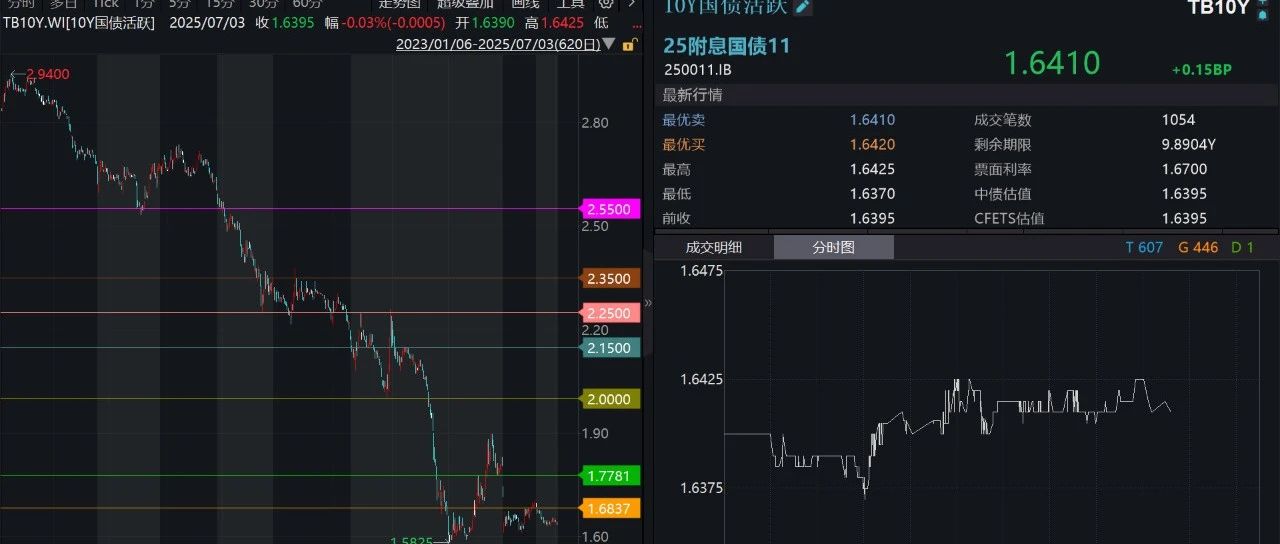
【笔记20250704— 30Y国债成“顶流”】
债券笔记· 2025-07-04 10:52
Core Viewpoint - The article emphasizes that trends are accelerated by news stimuli rather than changed, indicating that current market movements are aligned with broader trends [1]. Group 1: Market Conditions - The central bank conducted a 340 billion yuan reverse repurchase operation, with 5,259 billion yuan of reverse repos maturing today, resulting in a net withdrawal of 4,919 billion yuan [2]. - The funding environment remains balanced and loose, with the DR001 rate around 1.31% and DR007 at approximately 1.42% [3]. - The interbank funding rates show a slight decline, with R001 at 1.36% (down 1 basis point) and R007 at 1.49% (up 97 basis points) [4]. Group 2: Bond Market Dynamics - The bond market sentiment is stable, with the 10-year government bond yield fluctuating around 1.64% after opening flat [5]. - Despite rumors of regulatory investigations into short-term bond funds buying long-term government bonds, market enthusiasm remains high, with the 30-year government bond becoming the most active [6]. - The 30-year government bond recorded over 1,300 transactions, while the 10-year government bonds saw over 1,000 transactions, indicating a shift in investor preference towards ultra-long bonds [6].

国泰海通|固收:交易盘做多情绪已浓
国泰海通证券研究· 2025-06-18 15:25
Group 1: Core Insights - The report indicates a significant increase in net buying of 7-10 year long-term bonds and bonds over 10 years, with weekly net buying intensity reaching the second highest and highest levels of the year respectively [1] - The overall funding market has warmed up, with both net inflow and outflow amounts rising, and an increase in the leverage ratio in the interbank bond market [2] - The secondary market shows improved activity, particularly in ultra-long bonds, with a rise in turnover rates for 30-year government bonds and an increase in average duration for medium to long-term pure bond funds [3] Group 2: Market Dynamics - In the primary market, there was a noticeable "marginal" sentiment, with an increase in the issuance of government bonds and a rise in the bid-to-cover ratio for government bonds, while the ratio for policy financial bonds decreased [2] - Major institutional behaviors indicate that funds are aggressively allocating to long-term and ultra-long-term bonds, while rural commercial banks are selling off across all maturities, particularly in the 7-10 year and over 10-year segments [3] - The scale of wealth management products in June did not show the typical seasonal decline, with a slight overall decrease in the week of June 15, while fund sizes increased significantly compared to previous months [4]