
Alpamayo模型

Search documents
英伟达开源模型助力智能驾驶产业发展,智能驾驶ETF(516520)2026年以来累计吸金5.42亿元!
Xin Lang Cai Jing· 2026-01-14 05:31
Group 1 - The smart driving sector has been active since 2026, driven by favorable policies, technology advancements, and cost reductions, despite a recent pullback on January 13, 2026 [1][6] - The smart driving ETF (516520) has seen a net inflow of 542 million yuan over the past seven trading days, reaching a total fund size of 1.24 billion yuan and 898 million shares [1][6] - The L3-level autonomous driving regulations are gradually being implemented, hardware costs are decreasing, and the commercialization of Robotaxi is progressing, contributing to the growth of the sector [1][6] Group 2 - NVIDIA's release of the open-source AI model Alpamayo at CES 2026 aims to enhance decision-making capabilities in complex scenarios for autonomous driving systems, potentially lowering R&D costs for L4-level technologies [1][2][7] - The Alpamayo model reflects NVIDIA's "soft and hard integration" strategy, which enhances the value of solutions and promotes hardware iteration [2][7] - The smart driving ETF closely tracks the CSI Smart Car Theme Index, which includes companies involved in terminal perception and platform applications, with significant representation from automotive parts (24.0%), semiconductors (19.6%), and passenger vehicles (14.4%) [3][8] Group 3 - The fund manager of the smart driving ETF, Huatai-PB Fund, is one of the first ETF managers in China, having launched the largest ETF in the A-share market, the Huatai-PB CSI 300 ETF, which has a current size of 434.2 billion yuan [3][8] - The Huatai-PB CSI 300 ETF will implement a cash dividend of 1.23 yuan per 10 fund shares, with a total dividend amount expected to approach 11 billion yuan, potentially setting a record for single dividends in domestic ETFs [4][9]

黄仁勋的Agentic AI,闯入全球市值最高药厂
Sou Hu Cai Jing· 2026-01-13 08:03
Core Insights - Nvidia plans to collaborate with Eli Lilly to invest $1 billion in a joint AI lab aimed at transforming the healthcare sector through advanced AI technologies [3][25] - The focus of the collaboration is to address the global shortage of healthcare professionals by deploying AI agents in the medical field, with a significant emphasis on the rapid adoption of AI in healthcare compared to other industries [5][12] - Nvidia's CEO highlighted the importance of physical AI and its impact on the pharmaceutical industry, with advancements in AI models and robotics enhancing laboratory automation and drug development processes [6][10] Group 1: Collaboration and Investment - Nvidia and Eli Lilly will establish a joint AI lab with a $1 billion investment to integrate top scientists and AI researchers [3][25] - The partnership aims to accelerate drug discovery and laboratory automation, shifting the current model from 90% wet lab work to a more balanced approach with increased computational methods [25][29] Group 2: AI in Healthcare - The healthcare sector is experiencing unprecedented speed in the deployment of technology, with AI expected to play a crucial role in addressing the projected shortage of millions of healthcare workers by 2030 [12][11] - Nvidia's AI models and tools are being utilized to enhance clinical workflows, allowing healthcare professionals to save significant time and improve patient care [13][31] Group 3: Technological Advancements - Nvidia's advancements in AI, such as the Cosmos model and Isaac robotics platform, are designed to improve laboratory efficiency and quality control in drug manufacturing [6][19] - The company is also focusing on open-source models and tools to democratize access to AI technologies, enabling a wider range of companies to innovate in the healthcare space [9][22] Group 4: Future Outlook - The emergence of AI scientists and agents is expected to revolutionize the pharmaceutical industry, with a projected $300 billion market for drug development being reshaped by these technologies [18][25] - Nvidia's collaboration with Eli Lilly is seen as a pivotal moment in the integration of AI into scientific research, potentially leading to breakthroughs in drug discovery and development [25][28]


行业周报:英伟达开源Alpamayo,禾赛加入“朋友圈”-20260111
KAIYUAN SECURITIES· 2026-01-11 10:44
Investment Rating - The industry investment rating is "Overweight" [1] Core Insights - The report highlights significant advancements in the automotive and autonomous driving sectors, particularly with NVIDIA's release of the Alpamayo model and its strategic shift towards becoming a full-stack autonomous driving ecosystem leader [5][18] - The semiconductor industry is witnessing consolidation, with Huahong Semiconductor planning to acquire a majority stake in Huali Micro, which is expected to enhance long-term capacity and technology collaboration [6][24] Automotive & Autonomous Driving - NVIDIA has introduced the Alpamayo model, a reasoning-capable end-to-end autonomous driving AI, which utilizes the Cosmos world model for training and simulation, addressing the scarcity of real-world data [14][21] - The company is implementing a global deployment plan with Mercedes-Benz as a key partner, aiming to create an inclusive open business ecosystem [21] - Hesai Technology plans to double its production capacity for lidar sensors from 2 million units in 2025 to 4 million units in 2026, with a new factory in Bangkok expected to start production in early 2027 [21][22] Electronics - Huahong Semiconductor's acquisition of a 97.4988% stake in Huali Micro for a total consideration of 8.27 billion yuan is aimed at expanding production capacity, adding 38,000 wafers per month in 65/55nm and 40nm processes [6][26] - The acquisition is part of a broader strategy to enhance technology and production capabilities in the semiconductor sector [24][27] Weekly Data Update - The Hang Seng Technology Index and the Hang Seng Index experienced slight declines of 0.9% and 0.4% respectively, while the electronics index rose by 4.0% [6][28] - The report notes a significant increase in net buying through the Hong Kong Stock Connect, amounting to 29.32 billion yuan, indicating strong investor interest [28][37] Investment Recommendations - In the automotive and autonomous driving sector, companies such as Pony.ai, Horizon Robotics, and XPeng Motors are recommended as beneficiaries of the advancements in AI and autonomous driving technologies [7][36] - For the electronics sector, the report suggests focusing on companies like Samsung, SK Hynix, and Micron, which are expected to benefit from rising NAND and DRAM prices [7][39]
两大投行:英伟达将是2026最强AI概念股
3 6 Ke· 2026-01-08 03:02
Core Viewpoint - Nvidia is recognized as the strongest AI stock for 2026 by major Wall Street firms following CEO Jensen Huang's keynote at CES 2026 [1][2]. Group 1: Analyst Insights - Bank of America Securities analyst Vivek Arya reiterated a buy rating with a target price of $275, emphasizing strong demand for AI computing and the efficiency improvements in AI systems [2][3]. - Arya highlighted the significance of Nvidia's upcoming AI superchip platform, Vera Rubin, which is set to launch in the second half of 2026 and will include new AI chips and enhanced memory configurations [2][3]. - Evercore ISI analyst Mark Lipacis assigned an "outperform" rating with a target price of $352, noting Nvidia's advantageous position in the AI boom due to the shift towards parallel processing [4]. Group 2: Market Position and Future Outlook - Nvidia's extensive ecosystem allows for compatibility with various AI models, enabling clients to reduce costs as AI tools evolve, potentially capturing 70% to 80% of the AI industry's value [4]. - The expansion of AI applications from language models to practical uses like autonomous driving is expected to drive further demand over time [3].
黄仁勋2026第一场演讲,点赞中国3个大模型
3 6 Ke· 2026-01-07 03:24
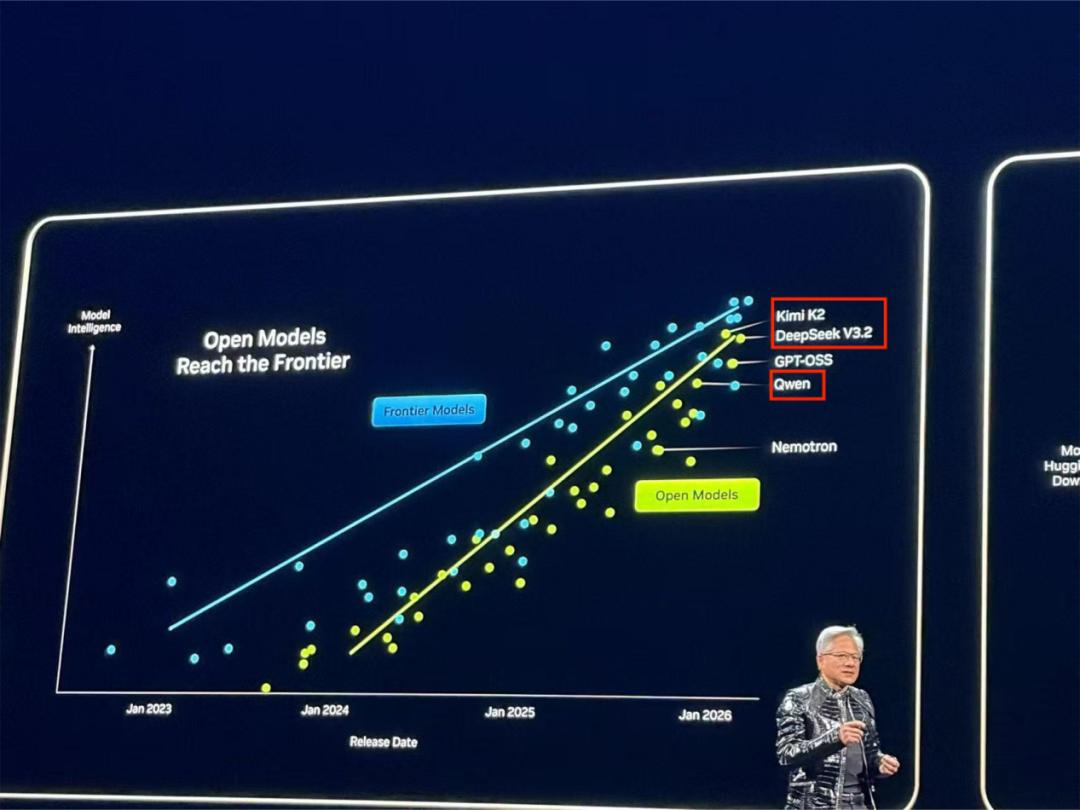
Core Insights - NVIDIA's CEO Jensen Huang emphasized the shift towards physical AI during his keynote at CES, moving away from consumer graphics cards to focus on advancements in AI technology [1][2] Group 1: AI Industry Developments - Huang highlighted the significant impact of open-source models on the AI industry, stating that they have become a catalyst for global innovation [2] - The emergence of the DeepSeek R1 model has notably accelerated industry transformation, surprising many in the field [2] - Open-source models are rapidly approaching top-tier performance, with a current gap of about six months compared to proprietary models, which is gradually narrowing [4] Group 2: NVIDIA's Innovations - NVIDIA introduced a comprehensive open-source model matrix covering six key areas, including agent AI, physical AI, autonomous driving, and robotics [5] - Huang defined physical AI as the fourth stage of AI development, capable of understanding physical causality in the real world, marking a transition from digital to physical applications [8] - The company launched the Alpamayo model, the world's first open-source autonomous driving inference model, which competes directly with Tesla's Full Self-Driving (FSD) technology [8] Group 3: Technical Advancements - The new Vera Rubin architecture was unveiled, named after astronomer Vera Rubin, and is designed to overcome limitations posed by the slowing of Moore's Law [11][13] - Rubin architecture features six chips working collaboratively, achieving a performance of 50 PFLOPS for inference tasks, which is five times that of the previous Blackwell architecture [13] - The cost of inference using Rubin has decreased by ten times, allowing for faster training and lower latency in decision-making processes [15] Group 4: Future Outlook - Huang expressed confidence that a significant portion of vehicles will be highly autonomous within the next decade [9] - The convergence of open-source model advancements, breakthroughs in physical AI, and the introduction of the Rubin architecture is expected to reshape industries and daily life [17]
美股盘前要点 | 2026“科技春晚”CES重磅来袭!传美国政府将与油企高管会面
Ge Long Hui· 2026-01-06 12:37
Group 1 - NVIDIA's CEO Jensen Huang announced the full production of the Vera Rubin platform, which enhances AI inference performance by 5 times and reduces costs to one-tenth [1] - NVIDIA released the world's first open-source VLA autonomous driving inference model, Alpamayo, and the first Mercedes-Benz CLA model equipped with NVIDIA's full-stack DRIVE system is set to hit the roads in the U.S. in the first quarter of this year [1] Group 2 - AMD launched a new chip, MI440X, aimed at enterprise data centers and showcased the Helios system based on MI455X, targeting NVIDIA's dominance in the AI hardware market [1] - U.S. stock index futures showed mixed results, with Nasdaq futures up by 0.09% while S&P 500 and Dow futures were down by 0.03% and 0.14% respectively [2] - European stock indices displayed mixed performance, with Germany's DAX up by 0.35% and the UK's FTSE 100 up by 0.69%, while France's CAC and the Euro Stoxx 50 were down by 0.41% and 0.14% respectively [2] - U.S. Energy Secretary is reported to meet with oil industry executives to discuss the "revival" of Venezuela's energy sector [2] - Qualcomm is expanding its PC chip lineup with the new X2 Plus processor targeting mid-range laptops [2] - Tesla China is offering a 5-year 0% interest plan for the purchase of Model 3 and Model Y vehicles [2] - Microchip Technology raised its third-quarter net sales forecast to approximately $1.19 billion, exceeding market expectations [2] - U.S. power supplier Vistra plans to invest $4 billion to acquire multiple power plants across the U.S. [2] - Lucid, Nuro, and Uber announced the production of mass-market autonomous taxis, expected to be launched within the year [2] - NIO celebrated the production of its one millionth vehicle, with CEO Li Bin stating a target of 40% to 50% annual sales growth in the future [2] - Hesai plans to double its annual production capacity to 4 million units by 2026 and has been selected by NVIDIA as a lidar partner [2] - WeRide's Robotaxi GXR became the world's first Robotaxi equipped with the NVIDIA DRIVE Thor X chip [2]
【招商电子】英伟达CES 2026跟踪报告:Vera Rubin已正式量产,展示全新Agentic和Physical AI平台
招商电子· 2026-01-06 09:28
Core Viewpoint - NVIDIA's CEO Jensen Huang presented significant advancements in AI and computing technology at CES, highlighting the launch of the Vera Rubin chip and its applications in AI Agent and Physical AI [2][4]. Group 1: Vera Rubin Chip and Cabinet - The Vera Rubin chip has entered mass production, consisting of six types of chips, including Vera CPU with 227 billion transistors and support for 1.8 TB/s NVLink-C2C connections [2]. - The Rubin GPU features 336 billion transistors with HBM4 bandwidth reaching 22 TB/s, and single GPU NVLink interconnect bandwidth of 3.6 TB/s [2]. - The overall transistor count in the Rubin cabinet is 1.7 times higher than previous generations, with peak inference performance increasing by 5 times and training performance by 3.5 times [3]. Group 2: Design and Storage Enhancements - The Rubin computing board adopts a cable-free design, significantly improving assembly efficiency, reducing assembly time from 2 hours to 5 minutes [3]. - A new storage system, the NVIDIA Context Memory platform, has been introduced, featuring a separate rack that enhances cluster storage capacity and processing capabilities [3]. Group 3: Advancements in AI Technology - NVIDIA introduced the Alpamayo model, a 10 billion parameter visual-language-action model aimed at enhancing autonomous driving capabilities [4]. - The transition to Agentic AI represents a significant shift towards autonomous action, utilizing multi-model and multi-modal systems to create reasoning chains [4]. - The Physical AI platform integrates training, simulation, and inference processes, aiming to accelerate the deployment of Level 4 autonomous driving technology [4]. Group 4: Investment Recommendations - The CES showcase indicates a substantial upgrade in NVIDIA's VR platform, suggesting investment opportunities in the GPU sector and related hardware components [5]. - Attention is recommended for domestic computing power manufacturers and companies involved in advanced manufacturing, packaging, and HBM technologies [5].
直击CES | 黄仁勋新年第一场发布:物理AI的ChatGPT时刻即将到来
Di Yi Cai Jing· 2026-01-06 02:20
Core Insights - NVIDIA's CEO Jensen Huang announced multiple open-source models related to physical AI and detailed the performance data of the new chip platform Rubin during a keynote speech at CES [1] - The event attracted significant attention, with a full audience of 3,000 people, indicating strong interest in NVIDIA's advancements in AI technology [1] Group 1: Product Announcements - NVIDIA introduced several open-source models focused on physical AI, marking a shift from solely relying on transistor density improvements to enhancing network processing and low-precision floating-point operations [1] - The Rubin chip platform includes six new chips, such as Vera CPU and Rubin GPU, with Rubin GPU achieving a 50 PFLOPS inference performance, five times that of the previous Blackwell platform [18][20] - The new platform's design allows for a 10-fold reduction in inference token costs and a fourfold decrease in the number of GPUs required for training MoE models compared to Blackwell [20] Group 2: AI Development and Trends - Huang emphasized that AI and computing architecture are undergoing simultaneous transformations, with AI serving as both an application and a new platform [6] - The shift in software development paradigms from coding to model training signifies a complete restructuring of the computing technology stack [6] - The global industry is reallocating R&D budgets towards AI, driven by the modernization of computing infrastructure valued at approximately $10 trillion over the past decade [7] Group 3: Future of AI and Autonomous Vehicles - Huang highlighted that the next phase of AI development involves integrating AI into the physical world, with a focus on teaching AI common sense about physical properties [9] - The transition from non-autonomous to autonomous vehicles is anticipated to occur within the next decade, with a significant portion of cars expected to be fully or highly autonomous [12] - NVIDIA's DRIVE AV software will be implemented in Mercedes-Benz vehicles, with the first autonomous vehicle expected to hit the roads in the U.S. in Q1 2024 [16] Group 4: Collaborations and Industrial Applications - NVIDIA announced a deepened collaboration with Siemens to integrate its physical AI models and Omniverse simulation platform into Siemens' industrial software, covering the entire lifecycle from chip design to production operations [16] - The company is positioned at the forefront of a new industrial revolution, leveraging physical AI to enhance chip design and automation in manufacturing [16] Group 5: Open-Source Models and Global Impact - Huang noted the significant rise of open-source models in the industry, specifically mentioning China's DeepSeek R1 as a model that has surprised the world and activated a global open-source movement [7][8] - The presentation included several open-source models from China, such as Kimi K2 and Qwen, showcasing the competitive advancements in AI technology [8]

历史新高!昨夜,美股全线上涨!
证券时报· 2026-01-06 00:23
Market Overview - The US stock market indices collectively rose, with the Dow Jones increasing by 1.23%, reaching a historical high, while the Nasdaq and S&P 500 rose by 0.69% and 0.64% respectively [1][3]. Economic Indicators - The upcoming US non-farm payroll report is a focal point for the market, as it may significantly influence the Federal Reserve's monetary policy path for 2026 [1]. Historical Performance - The S&P 500 index has seen a cumulative increase of 78% over the past three years, with predictions for a 9.2% rise this year, aligning with the average total return rate since the 21st century. However, this is expected to lag behind the previous three years' performances of 24%, 23%, and 16% [6]. Market Trends - Historical data suggests that after two consecutive years of at least 10% gains, the market typically experiences downturns, as seen in 2020 and 2015. If the S&P 500 rises by 10% this year, it would mark the best four-year performance since 1999 [6]. Sector Performance - The energy sector saw widespread gains, with Halliburton and Schlumberger's stocks soaring, as both companies are anticipated to participate in the reconstruction of Venezuela's energy infrastructure. Chevron also rose over 5% as it operates in Venezuela, which has the largest proven oil reserves globally [9]. Technology Sector - Major tech stocks mostly increased, with ASML rising over 5%, and other companies like ON Semiconductor, Tesla, and Amazon also showing gains. Amazon launched a dedicated website for its AI assistant, Alexa, indicating direct competition with OpenAI's ChatGPT [8]. Notable Stocks - Novo Nordisk's stock surged over 5% following the launch of its first oral GLP-1 weight loss drug in the US, which is priced competitively between $149 and $299 per month, addressing affordability issues in the weight loss medication market [9]. Chinese Stocks - The Nasdaq Golden Dragon China Index rose by 0.49%, with notable increases in stocks like Dingdong Maicai and Beike, while NIO and Xiaomi saw declines [10].

英伟达为“思考”工具推出Alpamayo模型
Hua Er Jie Jian Wen· 2026-01-05 21:29
Core Insights - The article discusses the recent financial performance of a leading company in the technology sector, highlighting a significant increase in revenue and net profit for the last quarter [1] Financial Performance - The company reported a revenue of $5 billion for the last quarter, representing a 20% increase year-over-year [1] - Net profit reached $1 billion, which is a 25% increase compared to the same period last year [1] Market Position - The company has strengthened its market position, capturing an additional 5% market share in the technology sector [1] - The growth is attributed to increased demand for its innovative products and services [1] Future Outlook - Analysts predict continued growth for the company, with expected revenue growth of 15% for the upcoming quarter [1] - The company plans to invest $500 million in research and development to enhance its product offerings [1]