DeepSeek(深度求索)

Search documents
金轩 | 以新质生产力为高质量发展注入澎湃动力
Ren Min Ri Bao· 2026-02-10 04:26
Group 1: Core Insights - The new wave of technological revolution and industrial transformation is creating opportunities for high-quality development, with significant advancements expected by 2025 in various sectors such as artificial intelligence, clean energy, and transportation [1] - The automotive industry is projected to see a dramatic increase in production, with annual sales of new energy vehicles expected to rise from approximately 1.4 million units in 2020 to over 16 million units by 2025 [1] - Traditional industries are undergoing upgrades towards high-end, intelligent, and green production, with the global share of newly installed industrial robots expected to exceed 50% during the 14th Five-Year Plan period [1] Group 2: Supply and Demand Dynamics - The new productive forces are driving disruptive innovations on the supply side, leading to a significant increase in exports, with integrated circuit exports projected to reach 1.444 trillion yuan, a 27.4% increase year-on-year by 2025 [2] - The automotive sector, including chassis, is expected to see exports amounting to 1.018 trillion yuan, reflecting a 22% year-on-year growth [2] - The share of electromechanical products in total exports is anticipated to exceed 60%, indicating a shift towards higher quality and competitively priced Chinese products in the global market [2] Group 3: Green Transformation - The transition towards green energy is accelerating, with non-fossil energy expected to become the second-largest energy type by 2025, and clean energy generation accounting for 35.2% of industrial power generation [3] - Significant energy savings of approximately 150 million tons of standard coal are anticipated, alongside a reduction of about 400 million tons of carbon dioxide emissions during the 15th Five-Year Plan period [3] Group 4: Regional Optimization - The development of new productive forces emphasizes regional advantages and collaborative competition, with successful examples such as the integration of robot components from Jiangsu, Zhejiang, and Anhui in Shanghai [3] - The Northwest region is leveraging its resources for clean energy, with a transmission capacity of 340 million kilowatts and a significant share of national computing power concentrated in eight major hubs [3] Group 5: Technological Self-Reliance - The focus on self-reliance in key technologies is crucial for high-quality development, with significant investments in areas like 5G, ultra-high voltage transmission, and new energy batteries [4] - The ongoing efforts to overcome "bottleneck" issues are yielding results, with advancements in integrated circuits and industrial software reducing dependency risks [4] - The strategic deployment of new productive forces is expected to enhance China's economic, technological, and comprehensive national strength, positioning the country favorably in its modernization journey [4]
这场AI竞赛,归根结底是“我们的中国人”对阵“他们的中国人”……
虎嗅APP· 2026-02-03 09:26
Core Insights - The article discusses the competitive landscape of AI talent, highlighting China's dominance in AI talent production, with a 47% share globally compared to the US's 18% [9][26]. - It emphasizes the importance of talent density over computational power in the research phase of AI development, suggesting that the future of AI will be shaped by the concentration of skilled individuals [8][9]. - The article also points out the geographical advantages of China's AI talent clusters, particularly in cities like Beijing, Shanghai, and Shenzhen, which collectively outperform the US's Silicon Valley [14][15][16]. Global AI Talent Landscape - China has established a significant lead in AI talent production, with major clusters in Beijing (16.11%), Shanghai-Hangzhou (14.82%), and the Guangdong-Hong Kong-Macao Greater Bay Area (11.71%) [17][18]. - The article notes that the density of top-tier research labs in Beijing's Haidian District surpasses that of Silicon Valley, indicating a self-reinforcing ecosystem for AI research in China [18][20]. Comparison of Talent Sources - The article highlights that 47% of top AI researchers come from Chinese universities, while only 18% are from US institutions, indicating a strong foundation of talent in China [27]. - It also mentions that approximately 42% of these Chinese talents choose to work in the US, creating a dependency of the US AI industry on Chinese talent [28][30]. Challenges and Opportunities - The article discusses the challenges faced by the US in retaining Chinese talent due to geopolitical tensions and visa restrictions, which may disrupt the flow of skilled individuals [31][32]. - Conversely, it notes a trend of top Chinese talents returning home, with retention rates increasing from 11% in 2019 to 28% in 2022, suggesting a shift in the talent landscape [32]. Regional Dynamics - The article contrasts the industrial maturity of the US, particularly in Silicon Valley, with China's dual-driven model of talent production from both universities and enterprises [20][21]. - It highlights the emergence of Shenzhen and Hangzhou as hubs for applied AI, particularly in robotics and embodied AI, showcasing a different aspect of AI development compared to Beijing's theoretical focus [22][23]. Global AI Competition - The article points out that Europe is lagging in AI talent production, with only 5.35% of global output, primarily due to regulatory challenges and a lack of concentrated talent clusters [34]. - Singapore is noted as a rising player, attracting talent and capital due to its geopolitical positioning, surpassing Europe in AI talent output [36]. Quality vs. Quantity - The article discusses the distinction between quantity and quality in AI research, noting that while the US leads in defining paradigms, China excels in rapid engineering and application [39][41]. - It suggests that as talent density reaches a critical mass, significant breakthroughs in AI research and applications are likely to occur in China [42]. Future Implications - The article concludes that the shift in talent dynamics, combined with China's population base and educational system, positions it favorably in the AI landscape, potentially leading to a new era of competition [52][54].


地方两会时间开启 敲定2026年稳增长“施工图”
Xin Lang Cai Jing· 2026-01-27 06:28
Core Insights - Local governments in regions such as Zhejiang, Beijing, and Guangdong are outlining their development plans for the next five years, focusing on technology innovation, modern industrial systems, and effective demand potential [1][2] - Economic growth targets for 2026 have been set, with regions like Tianjin and Guangdong aiming for 4.5% to 5% growth, while Beijing and Henan target around 5% [1][2] Group 1: Economic Growth and Demand - The emphasis is on transforming and upgrading consumption, with Beijing and Tianjin focusing on service sectors like education, health, and elder care to stimulate new growth points [2][3] - The National Development and Reform Commission highlights the need to strengthen domestic demand, with plans to implement a strategy for expanding domestic demand from 2026 to 2030 [2][3] Group 2: Technology and Innovation - Regions are prioritizing the application and transformation of technological achievements, with Guangdong aiming to establish a globally influential industrial technology innovation center [3][4] - The promotion of artificial intelligence is a key focus, with Zhejiang targeting over 800 billion yuan in revenue from its AI core industry by 2026 [3][4] Group 3: Emerging Industries - Local governments are identifying new emerging industries as critical to future development, with Zhejiang and Guangdong focusing on sectors like new materials, renewable energy, and intelligent connected vehicles [4][5] - The development of new industries is seen as essential for enhancing industrial competitiveness and ensuring long-term growth [5]
人工智能破解生命密码 | 两说
第一财经· 2026-01-15 06:41
Core Viewpoint - The article discusses the transformative impact of artificial intelligence (AI) on healthcare and longevity, suggesting that AI could revolutionize the treatment of diseases and extend human lifespan significantly in the coming years [4][10][39]. Group 1: AI in Healthcare - AI has successfully addressed the long-standing challenge of protein structure prediction, exemplified by AlphaFold, which achieved this in minutes, earning the 2024 Nobel Prize in Chemistry [9]. - Experts predict that within the next decade, AI could lead to groundbreaking advancements in treating various diseases, with the potential to make conditions like cancer chronic rather than terminal [10][36]. - The integration of AI in drug design and treatment methodologies is expected to yield significant results in managing diseases such as tumors, diabetes, and Alzheimer's [10][15]. Group 2: Longevity and Aging - By 2050, it is projected that one in six people will be over 65 years old, highlighting the urgency of addressing aging and healthspan [14]. - Advances in technology are redefining the relationship between lifespan and health, with the notion that for every three years lived, technology could add an additional year of healthy life [15]. - The World Health Organization has redefined aging as a manageable disease, indicating a shift in how society views longevity and health [15]. Group 3: AI and Biological Sciences - The convergence of AI and biology, termed "AIology," represents a new frontier in understanding and leveraging biological systems for advancements in health and medicine [19]. - The computational power of biological systems, such as the human brain, is vastly superior to current AI systems, suggesting that biological evolution has optimized efficiency over billions of years [20]. - The complexity of life sciences presents both challenges and opportunities for investment, with recent advancements in drug approvals indicating a potential for significant breakthroughs in treatment [36][39]. Group 4: Employment Landscape - The rise of AI has created a U-shaped employment market, where demand is high for top talent and basic skill jobs, while middle-tier positions are increasingly being replaced by AI [30]. - Jobs requiring strong social skills and emotional connections are less likely to be replaced by AI, indicating a shift in the types of skills that will be valued in the future workforce [32].

优良水质比例提升近30个百分点,地区生产总值翻一番多
Ren Min Ri Bao· 2026-01-06 01:17
Core Insights - The development of the Yangtze River Economic Belt has led to significant improvements in environmental quality and economic performance over the past decade, with a focus on ecological protection and green development. Economic Performance - The per capita disposable income of residents increased from 23,000 yuan to 44,000 yuan, a growth of 91% [1][3] - The regional GDP more than doubled, with its share of the national total rising from 42.2% to 47.3% [1][5] Environmental Improvements - The proportion of good water quality increased from 67% to 96.5% [5] - The water quality of the Yangtze River main stream has maintained a Class II standard for six consecutive years, with flagship species like the Yangtze River dolphin seeing population increases [4][6] Industrial Transformation - The Yangtze River Economic Belt is promoting green and low-carbon transformation of industries, with 41 national advanced manufacturing clusters and 30 strategic emerging industry clusters established, accounting for 51% and 45% of the national totals, respectively [7] - Traditional industries such as steel and petrochemicals are undergoing green transformations, with 24 national carbon peak pilot cities and parks established [7] Infrastructure Development - The construction of a comprehensive transportation corridor along the Yangtze River has accelerated, with the high-grade waterways increasing from 8,000 kilometers to 11,000 kilometers [3][8] - The cargo throughput of trunk ports grew by 71%, reaching 4.2 billion tons, maintaining the world's leading position in inland river transport [3] Cultural and Social Aspects - Efforts to protect and promote the cultural heritage of the Yangtze River are ongoing, with initiatives to enhance the cultural park and support the creative transformation of traditional culture [3]
优良水质比例提升近30个百分点,地区生产总值翻一番多(权威发布)
Ren Min Ri Bao· 2026-01-06 00:28
Core Viewpoint - The development of the Yangtze River Economic Belt has achieved significant progress over the past decade, focusing on ecological protection and green development, resulting in improved water quality, economic growth, and increased residents' disposable income. Group 1: Environmental Improvements - The proportion of good water quality in the Yangtze River has increased from 67% to 96.5% [1] - The water quality of the main stream has maintained a Class II standard for six consecutive years, with flagship species like the Yangtze River dolphin showing population recovery [4] - A total of 1361 illegal docks have been thoroughly cleaned up, and black and odorous water bodies in cities along the river have been largely eliminated [2] Group 2: Economic Growth - The regional GDP of the Yangtze River Economic Belt has more than doubled, increasing its share of the national GDP from 42.2% to 47.3% [1] - Residents' per capita disposable income has risen from 23,000 yuan to 44,000 yuan, representing a 91% increase [1][3] Group 3: Industrial and Technological Development - The Yangtze River Economic Belt has fostered the emergence of innovative companies and advanced technology in fields such as artificial intelligence and quantum information [6] - A total of 41 national-level advanced manufacturing clusters and 30 strategic emerging industry clusters have been cultivated, accounting for 51% and 45% of the national totals, respectively [6] Group 4: Infrastructure and Transportation - The high-grade navigable waterways of the Yangtze River have increased from 8,000 kilometers to 11,000 kilometers, with cargo throughput at trunk ports growing by 71% to reach 4.2 billion tons [3] - The construction of green service facilities along the Yangtze River has been completed, including 20 green service areas and 13 washing stations [7] Group 5: Disaster Prevention and Management - The water and drought disaster prevention system in the Yangtze River basin has shown significant effectiveness, successfully managing major floods and droughts in recent years [5] - The Yangtze River fishing ban has led to a positive recovery in aquatic biodiversity, with the number of native fish species monitored increasing by 36 since the ban [5]
坚定信心,续写中国奇迹新篇章
Xin Lang Cai Jing· 2026-01-04 02:26
Group 1 - The core message emphasizes the importance of setting clear goals and maintaining confidence to achieve high-quality development and common prosperity in China [1][4] - China's high-speed rail network has surpassed 50,000 kilometers, more than double that of other countries, showcasing its rapid modernization and industrialization achievements [2] - The country has successfully eliminated absolute poverty and built a moderately prosperous society, demonstrating its capability to tackle significant challenges [2][6] Group 2 - The leadership of the Communist Party is highlighted as a crucial factor in achieving continuous victories and writing new chapters in China's development [3][7] - The focus on technological innovation and integration with industry is essential for overcoming challenges posed by reliance on foreign technology [2][5] - The collective effort of the entire nation is necessary for achieving significant milestones in poverty alleviation and ecological civilization [6][7]
专访国泰海通首席策略分析师方奕:A股“转型牛”远未结束 2026年有望挑战十年前高位
Mei Ri Jing Ji Xin Wen· 2025-12-25 15:04
Core Viewpoint - The A-share market is expected to continue its "transformation bull" trend into 2026, with potential to challenge the highs of ten years ago, driven by economic restructuring and capital market reforms [2][3]. Market Outlook - The "transformation bull" market is characterized by the interplay of economic restructuring and capital market reforms, with significant room for growth in 2026 [2]. - The A-share market's underlying logic has fundamentally changed, with three core factors leading to improved market confidence: increased confidence in handling external risks, greater internal stability, and the end of the asset contraction cycle [2][3]. Market Dynamics - The previous "dumbbell" market structure is losing effectiveness, with a shift towards quality growth expected in 2026 [4]. - The performance of traditional dividend indices has lagged behind the overall market, indicating a transition in market style [4]. Investment Directions - Emerging technology is identified as a primary investment focus, with cyclical consumption and the financial sector also seen as promising due to improved performance and low valuations [4][5]. - The financial sector, particularly non-bank financial institutions, is expected to see significant performance improvements due to rising asset management demand and active market trading [5]. "Deposit Migration" Trend - The trend of "deposit migration" is anticipated to become more pronounced in 2026, as the shift from fixed income to "fixed income plus" investment strategies gains momentum [6][7]. - The capital market is becoming a crucial link between traditional industrial capital and household wealth, facilitating innovation and economic transformation [6]. Economic Context - The opportunity cost in the Chinese market has systematically decreased since 2025, breaking the traditional "guaranteed return" mindset and stimulating demand for asset and wealth management [7].

“汉语盘点2025”年度字词揭晓
Xin Lang Cai Jing· 2025-12-19 19:25
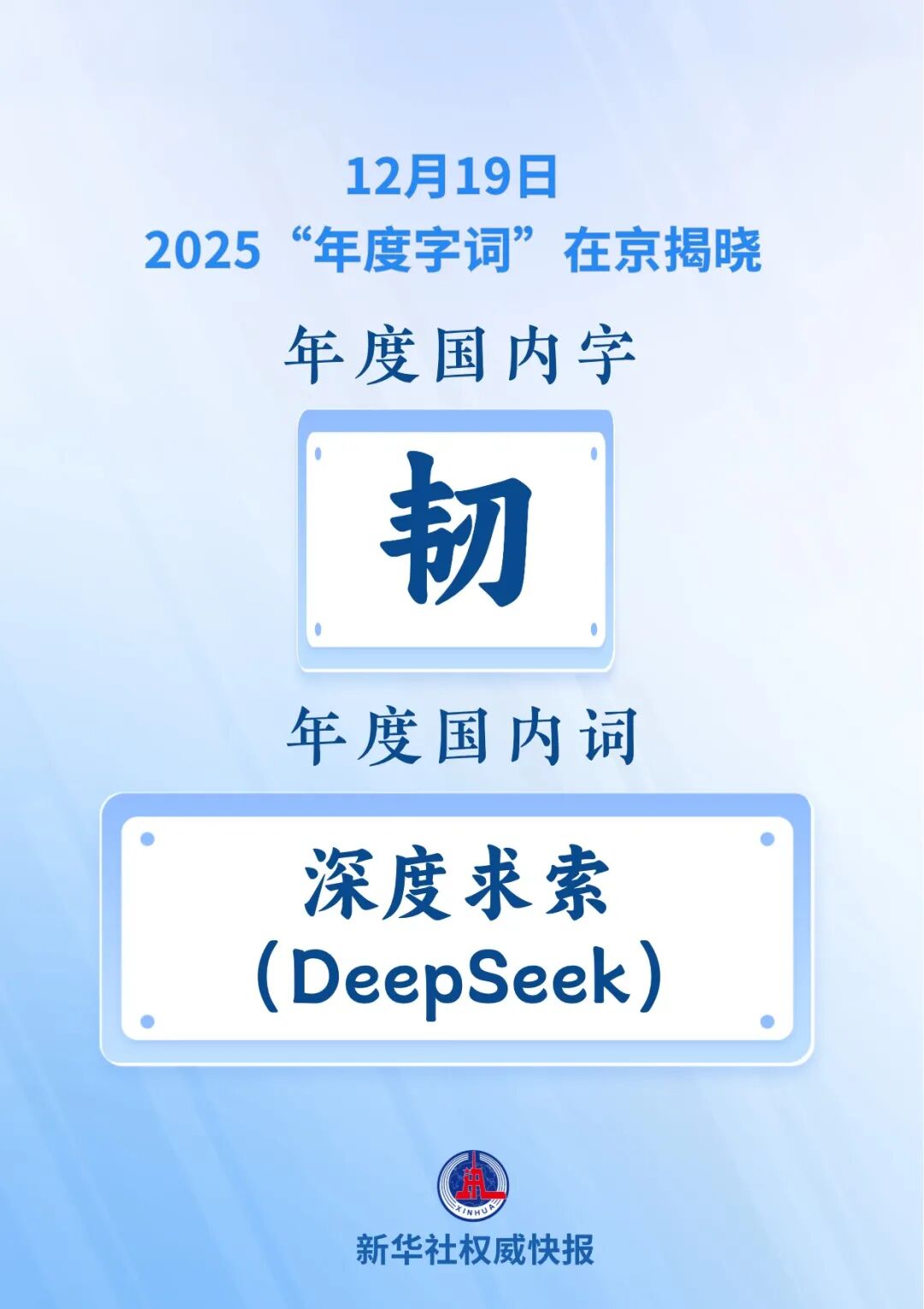
Core Insights - The "Chinese Language Countdown 2025" event revealed "Resilience" and "DeepSeek" as the annual domestic word and phrase, respectively, highlighting the significance of these terms in reflecting societal trends and values in 2025 [1][2] Group 1: Annual Word and Phrase - "Resilience" was chosen as the annual domestic word, symbolizing steadfastness, determination, and the ability to withstand challenges, particularly relevant in uncertain times [1] - "DeepSeek" was selected as the annual domestic phrase, representing a significant Chinese language model that showcases the rise of Chinese companies in the artificial intelligence sector [1] Group 2: Media and Cultural Trends - The event also presented the top ten media buzzwords, internet slang, and new terms, providing unique perspectives on contemporary society, with each list focusing on different aspects such as news value, youth culture, and social evolution [2] - Notable entries like "DeepSeek" appeared in both the media buzzwords and internet slang categories, indicating their integration into daily life and cultural discourse [2] Group 3: Historical Context and Future Outlook - The "Chinese Language Countdown" has been ongoing for 20 years, reflecting the evolution of language and societal values from early terms like "Weibo" and "Big Data" to current themes like "Resilience" and "Intelligence" [2] - The organizers emphasized the importance of language as a carrier of civilization and history, aiming to continue documenting the progress of the Chinese language and fostering cultural identity and historical confidence [2]
2025“年度字词”,揭晓!
Xin Hua She· 2025-12-19 09:32
Core Insights - The annual words for 2025 have been announced, with "韧" (Resilience) chosen as the domestic character and "深度求索" (DeepSeek) as the domestic term, reflecting the current socio-economic landscape and technological advancements in China [5][6]. Group 1: Selected Words - "韧" embodies the spirit of perseverance and resilience in the face of challenges, highlighting the importance of adaptability and recovery in uncertain times [6]. - "深度求索" signifies China's technological sovereignty in AI, marking the emergence of significant domestic advancements in artificial intelligence, particularly with the launch of the DeepSeek language model [6]. Group 2: Emerging Vocabulary - New terms such as "人形机器人" (humanoid robots), "情绪价值" (emotional value), and "票根经济" (ticket root economy) reflect ongoing innovations in technology and cultural practices [7]. - The annual language assessment also includes the top ten media buzzwords, internet slang, and new vocabulary, providing a comprehensive view of contemporary societal trends [8]. Group 3: Historical Context - The "汉语盘点" (Chinese Language Review) has been documenting the evolution of language in relation to national development for 20 years, showcasing how words mirror the country's progress and public sentiment [9][10]. - Each selected word serves as a "time capsule," encapsulating the dynamic changes in society and the collective emotions of the populace [10].