Gemini 3大模型

Search documents
谷歌A(GOOGL):深度报告:从搜索广告到全栈AI生态平台,AI开启增长新周期
Guohai Securities· 2025-12-31 07:18
Investment Rating - The report maintains a "Buy" rating for Google (GOOGL) [1] Core Insights - The report highlights Google's resilience in search advertising amidst AI disruptions, its competitive advantages in AI technology, and the growth potential of its cloud services driven by proprietary hardware and software innovations [7] Summary by Sections Company Overview - Google is a leading global player in search, advertising, and cloud computing, processing over 5 trillion queries annually and holding a significant market share in various sectors [12][14] Advertising and Search - Google's advertising business is the core revenue driver, with FY2024 ad revenue projected at $264.6 billion, accounting for 76% of total revenue. The search segment remains dominant, with a market share exceeding 90% [30][31] - YouTube is a key component of Google's advertising strategy, with 2.7 billion users and projected ad revenue of $36.1 billion for FY2024, reflecting a 15% year-over-year growth [46][49] AI and Competitive Edge - Google's AI capabilities, particularly through the Gemini model and proprietary TPU chips, provide a significant competitive advantage, enhancing its advertising and cloud services [7][9] - The Gemini 3 model outperforms competitors in various benchmarks, establishing Google as a leader in AI technology [9] Cloud Services - Google's cloud services are expected to grow rapidly, with FY2024 revenue projected at $43.2 billion, reflecting a 31% increase. The company is focusing on IaaS, PaaS, and SaaS to capture market share [13][14] - The introduction of TPU v7p is anticipated to lower costs and improve margins, with significant contracts already secured [7][9] Financial Projections - Revenue forecasts for Google are $336.9 billion in 2025, $383.1 billion in 2026, and $436.4 billion in 2027, with net profits expected to reach $128.4 billion, $134.3 billion, and $153.5 billion respectively [5][7]

Alphabet:像伯克希尔·哈撒韦一样买入并持有
美股研究社· 2025-12-03 11:42
Core Viewpoint - Google reported strong third-quarter earnings, significantly exceeding market consensus expectations, supported by advancements in artificial intelligence and hardware [1][12]. Group 1: Google's Third Quarter Performance - Google launched the new Gemini 3 model, receiving positive reviews from analysts and is now available in approximately 120 countries [1]. - The Gemini 3 model is trained on Google's proprietary AI chips, known as Tensor Processing Units (TPUs), which are seen as strong competitors to NVIDIA's GPUs in AI applications [1]. - The company's return on capital employed (ROCE) remains strong, with positive capital expenditure (CAPEX) growth guidance provided [8]. Group 2: Berkshire Hathaway's Investment - Berkshire Hathaway disclosed a new significant position in Google, purchasing 17,846,142 shares at a price of $243, making it the tenth largest holding in their portfolio, valued at $4.33 billion [5]. - In contrast to the new investment in Google, Berkshire reduced its holdings in Apple by 14.92% (approximately $10 billion) and in Bank of America by 6.15% (approximately $3.3 billion) [5]. Group 3: Valuation and Growth Potential - Despite a nearly 30% increase in Google's stock price since Berkshire's disclosure, Google remains one of the most reasonably valued companies among the "Magnificent Seven" tech giants, with a forward P/E ratio of about 30 [7]. - Analysts predict a long-term annualized return on investment (ROI) of approximately 11.6%, based on Google's scalable business model and projected growth rates [9].



12月全球十大富豪:第二名换人了
3 6 Ke· 2025-12-02 09:57
Core Insights - The latest Forbes Billionaires list reveals significant changes among the world's wealthiest individuals, particularly in the tech sector, driven by stock price fluctuations and advancements in AI technology [1][2][3]. Group 1: Wealth Changes Among Billionaires - Larry Page, co-founder of Google, has risen to the second position on the Forbes list with a net worth of $262 billion, an increase of $30 billion from November 1 due to a 14% rise in Alphabet's stock price [1][3]. - Sergey Brin, also a co-founder of Google, saw his wealth increase by $27 billion to approximately $242 billion, moving him up to the fifth position [1]. - Warren Buffett's Berkshire Hathaway disclosed nearly $5 billion in Alphabet shares, leading to a $9 billion increase in his wealth, bringing it to about $152 billion and elevating him to the tenth position [2][30]. Group 2: Notable Losers - Larry Ellison, founder of Oracle, experienced a significant loss, with his wealth decreasing by $67 billion to $253 billion due to a 23% drop in Oracle's stock price [3][11]. - Jensen Huang of Nvidia saw his wealth decrease by $22 billion to $154 billion, although he maintained the eighth position [3][23]. - Elon Musk, despite a $15 billion decrease in wealth due to a 6% drop in Tesla's stock price, remains the richest person in the world with an estimated net worth of $483 billion [3][8]. Group 3: Overall Billionaire Rankings - As of December 1, 2025, the total wealth of the top ten billionaires is $2.4 trillion, unchanged from the previous month [4]. - The top ten billionaires are predominantly from the United States, with Bernard Arnault from France being the only exception [33]. - All ten individuals on the list are male, with each having a net worth of at least $152 billion [34].

一觉醒来!万亿泡沫破裂了!
商业洞察· 2025-12-02 09:23
Core Viewpoint - The article discusses the shifting dynamics in the AI chip market, highlighting Google's TPU chips as a competitive threat to NVIDIA's dominance in AI training chips, which currently holds over 80% market share [4][10][28]. Group 1: Market Dynamics - NVIDIA has been the leading player in AI training chips, with a market cap exceeding $5 trillion and significant capital market interest [4]. - Recently, Google's TPU chips have gained recognition, leading to a shift in investment from NVIDIA to Google, as evidenced by rising Google stock prices and declining NVIDIA stock prices [10][20]. - Major companies like Meta and Anthropic are placing significant orders for Google's TPU chips, indicating growing industry confidence in their reliability and performance [11][13]. Group 2: Technical Advantages - Google's TPU chips are designed specifically for AI applications, offering better efficiency and lower costs compared to NVIDIA's more general-purpose chips [15][17]. - Industry data shows that NVIDIA's chips have lower utilization rates when training large-scale models, leading to wasted resources and higher operational costs [16][20]. - In contrast, Google's TPU chips utilize sparse computing and cluster interconnects, resulting in significantly lower power consumption [17][18]. Group 3: Implications for NVIDIA - As Google's market share in AI chips increases, NVIDIA's revenue growth may slow, raising concerns about its high valuation, which is already detached from its fundamentals [26][28]. - The potential for a significant correction in NVIDIA's stock price could trigger a broader market sell-off, affecting its suppliers and cloud service providers [29][30]. - The article warns that a collapse of NVIDIA's market position could have negative repercussions for the overall economy, particularly for startups and companies heavily invested in AI technologies [30][31]. Group 4: Future Outlook - The article suggests that the current trends indicate a potential bubble in the AI sector, particularly surrounding NVIDIA, which could lead to a market correction [26][32]. - In the long term, as training costs decrease and barriers to entry for large models lower, the market may enter a more competitive phase, referred to as the "hundred model war" [32].


这颗不被看好的芯片,终于翻身?
半导体芯闻· 2025-12-01 10:29
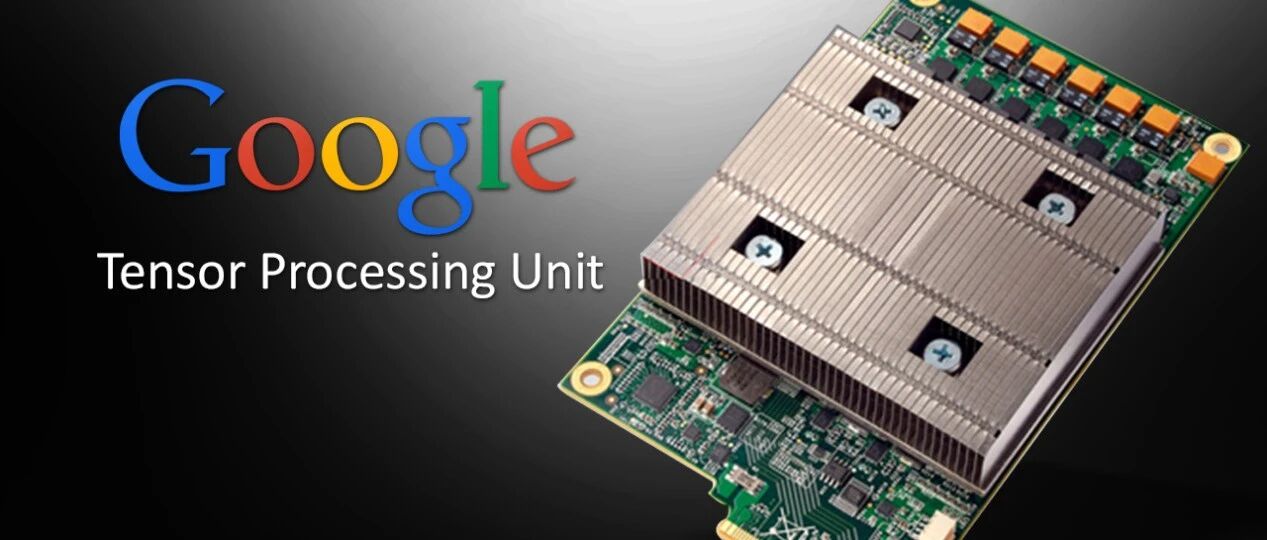
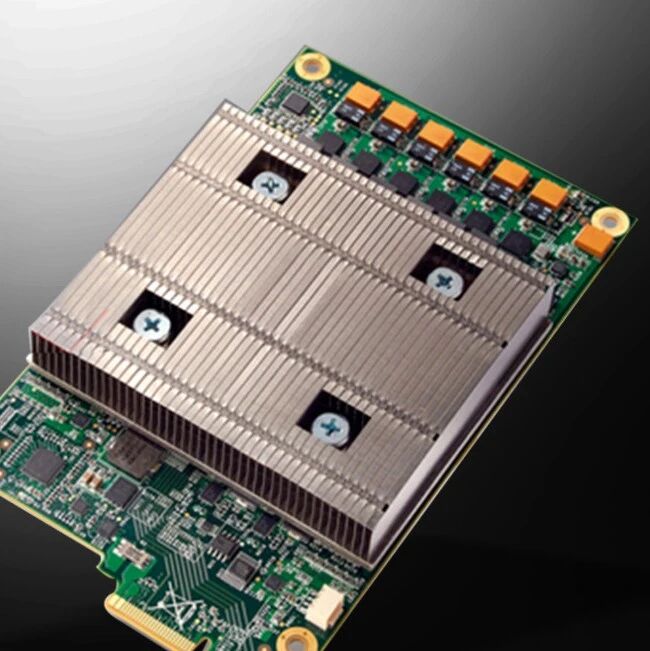
Core Insights - Google's TPU has gained significant attention recently, with Meta considering a multi-billion dollar contract to deploy TPUs in its data centers starting in 2027, leading to a surge in Google's stock price and a drop in NVIDIA's stock [1][20] - The TPU has evolved from a project initially deemed unpromising to a strategic asset that could challenge NVIDIA's dominance in the AI chip market [1][27] - The TPU's development has been marked by rapid iterations, with the latest version, TPU v7 Ironwood, achieving peak performance that surpasses NVIDIA's offerings [16][18] Development History - In 2013, Google faced a computational crisis, predicting that the demand for voice recognition would exceed its data center capacity, prompting the decision to develop its own ASIC chips instead of relying on NVIDIA GPUs [2][3] - The TPU project was initiated, and within 15 months, the first TPU was deployed, achieving significant performance and efficiency improvements over existing solutions [3][5] - The TPU's architecture, particularly the "Systolic Array" design, has been a key innovation, allowing for high data reuse and reduced energy consumption [5][6] Iterative Breakthroughs - TPU v2, released in 2017, marked a shift from inference to training capabilities, introducing the bfloat16 format and significantly enhancing performance for large models [9][10] - TPU v3, launched in 2018, adopted liquid cooling to manage increased power density, establishing a new standard for AI data centers [11][12] - TPU v4 introduced optical circuit switching technology, allowing for dynamic network configurations to optimize performance for varying tasks [13][14] - TPU v5p, released in 2023, aimed to balance training and inference capabilities, expanding its application scope [14] Market Position and Strategy - Google is now actively commercializing TPU, engaging with cloud service providers and large enterprises to deploy TPUs in their data centers, potentially generating billions in revenue [20][21] - The TPU's success has prompted a talent exodus from Google, with former TPU engineers founding new companies and developing competitive chips [25][26] - The competition between TPU and NVIDIA's GPUs is intensifying, with both technologies expected to coexist in a hybrid deployment model, leveraging their respective strengths [22][28] Future Outlook - The rise of TPU signifies a shift in the AI infrastructure landscape, moving towards a model that integrates cloud services with specialized chips, potentially disrupting NVIDIA's long-standing market dominance [27][28]
AI投资的逻辑变了?如何调整方向?
Zhong Guo Jing Ji Wang· 2025-12-01 01:40
Core Viewpoint - Google's strong performance in the AI sector is attributed to its "full-stack ecosystem," which integrates computing power, large models, and applications, creating a self-sufficient closed loop that threatens Nvidia's dominance in the market [1][3][4] Group 1: Google's Competitive Advantages - Google utilizes its self-developed TPU for model training, which offers higher efficiency and lower costs compared to Nvidia's general-purpose GPU, leading to concerns about market share shifts [3] - The Gemini 3 model outperforms OpenAI's GPT in various authoritative tests, breaking the previous dominance of GPT and benefiting from native compatibility with Google's TPU, enhancing training speed and reducing energy consumption [3][4] - Google's extensive downstream applications, including Android, Google Search, and YouTube, provide clear monetization paths for the Gemini model, making its AI commercialization more certain compared to companies focused solely on hardware or models [4] Group 2: Domestic Market Implications - The new narrative in the US AI market is expected to influence the A-share market, with domestic AI companies focusing on "overseas computing power, domestic substitution, and application landing" [5] - Companies in the optical module sector, which supply components to both Nvidia and Google, are expected to benefit from increased overseas computing power demand, although caution is advised due to high trading congestion [5] - The domestic market still faces challenges such as a lack of chips and computing power, but Google's disruption of Nvidia's dominance provides a positive example for domestic chip manufacturers [6] Group 3: Application Development Trends - Companies in the media sector can leverage advanced overseas models to enhance efficiency without developing complex AI technologies, indicating a potential for significant performance improvements [6] - Internet companies with large user bases and diverse application scenarios can rapidly implement AI solutions, exemplified by Alibaba, Tencent, and Baidu integrating AI into their platforms [6] - The trend of AI investment is shifting from computing power to application development, which may become a key focus for the AI market by 2026 [7]

这颗不被看好的芯片,终于翻身?
半导体行业观察· 2025-11-29 02:49
Core Insights - Google’s TPU (Tensor Processing Unit) has gained significant attention, with Meta considering a multi-billion dollar contract to deploy TPUs in its data centers starting in 2027, leading to a surge in Google's stock price and a decline in NVIDIA's stock [1][20] - The TPU has evolved from a project initially deemed unpromising to a strategic asset that could challenge NVIDIA's dominance in the AI chip market [1][28] Development History - In 2013, Google faced a computing power crisis, predicting that the demand from just 100 million Android users would exceed its total data center capacity, prompting the decision to develop its own ASIC chips instead of relying on NVIDIA GPUs [3][4] - Google rapidly assembled a team of chip industry veterans and completed the first TPU in just 15 months, achieving significant performance and efficiency improvements over existing solutions [4][6] - The TPU architecture utilizes a "Systolic Array" design, optimizing data flow and reducing energy consumption, which initially faced skepticism from industry experts [6][7] Iterative Breakthroughs - TPU v2 (2017) marked a shift from inference to training capabilities, introducing the bfloat16 format and expanding memory bandwidth to support large-scale training tasks [10][11] - TPU v3 (2018) doubled performance and introduced liquid cooling to manage increased power density, establishing a new standard for AI data centers [12][13] - TPU v4 (2022) incorporated optical circuit switching technology, allowing for dynamic network configurations to meet varying task demands, further enhancing performance [13][14] - TPU v5p (2023) aimed to balance training and inference capabilities, significantly increasing inter-chip bandwidth and cluster size [15][16] - TPU v6 (2024) is designed specifically for inference tasks, improving efficiency and performance metrics crucial for large-scale AI services [16] - TPU v7 Ironwood (2025) is positioned to directly compete with NVIDIA in inference performance, featuring advanced specifications and capabilities [18][19] Market Dynamics - Google is actively pursuing the commercialization of TPU, engaging with cloud service providers and major corporations to deploy TPUs in their data centers, potentially generating billions in revenue [20][21] - The rise of TPU is expected to challenge NVIDIA's market position, with projections indicating that ASIC shipments may surpass GPU shipments by 2026 [21][22] - Despite the success of TPU, Google continues to procure NVIDIA GPUs, indicating a future where both architectures coexist in the market [22][24] Talent Movement and Industry Impact - The success of TPU has led to a talent exodus from Google, with former TPU engineers founding new companies and developing competitive technologies, highlighting the competitive landscape in AI chip development [24][26] - The emergence of various companies developing their own AI chips, influenced by the TPU model, signifies a shift in the industry towards specialized hardware solutions [26][28] Future Outlook - The AI infrastructure landscape is expected to evolve from solely building GPU clusters to a hybrid model incorporating cloud services, dedicated chips, and diverse architectures, breaking NVIDIA's long-standing monopoly [29][30]
谷歌特斯拉“神仙打架”,自动驾驶红利怎么抓?
Xin Lang Ji Jin· 2025-11-28 00:50
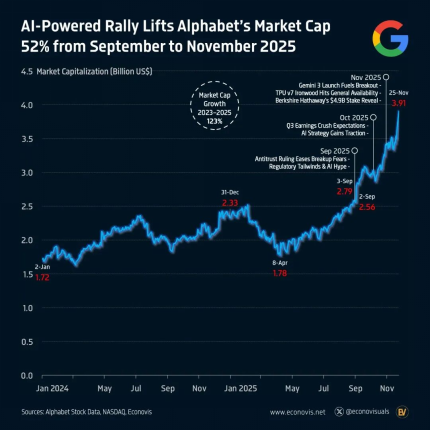
Group 1 - Alphabet has become the fourth company globally to surpass a market capitalization of $3 trillion, joining Apple, Microsoft, and Nvidia [3] - The rapid increase in Alphabet's market value, which rose over $1.34 trillion in just two months, is attributed to multiple disruptive actions reshaping the tech industry [1][4] - Key drivers of Alphabet's stock surge include favorable antitrust rulings, positive regulatory environment, optimistic sentiment towards AI, and strong Q3 earnings exceeding expectations [4] Group 2 - Waymo, Google's autonomous driving division, operates over 2,500 vehicles and has achieved over 100 million miles of fully autonomous driving, with plans to expand its service to over 20 cities [7][9] - Waymo's business model combines ride-hailing services with technology licensing, marking a significant step towards the commercialization of autonomous driving [8] - In contrast, Tesla's approach focuses on a pure vision technology route, with plans to deploy 1,000 Robotaxis by the end of 2025, aiming for a fleet of 1 million Robotaxis across the U.S. [9][10] Group 3 - The competition between Waymo and Tesla represents a significant technological rivalry that will shape the future of the trillion-dollar autonomous driving market, with 2026 being a pivotal year for both companies [10] - Waymo's multi-sensor fusion approach is more costly, while Tesla's pure vision strategy offers long-term cost advantages and scalability [10] - The ongoing expansion of Waymo's services, including plans for international testing in London, highlights its commitment to leading in the autonomous driving sector [9]

金价,大涨!油价,大跌
中国能源报· 2025-11-26 07:10
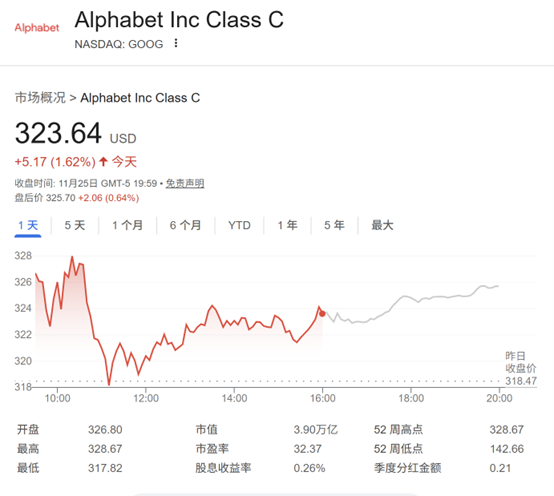
Economic Indicators - Recent data indicates a slowdown in consumer spending in the U.S., with September retail sales and producer price index showing signs of reduced economic momentum [1][3] - The private sector has seen an average weekly job cut of 13,500 positions over the past four weeks, indicating an increase in layoffs [1] Market Reactions - The expectation of interest rate cuts by the Federal Reserve has gained traction, leading to a rise in major U.S. stock indices, with the Dow Jones up 1.43%, S&P 500 up 0.91%, and Nasdaq up 0.67% [3] Technology Sector Developments - Google's new AI model, Gemini 3, has outperformed other models trained on Nvidia GPUs, leading to a surge in Alphabet's stock price, which rose 1.53% and approached a market capitalization of $4 trillion [6][8] - Nvidia's stock faced significant pressure, dropping over 7% at one point, and closing down 2.59%, marking a two-month low due to competition from Google's cost-effective TPU chips [10] European Market Trends - European stock indices collectively rose, driven by expectations of U.S. interest rate cuts and potential peace agreements in the Russia-Ukraine conflict, with the UK FTSE 100 up 0.78%, France's CAC 40 up 0.83%, and Germany's DAX up 0.97% [12] Commodity Price Movements - International oil prices fell due to concerns over potential oversupply as reports suggested Ukraine's agreement to a U.S.-proposed peace deal, with WTI crude closing at $57.95 per barrel, down 1.51% [15] - Gold prices increased by over 1% as expectations of Fed rate cuts led to a decline in U.S. Treasury yields and a weaker dollar, with December gold futures closing at $4,140.0 per ounce, up 1.12% [16]

Gemini+TPU双线破局,顶级科技投资人:七巨头中Alphabet最值得持有
Feng Huang Wang· 2025-11-26 02:58
Core Insights - Alphabet has emerged as a standout player in the tech sector, driven by its impressive Gemini 3 model and comprehensive AI capabilities, with its stock price surging significantly [1][3] - The company's market capitalization is nearing the $4 trillion mark, with a 20% increase in stock price this month and a cumulative rise of approximately 70% year-to-date, outperforming other major tech firms [1] Group 1: Market Position and Investor Sentiment - Gene Munster, a prominent tech investor, has expressed strong bullish sentiment towards Alphabet, highlighting its dominant position in the AI sector and the reshaping of power dynamics in Silicon Valley [3] - Recent advancements in AI, particularly the potential use of Google's Tensor Processing Units (TPUs) to support Meta's data centers by 2027, have positively impacted Alphabet's stock, while Nvidia's stock experienced a pullback [3] Group 2: Competitive Landscape and User Engagement - Alphabet's capabilities in large language models position it as a formidable competitor to OpenAI, with a revitalized competitive culture within the company [4] - The chatbot market represents a significant opportunity for Google, as only about 20% of its users currently utilize the Gemini AI tools, indicating room for growth [4] Group 3: Valuation and Market Dynamics - Alphabet's price-to-earnings ratio based on projected earnings for the next 12 months is approximately 28 times, comparable to other major tech firms, and its dual focus on chips and AI chatbots justifies a higher valuation multiple [5] - Despite the disruptive impact of ChatGPT on the digital search ecosystem, Google's core advantage remains its unparalleled user reach, allowing it to connect with more users than any other platform [5]