MR眼镜

Search documents
兆威机电20260306
2026-03-09 05:18
Summary of Zhaowei Electric's Conference Call Company Overview - **Company**: Zhaowei Electric - **Industry**: Robotics, Automotive, Consumer Electronics Key Points Industry and Market Dynamics - **Tesla V3 Release**: Expected to launch in 2-3 months, targeting mass production of over 10,000 units, which will drive recovery in the robotics sector [2][5] - **Market Position**: Zhaowei Electric is positioned as a high-elasticity stock with low valuation and strong profit characteristics [2] Financial Performance and Projections - **2026 Profit Forecast**: Expected profit of 400-500 million yuan, driven by automotive (60% of revenue) and consumer electronics growth, with natural improvement in expense ratios due to scale effects [2][6] - **Market Valuation Potential**: Main business could reach a market value of 15-20 billion yuan based on a valuation of 30-50 times earnings [6] Business Segments - **Robotics Business**: - Dual model of "modules + complete hands" with the second generation launched in July 2025 [2] - Potential market contribution of 30-35 billion yuan if integrated into Tesla's supply chain, leading to an overall market value of 50 billion yuan [2][13][14] - **Smart Automotive**: - Single vehicle value currently at approximately 1,900 yuan, expected to rise to 2,000-3,000 yuan [2][15] - Anticipated annual growth of 30% over the next 2-3 years, with significant market share growth potential [15] - **Consumer Electronics and MR Business**: - Expected to hit bottom in 2025, with recovery anticipated in 2026 due to new AI products and MR market recovery [3][16] Strategic Developments - **Investor Communication**: Focus will shift back to A-share investors following the successful completion of the Hong Kong stock issuance, which is expected to enhance governance and communication [3][17] - **Customer Engagement**: Strong progress with North American clients, with some products nearing exclusive supply agreements [10] Competitive Advantages - **Technological Edge**: Zhaowei Electric has a unique position in the dexterous hand sector due to its proprietary technology in transmission, motors, and control systems [11][12] - **R&D Commitment**: Continuous investment in R&D, maintaining a 10% expense ratio, and collaboration with leading institutions to advance key technologies [12] Risks and Considerations - **Market Conditions**: The overall robotics sector is currently in a relatively weak position, but the anticipated release of Tesla V3 is expected to catalyze recovery [5] - **MR Business Challenges**: The MR segment is expected to face challenges in 2025 but is projected to recover in 2026 [16] Conclusion - Zhaowei Electric is well-positioned for growth in the robotics and automotive sectors, with significant potential for market value increase driven by strategic partnerships and technological advancements. The upcoming Tesla V3 release is a critical catalyst for the robotics segment, while the company’s focus on improving communication with A-share investors post-Hong Kong issuance is expected to enhance its market presence.
Meta重启智能手表计划,目标2026年推出
Xin Lang Cai Jing· 2026-02-19 09:16
Core Viewpoint - Meta is planning to launch its first smartwatch by 2026, reviving a previously shelved project, and aims to compete directly with major players like Apple and Google in the consumer hardware market [2][7]. Group 1: Smartwatch Development - Meta has restarted its smartwatch project, codenamed Malibu 2, which is set to include health tracking features and an integrated Meta AI assistant [2][7]. - The decision to revive the smartwatch initiative was made during a strategic meeting held at CEO Mark Zuckerberg's home in Hawaii at the end of last year [2][7]. - Five years ago, Meta had ambitious plans for smartwatches, including three versions with cameras, but the project was canceled in 2022 due to budget cuts in its hardware division, Reality Labs [2][7]. Group 2: Augmented and Mixed Reality Products - Alongside the smartwatch, Meta is streamlining its augmented reality (AR) and mixed reality (MR) product roadmap, with concerns that launching too many devices too quickly may confuse consumers [3][8]. - Meta is currently developing approximately four AR/MR glasses, with the MR glasses project, Phoenix, postponed until 2027 [3][8]. - A new generation of Meta Ray-Ban Display smart glasses, codenamed Hypernova 2, is expected to be launched this year, following the initial product's release in the U.S. at a price of $799 [3][8]. Group 3: Future AR Glasses - Meta is also working on consumer AR glasses, codenamed Artemis, which are anticipated to be released in 2027 and will feature the ability to display digital content on a single lens [4][9]. - The Artemis glasses will allow users to make calls using realistic 3D avatars that mimic facial expressions and gestures, and will include a voice-activated Meta AI assistant [4][9]. - Zuckerberg has expressed optimism that AI-driven glasses will define the next era of personal computing, viewing these devices as the ideal interface for personal AI [5][9]. Group 4: Market Performance - The Meta Ray-Ban smart glasses have achieved commercial success, with a partner reporting that sales are expected to exceed 7 million units by 2025, compared to 2 million units sold from their launch in 2023 until the end of 2024 [5][9].



传vivo叫停AI眼镜项目 将深耕MR赛道
Zheng Quan Shi Bao Wang· 2026-01-23 07:34
Core Viewpoint - Vivo has halted its AI glasses project due to insufficient product differentiation, despite the growing competition in the AI glasses market [1][3] Group 1: Vivo's AI Glasses Project - Vivo has stopped the development of its AI glasses project, which had been in secret preparation for nearly six months [1] - The project involved collaborations with several ODM manufacturers, including GoerTek and Zhongke Chuangda, for solution and prototype validation [1] - Internal evaluations indicated that the AI glasses could not achieve significant product differentiation, leading to uncertainty in both experience and market acceptance [1][3] Group 2: Market Trends and Projections - The AI glasses market is experiencing a surge, with major tech companies like Baidu, Xiaomi, and Alibaba entering the space, and low-cost white-label AI glasses emerging in markets like Huaqiangbei [2] - IDC forecasts that global smart glasses shipments will reach 12.8 million units in 2025, a 26% year-on-year increase, with China's market expected to exceed 2.75 million units, growing by 107% [2] - By 2026, global shipments are projected to surpass 23.7 million units, with China's market reaching over 4.9 million units, marking a significant growth phase [2] Group 3: Vivo's Focus on Mixed Reality (MR) - Despite halting the AI glasses project, Vivo will continue to focus on the mixed reality (MR) sector, emphasizing devices with greater immersion and spatial computing potential [3] - Vivo has already launched its first MR glasses, the Vivo Vision Explorer, although specific pricing and public sales have not yet been initiated [4] - The decision to pause the AI glasses project reflects Vivo's strategic focus amid a complex macroeconomic environment and rising costs [3]
领益智造:公司深耕AR、VR、MR、AI眼镜等智能穿戴设备的核心组件和整机组装
Zheng Quan Ri Bao Wang· 2026-01-08 14:13
Core Viewpoint - Lingyi iTech (002600) is focused on the development of core components and assembly for smart wearable devices such as AR, VR, MR, and AI glasses, providing essential parts and assembly services to leading domestic and international clients [1] Group 1 - The company specializes in soft functional components, injection molded parts, thermal solutions, chargers, and wireless charging core components [1] - Lingyi iTech has signed commercial confidentiality agreements with clients, limiting the disclosure of specific cooperation details [1]

北京10后小孩哥做的机器人有多酷
Xin Lang Cai Jing· 2025-12-23 11:52
Core Viewpoint - The 2025-2026 academic year Beijing Chongwen Primary School Science and Technology Festival showcased impressive robotic innovations, highlighting the creativity and technological skills of students born after 2010 [1] Group 1: Event Highlights - The event featured performances by robotic dogs and humanoid robots, which captivated the audience with their abilities to perform backflips, jumps, and wave [1] - Students had the opportunity to learn about scientific principles such as electromagnetic induction and explore the structural secrets of ancient architecture [1] - The festival emphasized the ongoing exploration of science, suggesting that the future holds limitless possibilities for the students [1]

福蓉科技(603327.SH):生产的高强度铝制结构件材料已用于MR、AR眼镜上
Ge Long Hui· 2025-12-02 08:30
Core Viewpoint - Fulong Technology (603327.SH) has successfully produced high-strength aluminum structural components that are now utilized in MR and AR glasses, primarily for brands such as Samsung and Vivo [1] Group 1 - The company has confirmed that its high-strength aluminum materials are being used in the production of MR and AR glasses [1] - Major brands utilizing these materials include Samsung and Vivo, indicating a strong market presence [1]

在计算机展览会感受智趣生活
Ke Ji Ri Bao· 2025-11-14 00:43
Group 1: Robotics and AI in Gaming - The interactive chess area at the exhibition was a major attraction, featuring multiple chessboards and a strong AI opponent that adapts to the player's skill level, with capabilities comparable to professional players in Go [2] - The chess-playing robot developed by Shanghai Yuanluobo Intelligent Technology Co., Ltd. utilizes a visual recognition system and precise mechanical arms, allowing it to dynamically adjust its strategy based on the opponent's skill level [2] - A children's chess robot designed for ages 3 to 12 was also showcased, supporting four types of chess games, indicating a focus on early education in gaming [2] Group 2: AI in Music Creation - The AI music creation tool, Tunee, allows non-professionals to easily create music by simply describing their feelings or stories, significantly lowering the barriers to music composition [3] - Tunee can generate lyrics, melodies, and even a personalized music video, showcasing its comprehensive functionality [3][4] - An intelligent guitar equipped with LED lights provides real-time visual guidance for beginners, enhancing the music learning experience [4] Group 3: MR Technology in Education - The MR glasses developed by Shenyang Jinran Technology Co., Ltd. transform any location into a virtual laboratory, allowing users to conduct experiments safely without the constraints of a physical lab [5] - The MR system includes 43 designed experimental courses that record user actions and generate performance reports, helping students identify areas for improvement [5][6] - Feedback from a school using the MR glasses indicated increased student interest and better understanding of experimental concepts [6]
走进乌镇看科技对话文明 感受数字技术让文化遗产“活”起来神奇时刻
Yang Shi Wang· 2025-11-09 05:47
Core Insights - The 2025 World Internet Conference in Wuzhen established a Digital Heritage Professional Committee and released a collection of digital heritage case studies, showcasing how digital technology can revitalize cultural heritage [1][3] Group 1: Digital Heritage Initiatives - The project integrates digital technology with the "Siku Quanshu" (Complete Library of the Four Treasuries) and the Wenlan Pavilion, representing a new path for the restoration of cultural heritage [3] - The Zhejiang Library has digitized all ancient texts, eliminating the need to view original manuscripts [3] Group 2: Global Perspectives on Cultural Heritage - The innovative "Chinese model" offers significant insights for global cultural heritage preservation, with AI and digital technologies serving as tools for historical preservation and future civilizational dialogue [5] - Global youth leaders from Kyrgyzstan and Bangladesh expressed the importance of using technology to preserve their cultural heritage, highlighting the potential of AI and digital twin technology [7][9]

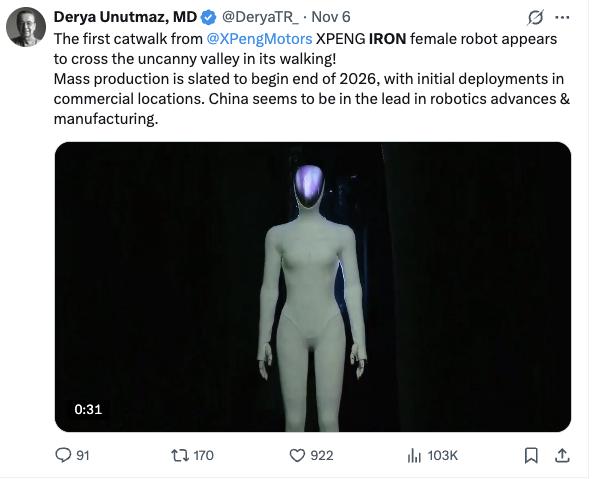
小鹏IRON机器人,产品经理下一个IPHONE时刻:MR眼镜与人形机器人AppStore
3 6 Ke· 2025-11-07 11:06
Core Insights - The recent unveiling of XAI's humanoid robot IRON by Xiaopeng has generated significant buzz in the tech community, positioning it as a strong competitor to Tesla's Optimus robot [1][4] - The robot's ability to walk with a human-like gait has led to initial skepticism about its authenticity, prompting a reveal that confirmed its robotic nature, which further fueled interest and publicity [4][6] - Xiaopeng's robot is set for mass production and pre-orders starting in April 2024, indicating a shift in consumer robotics towards personal ownership [6] Group 1: Technological Advancements - The IRON robot showcases advanced engineering, with its hydraulic walking mechanism allowing for a gait that closely mimics human movement, reflecting a high level of robotic craftsmanship [1][4] - The robot's internal coordination and system integration are superior to that of Tesla's Optimus, despite the similar external appearance [12][9] - The introduction of a robot AppStore based on the ROS2 system is anticipated, enabling users to download various applications and skills for the robot, similar to mobile app ecosystems [13][20] Group 2: Market Trends - The demand for personal robots is expected to rise, as evidenced by changing consumer behavior towards intimacy products, suggesting a growing trend of loneliness that robots may address [6] - Xiaopeng's robots are gaining traction in the global market, with significant sales growth and production capabilities, including a monthly output of 200,000 units for related components [8] - The emergence of a developer ecosystem for robot applications is likely, paralleling the early days of personal computing, where software and hardware development became distinct yet interdependent [18][22]

老字号与新科技齐发力 文化创新打造新场景
Bei Jing Qing Nian Bao· 2025-09-23 18:52
Group 1 - The core concept of the news is the launch of the "Zhi Ma Health Zero Store" by Tong Ren Tang, which integrates traditional Chinese medicine with modern health and wellness products, targeting a younger demographic [2] - The store features a large unmanned vending machine capable of holding 9,000 products, providing 24-hour service with robotic delivery [2] - The first floor of the store focuses on precision dietary therapy, offering various herbal coffee and baked goods, while the second and third floors provide anti-aging management and a wide range of medicinal herbs [2] Group 2 - The "Mosu World Artificial Intelligence New Quality Industry Community" is highlighted as a hub for innovation, featuring over 30 companies and a comprehensive support system for AI development [2] - The community has established a 1-kilometer AI industry core ecosystem, supported by significant funding and resources, including a 500 billion-level industrial fund [2] - Various immersive experiences showcasing Chinese culture are being developed, including MR glasses that enhance visitor experiences in museums and cultural sites [3] Group 3 - The China Digital Culture Group is working on creating a digital screen for inbound tourism that integrates product guidance, storytelling, multilingual interaction, and convenient payment solutions [3] - This initiative aims to address the "last mile" issue in inbound tourism, providing a replicable model for enhancing tourist experiences in China [3]