Vera Rubin超级GPU

Search documents
2025财经大事记:特朗普2.0奠定动荡基调,贵金属开启史诗级牛市!
Jin Shi Shu Ju· 2025-12-26 07:45
Group 1: Global Trade and Economic Policies - Trump's return to the White House significantly altered global trade dynamics, introducing a "MAGA 2.0" policy that included a "reciprocal tariff" approach, leading to a 9% drop in the S&P 500 index [4] - The market adapted to Trump's unpredictable tariff announcements, leading to the emergence of the "TACO trade" strategy among investors [4] - The U.S. government faced a record shutdown lasting 43 days due to budget negotiations, highlighting deep-rooted issues in fiscal management, with national debt surpassing $38 trillion [13] Group 2: AI and Technology Developments - The launch of DeepSeek's open-source model R1 marked a pivotal moment in AI, challenging Western dominance and leading to a surge in Chinese tech stocks [5] - Oracle's $300 billion contract with OpenAI raised concerns about over-reliance on a single partner, with Oracle's stock experiencing a significant drop of over 40% from its peak [11][12] - Nvidia's market capitalization surpassed $5 trillion, becoming the first company to reach this milestone, although concerns about a potential bubble emerged as its stock faced volatility [15][16] Group 3: Precious Metals Market - The precious metals market experienced a historic bull run, with gold prices rising over 70% to exceed $4,500 per ounce, while silver prices surged nearly 160% [14] - The rise in precious metals was driven by multiple factors, including Fed rate cuts, geopolitical tensions, and concerns over national debt [14] Group 4: Leadership Changes and Market Reactions - Warren Buffett's retirement announcement and the appointment of Greg Abel as his successor led to a decline in Berkshire Hathaway's stock price by over 10% [6][7] - The political landscape in Japan shifted with the election of Prime Minister Kishi Sanae, whose expansive fiscal policies raised concerns about increasing national debt [17]


英伟达在下一盘很大的“棋”
Shen Zhen Shang Bao· 2025-11-02 00:40
Core Insights - Nvidia announced a $1 billion investment in Nokia, acquiring 2.9% of the company, to support the transition from 5G to 6G networks and enhance its position in the next-generation network standards competition [2][6] - The integration of AI with 6G, quantum computing, and robotics reflects a trend towards deeper technological convergence and multi-domain collaboration in the AI industry [1][6] - Nvidia's ambition to transform into a full-stack AI infrastructure provider is evident, as it aims to integrate various technologies into a cohesive ecosystem [6][7] Investment and Partnership - Nvidia will purchase 166.4 million new shares of Nokia at $6.01 per share, making it Nokia's second-largest shareholder [2] - The collaboration will focus on launching the ARC platform, which combines Grace CPU, Blackwell GPU, and ConnectX networking to create a programmable computer capable of wireless communication and AI processing [2] Technological Developments - Nvidia showcased its next-generation Vera Rubin super GPU, which is expected to achieve 100 Petaflops of performance, significantly outperforming previous models [3] - The company introduced NVQLink, a new interconnect architecture designed to link quantum processors with Nvidia GPUs, addressing challenges in quantum computing [4] Autonomous Driving Initiative - Nvidia plans to deploy 100,000 Robotaxis in partnership with Uber and Stellantis starting in 2027, highlighting its focus on autonomous driving as a key AI application [6] - The integration of AI with various technologies, including 6G and quantum computing, is seen as a strategic move to solidify Nvidia's role in the AI infrastructure market [6] Market Perspective - Nvidia's CEO refuted concerns about an AI bubble, asserting that the strength of current AI models and customer willingness to pay validate the investments in infrastructure [7]

硅谷「芯片四杰」,一个月涨了5.5个拼多多
36氪· 2025-10-31 13:36
Core Insights - The article discusses the competitive landscape among AI chip giants, highlighting the blurred lines between competition and collaboration in the industry [4][44] - NVIDIA has expanded its reach beyond data centers into sectors like 6G, quantum computing, and biomedicine, indicating a strategic shift [4][6] - The market capitalization of major AI chip companies surged significantly in October, with NVIDIA's market cap reaching $5 trillion in just 113 days [7][14] Company Developments - NVIDIA's recent investment of $100 billion in OpenAI aims to establish a partnership that ensures a minimum of 10GW data center capacity using NVIDIA's new Vera Rubin platform [17][20] - AMD's strategic move to acquire a 10% stake in OpenAI and secure a significant computing order has positioned it as a strong competitor, with its stock price rising by approximately 60% [8][34] - Broadcom announced a collaboration with OpenAI to develop GPUs, further intensifying the competition in the AI chip market [12][14] Market Dynamics - The combined market capitalization of NVIDIA, AMD, Broadcom, and Qualcomm increased by $1 trillion in October, reflecting the intense competition in the AI chip sector [14][40] - NVIDIA's capital strategy has created a symbiotic ecosystem where downstream model developers and upstream computing infrastructure players are interconnected [27][43] - OpenAI's long-term plan includes building 250GW of computing power by 2033, with 10% already planned in a short timeframe [41][42] Competitive Strategies - AMD's approach involves offering "expectations" rather than direct financial investments, allowing it to secure significant orders while maintaining a competitive stance against NVIDIA [28][30] - OpenAI's strategy includes diversifying its computing sources, balancing costs, and mitigating risks associated with reliance on a single supplier [39][42] - The evolving relationships among these companies suggest a complex future where competition and collaboration will continue to shape the AI chip landscape [44]


算力需求持续高景气,人工智能AIETF(515070)布局AI基础设施核心环节
Mei Ri Jing Ji Xin Wen· 2025-10-31 02:20
Group 1 - The A-share market opened slightly lower, with the Shanghai Composite Index down 0.05%, the Shenzhen Component down 0.11%, and the ChiNext Index down 0.08% [1] - The AI ETF (515070) fell by 1.89%, with its holdings such as Stone Technology, Lanke Technology, New Yisheng, Inspur Information, and Zhongji Xuchuang experiencing significant declines [1] - Nvidia announced a partnership with Nokia to develop a 6G network platform and introduced NVQLink technology to connect quantum processors with GPU supercomputers, further solidifying its global leadership in AI infrastructure [1] Group 2 - Nvidia's CEO Huang Renxun refuted claims of an "AI bubble," emphasizing the practicality of AI models and the willingness of customers to pay, indicating strong demand for AI infrastructure [1] - According to CITIC Construction Investment Securities, Nvidia is strategically positioned as an AI infrastructure platform provider, with a broad market space expected for ASIC (Application-Specific Integrated Circuit) and sustained high prosperity in the computing power industry chain [1] - The AI ETF (515070) tracks the CS AI Theme Index (930713), focusing on companies providing technology, basic resources, and applications in the AI industry chain, with top-weighted stocks including Zhongji Xuchuang, New Yisheng, and others [2]
英伟达,狂飙!
Xin Lang Cai Jing· 2025-10-30 09:09
Group 1 - The core viewpoint of the article is that Nvidia is not in an AI bubble, as stated by CEO Jensen Huang, and the company has reached a market capitalization of $5 trillion, making it the first company to achieve this milestone [1][31][40] - Nvidia's market cap surpasses that of entire countries like Germany and Japan, ranking it as the third-largest economy globally, behind only the US and China [2] - The rapid growth of Nvidia's market value is unprecedented in business history, with the company reaching $1 trillion in 16 years, $2 trillion in less than 200 days, and $3 trillion in just over two months [4][5] Group 2 - The immediate catalyst for Nvidia's market surge was the GTC conference held on October 28, where Huang announced significant partnerships and technological advancements [6][12] - Nvidia's investment of $1 billion in Nokia aims to develop an AI-native 6G network platform, positioning the company as a key player in future communication infrastructure [9][10] - The introduction of NVQLink technology connects traditional GPU supercomputers with quantum processors, indicating Nvidia's commitment to being a leader in both classical and quantum computing [11][12] Group 3 - Nvidia's revenue for the first half of the year exceeded $100 billion, with projections of $500 billion in GPU sales by the end of 2026, representing an 8 to 9-fold increase in just two years [12][12] - The company has built a nearly unreplicable ecosystem through its CUDA platform, which allows GPUs to perform complex calculations beyond graphics processing, making it essential for AI and deep learning applications [14][15][17] - Over 400,000 developers use CUDA, and the platform has been downloaded 40 million times, creating a strong path dependency that makes it difficult for competitors to lure developers away [17][18] Group 4 - Nvidia is strategically investing in key partnerships, including a $10 billion investment in OpenAI to support AI applications and a $5 billion stake in Intel to secure AI-specific CPU access [20][21] - The vision of Nvidia extends beyond being a chip manufacturer to becoming the architect of "AI factories," where data serves as raw material and GPUs form the production line [22][27][29] - Huang's statement that "AI is the main productive force" reflects a shift in perspective, positioning AI as a core component of future economic productivity [27][40] Group 5 - Despite the optimism, there are concerns about competition from companies like AMD and the self-development of AI chips by major cloud providers such as Google, Amazon, and Microsoft [42][44] - Geopolitical risks, particularly US export controls affecting sales in China, have led to a 24% year-over-year decline in Nvidia's revenue from that market [46] - The potential for disruptive changes in computing paradigms, such as quantum and neuromorphic computing, poses long-term risks to Nvidia's market position [49][50] Group 6 - The debate over whether Nvidia's $5 trillion valuation represents a genuine industrial leap or a bubble continues, with arguments on both sides regarding the sustainability of AI-driven growth [52][53] - Supporters argue that Nvidia's valuation is justified by its technological advancements and strong financial performance, while skeptics caution about the potential for a market correction similar to the dot-com bubble [38][39][41]
英伟达市值破5万亿美元,携“财富风暴”助美国领跑6G
Sou Hu Cai Jing· 2025-10-30 05:59
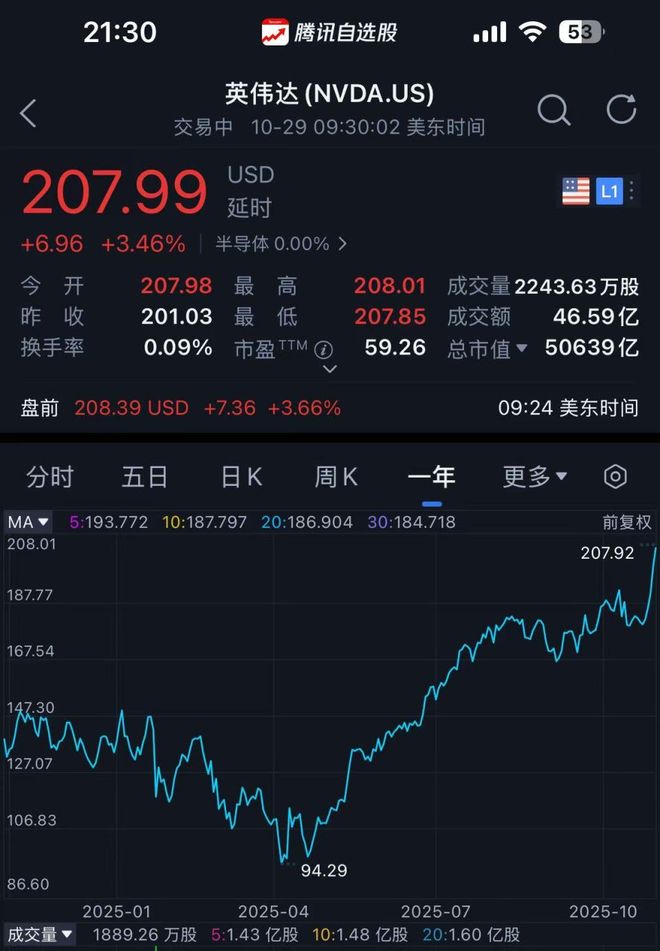
Core Insights - Nvidia's stock price has surged over 1300% since the end of 2022, with analysts optimistic about its future prospects [1][4] - The company's market capitalization has reached a historic milestone of over $5 trillion, making it the first publicly traded company to achieve this [1][4] - Nvidia's CEO, Jensen Huang, refuted claims of an AI bubble, asserting that the demand for AI models justifies the investment in expensive computing infrastructure [2][8] Market Performance - Nvidia's stock opened with a 3.4% increase on October 29, 2023, and closed up 2.99%, with a market cap of $5.09 trillion [1] - The company’s market cap increased from $4 trillion to $5 trillion in just 113 days, compared to 410 days for the previous $1 trillion increase [1] - The stock has rebounded over 135% from its April low, with a year-to-date increase of 54% [3][4] Analyst Ratings - Over 90% of the 80 analysts tracked by Bloomberg rated Nvidia's stock as "buy" or equivalent, with an average target price of $225.48, indicating a potential upside of about 7% [3][4] - The stock's expected price-to-earnings ratio is currently below 34, lower than its five-year historical average of approximately 39 [4] Strategic Partnerships and Innovations - Nvidia has announced significant collaborations, including a $1 billion investment in Nokia, becoming its largest shareholder, and plans to develop a 6G telecom computing platform [6][7] - The company is also working on integrating quantum computing with AI through its NVQLink technology, which has garnered support from 17 quantum computing firms [7][8] - Nvidia's partnerships with Uber and Stellantis aim to deploy 100,000 Robotaxi vehicles based on Nvidia technology starting in 2027 [7] Future Outlook - Nvidia anticipates securing $500 billion in AI chip orders, significantly exceeding Wall Street's expectations [4] - The company is set to build seven new supercomputers for the U.S. Department of Energy, further solidifying its position in the AI infrastructure market [4][6] - Huang emphasized that the latest generation of Nvidia chips is expected to generate up to $500 billion in revenue over the coming quarters [8]

见证AI时代的奇迹:英伟达市值突破5万亿美元,全球首家
3 6 Ke· 2025-10-29 23:24
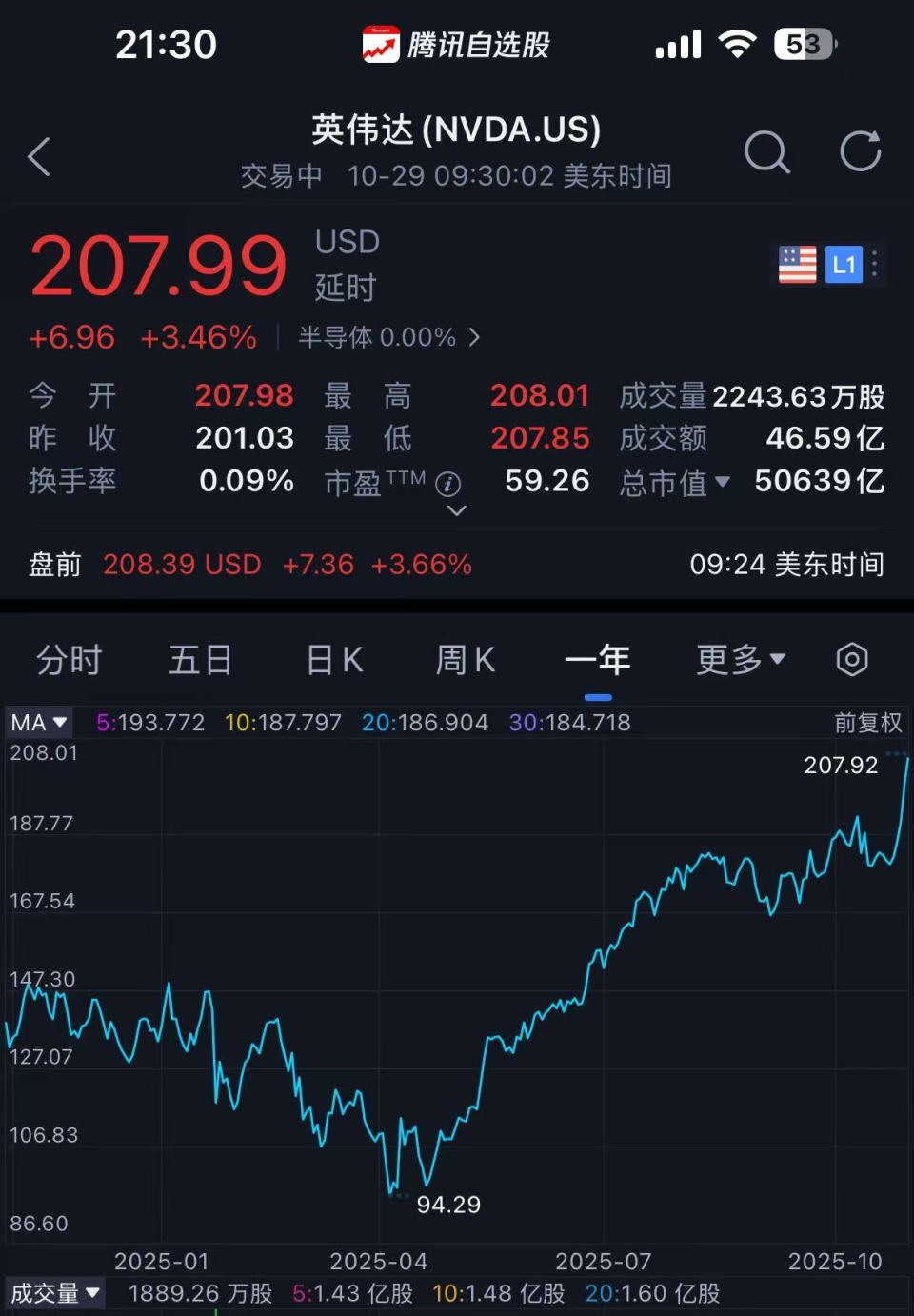
Core Insights - Nvidia's market capitalization has surpassed $5 trillion, making it the first company globally to achieve this milestone, increasing from $4 trillion in less than four months [1][4] - The company's stock price has risen over 50% this year, doubling since its low in April [3] Group 1: Nvidia's Market Value Growth - Nvidia's market value milestones include reaching $1 trillion on May 30, 2023, $2 trillion on February 23, 2024, $3 trillion on June 5, 2024, $4 trillion on July 9, 2025, and finally $5 trillion on October 29, 2025 [6][4] Group 2: Recent Developments and Strategic Initiatives - At the GTC conference on October 28, Nvidia announced significant product updates and strategic partnerships, leading to a stock price increase of 4.98% [3][7] - CEO Jensen Huang emphasized advancements in 6G, AI, quantum computing, and robotics, highlighting Nvidia's role in driving global technological progress [9] - Nvidia plans to invest $1 billion in Nokia to co-develop an AI-native 6G network platform and is collaborating with telecom companies to accelerate 6G deployment [9] - The company introduced NVQLink technology for efficient connections between quantum processors and GPU supercomputers, gaining support from 17 quantum computing firms [9] Group 3: Financial Performance and Future Projections - Nvidia's revenue exceeded $100 billion in the first half of the year, with projections indicating GPU sales could reach $500 billion by the end of 2026 [10] Group 4: Market Position and Competitive Landscape - Despite maintaining dominance in the AI chip market, competitors like AMD and Qualcomm are intensifying their efforts, with AMD signing agreements to provide AI processors and Qualcomm entering the AI data center market [18] - Nvidia's technological advantages, particularly in software ecosystems like CUDA and TensorRT, create significant barriers for competitors [18][19] - The company is pursuing a strategy of vertical integration and horizontal collaboration, including a potential $100 billion investment in OpenAI and a strategic alliance with Intel [19]
A股五张图:重新定义“踏空”
Xuan Gu Bao· 2025-10-29 10:32
Market Overview - Major indices saw collective gains, with the Shanghai Composite Index, Shenzhen Component Index, and ChiNext Index rising by 0.7%, 1.95%, and 2.93% respectively, marking new highs for the year [4] - Despite the overall positive performance, the market exhibited mixed results with half of the stocks rising and half declining [4] Sector Performance - The Hainan Free Trade Zone sector experienced significant gains, with stocks like Hainan Development and Haide Shares hitting the daily limit [3] - The PCB and copper foil sectors also surged, with companies such as Honghe Technology and Tongguan Copper Foil reaching the daily limit [3] - The photovoltaic and energy storage sectors rebounded, with notable stocks like Canadian Solar and Trina Solar hitting the daily limit [3] - The non-ferrous aluminum sector saw substantial increases, with companies like Zhongfu Industrial and Nanshan Aluminum reaching the daily limit [3] - The Beijing Stock Exchange (BSE) saw a strong performance in the afternoon, with multiple stocks hitting the daily limit and the BSE 50 index closing up by 8.41% [6][7] North Exchange Developments - The China Securities Regulatory Commission reported a 40% increase in qualified investors on the BSE since early 2024 [6] - Plans to maintain regular issuance and listing on the BSE were reiterated, along with efforts to optimize listing standards and enhance merger and acquisition regulations [6] - The introduction of the BSE 50 ETF is anticipated to benefit constituent stocks, although their individual performances have been modest [7] Nvidia and Related Stocks - Nvidia's stock surged nearly 5% following announcements at the GTC conference regarding advancements in 6G, AI, quantum computing, and robotics [10] - The company plans to ship 20 million Blackwell chips, a significant increase compared to the previous generation [10] - Related A-share stocks in sectors like PCB and copper foil also saw substantial gains, reflecting the positive sentiment from Nvidia's announcements [10] Quantum Technology Sector - The quantum technology sector experienced a notable increase, with stocks like Shenzhou Information and Tianrongxin hitting the daily limit [16] - The sector's strong performance is attributed to its prominence in the national 14th Five-Year Plan and recent discussions on quantum computing at Nvidia's conference [16]
英伟达Rubin明年量产,液冷、固态变压器大涨!高手看好这些赛道!
Mei Ri Jing Ji Xin Wen· 2025-10-29 08:57
Group 1 - A-shares in multiple sectors performed well, with notable gains in non-ferrous metals and brokerage sectors [1] - Nvidia's CEO Jensen Huang showcased the next-generation Vera Rubin super GPU at the GTC conference, which has completed lab testing and is expected to enter mass production by next year [1] - Nvidia shipped 6 million Blackwell GPUs over the past four quarters, with projected cumulative revenue from Blackwell and Rubin GPUs exceeding $500 billion by fiscal year 2026, significantly higher than previous market expectations [1] Group 2 - Goldman Sachs highlighted that the $500 billion revenue target for Nvidia's GPUs is 12% above market consensus and 10% higher than Goldman Sachs' own previous forecast [1] - The competition in the stock simulation event has seen participants achieving returns exceeding 60%, indicating strong market engagement [2] - Participants in the competition are optimistic about sectors such as brokerage, liquid cooling, and upstream materials related to M9-grade copper-clad laminates [5]

一文看清英伟达GTC黄仁勋演讲要点
华尔街见闻· 2025-10-29 03:05
Core Insights - NVIDIA's CEO Jensen Huang emphasized the importance of accelerated computing and GPU technology as core drivers of technological advancement, especially as Moore's Law becomes less effective [2][6] - The company announced significant partnerships and investments, including a $1 billion investment in Nokia to develop AI-native 6G networks [3][20] - NVIDIA is transitioning from a chip manufacturer to a full-stack AI infrastructure provider, showcasing its next-generation Vera Rubin super GPU and various collaborations across industries [5][6][42] Group 1: AI and 6G Collaboration - NVIDIA and Nokia are collaborating to launch the Aerial RAN Computer (ARC) to facilitate the transition to 6G networks, integrating AI capabilities into their offerings [20][21] - The AI-RAN market is projected to exceed $200 billion by 2030, highlighting the growth potential of this collaboration [21] - T-Mobile will also partner with Nokia and NVIDIA to test and develop AI-RAN technology, focusing on performance and efficiency improvements [22] Group 2: Quantum Computing and Supercomputing - NVIDIA introduced NVQLink technology, which connects quantum processors with GPU supercomputers, aiming to enhance quantum computing capabilities [4][23] - The company is collaborating with the U.S. Department of Energy to build the largest AI supercomputer, equipped with 100,000 NVIDIA Blackwell GPUs, to support advanced scientific research [28] - NVIDIA's Vera Rubin supercomputer architecture boasts significant performance improvements, achieving up to 3.6 Exaflops in inference performance [10][11] Group 3: AI in Various Industries - NVIDIA's BlueField-4 processor is designed to support AI factory operations, enhancing data processing capabilities for AI infrastructure [30][31] - The company is partnering with CrowdStrike to develop AI-driven cybersecurity solutions, integrating NVIDIA's computing power with CrowdStrike's Falcon platform [32][35] - NVIDIA and Palantir are working together to optimize supply chain processes using AI, with Lowe's as one of the first adopters of this integrated technology [42][43] Group 4: Autonomous Vehicles - NVIDIA announced a partnership with Uber to deploy a fleet of 100,000 Robotaxi vehicles by 2027, utilizing NVIDIA's DRIVE AGX Hyperion platform [36][38] - The DRIVE AGX Hyperion platform enables manufacturers to develop vehicles equipped for Level 4 autonomous driving, marking a significant step in the evolution of transportation [40] - Stellantis and other automotive manufacturers are collaborating with NVIDIA to enhance their autonomous vehicle capabilities [41] Group 5: Pharmaceutical Advancements - Eli Lilly is building a supercomputer powered by over 1,000 Blackwell Ultra GPUs to accelerate drug discovery and development processes [44][45] - The collaboration aims to leverage AI models to significantly reduce the time required for drug development, with potential benefits expected by 2030 [46] - The partnership will utilize federated learning to allow biotech companies to access AI models without sharing sensitive data directly [46]