Ke Ji Ri Bao

Search documents
超声脑机接口来了!胶质母细胞瘤治疗将迎关键突破
Ke Ji Ri Bao· 2026-01-30 13:06
Core Viewpoint - The article discusses a breakthrough in medical technology that allows for the safe opening and closing of the blood-brain barrier (BBB) using an ultrasound device called UltraBrainPad, which enhances drug delivery for treating glioblastoma patients [1][2]. Group 1: Technology and Methodology - The UltraBrainPad device enables real-time observation of the brain using a handheld ultrasound probe, allowing doctors to select treatment targets and open the BBB with high precision [2]. - The research team optimized the ultrasound parameters to open the BBB in just 3 minutes, resulting in an average increase of 8 times in drug concentration compared to untreated brain tissue [1][2]. - The technology is described as a "ultrasound brain-machine interface," which not only facilitates drug delivery but also allows for the monitoring and adjustment of brain functions [2][3]. Group 2: Clinical Applications and Future Research - Glioblastoma accounts for approximately 30% of brain tumors, with an average survival time of around 16 months for patients [2]. - Future clinical trials will explore the application of this technology in treating other neurological diseases, including Alzheimer's and Parkinson's disease, as well as various functional neurological disorders [3]. - The research team plans to initiate the "ROAR-BBBO" clinical study to treat recurrent glioblastoma patients, aiming to expand the use of ultrasound brain-machine interface technology beyond drug treatment to include neural regulation and brain-machine integration [3].
甬江实验室团队创制出超级压电陶瓷
Ke Ji Ri Bao· 2026-01-30 13:04
Core Viewpoint - The research team at Yongjiang Laboratory has developed a new type of piezoelectric ceramic based on low-cost polycrystalline lead zirconate titanate, achieving a piezoelectric coefficient of up to 6850 pC/N, marking the birth of a new class of "super piezoelectric ceramics" with high performance and engineering potential [1][2]. Group 1: Research Breakthrough - The new piezoelectric material maintains a stable output of d > 6000 pC/N from room temperature to 350 degrees Celsius, and this performance can potentially extend to extremely low or high temperatures [2]. - The innovative "active working mode" allows the material to function effectively even at traditional "death temperatures," overcoming a long-standing limitation in piezoelectric materials [2]. Group 2: Technological Implications - The research is expected to provide critical material support for next-generation micro-robots, cellular-level ultrasound imaging, and high-fidelity tactile interaction [2]. - The active piezoelectric device paradigm is anticipated to have profound implications for the field of functional materials [2].
“AI+教育创新对接活动”在四川成都举办
Ke Ji Ri Bao· 2026-01-30 08:48
Core Insights - The "AI + Education Innovation Matching Event" held in Sichuan aims to address the challenges of integrating AI technology into educational settings, focusing on the digital transformation of education [1] - The event created a comprehensive communication loop involving policy interpretation, demand release, solution demonstration, and deep collaboration [1] - Sichuan has over 150 companies in the AI + education sector, with more than 80 core enterprises, making Chengdu a central hub for smart education platforms and AI teaching tools [1] Group 1 - The Sichuan Provincial Center for the Development of Private Economy has established six business departments to support high-quality development, including legal rights protection and market expansion [1] - During the demand release segment, various educational leaders outlined their needs for AI integration, focusing on infrastructure, teacher training, and application scenarios [1] - Specific demands included advancements in digital campus construction and the development of specialized AI tools from institutions like Leshan Vocational and Technical College [1] Group 2 - The solutions showcase featured 12 tech companies presenting innovative products across various fields, including smart education platforms and AI teaching tools [2] - Notable products included Alibaba Cloud's cloud computer infrastructure and Xiaoduo Technology's campus AI assistant, which directly addressed the needs of educational institutions [2] - The event facilitated in-depth discussions between educational units and tech companies, leading to preliminary cooperation intentions between institutions like Chengde High School and several enterprises [2]
6英寸二维半导体单晶量产核心技术获突破
Ke Ji Ri Bao· 2026-01-30 08:48
Core Insights - The research teams from Southeast University and Nanjing University have made significant advancements in the production of two-dimensional (2D) semiconductor single crystals, overcoming challenges related to carbon contamination, small crystal size, and low mobility through a novel metal-organic chemical vapor deposition technique [1][2]. Group 1: Technological Breakthrough - The introduction of oxygen in the growth process has led to a more efficient reaction, increasing the precursor reaction rate by over 1000 times, which is crucial for the production of high-quality 2D semiconductors [1][2]. - The new method has improved the growth rate of molybdenum disulfide crystals significantly, with average crystal sizes increasing from the nanometer range to several hundred micrometers, facilitating uniform large-area growth [2]. Group 2: Industry Implications - This breakthrough marks a substantial step towards the industrialization of 2D semiconductors, laying a material foundation for their application in integrated circuits, flexible electronics, and sensors [2]. - The research validates the theory that controlling growth dynamics can enhance material quality, indicating a promising future for non-silicon materials in the post-Moore era [2].
120吉比特每秒,刷新中国纪录!我国实现业务化应用→
Ke Ji Ri Bao· 2026-01-30 07:39
Core Viewpoint - The successful implementation of a high-speed laser communication system in China marks a significant advancement in satellite-ground communication technology, achieving a new record of 120 Gbps transmission speed, which lays a crucial technical foundation for future data transmission needs in space-based applications [2] Group 1: Technological Achievements - The experiment conducted by the Aerospace Information Innovation Research Institute utilized a self-developed 500mm laser communication system and the AIRSAT-02 satellite, achieving over 100 Gbps in practical applications [2] - The laser link established a rapid capture time of seconds, with a success rate exceeding 93%, and maintained stable communication for up to 108 seconds, validating the reliability of data transmission at ultra-high speeds [2] - The research team enhanced the satellite's original transmission capability from 60 Gbps to 120 Gbps through "on-orbit software reconfiguration," demonstrating the potential for significant performance improvements without hardware modifications [2]



进一步推进老龄和养老服务科技创新
Ke Ji Ri Bao· 2026-01-30 07:36
Core Viewpoint - The Ministry of Civil Affairs has issued the "Guiding Opinions on Further Promoting Technological Innovation in Civil Affairs," which aims to leverage new technological and industrial transformation opportunities to innovate civil affairs work and enhance the technological innovation system in the sector [1] Group 1: Overall Requirements and Measures - The "Opinions" is the first comprehensive policy document on civil affairs technological innovation issued for the 14th Five-Year Plan, proposing 14 specific measures across five areas: overall requirements, strengthening key core technology breakthroughs, promoting the transformation and application of technological achievements, enhancing technological support capabilities, and strengthening organizational guarantees [1] Group 2: Technological Integration and Innovation - The document emphasizes the need to widely apply cutting-edge technologies such as humanoid robots, brain-computer interfaces, and artificial intelligence in areas like disability prevention, elderly care, rehabilitation, mental comfort, safety monitoring, and the construction of age-friendly environments [2] - It highlights the importance of deeply integrating technological products with typical service scenarios in home, community, and institutional settings to create comprehensive care solutions for the elderly [2] Group 3: Industry Development and Standards - The "Opinions" supports the establishment of regional clusters for the elderly and elderly care service industries, focusing on intelligent elderly care service robots and smart elderly products [2] - It proposes measures for building national-level technological innovation platforms and international cooperation platforms in the elderly and elderly care service sectors, as well as establishing a technical standards system [3] - The Ministry encourages collaboration among universities, research institutions, leading technology enterprises, and elderly care service organizations to drive technological innovation in the sector [3]
【科技日报】花垣生物群揭秘显生宙第一次生物大灭绝事件
Ke Ji Ri Bao· 2026-01-30 06:08
2021年,团队收到湖南省博物馆采集到的化石标本线索,意识到湘西土家族苗族自治州花垣县境内 存在重要的寒武纪软躯体化石群,随即开展了持续5年的野外化石发掘工作,将发现的化石命名为"花垣 生物群"。他们采集超过5万件化石标本,分类鉴定出153个动物物种,其中59%为新物种。许多化石清 晰地保存了消化、神经、呼吸系统等软躯体生物学结构,同时也展现了一个具有复杂食物网和生物碳循 环机制的深水动物群落。 (原载于《科技日报》 2026-01-30 02版) 29日,中国科学院南京地质古生物研究所朱茂炎团队和国内相关科研单位联合,在《自然》发表的 一项研究成果表明,5.13亿年前,显生宙爆发了第一次生物大灭绝事件。在中国湖南发现的"花垣生物 群"成为生命演化的"接力棒",给全球生态系统带来巨大改变。 研究团队基于大数据对比分析发现,花垣生物群中有体长可达2米的顶级掠食者奇虾,挥舞着巨大 的前肢,刺穿猎物的身体;樽海鞘等浮游动物滤食漂浮在海洋中的有机质颗粒,共同组成了一个复杂的 食物网。一些物种甚至还会"跨洋旅行",花垣生物群中的马尔虫、头盔虫等物种也出现在加拿大布尔吉 斯页岩生物群,这表示它们可能是在幼虫时期借助洋流, ...
【科技日报】我科学家成功调控量子系统预热化持续时间
Ke Ji Ri Bao· 2026-01-30 06:07
范桁表示,这项研究不仅首次在量子模拟器上实现了对超越周期驱动的预热化过程的主动调控,也 为未来设计更优的量子纠错方案、延长量子比特的相干时间提供了新思路。它验证了量子模拟器在解决 特定复杂问题上的独特优势,推动了量子计算与经典计算在竞争中相互促进。 (原载于《科技日报》 2026-01-30 01版) 科幻电影《流浪地球2》中,能洞悉一切复杂演化的超级智能体"MOSS"令人惊叹。如今,真实量 子世界初现实现这一能力的曙光。记者29日从中国科学院物理研究所获悉,来自该所等单位的科研人 员,在一块包含78个量子比特的超导芯片"庄子2.0"上,发现并主动调控了量子系统走向混乱前的关 键"缓冲期"——预热化,为未来实现更稳定、更可控的量子计算与模拟奠定了基础。相关研究成果在线 发表于《自然》杂志。 量子系统的热化,是指系统在演化中逐渐达到一种平衡态,能量与信息会自然扩散并趋于均匀,就 像一滴墨水滴入清水,墨迹缓缓散开,直至整杯水颜色一致,而最初的信息也在这个过程中消散。这对 需要长时间保持信息不丢失的量子计算而言,是一大障碍。量子系统的预热化是热化过程中的一个中间 阶段,系统虽然受到外场驱动,但不会立即进入完全混乱状 ...
是什么让郭帆导演又破防了?网友:祖国科技专治拖延症
Ke Ji Ri Bao· 2026-01-30 05:34
1月29日,中国科学院超导芯片落地,让《流浪地球2》的超级智能体"MOSS"照进现实,郭帆感慨直 呼"妈妈的步伐慢点,等等我"!中国科技正硬核提速:东风列阵惊艳世界,人造太阳攻克亿度千秒难 关,亚轨道激光3D打印首成,北脑一号进入临床验证。中国科技步履不停,捷报频传,专治拖延症 的,永远是蒸蒸日上的中国! (文章来源:科技日报) ...
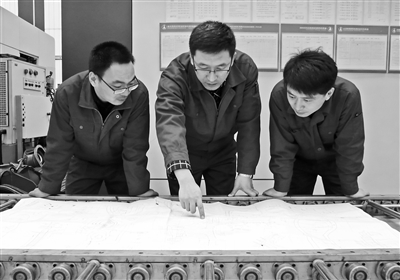
带领学徒“在头发丝上跳芭蕾”——专访国家级技能大师工作室领办人闫文利
Ke Ji Ri Bao· 2026-01-30 03:49
【百家话职教】 ◎科技日报记者 张景阳 通讯员 朱小萌 "我们应通过媒体、展览、公开课等方式,讲好航天工程、深海装备背后的制造故事,让公众认识到没 有技能人才,再好的设计也只是纸上谈兵。" 清晨,内蒙古第一机械集团桥箱公司的车间里还带着隔夜的凉意,特级技师闫文利已经换上深蓝色工 装,站在了他最熟悉的数控机床前。他要带领团队完成车桥主减速器壳体的最后一轮精度调试,这批零 件将用于国家重点装备项目。 闫文利盯着屏幕上的加工路径,突然抬手示意徒弟暂停:"进给量调慢0.02毫米,主轴转速再降50 转。"徒弟愣了一下,刚想追问,却见闫文利俯身贴近正在运转的刀具,"你听,声音有点发颤,这是切 削力要超标的信号。"果然,调整参数后,机床的轰鸣声变得平稳,屏幕上的误差值稳定在了1微米以内 ——这个比头发丝直径还小的精度,正是闫文利从业23年来,刻进骨子里的标准。 作为全国技术能手、国务院政府特殊津贴专家、国家级技能大师工作室领办人,闫文利始终以"微米 级"的执着,在军工制造领域书写新时代工匠的创新答卷。 近日,科技日报记者对闫文利进行专访,探寻他从职校毕业生到国家级技能大师工作室领办人的成长路 径,并了解他如何通过技能创新, ...