Zheng Quan Shi Bao

Search documents
并购金融竞争拼的是银行能力体系
Zheng Quan Shi Bao· 2025-12-24 18:54
Core Viewpoint - The current synergy of policy support and industrial transformation is driving the M&A market into a new phase of structured activity, with commercial banks strategically positioning themselves in the M&A sector, indicating a reshaping of public business patterns and serving as a window to observe how Chinese finance systematically empowers the transformation and upgrading of the real economy [1][2]. Group 1: Industry Trends - The traditional interest margin model is under pressure, making high-tech and high-value-added M&A finance a key option for banks to explore a second growth curve and optimize income structure [1]. - M&A serves as a top-level strategic decision for enterprises, providing banks with a valuable opportunity to upgrade client relationships, transitioning from basic financial service providers to "strategic co-creation partners" for long-term corporate development [1]. Group 2: Competitive Dynamics - As the strategic direction becomes an industry consensus, the core of competition shifts from "whether to layout" to "how to win," with the competition in M&A finance evolving into a contest of deeper capability systems [1]. - Future competitive advantages may depend on three core dimensions: 1. Depth of industry cultivation, requiring banks to establish profound industry insights beyond financial statements in specific cutting-edge fields like AI and biotechnology [2]. 2. Breadth of ecological integration, necessitating collaboration with top investment banks, law firms, accounting firms, and private equity funds to create a stable and trustworthy "service community" for comprehensive solutions [2]. 3. Precision in risk pricing and management, as technology M&A involves new risks that demand advanced risk management tools and models from banks [2]. Group 3: Financial Services Capability - The construction of comprehensive financial service capabilities is becoming crucial for banks to build future core competitiveness, with M&A business serving as a comprehensive test of banks' industry research, transaction design, resource integration, and risk management levels [2].
更大力度引外资 2025年版鼓励外商投资产业目录出炉 更多服务消费领域纳入全国鼓励范围 增加地区特色鼓励条目
Zheng Quan Shi Bao· 2025-12-24 18:53
Core Points - The National Development and Reform Commission and the Ministry of Commerce jointly released the "Encouraged Foreign Investment Industry Catalog (2025 Edition)" which will take effect on February 1, 2026, replacing the 2022 version, reflecting China's commitment to high-level opening-up [1][2] Group 1: Focus on Advanced Manufacturing - The new catalog emphasizes advanced manufacturing, guiding foreign investment towards high-end and intelligent manufacturing sectors, including the development and production of nucleic acid drugs, zero-magnetic medical equipment, intelligent detection equipment, and key components for robots [1][2] Group 2: Modern Service Industry Development - The catalog aims to enhance the high-quality development of the productive service industry, adding items such as new materials common technology platform operations, modern high-end shipping services, and virtual power plant operations, while also addressing consumer upgrade demands by including pet hospitals, sports tourism services, and "Internet + healthcare services" [1][2] Group 3: Regional Investment Expansion - The catalog expands the encouraged investment scope based on regional endowments, adding unique items for specific provinces, such as cruise tourism services in Liaoning, ice and snow equipment R&D in Heilongjiang, and marine environment governance in Hainan, promoting balanced regional development [2][3] Group 4: Policy Incentives for Foreign Investment - Industries included in the encouraged catalog will benefit from various policy incentives, such as exemption from import duties on self-used equipment, a reduced corporate income tax rate of 15% for investments in western regions and Hainan, and tax credit benefits for foreign investors reinvesting profits in eligible sectors [3][4] Group 5: Future Initiatives for Foreign Investment - The National Development and Reform Commission plans to enhance coordination and implementation of foreign investment initiatives, focusing on expediting major foreign investment projects, addressing bottlenecks in land use, environmental assessments, and energy consumption, and providing support for foreign enterprises [4]
引才做“加法” 留才做“乘法”
Zheng Quan Shi Bao· 2025-12-24 18:53
Group 1 - The core driving force behind the transformation of traditional industries and the advancement of emerging industries in Shandong is the emphasis on talent and respect for talent [1] - Jinan's "5150" talent plan originally aimed to attract 150 high-level innovative and entrepreneurial talents over five years, but has successfully brought in three to four hundred PhDs, leading to the launch of the "5150" talent doubling plan [1] - Companies like Shengquan Group emphasize the need to break the salary "ceiling" to attract top talent, setting ambitious goals for annual recruitment of 20 PhDs [1] Group 2 - Retaining and utilizing talent is crucial, with companies like New Henghui focusing on providing platforms for talent to turn their ideals into results [2] - Boyuan Co. has established an integrated system for attracting, nurturing, and retaining talent, linking talent contributions and project benefits to business development [2] - The value of talent is fully realized in the cultivation of new productive forces, with companies achieving significant technological breakthroughs, such as reducing infrared costs and filling industry gaps [2]


上交所发布公司债券受托管理指南
Zheng Quan Shi Bao· 2025-12-24 18:49
Core Viewpoint - The Shanghai Stock Exchange (SSE) has released the "Guidelines for the Management of Corporate Bonds" to enhance proactive credit management by trustees, marking the first specialized guidelines for bond trustee management in the exchange market [1] Group 1: Guidelines Overview - The guidelines integrate the concept of credit management throughout the entire lifecycle of bond products, encouraging proactive credit management efforts and transforming the role of trustees [1] - A roadmap for proactive credit management is provided, detailing monitoring, initiation, implementation, and incentives, along with a toolbox and case studies [1] - Trustees can utilize market-based tools such as bond buybacks and resale, and engage with credit enhancement entities, rating agencies, and valuation institutions to improve issuer credit [1] Group 2: Implementation and Impact - Since the second half of 2024, the SSE has initiated pilot programs encouraging brokers to implement proactive credit management, with several cases already being executed [2] - Issuers have improved their credit ratings and reduced financing costs, while investors have benefited from protected rights and stable returns [2] - The SSE plans to further enhance the quality and efficiency of trustee management services, promoting a tailored development path for brokers and rewarding those with significant proactive credit management results [2]
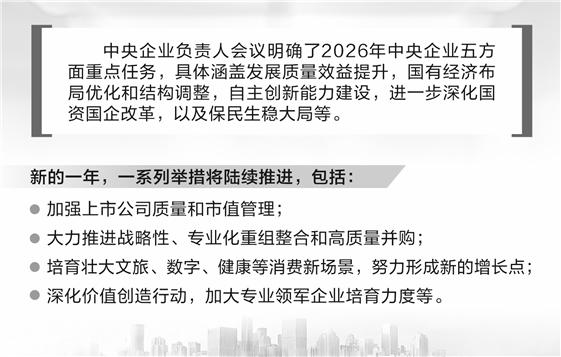
国资委明确2026年央企五大重点任务 大力推进战略性、专业化重组整合和高质量并购
Zheng Quan Shi Bao· 2025-12-24 18:49
Core Viewpoint - The central enterprises' meeting held on December 22-23, 2023, outlined key tasks for 2026, emphasizing stability, quality improvement, and efficiency enhancement in the context of the "14th Five-Year Plan" and the upcoming "15th Five-Year Plan" [2] Group 1: Key Tasks for 2026 - The meeting identified five key tasks for central enterprises in 2026, focusing on improving development quality and efficiency, optimizing the layout and structure of state-owned economy, enhancing independent innovation capabilities, deepening state-owned enterprise reform, and ensuring public welfare and stability [2] - A series of measures will be implemented, including strengthening the quality and market value management of listed companies, promoting strategic and professional restructuring, and facilitating high-quality mergers and acquisitions [2] Group 2: Economic Performance - From January to November 2023, central enterprises achieved a value-added output of 9.5 trillion yuan, representing a year-on-year growth of 1.4% [3] - Fixed asset investment (excluding real estate) reached 3.3 trillion yuan, with a year-on-year increase of 0.7% [3] Group 3: Market Expansion and Management - The meeting emphasized the need to explore various big data and industry models to accurately capture potential market demands and innovate product and service quality [4] - It highlighted the importance of strengthening the quality and market value management of listed companies as a means to stabilize the national economy [5] Group 4: Restructuring and Mergers - Central enterprises are focusing on optimizing their layout and structure, concentrating on sectors related to national security and the economy, and advancing strategic professional restructuring [7] - The meeting underscored the importance of high-quality mergers and acquisitions, encouraging enterprises to seek external resources that complement their strengths [8] Group 5: Innovation and Reform - Central enterprises have invested over 5 trillion yuan in R&D over the past five years, with significant growth in emerging industries [9] - The meeting called for the establishment of a market-oriented research organization management system to enhance the efficiency of innovation resource allocation and to cultivate leading technology enterprises [9] - It also emphasized the need for further reforms in the management and operational systems of state-owned enterprises to enhance their competitiveness [10]

小游戏销售收入突破五百亿元 成为产业重要增量
Zheng Quan Shi Bao· 2025-12-24 18:47
证券时报记者 吴志 在国内游戏产业收入规模再创新高之际,小程序游戏成为不可忽视的增量来源。 根据中国音数协游戏工委近日发布的《2025年中国游戏产业报告》,2025年,国内游戏市场实际销售收入3507.89 亿元,同比增长7.68%;用户规模6.83亿,同比增长1.35%。两项数据均创历史新高。 游戏收入及用户规模同步增长,动力主要来自三方面。一是移动游戏品质提升,新品市场表现出色;二是多款头 部常青游戏创新玩法、优化运营;三是小程序游戏(以下简称"小游戏")的强劲增长。 2025年,我国小游戏市场收入达到535.35亿元,同比大幅增长34.39%。小游戏在游戏市场整体收入中所占的比例 升至15%。如果与2024年的数据对比就会发现,小游戏是2025年游戏市场重要的"增量"来源。 2024年,国内游戏市场实际销售收入为3257.83亿元,同比增长7.53%,再创新高。2025年整体收入较2024年高出 约250亿元。而2024年国内小游戏市场收入398.36亿元,同比增长99.18%,2025年小游戏市场收入较2024年高出约 137亿元。这意味着2025年,小游戏贡献了市场重要的增量来源。 小游戏依托于小程 ...


“人形机器人第一股”拟入主锋龙股份
Zheng Quan Shi Bao· 2025-12-24 18:45
Group 1 - The core point of the news is that the Hong Kong-listed humanoid robot company, UBTECH (09880.HK), plans to acquire a listed A-share company, Fenglong Co., Ltd. (002931.SZ), through a combination of agreement transfer and tender offer, acquiring 93.96 million shares, which accounts for 43% of the total shares [1] - The share transfer and tender offer price is set at 17.72 CNY per share, representing a 10% discount compared to the last trading price of 19.68 CNY before suspension on December 17, with a total consideration of 1.665 billion CNY [1] - UBTECH focuses on the research, design, manufacturing, and commercialization of intelligent humanoid robots, while Fenglong Co., Ltd. specializes in high-tech manufacturing, particularly in lawn mowers and automotive components, indicating a complementary business synergy [1] Group 2 - UBTECH aims to enhance its industrial chain layout and strengthen its core competitiveness through this strategic acquisition, leveraging its technological advantages in humanoid robots alongside Fenglong's manufacturing and supply chain capabilities [2] - The production capacity of UBTECH's industrial humanoid robot, Walker S2, has exceeded 300 units per month, with an expected annual delivery of over 500 units, and plans to increase production capacity to 10,000 units by 2026 [2] - Following the share transfer, the controlling shareholder will change from Chengfeng Investment to UBTECH, with the actual controller changing from Dong Jianggang to Zhou Jian [3]

新能源车企竞争转向存量市场 “复购”成为新增长引擎
Zheng Quan Shi Bao· 2025-12-24 18:43
Core Viewpoint - The competition in the electric vehicle (EV) market is shifting from a focus on new customer acquisition to deepening engagement with existing customers through repurchase policies, as companies aim to enhance customer loyalty and brand value [1][3][7]. Group 1: Market Dynamics - The focus of EV companies has transitioned from "mileage competition" to "technology competition," with an emphasis on smart cabins and user experience [1]. - As early EV models enter a 4-6 year replacement cycle, there is a growing demand for upgrades, prompting companies to implement repurchase incentives [1][3]. - The shift towards a stock market competition reflects the increasing costs of acquiring new customers, making it more advantageous to activate existing customers with positive experiences [3][6]. Group 2: Repurchase Policies - Companies like Li Auto and Tesla are introducing repurchase benefits for existing customers, including cash discounts, warranty transfers, and loyalty points [2][4]. - The repurchase policies are not merely promotional tactics but represent a strategic shift in customer service models, moving towards a full lifecycle user operation approach [1][4]. - The combination of direct discounts and exclusive benefits is becoming a common strategy among EV manufacturers to retain existing customers [4]. Group 3: Customer Engagement - The majority of Chinese electric vehicle users express a strong intention to repurchase EVs, with 99% indicating they would consider buying another electric vehicle [3]. - Companies are exploring ways to create a sense of identity and community among existing customers, such as through social platforms and exclusive events [5]. - The focus is shifting from simple vehicle sales to creating an ecosystem that includes user habits, charging networks, and after-sales services [4][5]. Group 4: Challenges in Repurchase - The low resale value of many EVs poses a challenge to customer repurchase intentions, leading companies to develop certified used car programs to stabilize residual values [6]. - Balancing the benefits for new and existing customers is crucial, as overly generous repurchase policies may alienate new customers [6]. - Managing customer expectations is essential, as existing users may be tempted by new technologies and brands, complicating their repurchase decisions [6]. Group 5: Future Outlook - Companies that can establish emotional connections and systemic advantages with existing customers will likely dominate the stock market competition [7]. - As the penetration rate of EVs continues to rise, repurchase strategies are becoming a key growth driver for the industry [7].
3家在港银行首批参与香港知识产权融资沙盒
Zheng Quan Shi Bao· 2025-12-24 18:43
根据香港此前发布的《行政长官2025年施政报告》,知识产权融资沙盒旨在协助试点行业利用知识产权 资产进行融资。香港金融管理局表示,沙盒提供一个协作和风险可控的环境,让银行、知识产权估值机 构、法律执业者及其他相关专业界别共同测试以知识产权资产(例如专利、商标及版权)为基础的整个 融资安排。 (文章来源:证券时报) 近日,香港金融管理局联同香港商务及经济发展局、香港知识产权署推出知识产权融资沙盒,中国银行 (香港)、汇丰银行、渣打银行(香港)加入沙盒,成为首批参与者。多家生物、电子等行业企业有意 向参与沙盒测试知识产权融资交易。 据介绍,银行可以透过沙盒,获得跨领域专业人士的支持,以及香港金融管理局、香港商务及经济发展 局、香港知识产权署的指导,制定并完善其知识产权融资的安排。这一措施亦能为银行日后提供知识产 权融资累积实务经验,以更好满足创新企业的需要,尤其是拥有丰富知识产权但欠缺有形资产作银行融 资抵押品的中小企业。 ...