
Xin Hua Cai Jing

Search documents
商品日报(1月22日):商品普涨化工板块多头发力 合成橡胶乙二醇苯乙烯携手领涨
Xin Hua Cai Jing· 2026-01-22 09:00
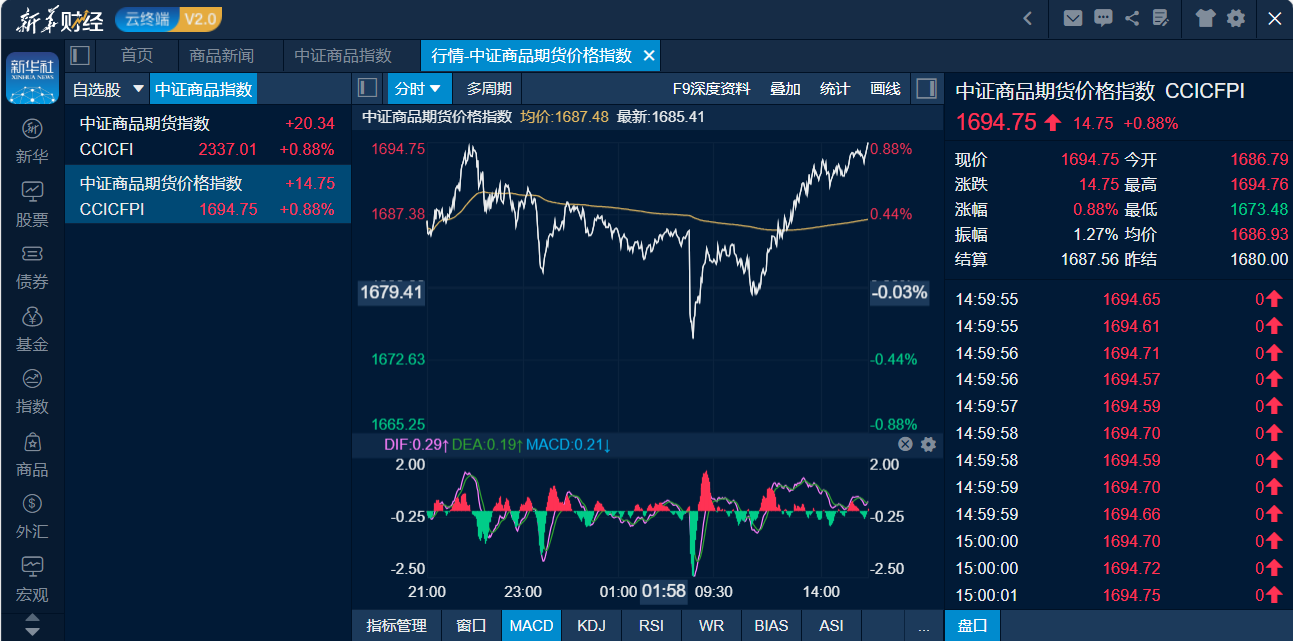
Group 1: Commodity Market Overview - The domestic commodity futures market experienced a broad increase on January 22, with the chemical sector leading the gains, particularly in products like butadiene rubber, ethylene glycol, and styrene, which saw daily increases of over 3% to 4% [1][2] - The China Securities Commodity Futures Price Index closed at 1694.75 points, up 14.75 points or 0.88% from the previous trading day, while the China Securities Commodity Futures Index closed at 2337.01 points, also up 20.34 points or 0.88% [1] Group 2: Chemical Products Performance - Chemical products saw a significant rally, with synthetic rubber, ethylene glycol, and styrene all rising over 4%. This surge is attributed to a strong consensus on the return of a bull market in commodities, with investors shifting focus to the chemical sector after previous gains in precious and industrial metals [2] - Factors supporting this rally include rising oil prices due to geopolitical tensions in major oil-producing countries and increased natural gas prices in Europe and the U.S. due to severe weather, which have positively impacted the cost side for chemical products [2] - Supply-demand mismatches have also contributed to the strength in the chemical sector, with tight supply conditions for butadiene and unexpected shutdowns in styrene production leading to increased speculative activity in the market [2] Group 3: Lithium Carbonate and Other Commodities - Lithium carbonate saw a significant increase, rising nearly 6% to reach a new high, driven by supply uncertainties and strong downstream demand from battery manufacturers. The upcoming Chinese New Year has also led to stockpiling activities [3] - Other commodities, including polysilicon, alumina, tin, eggs, palm oil, and crude oil, also experienced gains of over 1% [3] Group 4: Precious Metals Adjustment - The precious metals sector underwent a high-level adjustment, with gold and silver rebounding to maintain their gains, while palladium and platinum led the declines with drops of 1.90% and 0.92%, respectively [4] - The recent geopolitical tensions and changes in trade policies have impacted the demand for precious metals, leading to a retreat in prices, particularly for palladium and platinum, which have shown weaker monetary attributes [4] Group 5: Sugar Market Dynamics - The sugar market saw a slight recovery after five consecutive days of decline, influenced by overall market improvements. However, expectations of increased global sugar production for the 2025/26 season and the nearing end of the domestic peak season have created a supply surplus against weak demand [5] - Current domestic sugar prices are considered undervalued and close to cost support levels, which may drive prices into a bottoming phase [5]

2026年浙江电网固定资产投资预计超500亿元
Xin Hua Cai Jing· 2026-01-22 08:47
Core Viewpoint - Zhejiang Province plans to invest 51.23 billion yuan in fixed assets for the power grid in 2026, marking a 6.2% increase year-on-year, focusing on the construction of a new power system and technological innovation to support energy transition and economic development [1] Group 1: Investment and Infrastructure Development - The investment will primarily support the construction of a new energy system, with an expected installed capacity of wind and solar power reaching approximately 71 million kilowatts by the end of 2025 [1] - By the end of the 14th Five-Year Plan, the installed capacity of wind and solar power in Zhejiang is projected to exceed 100 million kilowatts, with over 75% of new power sources being non-fossil fuels [1] - The company plans to start 160 projects of 110 kV and above in 2026, with a total line length of 3,373 kilometers and a transformer capacity of 24.96 million kVA [2] Group 2: Load Forecast and Power Supply - The maximum electricity load in Zhejiang is expected to reach 142 million kilowatts in 2026, representing an 8.3% year-on-year increase [2] - The company aims to enhance the power supply capacity and operational resilience of the grid to ensure alignment with power source layout and load growth [1][2] - The construction of a high-reliability, interactive smart distribution network will be accelerated in key areas such as urban centers and high-tech parks [2] Group 3: Strategic Alignment and Economic Impact - The investment strategy will closely align with Zhejiang's 14th Five-Year Plan and major industrial layouts to ensure that funds are directed towards key grid projects that support the construction of a modern industrial system [2] - The company will promote new technologies such as smart distribution and flexible load adjustment to enhance the grid's responsiveness to distributed energy sources and electric vehicle charging [2]
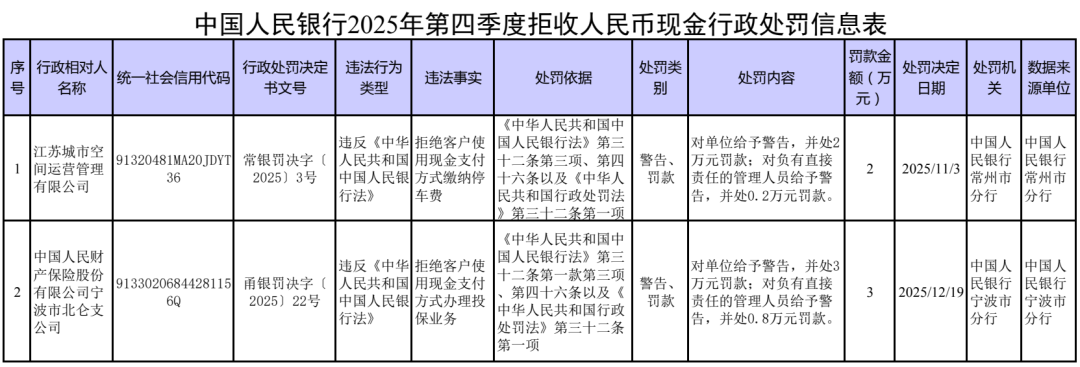
央行2025年第四季度对2家核实为拒收人民币现金的单位及相关责任人依法作出经济处罚
Xin Hua Cai Jing· 2026-01-22 08:47
Core Viewpoint - The People's Bank of China (PBOC) has imposed economic penalties on two entities for refusing to accept cash payments, emphasizing the importance of respecting the public's right to choose payment methods and maintaining the status of the Renminbi as legal tender [1] Group 1: Regulatory Actions - The PBOC will continue to enforce regulations against the refusal of cash payments to protect consumer rights and uphold the legal status of the Renminbi [1] - Two entities were penalized for violating the law regarding cash payments, with one receiving a fine of 0.2 million yuan and the other 0.3 million yuan [2] Group 2: Specific Violations - Jiangsu Urban Management Company was found to have refused cash payments for vehicle fees, leading to a warning and a fine of 0.2 million yuan [2] - China People's Insurance Company was also penalized for similar violations, receiving a warning and a fine of 0.3 million yuan [2]

中钢协:2025年12月会员企业总能耗同比下降6.44%
Xin Hua Cai Jing· 2026-01-22 08:43
Core Insights - The China Steel Association reported on energy conservation and emissions reduction among its member companies for December 2025, highlighting a mixed performance in energy consumption and emissions metrics [1][2]. Energy Consumption - Total energy consumption of member companies decreased by 6.44% year-on-year - Comprehensive energy consumption per ton of steel increased by 4.44% year-on-year - Comparable energy consumption per ton of steel rose by 2.54% year-on-year - Electricity consumption per ton of steel increased by 6.24% year-on-year - Total electricity usage decreased by 0.46% year-on-year - Total self-generated electricity decreased by 1.42%, with a self-generation ratio of 58.95%, down by 0.57 percentage points - Clean energy generation increased by 46.87%, with wind power generation up by 415.13% and photovoltaic generation up by 42.25% [1]. Water Usage - Total water usage increased by 26,102.77 million cubic meters, a year-on-year increase of 3.56% - Water intake decreased by 179.88 million cubic meters, down by 1.55% year-on-year - Reused water increased by 26,282.66 million cubic meters, a year-on-year increase of 3.64% - Water reuse rate improved to 98.49%, up by 0.08 percentage points - Water intake per ton of steel was 2.55 cubic meters, a year-on-year increase of 10.15% [1]. Wastewater and Emissions - Wastewater discharge increased by 1.66% year-on-year - Chemical oxygen demand, ammonia nitrogen, volatile phenols, total cyanides, and suspended solids in wastewater decreased by 29.06%, 29.09%, 46.38%, 81.04%, and 18.63% respectively - Oil pollutants in wastewater increased by 21.25% year-on-year - Total waste gas emissions increased by 4.41% year-on-year, with sulfur dioxide, particulate matter, and nitrogen oxides emissions decreasing by 16.74%, 3.65%, and 19.35% respectively [2]. Solid Waste Utilization - The utilization rates for steel slag, blast furnace slag, and iron-containing dust remained above 99% - The utilization rates for combustible gases such as blast furnace gas, converter gas, and coke oven gas remained above 98%, with converter gas recovery per ton of steel increasing by 1.66% year-on-year [2].
沈阳电网最大负荷连创新高 电力供应保持平稳有序
Xin Hua Cai Jing· 2026-01-22 08:32
据了解,国网沈阳供电公司提前制定《迎峰度冬电力保供工作实施方案》,分解落实68项关键任务清单 及67项常态化任务清单。各级电力调度按照"主配协同、动态调控"策略,科学优化调整电力系统运行方 式,加强设备监视维护。电网运检人员通过无人机巡检、红外测温等先进技术手段对城市"生命线"供电 线路、重要变电站、配电线路等供电设备开展特巡特护,精准排查设备潜在安全隐患,不间断维护消 缺。日均出动特巡人员500余人次、车辆70余台、无人机30余架次,确保冬季电力供应稳定可靠。抢修 队伍随时待命,密切关注天气变化、电网运行、安全生产、重要保电等情况,每日集结应急抢修人员 1034名、抢修车辆263台、应急发电机36台、发电车6辆,确保应急响应快速高效。 (文章来源:新华财经) 近日,沈阳遭遇今冬以来最强寒潮天气,气温降至零下25摄氏度以下,空调制热、电暖气等取暖设备集 中启用,居民采暖、商业取暖等用电负荷大幅攀升,带动全市用电负荷激增约13%。 面对负荷新高,国网沈阳供电公司坚决扛牢电力保供责任,统筹推进电网安全运行、设备精益运维、电 力资源优化配置各项工作,全力保障经济社会发展和民生用电需求。 1月19日至21日,沈阳电网 ...
海南省召开全省金融系统工作会议:重心聚焦到防风险、强监管及高质量发展
Xin Hua Cai Jing· 2026-01-22 08:28
Core Viewpoint - The Hainan provincial financial system meeting emphasized the importance of strengthening risk prevention, enhancing regulatory measures, and promoting high-quality development to support the construction of the Hainan Free Trade Port [1] Group 1: Financial Work Summary - The financial safety situation in Hainan province has further stabilized in 2025, with improved governance efficiency and enhanced financial policy effects [1] - The meeting highlighted the positive outcomes achieved in the province's financial work [1] Group 2: Key Work Arrangements - Five key requirements were proposed for future financial work: strengthening the Party's comprehensive leadership, expanding institutional openness, serving the real economy, effectively preventing financial risks, and continuously enhancing financial regulation [1] - In terms of expanding institutional openness, there is an emphasis on accelerating the implementation of financial opening policies and striving for a new round of financial opening policies [1] - The meeting stressed the need to facilitate the transmission of monetary policy and implement financial tools to support local economic development, including promoting high-quality development in the insurance industry and enhancing the capital market's service capabilities [1]
ESG:截至1月21日当周新加坡燃料油库存下降209.5万桶
Xin Hua Cai Jing· 2026-01-22 08:25
Group 1 - Singapore's fuel oil inventory decreased by 2.095 million barrels, reaching a 13-week low of 23.378 million barrels [1] - Light distillate oil inventory increased by 297,000 barrels, reaching a 41-week high of 1.5821 million barrels [1] - Medium distillate oil inventory rose by 319,000 barrels, reaching a 7-week high of 8.638 million barrels [1]
债市日报:1月22日
Xin Hua Cai Jing· 2026-01-22 08:04
Core Viewpoint - The bond market showed slight weakness with all government bond futures closing down, while the interbank bond yield exhibited mixed trends, indicating a cautious outlook ahead of the Spring Festival and the Two Sessions [1][2]. Market Performance - Government bond futures closed lower across the board, with the 30-year main contract down 0.07% at 112.17, the 10-year main contract down 0.05% at 108.15, the 5-year main contract down 0.04% at 105.835, and the 2-year main contract down 0.02% at 102.408 [2]. - The interbank bond yield showed slight divergence, with the 30-year government bond yield down 0.45 basis points (bps) to 2.2565%, while the 10-year government bond yield increased by 0.05 bps to 1.834% [2]. Overseas Market Trends - In North America, U.S. Treasury yields collectively fell, with the 10-year yield down 5.16 bps to 4.241% [3]. - In Asia, Japanese government bond yields continued to decline, with the 10-year yield down 2.3 bps to 2.266% [3]. - In the Eurozone, yields on 10-year bonds increased, with French bonds up 1.7 bps to 3.541% [3]. Primary Market - The Export-Import Bank's financial bonds had a bid yield of 1.4226% for the 1.2521-year and 1.7028% for the 5.5041-year, with bid-to-cover ratios of 2.63 and 6.74 respectively [4]. - The China Development Bank's financial bonds had a bid yield of 1.6683% for the 3-year and 1.8772% for the 7-year, with bid-to-cover ratios of 2.85 and 3.83 respectively [4]. Liquidity Conditions - The central bank conducted a 7-day reverse repurchase operation with a total amount of 2102 billion yuan at an interest rate of 1.40%, resulting in a net injection of 309 billion yuan for the day [5]. - The Shibor rates showed mixed performance, with the overnight rate rising by 9.1 bps to 1.413% [5]. Institutional Insights - Huatai Securities suggests maintaining a configuration of medium to short-term credit bonds, with a focus on leveraging opportunities in the ultra-long end and government bonds [6]. - CITIC Securities notes that the central bank's balance sheet has expanded steadily, indicating a potential for government bond trading to influence yields [7]. - Guosheng Fixed Income emphasizes that current inflation is not indicative of a broad price increase, suggesting that monetary policy may remain stable or undergo minor adjustments [7].


众安保险:2025年累计赔付179亿元,AI应用融入理赔全流程
Xin Hua Cai Jing· 2026-01-22 08:04
Core Insights - ZhongAn Insurance reported a total claim amount of 17.9 billion yuan for the year 2025, processing an average of 2.9 million claims daily, with a strong focus on integrating artificial intelligence throughout the claims process [2] Claims and Customer Demographics - In 2025, 58.8% of claimants were female, and 53.6% of claims were concentrated among individuals born between the 1950s and 1990s [2] - Common health issues such as coronary artery disease, diabetes, and hypertension were highlighted as key areas of concern for health insurance [2] Pet Insurance Sector - ZhongAn Insurance covered over 5.6 million pets in 2025, with more than 1 million claims processed [2] - The average medical expenses for cats and dogs were reported at 1,489 yuan and 1,664 yuan, respectively [2] New Citizen Services - The company served over 160 million new citizens, providing insurance support to nearly 2,000 enterprises across nine industries, including property, construction, and logistics [2] - ZhongAn Insurance processed 17.88 million claims for small and micro enterprises, amounting to 421 million yuan in claims, supporting their stable operations [2] Disaster Response - The company activated its disaster emergency response mechanism over 100 times, promptly compensating 36.98 million yuan through AI-driven property insurance assessments [2] AI Integration in Health Insurance - AI has been fully integrated into ZhongAn Insurance's health claims process, allowing over 90% of users to submit claims with materials required only once [3] - More than 45% of claims were automatically reviewed and settled, with the fastest resolution time recorded at just 15 seconds [3] Auto Insurance Innovations - The "ZhongAn Car Insurance" mini-program has increased online self-reporting of claims to 88.2% [3] - Innovative services such as NFC emergency assistance and video claims processing have reduced the time for claims under 10,000 yuan to as little as 13.3 minutes [3] Automation in Other Insurance Areas - AI technology is also applied in pet and accident insurance, with over 10,000 cases processed automatically each month and an exceptional accuracy rate of 98% in identifying anomalies [3]

本周环渤海动力煤价格指数小幅下降
Xin Hua Cai Jing· 2026-01-22 08:04
Core Viewpoint - The price index for thermal coal in the Bohai Rim region has slightly decreased, reflecting a balance of market forces amid seasonal demand and supply dynamics [1] Group 1: Market Dynamics - The Bohai Rim thermal coal price index reported at 685 yuan per ton, down by 1 yuan from the previous period [1] - The market is experiencing a tug-of-war between bullish and bearish factors, with a recent cold wave not sufficiently countering the multi-source replenishment at terminals [1] - Coastal coal prices have stopped rising and have slightly declined due to stable shipments from main production areas and sufficient supply at transfer ports [1] Group 2: Seasonal Demand - The winter heating season is in full swing, with daily coal consumption at coastal power plants 300,000 tons higher than the same period last year, indicating strong seasonal demand [1] - The impact of the cold air mass has led to high daily consumption levels, but replenishment at terminals remains stable and orderly [1] Group 3: Future Outlook - As the cold wave subsides and temperatures are expected to rise, coal consumption in the coastal market is anticipated to decline from high levels [1] - With the upcoming Spring Festival, small and medium-sized coal mines and terminal factories will begin to close, leading to a period of weakened supply and demand in the coastal coal market [1] - The probability of coal prices remaining weak and stable in the short term is increasing due to insufficient operational rates in the upstream and downstream sectors [1]