
Xin Hua Cai Jing

Search documents
1月20日中国汽、柴油批发价格分别为7346、6144元/吨
Xin Hua Cai Jing· 2026-01-21 03:28
Core Viewpoint - As of January 20, 2023, China's wholesale prices for gasoline and diesel have both decreased, reflecting a cautious market atmosphere influenced by extreme weather and pressure on major suppliers [1]. Price Changes - The average wholesale price for 92 gasoline is 7346 yuan per ton, down by 5 yuan per ton from the previous day [1]. - The average wholesale price for diesel (including low pour point) is 6144 yuan per ton, down by 17 yuan per ton from the previous day [1]. Market Conditions - On January 19, international crude oil futures prices experienced a slight decline, which contributed to the domestic retail price increase despite the overall downward trend in wholesale prices [1]. - The extreme weather in northern regions has suppressed market transactions, leading to significant discounts in actual sales [1]. - The market sentiment is characterized by caution and a strong wait-and-see attitude among traders [1]. Regional Price Variations - In Sichuan, gasoline wholesale prices have increased, while prices in Qinghai, Inner Mongolia, Shaanxi, Chongqing, Shandong, Jiangxi, Fujian, Henan, Hubei, and Guizhou have decreased [1]. - Diesel wholesale prices have dropped in Fujian, Beijing, Hebei, Chongqing, Shaanxi, Jiangxi, Shandong, Heilongjiang, Sichuan, and Zhejiang [1]. - In Shandong, independent refineries have reported a significant drop in both gasoline and diesel prices [1]. Data Source - The wholesale price data is published by the China Economic Information Agency and the China Petroleum Economic and Technological Research Institute, in collaboration with the Shanghai Petroleum and Natural Gas Exchange Center, providing an authoritative reflection of the overall situation in China's gasoline and diesel wholesale market [1].
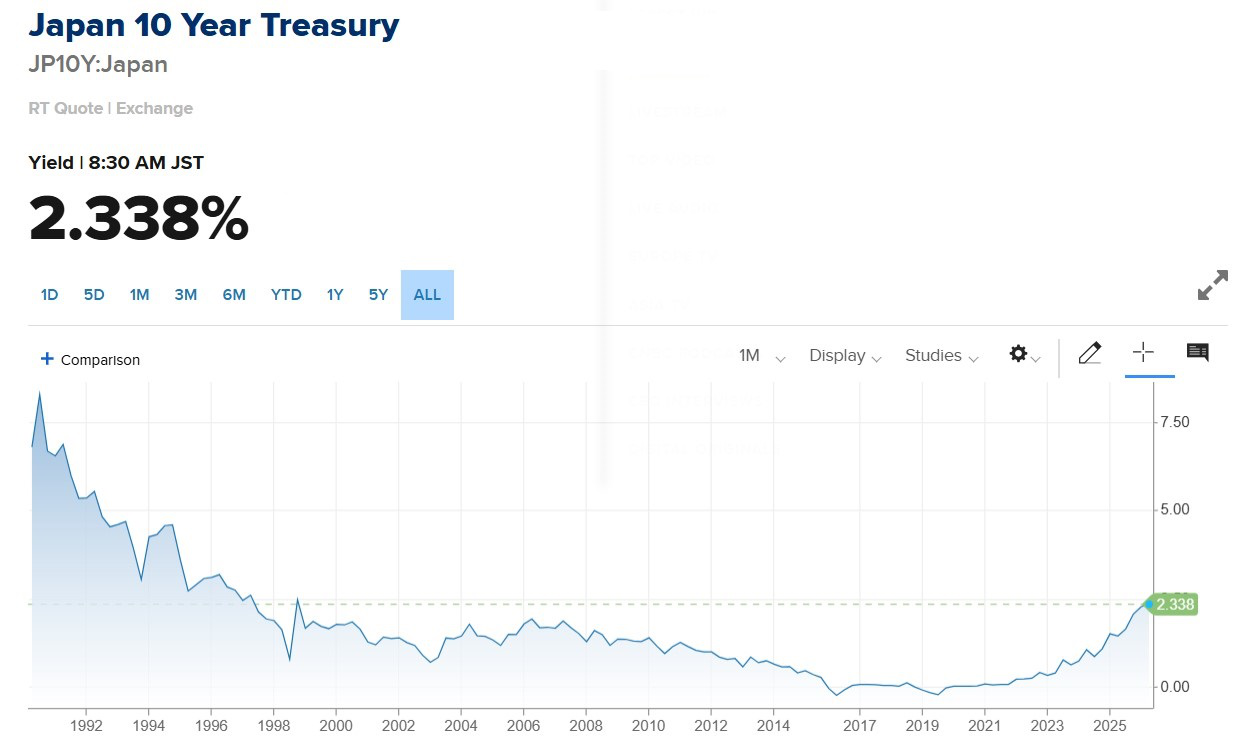
【财经分析】日债收益率创近27年新高:一场政治豪赌与财政风暴的碰撞
Xin Hua Cai Jing· 2026-01-21 03:20
Core Viewpoint - The Japanese bond market is facing its most severe test in over two decades, with the 10-year bond yield reaching a high of 2.338%, marking the highest level since February 1999, driven by political maneuvers ahead of the upcoming House of Representatives election on February 8 [1][3]. Group 1: Political Context and Fiscal Policy - Prime Minister Fumio Kishida announced the dissolution of the House of Representatives, leading to a politically unstable environment as the election approaches [3]. - The ruling Liberal Democratic Party proposed a significant reduction in the consumption tax on food and beverages from 8% to 0% within two years, which is estimated to reduce annual fiscal revenue by approximately 5 trillion yen [3]. - The opposition party has suggested even more radical measures, including the permanent elimination of the food consumption tax, raising concerns about the clarity of funding mechanisms [3]. Group 2: Economic Indicators and Debt Levels - Japan's real GDP is projected to decline by 0.4% quarter-on-quarter in Q3 2025, with personal consumption showing only a marginal increase of 0.1% [6]. - The number of corporate bankruptcies in Japan is expected to reach 10,300 in 2025, the highest since 2013, with a significant proportion being small and medium-sized enterprises [6]. - The government's budget proposal for FY2026 amounts to 122.3 trillion yen, with debt repayment costs reaching a record 31.3 trillion yen, leading to a government debt-to-GDP ratio of 240%, the highest among major developed economies [6][9]. Group 3: Market Reactions and Central Bank Challenges - The bond market has reacted negatively to the government's fiscal expansion, with the 10-year bond yield rising over 0.5% in just three months [8]. - The yen has depreciated significantly against the dollar, prompting intervention from the finance minister to stabilize the currency [8]. - The Bank of Japan faces a dilemma in its monetary policy, having ended negative interest rates in December 2025 but now needing to reassess its approach amid market volatility [8].

工信部:2025年工业和信息化发展呈现“稳”“进”“新”“活”四个特点
Xin Hua Cai Jing· 2026-01-21 03:20
Core Viewpoint - The press conference held by the State Council Information Office highlighted the achievements in industrial and information development by 2025, showcasing four key characteristics: stability, progress, new momentum, and vitality. Group 1: Stability - The industrial and information sector has maintained a stable growth trajectory, with the added value of large-scale industries increasing by 5.9% year-on-year, and the manufacturing sector's contribution to GDP remaining stable, keeping its position as the world's largest for 16 consecutive years [1] - The total telecommunications business volume grew by 9.1% year-on-year, contributing over 40% to economic growth, effectively acting as a "ballast" for the economy [1] Group 2: Progress - The focus on high-quality development has accelerated, with the added value of equipment manufacturing and high-tech manufacturing increasing by 9.2% and 9.4% year-on-year, respectively, outpacing overall industrial growth by 3.3 and 3.5 percentage points [2] - The establishment of over 35,000 basic-level and 8,200 advanced-level smart factories has been achieved, alongside the cultivation of 15 leading smart factories, indicating solid progress in the digital transformation of manufacturing [2] Group 3: New Momentum - Significant advancements in technology and industry innovation have been made, with breakthroughs in major equipment such as ultra-large diameter shield machines and heavy-duty gas turbines, and over 300 key technologies reserved for 6G [3] - The added value of integrated circuits and electronic materials increased by 26.7% and 23.9% year-on-year, respectively, while industrial robot production rose by 28%, and new energy vehicle sales reached 16.49 million, up 28.2% [3] Group 4: Vitality - Reforms in key areas have been accelerated, with actions taken to reduce corporate burdens and clear overdue payments, creating a more vibrant business environment [4] - The cumulative cultivation of over 140,000 specialized and innovative small and medium-sized enterprises has been achieved, with high-tech enterprises reaching 504,000, indicating a robust ecosystem for innovation [4]
【环球财经】2025年12月澳大利亚经济活动领先指数增长率上升 2026年GDP增速预计为2.4%
Xin Hua Cai Jing· 2026-01-21 03:20
Core Viewpoint - The Westpac-Melbourne Institute Leading Index of Economic Activity for Australia shows a slight increase in the six-month annualized growth rate, indicating a continuation of economic recovery into 2026, although the momentum remains weak compared to previous strong growth periods [1][2]. Economic Activity Index - The six-month annualized growth rate of the index rose from a revised 0.2% in November to 0.42% in December 2025 [1]. - The index's growth has accumulated an increase of 0.38 percentage points since mid-2025, moving from 0.04% in June to 0.42% in December [2]. Contributing Factors - The increase in the index is primarily driven by rising commodity prices in Australian dollars and a rebound in residential construction approvals [2]. - The commodity price index rose by 5.4% in the second half of 2025, mainly influenced by increases in gold and copper prices [2]. Economic Forecast - Westpac forecasts a 2.4% growth for the Australian economy in 2026, which is close to the trend level [1]. - The upcoming Reserve Bank of Australia monetary policy meeting is expected to maintain the current benchmark interest rate, with sensitivity to inflation risks noted [2].
机构看金市:1月21日
Xin Hua Cai Jing· 2026-01-21 03:18
Core Viewpoint - The geopolitical tensions surrounding Greenland have led to increased demand for safe-haven assets, driving up the prices of gold and silver to new highs [1][2][3][4]. Group 1: Geopolitical Events and Market Reactions - The situation in Greenland has escalated, with U.S. President Trump asserting his intention to control the territory, which has raised concerns among European investors [1]. - European institutions, including Denmark's Akademiker Pension, are beginning to sell off U.S. Treasury bonds, reflecting a reassessment of their safe-haven status [1]. - The Polish central bank's decision to purchase 150 tons of gold is seen as a significant factor supporting gold prices amid rising geopolitical tensions [2]. Group 2: Price Movements and Predictions - Gold prices are expected to surpass $5,000 per ounce due to new geopolitical uncertainties and concerns regarding U.S. monetary policy [4]. - Silver prices are projected to reach $100 per ounce, although a potential correction may occur as physical shortages improve [4]. - The gold-silver ratio has decreased significantly, indicating a strong upward trend in silver prices, which is also contributing to gold's rise [3]. Group 3: Institutional Insights - Analysts from various institutions highlight that the ongoing geopolitical tensions and U.S. trade policies are primary drivers of the current gold price surge [4]. - The influx of central bank purchases and ETF investments has further propelled gold prices to unprecedented levels [4].
2025年上海GDP同比增长5.4%,三大先导产业制造业产值同比增长9.6%
Xin Hua Cai Jing· 2026-01-21 02:51
Economic Overview - In 2025, Shanghai's GDP reached 56,708.71 billion yuan, reflecting a year-on-year growth of 5.4% at constant prices [1] Industrial Production - Shanghai's industrial added value grew by 5.0% year-on-year, with total industrial output value increasing by 4.6% [2] - Key sectors such as railway, shipbuilding, aerospace, and other transportation equipment manufacturing saw a significant increase of 15.8% in output [2] - The three leading manufacturing industries experienced a 9.6% growth, with integrated circuit manufacturing up by 15.1% and artificial intelligence manufacturing up by 13.6% [2] Service Sector Growth - The tertiary sector's added value increased by 6.0%, with the information transmission, software, and IT services sector leading at a growth rate of 15.3% [3] - The financial sector's added value reached 8,979.66 billion yuan, growing by 9.7% [3] Fixed Asset Investment - Fixed asset investment in Shanghai grew by 4.6%, with industrial investment surging by 20.0%, significantly outpacing the overall investment growth [4] - Urban infrastructure investment rose by 11.2% [4] Consumer Market - The total retail sales of consumer goods reached 16,600.93 billion yuan, marking a 4.6% year-on-year increase [5] - Online retail sales from major enterprises grew by 14.1% [5] Financial Market Activity - Major financial markets in Shanghai recorded a transaction volume of 40.5895 trillion yuan, up by 11.2% [6] - The balance of deposits in financial institutions reached 24.50 trillion yuan, growing by 11.3% [6] Trade Performance - Shanghai's total goods import and export volume reached 4.51 trillion yuan, with exports growing by 10.8% [7] - The export of "new three samples" products increased by 17.4%, including a 13.8% rise in electric vehicle exports [7] Price Trends and Income - The consumer price index (CPI) in Shanghai rose by 0.1%, while the core CPI increased by 0.7% [8] - The average disposable income per capita reached 91,987 yuan, reflecting a growth of 4.1% [9]
撬动需求激活场景 上海农商银行多维助推服务业发展与消费提振
Xin Hua Cai Jing· 2026-01-21 02:14
Core Viewpoint - Shanghai Rural Commercial Bank actively responds to the recently released measures aimed at enhancing service quality and boosting consumption in Shanghai, focusing on enriching personal financial services, activating diverse consumption scenarios, and strengthening support for business entities [2] Group 1: Enriching Financial Services for Diverse Consumer Groups - Shanghai Rural Commercial Bank serves over 24 million individual customers and manages more than 800 billion yuan in personal financial assets, effectively leveraging financial resources to promote consumption [3] - The bank has launched the "Happiness Express" initiative in collaboration with the Shanghai Federation of Trade Unions to enhance the utility of the Union Membership Card, which has over 6 million holders, by providing financial services and connecting with quality consumption products [3] - The bank has introduced consumption discounts and subsidies in partnership with merchants and third-party payment platforms to stimulate offline quality consumption [3] Group 2: Focus on Elderly Population and Quality Consumption - Shanghai Rural Commercial Bank provides pension services to over 1.2 million elderly clients, establishing 114 specialized financial service outlets for seniors and launching the first "Elderly Life Experience Hall" in the city [4] - The bank offers a "Six Special" service system and various subsidies for health and daily living products, enhancing the quality of life for the elderly and promoting consumption [4] - The bank has optimized personal consumption loan services, including preferential auto loan products, to further stimulate quality consumption [4] Group 3: Expanding Service Boundaries in Diverse Consumption Scenarios - The bank is constructing a "Finance + Life" ecosystem by exploring partnerships in transportation, tourism, and health sectors to create a closed-loop service model [5] - In the transportation sector, the bank collaborates with airlines and travel agencies to offer travel consumption rights products and has partnered with Didi Chuxing to provide fare subsidies [5] - In the cultural and entertainment sectors, the bank promotes local tourism through short videos and collaborates with cultural institutions to provide family-friendly cultural experiences [6] Group 4: Strengthening Financing Support for Business Entities - The bank has provided approximately 80 billion yuan in credit support to 24,000 small and micro enterprises, addressing their financial pressures [7] - It has issued over 2.9 billion yuan in entrepreneurial guarantee loans, ranking first in the city, to support employment stability [7] - The bank offers seamless and non-repayment renewal loan services to assist small and micro enterprises in maintaining operational continuity [7] Group 5: Advancing Intellectual Property Financing - Shanghai Rural Commercial Bank leads the city in intellectual property pledge financing and has introduced innovative financial products related to intellectual property [8] - The bank actively engages business entities in intellectual property financial services and provides regular updates on policies to help them benefit from these initiatives [8] - The bank aims to enhance its service offerings to meet high-quality consumption demands and contribute to the development of the service industry [8]
1月20日SPDR黄金持仓量较上日减少4.01吨
Xin Hua Cai Jing· 2026-01-21 01:10
Group 1 - The core point of the article is that as of January 20, the world's largest gold ETF, SPDR Gold Trust, has seen a decrease in holdings by 4.01 tons, bringing the current total holdings to 1081.66 tons [1]
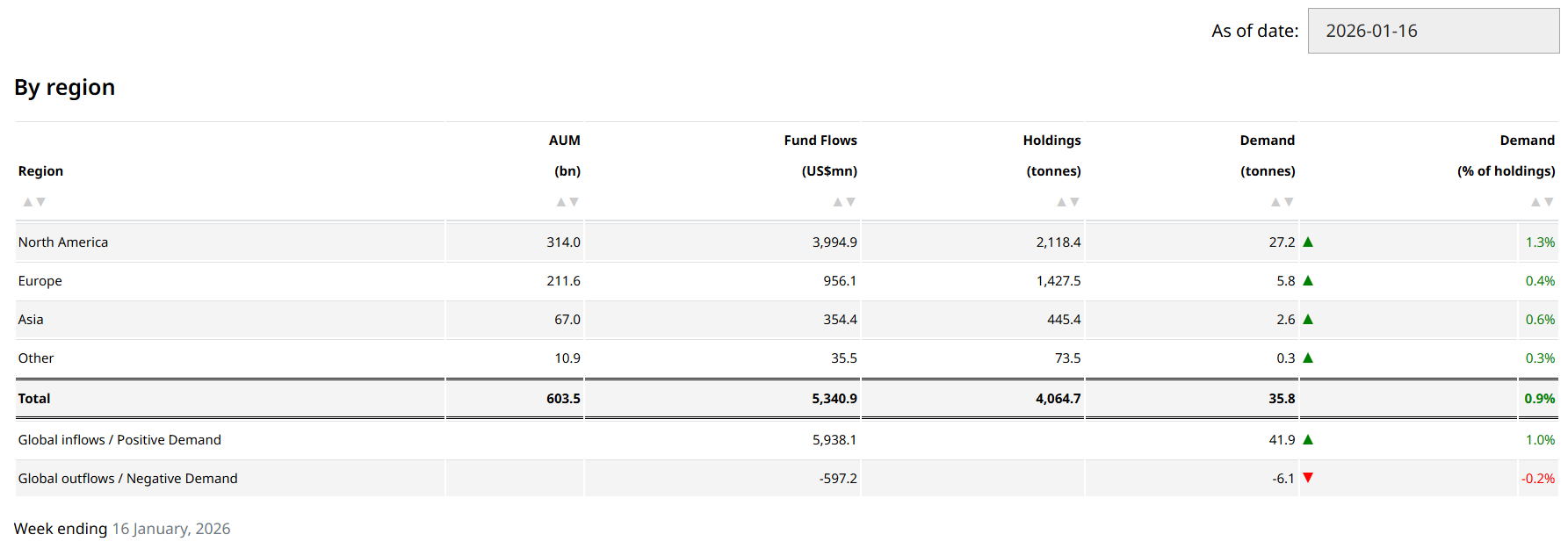
WGC:截至1月16日当周,全球实物黄金ETF净流入53.409亿美元
Xin Hua Cai Jing· 2026-01-21 01:10
Core Insights - The total Assets Under Management (AUM) across various regions amounts to $603.5 billion, with North America leading at $314.0 billion, followed by Europe at $211.6 billion, Asia at $67.0 billion, and other regions at $10.9 billion [1] - Global fund flows indicate a positive demand with inflows of $5,938.1 million, while outflows reflect a negative demand of $597.2 million [1] AUM Summary - North America: AUM is $314.0 billion [1] - Europe: AUM is $211.6 billion [1] - Asia: AUM is $67.0 billion [1] - Other regions: AUM is $10.9 billion [1] - Total AUM: $603.5 billion [1] Fund Flows Summary - North America: Fund flows are $3,994.9 million [1] - Europe: Fund flows are $956.1 million [1] - Asia: Fund flows are $354.4 million [1] - Other regions: Fund flows are $35.5 million [1] - Total fund flows: $5,340.9 million [1]
1月20日iShares白银持仓量较上日增加149.42吨
Xin Hua Cai Jing· 2026-01-21 01:10
Group 1 - The iShares Silver Trust, the world's largest silver ETF, increased its holdings by 149.42 tons as of January 20, bringing the total holdings to 16,222.48 tons [1]