Guan Cha Zhe Wang

Search documents
通用汽车去年第四季度计提70亿美元亏损
Guan Cha Zhe Wang· 2026-01-12 10:31
Core Viewpoint - General Motors reported a significant loss of up to $7 billion in Q4 due to challenges in electric vehicle (EV) transition and restructuring in the Chinese market, leading to a 1.9% drop in stock price after the announcement [1] Group 1: Financial Performance - The company expects to incur a loss of $6 billion related to the electric vehicle transition, alongside $1.1 billion in service fees tied to the restructuring in China [1] - In 2022, General Motors sold less than 170,000 electric vehicles in the U.S., falling short of its previous target of producing 1 million EVs by 2025 [1] - The company plans to report additional significant cash and non-cash expenses related to ongoing commercial negotiations with supply bases in 2026, which are expected to be lower than the 2025 EV-related expenses [1] Group 2: Market Dynamics - The demand for electric vehicles in North America is anticipated to slow down in 2025 due to the termination of consumer tax incentives and the relaxation of emission regulations [1] - In response to declining EV sales, General Motors is reducing its EV production capacity and has reintroduced the low-cost Chevrolet Bolt, despite high tariffs on Chinese imports [2] - The company faced a 43% decline in EV sales in the latter half of the previous year, following the Trump administration's cancellation of the $7,500 EV consumer tax credit [2] Group 3: Competitive Landscape - Ford Motor Company also announced a significant write-down of $19.5 billion and is shifting focus from large electric vehicles to more profitable hybrid and internal combustion engine models [3] - Ford sold 84,100 pure electric vehicles in the U.S. in 2025, which is less than half of General Motors' total sales [3]

中国跃升澳大利亚第二大新车来源国,市占率突破20%
Guan Cha Zhe Wang· 2026-01-12 10:21
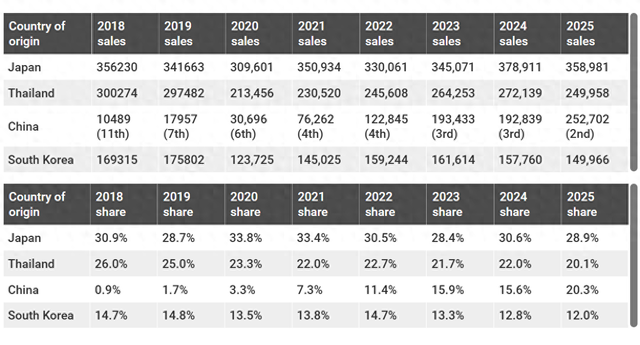
Core Insights - In the past year, Chinese-made cars have surpassed 250,000 units sold in Australia, making China the second-largest source of new cars in the country [1] - The Australian Federal Chamber of Automotive Industries (FCAI) reported that total new car sales in Australia reached 1.209 million units in 2025, with Chinese car sales accounting for 252,702 units, representing a growth rate of over 31% and a market share of 20.4% [1][2] Sales Data - In 2025, the sales figures for cars from various countries are as follows: Japan (358,981 units), Thailand (249,958 units), China (252,702 units), and South Korea (149,966 units) [2] - The market share for Chinese cars has increased from 0.9% in 2018 to 20.3% in 2025, indicating significant growth in the Australian automotive market [2] Brand Performance - Chinese brands such as Great Wall, BYD, and MG have entered the top ten best-selling brands in Australia, with Chery expected to join the ranks by 2026 [3] - BYD's Shark plug-in hybrid electric vehicle (PHEV) has shown strong market performance, contributing to a trend of electric pickups replacing traditional fuel pickups [5] Electric Vehicle Trends - In 2025, plug-in hybrid electric vehicle sales in Australia reached 53,000 units, a 130.9% increase from 2024, while hybrid electric vehicle (HEV) sales totaled 199,000 units, growing by 15.3% [7] - Battery electric vehicle (BEV) sales grew at a slower pace, reaching 103,000 units, a mere 1.1% increase, accounting for 8.3% of total passenger car sales [7] - The top ten electric vehicle models sold in Australia in 2025 were predominantly from Chinese manufacturers, with new entrants including Deep Blue, Leap Motor, and Zeekr [7]


万联易达冯波:以“AI+物流”驱动整车运输效率提升
Guan Cha Zhe Wang· 2026-01-12 09:28
在近日中国物流与采购联合会主办的"2025(第八届)物流与供应链平台年会暨东疆新型物流产业高质量发展大会"上,万联易达物流科技公司副总经理冯波以 《AI赋能整车物流循环线路规划》为主题,分享了万联易达在智慧物流领域的前沿探索与实践成果。 当前,"万连通"作为万联易达物流服务平台"AI+物流"解决方案落地的关键载体,已整合网络货运、物流撮合、智慧场站、万联驿站(车后电商)等多元服 务,连接超3万家货主企业、汇聚优质运力超400万,通过技术与场景的深度融合,持续赋能物流产业生态的协同效率与数智化进程。 作为以生产性服务业平台运营为主业的产业互联网公司,万联易达通过构建新型产业互联网生态系统,打造全产业可信数据空间,依托线上平台与线下服 务,为企业提供商品交易,物流仓储,数智金融,数字科技,人工智能,产业资讯,商务服务以及其他全方位、多样化服务。后续,万联易达将持续深化 AI与大数据在物流场景的创新应用,携手生态伙伴,共同推动物流生态的高质量可持续发展。 冯波指出,当前整车物流运行模式长期依赖人工经验,面临效率低下、空驶率高、全局优化难等挑战。针对这一行业痛点,万联易达推出的"AI+物流"解决 方案构建了以"车-货 ...

真要动武?特朗普:伊朗“正开始”触碰美国的红线,强硬措施已备好
Guan Cha Zhe Wang· 2026-01-12 09:24
【文/观察者网 张菁娟】随着"暴徒"和武装人员在伊朗全国各地的暴力行为导致数百名伊朗人民和安全 人员死亡,美国政府的干预之手加快伸向伊朗。 综合《纽约时报》、半岛电视台等媒体报道,当地时间1月11日,美国总统特朗普在"空军一号"上告诉 记者,伊朗方面"正开始"触碰美国的红线,美国正在考虑应对伊朗局势的一系列措施,包括军事行动 等"一系列非常强硬的选项",具体决定将择机公布。 对此,上海外国语大学中东研究所教授刘中民告诉观察者网,目前不排除美国以特定方式对伊朗实施打 击,但发动大规模战争的可能性极低。他指出,特朗普政府有两方面的顾虑,一是行动尺度的拿捏,二 是行动方式选择存在困境。 美官员透露:方案涵盖军事、网络、经济等多重手段 据报道,特朗普在专机上表示,自己正每小时接收一份伊朗局势最新报告,同时发出警告,任何针对美 国利益的袭击,都将招致美方反击。 他还透露,在美方发出军事打击威胁后,伊朗领导层已主动致电寻求 "谈判磋商",相关 "会晤安排正在 推进中"。但同时强调,"会晤召开前,我们或许不得不采取行动"。 同日,《华尔街日报》援引美国官员的话报道称,特朗普计划于周二(13日)听取针对伊朗抗议活动的 应对方 ...

岚图汽车与华为引望深化战略合作,着力智驾智舱软件开发
Guan Cha Zhe Wang· 2026-01-12 09:00
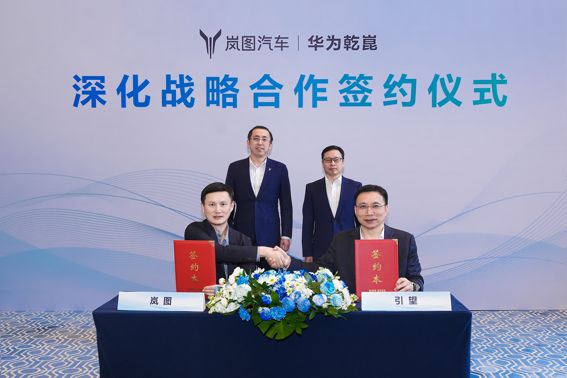
Group 1 - The core viewpoint of the article is the deepening strategic cooperation between Lantu Automotive and Huawei's subsidiary, focusing on smart driving and smart cockpit development, as well as joint operations for consumer software [1][3] - A joint team for consumer software operations will be established to enhance the marketization of software services and improve user experience [1] - The partnership aims to expand market scale through collaborative marketing and brand standardization efforts [1] Group 2 - In 2024, Lantu signed a strategic cooperation agreement with Huawei's subsidiary, and in September, Dongfeng and Huawei upgraded their cooperation to cover areas such as automotive intelligence and digital enterprise [3] - Lantu has initiated an "ALL in smart" strategy, equipping all models with Huawei's advanced driving and smart cockpit technologies [3] - By 2025, Lantu had delivered over 150,000 vehicles, marking an 87% year-on-year growth and becoming the first high-end new energy brand among state-owned enterprises to achieve a production and sales scale of 300,000 vehicles [4]
叮当健康荣获港股“年度最具成长潜力公司” 数字化健康生态与专业服务共筑长期投资价值
Guan Cha Zhe Wang· 2026-01-12 08:13
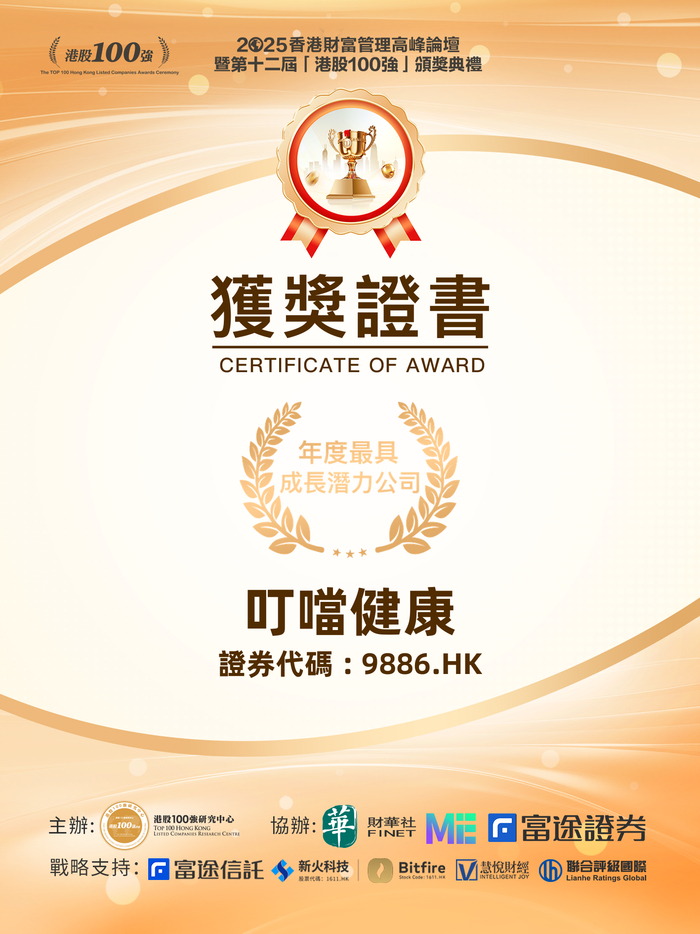
依托智慧化"仓店一体"系统与线上线下资源深度融合,叮当健康已实现7×24小时快速响应、平均28分钟 送药上门的行业领先服务标准,重新定义了医药零售的即时性与可靠性,为后续规模扩张与跨区域复制 奠定技术基础。 "医药检险"生态闭环,构筑模式护城河 2025年1月9日,在香港财华网"港股100强"峰会上,即时健康到家企业叮当健康成功获评"年度最具成长 潜力公司"。此次奖项的颁发,不仅是对公司过往成绩的肯定,更是对未来在港股市场中持续增长潜力 的高度认可。从投资视角来看,叮当健康的成长潜力主要源于其在科技赋能、模式护城河及标的独特性 三大维度的系统性构建。 科技驱动效率革命,打造智慧健康新基建 叮当健康持续加大数字化投入,自主研发并升级"叮当大脑—星垣系统",整合华北、华中、华东、华南 四大智能仓、千寻分拣、天眼智址、MedNOW等子系统,实现了从仓储、分拣到配送的全链路智能化 管理。公司应用AI库存预警与自动调度系统,在季节性需求高峰前完成精准备货,同时通过自助拣药 扫码设备,将单订单处理时间缩短至10余秒,大幅提升运营效率与稳定性。 叮当健康以"以健康管理为中心",逐步构建起集在线咨询、药品配送、到家检测、医保 ...
发布15年后,iPhone 4突然爆火
Guan Cha Zhe Wang· 2026-01-12 08:01
Core Viewpoint - The resurgence of the iPhone 4 on social media platforms, particularly TikTok, highlights a nostalgic trend among younger generations, with a significant increase in search interest for purchasing the device, indicating a shift in consumer preferences towards retro technology [1][3]. Group 1: Market Trends - In 2025, searches for "buy iPhone 4" increased by 979%, reflecting a growing demand for this classic model [1]. - The iPhone 4 is seen as a symbol of nostalgia and individuality, contrasting sharply with modern smartphones that feature larger screens and rounded designs [3][8]. Group 2: Cultural Impact - The iPhone 4's camera capabilities, despite being limited by modern standards, have gained popularity for their unique aesthetic, with over 700,000 posts related to retro photography on TikTok [3][4]. - The trend towards using the iPhone 4 for photography is attributed to its "Lo-fi" quality, which resonates with users seeking emotional and narrative depth in their images [4][6]. Group 3: Brand Perception - The revival of interest in the iPhone 4 has sparked discussions about the legacy of Steve Jobs and the perceived decline of Apple's innovation in recent years [6][8]. - Many users express a longing for the design and groundbreaking features of the iPhone 4, viewing it as a pivotal product that established Apple's market position [8].


创纪录!沪指17连阳,三市成交额超3.6万亿
Guan Cha Zhe Wang· 2026-01-12 07:41
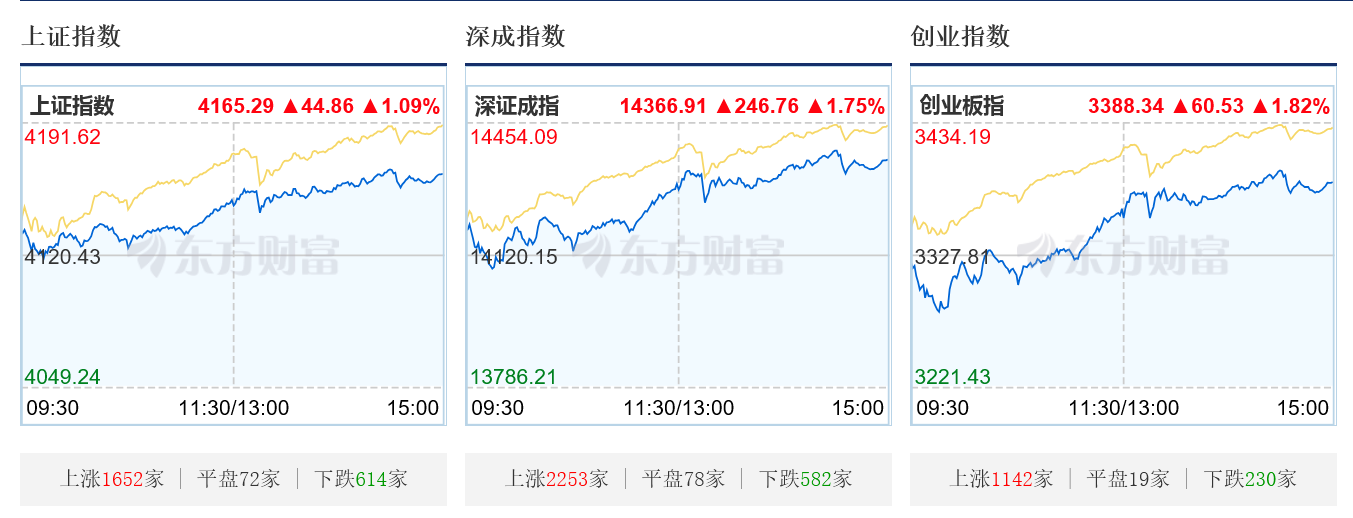
据东方财富网数据,1月12日,A股三大指数全天震荡拉升,沪指日线17连阳,突破4100点。截至收盘,沪指涨1.09%,深证成指涨1.75%,创业板指涨 1.82%。 值得注意的是,沪深京三市成交额超过3.6万亿,较上一交易日大幅放量近5000亿,创A股历史最大成交量。 盘面上,市场热点快速轮动,全市场超3900只个股上涨,连续2日超百股涨停。AI应用概念集体爆发,二十余只成分股涨停,引力传媒5天4板,省广集团、 会畅科技、粤传媒、易点天下涨停。商业航天概念反复活跃,鲁信创投11天9板,中国卫通9天5板,金风科技4连板,航天电子6天4板。可控核聚变概念延续 强势,弘讯科技、中国一重双双3连板。下跌方面,脑机接口概念下挫,美好医疗、倍益康跌超10%。 (观察者网综合东方财富网、智通财经、智通财经及其他公开资料) 本文系观察者网独家稿件,未经授权,不得转载。 据Wind统计,A股成交额突破3万亿元此前总共发生了6次,分别是2024年10月8日,2025年8月25日、8月27日、8月28日和9月18日,2026年1月9日。此前最 高成交量记录为2024年10月8日创下的3.47万亿元。 板块方面,豆包大模型、AI语料 ...
受制于英特尔指令集?兆芯总工:掌握CPU设计全部源码
Guan Cha Zhe Wang· 2026-01-12 07:01
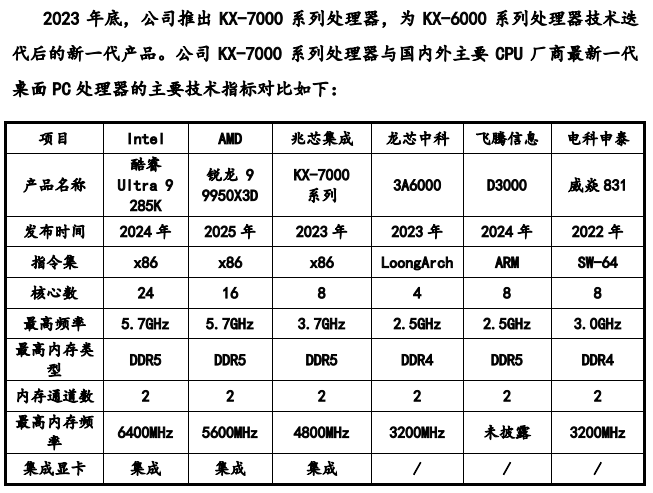
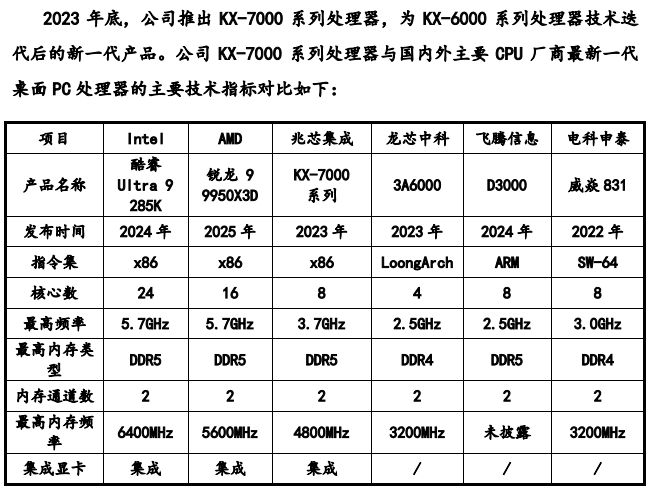
Core Insights - The domestic CPU market is entering a critical development phase, with increasing market scale and applications in key sectors such as finance, education, energy, and transportation [1] - The shipment volume of desktop CPUs in key sectors is expected to grow from approximately 2 million units in 2022 to about 4 million units in 2024, and potentially reach 9-9.5 million units by 2027, with a compound annual growth rate (CAGR) of 35%-40% from 2022 to 2027 [1] - The server CPU shipment volume is projected to increase from 1.1-1.3 million units in 2022 to 1.8-2 million units in 2024, and reach 2.8-3 million units by 2027, with a CAGR of around 20% [1] - Zhaoxin's General Manager Wang Weilin emphasized the importance of improving the usability of domestic CPUs to gain user acceptance [1] Company Overview - Zhaoxin Integrated was established in 2013 and is preparing for an IPO, with revenue projected to grow from 340 million yuan in 2022 to 889 million yuan in 2024, representing a CAGR of 61.71% [2] - The company reported a narrowing loss of 676 million yuan in 2023, a year-on-year increase of 7.03%, with losses expected to rise to 951 million yuan in 2024 [2] Product Development - Zhaoxin has developed multiple generations of its proprietary CPU architecture, with core counts ranging from dual-core to 96-core and clock speeds from 1.6GHz to 3.7GHz [4] - The KX-7000 desktop processor, released in 2023, has performance comparable to AMD's Ryzen 5 4500 CPU, and has been commercially deployed by brands such as Lenovo and Tsinghua Tongfang [4] - The company plans to raise 4.169 billion yuan through its IPO to invest in new server and desktop processor projects, as well as advanced technology research and development [7] Market Position and Challenges - Despite the growth of domestic CPUs, Intel and AMD continue to dominate the global CPU market, with Intel projected to generate $53.1 billion in revenue and AMD $25.8 billion in 2024 [7] - Zhaoxin has developed a complete intellectual property system for its ZX86 instruction set, ensuring independence from Intel's licensing issues [6] - The company aims to adopt a more open strategy in technology applications and collaborations to support the entire domestic server industry ecosystem [7]
受制于英特尔X86指令集?兆芯总工程师:掌握CPU设计全部源码
Guan Cha Zhe Wang· 2026-01-12 06:45
Core Viewpoint - The domestic CPU market is entering a critical development phase, with increasing application in key sectors and significant growth in shipment volumes expected in the coming years [1][6]. Group 1: Market Growth and Projections - The shipment volume of desktop CPUs in key foundational sectors is projected to grow from approximately 2 million units in 2022 to about 4 million units in 2024, and is expected to reach 9-9.5 million units by 2027, with a compound annual growth rate (CAGR) of 35%-40% from 2022 to 2027 [1]. - The shipment volume of server CPUs in key foundational sectors is expected to increase from 1.1-1.3 million units in 2022 to 1.8-2 million units in 2024, and is projected to reach 2.8-3 million units by 2027, with a CAGR of around 20% from 2022 to 2027 [1]. Group 2: Company Performance and Financials - Zhaoxin Integrated, established in 2013, is preparing for an IPO, with revenue projected to grow from 340 million yuan in 2022 to 889 million yuan in 2024, reflecting a CAGR of 61.71% over three years [2]. - The company reported a narrowing loss of 676 million yuan in 2023, a year-on-year increase of 7.03%, with losses expected to rise to 951 million yuan in 2024 [2]. Group 3: Technological Advancements - Zhaoxin has developed multiple generations of its proprietary microarchitecture, with the latest KX-7000 desktop processor achieving performance comparable to AMD's Ryzen 5 4500 CPU [4]. - The company has established a complete intellectual property system for its ZX86 instruction set, ensuring independence from Intel's licensing issues [6]. Group 4: Industry Challenges and Strategies - Despite the growth of domestic CPUs, Intel and AMD continue to dominate the global CPU market, with Intel projected to generate $53.1 billion in revenue and AMD $25.8 billion in 2024, highlighting the technological and ecological gaps that still exist [6]. - Zhaoxin plans to adopt a more open strategy in technology application and promotion, aiming to support the entire domestic server industry ecosystem [7].