
Shen Zhen Shang Bao

Search documents
奥特曼和马斯克互撕!特斯拉Roadster退款风波点燃新骂战
Shen Zhen Shang Bao· 2025-11-04 06:38
Core Points - The recent public dispute between OpenAI CEO Sam Altman and Tesla CEO Elon Musk centers around the delayed delivery of the Tesla Roadster and refund issues, highlighting their long-standing tensions regarding AI development [1][2][3] - Musk's xAI company suggested that investing in Tesla stock would have yielded a 21-fold return over the past seven years, contrasting with Altman's frustrations over the Roadster delivery [1] - The conflict reflects deeper ideological differences between Musk and Altman regarding the direction of AI, with Musk advocating for caution and Altman pushing for commercialization [2][3] Company Developments - OpenAI has recently announced significant partnerships with major companies like NVIDIA, Broadcom, and Oracle to enhance its AI infrastructure [4] - Altman expressed optimism about OpenAI's revenue forecasts, claiming that the company's actual revenue exceeds the projected figures despite a reported annual income of $13 billion [4] Historical Context - Musk was removed from the OpenAI board in February 2018 and subsequently founded xAI in April 2023, establishing a competitive relationship between the two entities [2] - Musk has repeatedly criticized OpenAI, claiming it deviated from its original mission and has initiated legal action against Altman and OpenAI's president for alleged breaches of their founding agreement [3]

35家百亿私募持仓市值700亿元
Shen Zhen Shang Bao· 2025-11-04 06:35
Group 1 - The core viewpoint of the articles highlights the recent movements of large private equity firms in the stock market, particularly focusing on their significant holdings in various sectors such as computers, food and beverages, and electronics [1] - As of October 31, 35 large private equity firms have reported holdings in 203 stocks, with a total market value exceeding 700 billion yuan [1] - Gao Yi Asset, led by Qiu Guolu, has significant positions in 18 companies, with Hikvision (002415) being the largest holding valued at 8.826 billion yuan, despite a reduction of 58 million shares in the third quarter [1] - Another firm, Zhongyang Investment, maintained its position in Xinhecheng (002001) with 61.1781 million shares, valued at 1.458 billion yuan, while also entering new positions in several other stocks [1] Group 2 - Some large private equity firms have announced a suspension of new investments, such as Ningquan Asset, which will stop accepting new subscriptions from October 30, while existing investors can still make additional purchases [2] - In the third quarter, Ningquan Asset increased its holdings in Zhuming Technology (300232) by 6.5721 million shares and made new investments in Fuanna (002327) with 605.12 thousand shares [2] - Starstone Investment believes that the market still has internal driving forces, with short-term uncertainties affecting risk appetite, while medium-term uncertainties are expected to ease, indicating a potential continuation of a bull market [2]





大手笔!218家公司拟分红466亿元
Shen Zhen Shang Bao· 2025-11-04 06:26
Core Viewpoint - Over 200 listed companies in A-shares have announced dividend plans, with a total planned dividend amount of 466.19 billion yuan as of October 31 [1] Group 1: Industry Distribution - Significant dividends are frequently seen in industries such as food and beverage, pharmaceuticals, electronics, media, automotive, and agriculture [1] - More than 20 companies in the pharmaceutical and basic chemical industries, machinery equipment, and automotive sectors have announced dividends [1] - Approximately 100 companies have joined the dividend distribution for the first time this quarter, with several companies consistently distributing dividends multiple times a year [1] Group 2: Leading Companies and Their Dividend Plans - Leading companies are the main contributors to large dividends, with Wuliangye (000858) planning to distribute 25.78 yuan per 10 shares, totaling approximately 100.07 billion yuan [2] - Gree Electric (000651) plans to distribute 10 yuan per 10 shares, amounting to 55.85 billion yuan, and has distributed over 177.6 billion yuan since its listing [2] - Yili (600887) intends to distribute a total of 30.36 billion yuan in dividends [2] - Wen's Food (300498) plans to distribute 3 yuan per 10 shares, totaling 19.94 billion yuan, with cumulative dividends of 30.11 billion yuan since 2015 [2] - Gigabit (603444) plans to distribute 60 yuan per 10 shares, totaling approximately 4.31 billion yuan [2] - Dahua Technology (002236) plans to distribute 1.85 yuan per 10 shares, with a total cash dividend of about 6.02 billion yuan [2] Group 3: Companies with Consistent Dividend Distribution - Long-term dividend distribution is observed in companies like Longbai Group (002601), which has distributed dividends quarterly since 2019 [3] - Mindray Medical (300760) plans to distribute 13.5 yuan per 10 shares, totaling 16.37 billion yuan, with cumulative dividends of 37.3 billion yuan since its listing [3] - Other companies maintaining multiple dividend distributions within a year include Guilin Sanjin (002275) and Linglong Tire (601966) [3] Group 4: Market Trends and Insights - The capital market's focus on asset allocation is increasing, with policies aimed at enhancing the quality of listed companies and encouraging higher dividend payouts [3] - These measures are intended to protect and increase residents' wealth, thereby stimulating consumption and investment potential [3]

工行建行暂停部分如意金积存业务申请
Shen Zhen Shang Bao· 2025-11-04 06:22
Core Viewpoint - The recent announcements by Industrial and Commercial Bank of China (ICBC) and China Construction Bank (CCB) to suspend certain gold accumulation services are responses to macroeconomic policy directions and market volatility, aiming to regulate market order and manage risk exposure [1][2]. Group 1: Bank Actions - ICBC has suspended the acceptance of new accounts, proactive accumulation, new fixed accumulation plans, and applications for physical gold extraction from November 3, while existing customers' fixed accumulation plans remain unaffected [1]. - CCB has also suspended real-time purchases, new investment purchases, and physical gold exchanges for its easy storage gold business, effective from November 3, while existing investment plans and account operations remain intact [1]. Group 2: Market Regulation - The banks' actions are seen as routine measures to align with macroeconomic policies aimed at curbing irrational trading and preventing systemic risks associated with price volatility in the precious metals market [2]. - The recent announcement by the Ministry of Finance and the State Taxation Administration regarding gold tax policies, effective from November 1, 2025, is expected to further influence the market dynamics [2]. Group 3: Consumer Impact - The decision to reduce new fund inflows is intended to guide investors towards more rational participation in precious metal trading, thereby avoiding excessive speculation that could heighten market volatility [3]. - Existing customers' rights regarding active accumulation plans, redemptions, and account closures remain unchanged, indicating that the new policies do not adversely affect current users [3].


社保基金现身617只个股前十大
Shen Zhen Shang Bao· 2025-11-04 06:21
Core Insights - The Social Security Fund has shown significant activity in the stock market, with a presence in the top ten shareholders of 617 companies by the end of Q3, indicating a strategic investment approach [1][2] - The fund has newly entered 188 stocks and increased holdings in 156 stocks during the third quarter, reflecting a proactive investment strategy [1] Group 1: Stock Holdings - The highest holding percentage by the Social Security Fund is in Andar Intelligent, with a 10.57% stake, followed by Norshig with an 8.16% stake [1] - The largest market value of holdings is in Sany Heavy Industry, amounting to 4.142 billion yuan, closely followed by BYD with 4.037 billion yuan [1] - There are 23 stocks where the Social Security Fund holds over 100 million shares, with the largest being Focus Media at 333 million shares [1] Group 2: New Investments - The most significant new investment by the Social Security Fund in Q3 was in China Metallurgical Group, with 100.36 million shares acquired, followed by Longi Green Energy and Haier Smart Home with 79.08 million and 74.87 million shares, respectively [2] - The company with the most Social Security Fund products in the top ten shareholders is Shantui, with five different fund products holding a total of 85.16 million shares, representing 6.48% of the circulating shares [2] Group 3: Investment Style - The investment style of the Social Security Fund is characterized as long-term and stable, focusing on companies with steady growth in performance [2] - The fund's investments span traditional cyclical industries such as machinery, chemicals, and non-ferrous metals, as well as emerging sectors like electronics, new energy, and biopharmaceuticals [2]
星巴克中国易主!最新官宣
Shen Zhen Shang Bao· 2025-11-04 06:13
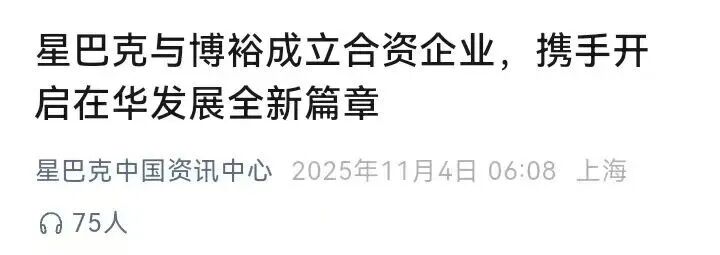
Core Viewpoint - Starbucks has announced a strategic partnership with Boyu Capital to establish a joint venture for its retail operations in China, with Boyu holding up to 60% equity and Starbucks retaining 40% [1][3]. Group 1: Joint Venture Details - The joint venture will be based on an enterprise value of approximately $4 billion, excluding cash and debt, with Boyu acquiring corresponding equity [1]. - Starbucks expects the total value of its retail business in China to exceed $13 billion, which includes the value from the equity transfer to Boyu, retained equity in the joint venture, and ongoing royalty income over the next decade [1]. Group 2: Market Performance - Starbucks reported a 5% year-over-year revenue growth in Q4 2025, reaching $9.6 billion, and a total annual revenue of $37.2 billion, up 3% [3]. - The Chinese market showed significant recovery, with Q4 revenue reaching $831.6 million, a 6% increase year-over-year, and total revenue for FY2025 at $3.105 billion, up 5% [3]. Group 3: Expansion and Growth Strategy - In Q4, Starbucks opened 183 new stores and entered 47 new county-level markets, with a total of 415 net new stores for FY2025 [4]. - By the end of FY2025, Starbucks had opened 8,011 stores across 1,091 county-level cities in China, with new stores contributing above-average same-store sales [4].


董事、副总经理双双辞职!美芝股份连续亏损多年卖房自救
Shen Zhen Shang Bao· 2025-11-04 01:17
Group 1 - The company Shenzhen Meizhi Decoration Design Engineering Co., Ltd. announced the resignation of board member Ms. Hu Die and Vice General Manager Mr. Wan Zheng due to personal reasons [1] - Ms. Hu Die's resignation will not reduce the board members below the legal number, but it will cause the audit committee to fall below the legal number [1] - The company plans to complete the election of new non-independent directors and audit committee members as soon as possible [1] Group 2 - Meizhi has experienced continuous losses in recent years, with revenues of 588 million, 1.667 billion, 878 million, and 704 million from 2021 to 2024, respectively [2] - The net profit attributable to the parent company has also been negative, with figures of -161 million, -143 million, -174 million, and -257 million during the same period [2] - For the first three quarters of 2025, the company reported total revenue of 241 million and a net profit of -44.258 million [2] Group 3 - The company was established in 1984 and specializes in various construction-related services, including decoration design, curtain walls, and mechanical and electrical installations [2] - To optimize resource allocation, the company plans to transfer 50 real estate properties through public listing, with a total area of 3,097.90 square meters and a base price of 39.31 million [2]


这两家永辉超市,16日停止营业
Shen Zhen Shang Bao· 2025-11-03 16:23
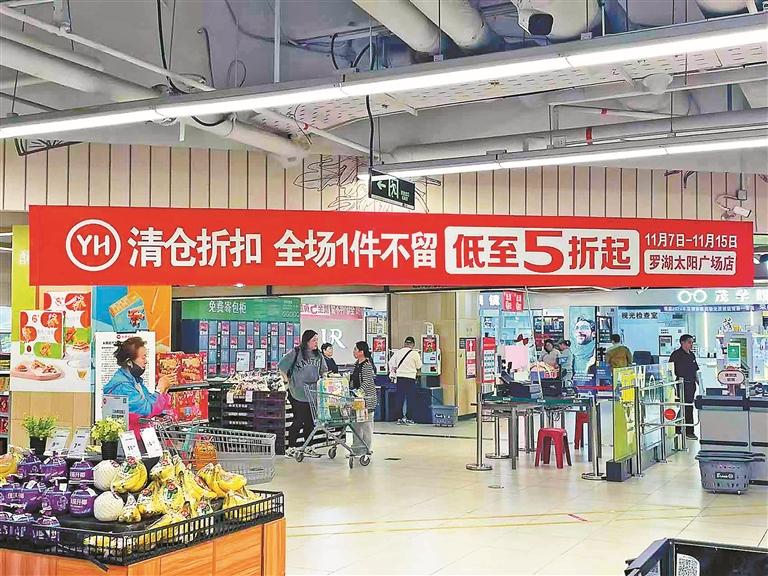
Group 1 - The core point of the news is that Yonghui Supermarket is closing two stores in Shenzhen's core business districts, indicating a shift in its operational strategy amid significant financial losses [2][3]. - Yonghui Supermarket's third-quarter report revealed a revenue of 42.434 billion yuan, a year-on-year decline of 22.21%, and a net profit attributable to shareholders of -710 million yuan, marking a substantial increase in losses [2][4]. - The company has closed a total of 325 stores this year, with 102 closures in the third quarter alone, while only opening 2 new stores, reflecting its ongoing strategy of "closing old stores to renovate" [3]. Group 2 - As of September 30, Yonghui Supermarket had 450 operating stores, a significant reduction from 775 at the end of 2024, primarily due to the closure of underperforming stores [3]. - The closures now include stores in core business areas, such as the Luo Hu Sun Plaza store, which was previously recognized as a "national quality store" under Yonghui's "original intention plan" [3]. - The company aims to close between 300 and 350 stores by the end of 2025, with a focus on refining store operations and restoring the pace of new store openings [3]. Group 3 - Yonghui Supermarket's stock price has declined by 26% this year, resulting in a market capitalization of 42.5 billion yuan [4]. - The company's total assets decreased from 42.749 billion yuan at the end of the previous year to 31.620 billion yuan, a drop of 26.03% [4]. - Yonghui has announced a new positioning strategy called "National Supermarket Quality Yonghui," initiating a "product centralization" strategy aimed at developing billion-level flagship products over the next three years [4].

上市快递四巨头业绩分化
Shen Zhen Shang Bao· 2025-11-03 16:21
Core Viewpoint - The express delivery industry in China is experiencing significant performance differentiation among major listed companies, driven by the ongoing effects of the "anti-involution" policy, leading to a shift from scale expansion to quality upgrades in operations [1][4]. Performance Differentiation - The total express delivery volume in China reached 1,450.8 billion pieces in the first three quarters of 2023, a year-on-year increase of 17.2%, with total revenue of 1,085.74 billion yuan, up 8.9% [1]. - Shentong Express led the growth with a revenue of 38.57 billion yuan, a year-on-year increase of 15.17%, and a net profit of 756 million yuan, up 15.81%, showing strong profitability [1]. - YTO Express, benefiting from scale advantages, reported a revenue of 54.156 billion yuan, a 9.69% increase, and a net profit of 2.877 billion yuan, with a 10.97% growth in the third quarter [1]. - SF Holding achieved a revenue growth of 8.89% to 83.08 billion yuan, with a net profit increase of 9.07% [2]. - Yunda Holdings faced significant pressure, with a revenue of 37.493 billion yuan, a 5.59% increase, and a net profit of 730 million yuan, down 48.15% [2]. Market Share and Competitive Landscape - In the third quarter, YTO Express held the largest market share at 15.05%, followed by Shentong Express at 13.18%, which surpassed Yunda [3]. - Yunda's business volume grew by 6.61% to 6.417 billion pieces, the slowest among the four major companies, with a market share of 13% [3]. - SF Holding's business volume surged by 33.4% to 4.31 billion pieces, significantly increasing its market share by 0.9 percentage points to 8.7% [3]. Pricing and Revenue Trends - The "anti-involution" policy has effectively curbed the long-standing price wars in the industry, leading to a stabilization and recovery in per-package revenue [3]. - In September, the per-package revenue for Shentong, YTO, and Yunda was 2.12 yuan, 2.21 yuan, and 2.02 yuan, respectively, showing year-on-year increases of 4.95%, 1.09%, and 0.5% [3]. - SF Holding's per-package revenue was 13.87 yuan, slightly down year-on-year but up 0.60 yuan from the previous month, indicating ongoing optimization of its pricing structure [3]. Future Outlook - The industry anticipates continued effects from the "anti-involution" policy, leading to profit recovery for companies [4]. - Regulatory measures are expected to push companies towards quality upgrades, with several express companies already announcing price increases in response to market conditions [4]. - Historical trends suggest that after years of refined operations, express companies will have higher network efficiency and greater earnings elasticity, with price increases and stricter checks on low-priced packages likely to enhance profit margins [4].



莱茵生物容器爆炸事故,罚款60万元
Shen Zhen Shang Bao· 2025-11-03 15:46
Core Viewpoint - The company faced a production safety incident leading to a fine of 600,000 yuan, but it claims that this will not significantly impact its operations [1]. Group 1: Incident Details - On August 21, 2025, the company experienced a general production safety responsibility accident due to an operator's failure to follow procedures, resulting in an explosion caused by high-pressure gas [1]. - The company received an administrative penalty from the Guilin City Emergency Management Bureau, imposing a fine of 600,000 yuan [1]. - Key personnel, including the workshop supervisor and safety management committee members, were held responsible and penalized according to regulations [1]. Group 2: Operational Impact - The company stated that the incident and the related penalty would not have a major impact on its normal production operations [1]. - The affected equipment and area are undergoing accelerated updates and reconstruction, expected to be operational by early 2026 [1]. - The company has other drying workshops that ensure continuity in production operations [1]. Group 3: Financial Performance - For the first three quarters of 2025, the company reported revenue of 1.272 billion yuan, an increase of 8.73% year-on-year [2]. - The net profit attributable to shareholders was 70.4 million yuan, a decrease of 30.73% year-on-year [2]. - The decline in profit is attributed to various factors, including increased depreciation costs from new capacity and a slight improvement in gross margins of core products that have not yet returned to previous levels [2].
