
Zhong Guo Neng Yuan Wang

Search documents
2025年快递业务量同比增长13.7%,上海发布智驾利好政策
Zhong Guo Neng Yuan Wang· 2026-01-19 02:10
Group 1: Express Delivery Industry - The express delivery business volume is expected to grow by 13.7% year-on-year by 2025, with some companies benefiting from price increases amid reduced competition [2] - During the week of January 5-11, the total collection volume of postal express reached approximately 4.107 billion pieces, a week-on-week increase of 7.1% and a year-on-year increase of 4.1% [2] - The total delivery volume for the same week was about 4.16 billion pieces, with a week-on-week increase of 6.0% and a year-on-year increase of 9.0% [2] - By 2025, the express delivery industry in China is projected to achieve a revenue of 1.5 trillion yuan and a business volume of 199 billion pieces, representing year-on-year growth of 6.5% and 13.7% respectively [2] - The report recommends investing in SF Holding (002352) due to valuation, operational resilience, and improved shareholder returns, while also being optimistic about Zhongtong Express [2] Group 2: Logistics Industry - The chemical product price index (CCPI) in China is at 4024 points, showing a year-on-year decrease of 7.7% but a month-on-month increase of 1.1% [3] - The domestic sea freight price for liquid chemicals is 169 yuan/ton, reflecting a year-on-year decrease of 8.98% [3] - Shanghai has launched a plan to promote high-level autonomous driving, aiming to enhance the competitiveness of smart connected technologies and expand the application of L3 autonomous vehicles [3] - The report recommends Hai Chen Co., Ltd. (300873) due to improved demand in the logistics sector [3] Group 3: Aviation Industry - The average daily number of flights in China has decreased by 5.66% year-on-year, with domestic flights down by 6.18% and international flights down by 2.58% [4] - The Brent crude oil futures price is at $64.13 per barrel, showing a month-on-month increase of 1.25% and a year-on-year decrease of 19.76% [4] - The report recommends investing in the aviation sector, specifically China National Aviation (601111) and China Southern Airlines (600029), due to expected profit elasticity from supply-demand optimization [4] Group 4: Shipping Industry - The China Container Freight Index (CCFI) is at 1209.85 points, reflecting a month-on-month increase of 1.3% but a year-on-year decrease of 22.5% [5] - The Shanghai Container Freight Index (SCFI) is at 1574.12 points, showing a month-on-month decrease of 4.4% and a year-on-year decrease of 31.3% [5] - The report indicates that the dry bulk freight index (BDI) is at 1586.4 points, with a year-on-year increase of 51.2% [5] - The report highlights that the highway freight traffic has decreased year-on-year by 2.02%, with a total of 55.089 million trucks passing through highways during the week of January 5-11 [5]
先进封装龙头积极抢滩布局,产业进入“扩产+提价”新阶段
Zhong Guo Neng Yuan Wang· 2026-01-19 02:10
Group 1 - The core viewpoint of the report highlights the significant price increases in semiconductor packaging services driven by strong demand for AI chips and rising raw material costs, with price hikes expected to range from 5% to 30% across various companies [1][4] - TSMC has raised its capital expenditure guidance for 2026 to between $52 billion and $56 billion, a substantial increase of up to 36.9% from 2025, with 10-20% of this investment allocated to advanced packaging and testing [2] - Major companies are actively expanding capacity to meet the growing demand for advanced packaging, with significant investments announced by firms such as Changdian Technology and Tongfu Microelectronics for new facilities and production lines [3] Group 2 - The semiconductor packaging industry is experiencing structural demand growth, particularly for AI and storage chips, leading to a tightening of standard storage chip packaging capacity as resources shift towards advanced packaging [4] - The increase in prices for raw materials such as gold, silver, and copper is contributing to higher packaging costs, prompting packaging companies to raise prices to maintain profitability [4] - Investment recommendations focus on domestic companies actively engaging in high-end advanced packaging, such as Changdian Technology and Tongfu Microelectronics, as well as potential beneficiaries in the sector [5]


数据中心提振效果显现,美国及中东大储需求高增
Zhong Guo Neng Yuan Wang· 2026-01-19 02:06
Core Insights - The report from Huazhong Securities highlights significant growth in energy storage installations in both domestic and international markets, with a focus on new energy storage technologies and upcoming projects in various regions [1][2]. Demand Side - Domestic market: In 2025, new energy storage installations are expected to reach 58.6 GW/175.3 GWh, with a December 2025 tender scale of 22.5 GW/55.8 GWh, showing a year-on-year increase of 75% and a month-on-month increase of 88% [2]. - Indian market: By 2025, energy storage system installations are projected at 0.5 GWh, with tenders for standalone storage at 45 GWh and solar storage projects at 15.2 GWh. The Indian government mandates the integration of 4 GW/17 GWh of electrochemical storage projects by the 2025-26 fiscal year without delays [1][2]. High ROE Market - Germany: By December 2025, energy storage installations are expected to be 394 MWh, a decrease of 20.4% year-on-year. The breakdown includes 210 MWh for household storage, down 26.83% year-on-year, and 159 MWh for large-scale storage [3]. - Italy: In Q2 2025, energy storage installations reached 817 MW/2728 MWh, reflecting a year-on-year increase of 48% and 75% respectively [3]. - The UK: As of Q3 2025, there are 121.76 GW of energy storage projects awaiting construction, an increase of 21.83 GW from Q2 [3]. Leading Indicators - Europe: The average wholesale electricity price in nine core European countries is projected to be €111.44/MWh by December 2025, a 7% increase month-on-month [4]. - Australia: In Q3 2025, the net income from energy storage in the national electricity market reached $111.9 million, a year-on-year increase of 47% [4]. - The US: The number of pending projects has increased by 17% year-on-year, while the prices for utility-scale storage systems have decreased by 11% [4]. Supply Side - In December 2025, the average tender price for domestic energy storage systems is expected to be 0.669/0.455 yuan/Wh for 2/4-hour systems, with a month-on-month change of +12%/-3% [6]. - In the first three quarters of 2025, global energy storage cell shipments reached 410.45 GWh, a year-on-year increase of 98.5%, with total energy storage system shipments at 286.35 GWh [6].
库存累积叠加关税预期推迟,铜价短期或迎来高位震荡
Zhong Guo Neng Yuan Wang· 2026-01-19 01:55
Group 1: Lithium Market - Lithium battery demand remains strong despite the off-season, with a reversal in supply and demand for lithium carbonate, leading to an upward price trend [4] - This week, lithium carbonate prices increased by 12.86% to 158,000 CNY/ton, while spodumene concentrate rose by 5.32% to 1,980 USD/ton [4] - The main futures contract for lithium carbonate rose by 1.94% to 146,200 CNY/ton, although there was a limit down on Friday due to increased regulatory scrutiny and profit-taking by speculative funds [4] Group 2: Copper Market - Copper prices may experience high volatility in the short term due to inventory accumulation and delayed tariff expectations, with LME copper down by 0.50% [2] - Significant inventory increases were noted, with LME copper inventory rising by 3.31% to 144,000 tons, and domestic electrolytic copper social inventory up by 17.20% to 321,000 tons [2] - The operating rate for electrolytic copper rods increased by 9.65 percentage points to 57.47%, indicating a potential demand recovery [2] Group 3: Aluminum Market - Aluminum prices are expected to face high volatility due to inventory accumulation, with domestic aluminum inventory increasing by 29.24% to 185,900 tons [3] - The price of alumina fell by 1.12% to 2,655 CNY/ton, while electrolytic aluminum prices rose by 0.83% to 24,200 CNY/ton [3] - The demand for aluminum may increase due to the "aluminum replacing copper" trend in the home appliance sector, driven by high copper prices [3] Group 4: Cobalt Market - The cobalt raw material supply remains tight, with cobalt prices expected to continue rising, as MB cobalt increased by 0.59% to 25.68 USD/pound [5] - The Democratic Republic of Congo has lifted its cobalt export ban, implementing a quota system instead, which may affect the timing of raw material availability in the domestic market [5] - The structural tightness in cobalt raw materials is expected to persist, supporting upward price momentum [5]
聚酯成本端支撑较强,长丝龙头宣布进一步减产
Zhong Guo Neng Yuan Wang· 2026-01-19 01:49
Group 1 - The price spread for domestic key refining projects this week is 2439 CNY/ton, a decrease of 102 CNY/ton (down 4%) compared to the previous week [1] - The price spread for foreign key refining projects this week is 1102 CNY/ton, a decrease of 58 CNY/ton (down 5%) compared to the previous week [1] - The average price of PX this week is 893.7 USD/ton, an increase of 3.0 USD/ton compared to the previous week, with a price spread against crude oil of 422.9 USD/ton, a decrease of 18.1 USD/ton [2] Group 2 - The average prices for POY, FDY, and DTY in the polyester sector this week are 6657 CNY/ton, 6879 CNY/ton, and 7779 CNY/ton, with increases of 107 CNY/ton, 129 CNY/ton, and 29 CNY/ton respectively compared to the previous week [1] - The weekly average profits for POY, FDY, and DTY are -61 CNY/ton, -179 CNY/ton, and -179 CNY/ton, with increases of 79 CNY/ton, 93 CNY/ton, and 27 CNY/ton respectively compared to the previous week [1] - The inventory levels for POY, FDY, and DTY are 12.8 days, 17.4 days, and 23.2 days, with changes of +1.1 days, -2.1 days, and -1.4 days respectively compared to the previous week [1] Group 3 - The operating rate for long filaments is 90.3%, an increase of 0.1 percentage points compared to the previous week [1] - Domestic refined oil prices for gasoline, diesel, and aviation kerosene have decreased this week [2] - In the US, gasoline, diesel, and aviation kerosene prices have increased this week [2] Group 4 - Relevant listed companies in the private refining and polyester filament sector include Hengli Petrochemical (600346), Rongsheng Petrochemical (002493), Hengyi Petrochemical (000703), Tongkun Co., Ltd. (601233), and Xin Fengming (603225) [2]


太空应用强化美国光伏自主可控诉求,海风与电网设备迎重大催化
Zhong Guo Neng Yuan Wang· 2026-01-19 01:46
Core Viewpoint - The report highlights the significant advancements in the space photovoltaic industry, emphasizing the strong demand for ground data centers and space computing, which aligns with the U.S. push for "self-controlled" photovoltaic solutions, thereby enhancing China's photovoltaic industry's competitive edge in the global market [1][2]. Sub-industry Weekly Core Insights Photovoltaics & Energy Storage - The resonance between ground data centers and space computing demand is noted, with the U.S. reinforcing its "self-controlled" photovoltaic demands, which will accelerate the growth of the space photovoltaic market, benefiting core equipment companies [2]. - Major companies in the photovoltaic supply chain are releasing annual performance forecasts, confirming a "performance bottom" in Q4 alongside improved asset quality, positioning them well for the anticipated recovery in 2026 [1][2]. Wind Power - The UK government announced the results of the AR7 offshore wind auction, totaling 8.4 GW of projects, exceeding market expectations of 6-7 GW, which strengthens the outlook for domestic supply chain exports amid capacity shortages in Europe [2]. Power Grid - The State Grid's investment plan for the 14th Five-Year Plan is set at 4 trillion yuan, a 40% increase from the previous plan, establishing a strong foundation for long-term domestic market growth [3]. - The aging infrastructure in North America is highlighted, with transformer explosions and calls for tech companies to cover data center electricity costs, reinforcing the need for grid upgrades [3]. Lithium Batteries - New regulations on battery recycling are set to take effect on April 1, 2026, emphasizing a "vehicle-battery integrated scrapping" system and establishing a digital identity for batteries [3]. - Fulin Precision plans to raise 3.175 billion yuan to enhance its lithium iron phosphate production capacity and advance its strategic positioning in the industry [3]. Hydrogen and Fuel Cells - Inner Mongolia has optimized the economic viability of green hydrogen projects with a 1.2x ratio and consumption agreements, indicating a nearing explosion in the hydrogen industry supported by strong policies [4]. - The sales of hydrogen vehicles are expected to surge in December, with projections for over 10,000 units sold in 2025, signaling robust growth in the sector [4]. Important Industry Events - JunDa Co. has officially launched investments related to space photovoltaics, expanding its product range from batteries to packaging materials [5]. - Strategic collaborations have been established between Dongfang Risheng and Shanghai Port for advanced photovoltaic technologies [5]. - The UK AR7 offshore wind auction results have been published, with a total capacity of 8.4 GW, surpassing expectations [5].
美国经济与通胀数据回升,降息预期下行工业金属价格冲高回落
Zhong Guo Neng Yuan Wang· 2026-01-19 01:20
Core Viewpoint - The non-ferrous metal sector experienced a weekly increase of 3.03% from January 12 to January 16, ranking among the top in all primary industries [1][2]. Summary by Category Overall Market Performance - The non-ferrous metal sector's performance included a 6.86% increase in precious metals, a 4.31% rise in minor metals, a 2.81% gain in industrial metals, a 1.47% increase in energy metals, while new metal materials saw a decline of 0.32% [1][2]. Industrial Metals - Industrial metals faced price fluctuations due to rising U.S. economic and inflation data, leading to a downward adjustment in price expectations. As of January 16, copper prices were reported at $12,803 per ton, down 1.50% week-on-week, while domestic copper prices were at 100,770 yuan per ton, down 0.63% [3]. Aluminum - The aluminum market showed signs of seasonal weakness, with prices slightly declining. As of January 16, LME aluminum was priced at $3,134 per ton, down 0.06%, and domestic aluminum was at 23,925 yuan per ton, down 1.66%. The supply side saw an increase in production capacity, while demand showed a decrease, leading to a 4.44% rise in social inventory [4]. Precious Metals - Precious metals prices were driven up by geopolitical tensions, with COMEX gold closing at $4,601.10 per ounce, a 1.83% increase week-on-week, and SHFE gold at 1,032.32 yuan per gram, up 2.57%. The market is observing fluctuations in interest rate expectations, which may affect future price trends [5].
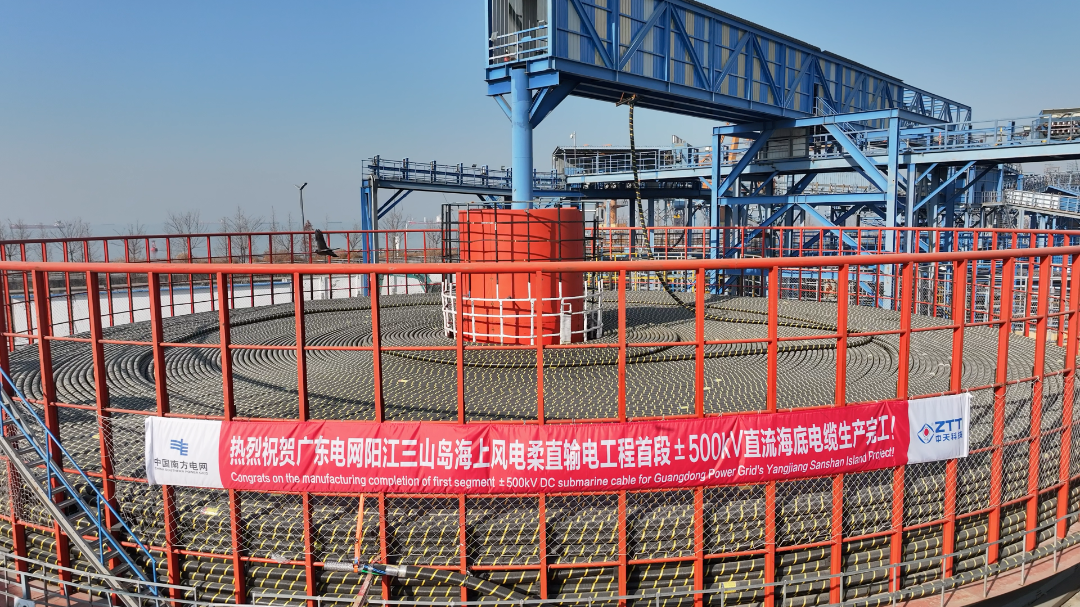
全球首个超大规模海陆一体±500kV柔直输电工程首段海缆在中天科技完成生产
Zhong Guo Neng Yuan Wang· 2026-01-19 01:04
Group 1 - The Guangdong Electric Power Grid Yangjiang Sanshan Island offshore wind power flexible direct current transmission project is the world's first ultra-large-scale integrated offshore and onshore ultra-high voltage flexible direct current transmission project, with a planned total installed capacity of 2GW and a total length of 116.5 kilometers for the submarine cable [3] - The project is located in the South China Sea, an area prone to typhoons and complex sea conditions, which poses extreme challenges to the electrical performance, mechanical strength, and environmental resistance of the submarine cable [3] - Zhongtian Technology has made significant advancements in key technologies for ±500kV direct current submarine cables, overcoming global challenges related to space charge accumulation and electric field distribution control under high direct current voltage [3] Group 2 - Zhongtian Technology has successfully developed key technologies for various voltage levels of direct current submarine cables, including ±160kV, ±200kV, ±320kV, and ±400kV, and has supplied the first ±400kV flexible direct current offshore wind project in Asia in 2021 [3] - The company plans to focus on high-capacity, long-distance, and highly reliable offshore transmission technology needs during the 14th Five-Year Plan, continuing to invest in research and development in core areas such as insulation materials, system design, and intelligent operation and maintenance [5] - Zhongtian Technology aims to build a comprehensive solution capability for direct current submarine cables, covering survey design, product manufacturing, offshore construction, and intelligent operation and maintenance [5]


钢厂补库仍稳,原料支撑行情趋缓
Zhong Guo Neng Yuan Wang· 2026-01-19 01:00
Core Viewpoint - The steel industry is experiencing a stable bottom in its fundamentals, with a slight increase in price differentials and a current loss per ton of 34.6 yuan, while the profitability rate for steel companies stands at 39.8% [1][2]. Group 1: Market Overview - The iron ore port inventory has reached a high level, leading to cautious replenishment by steel mills, resulting in a slight price correction for iron ore due to a lack of further catalysts [2][5]. - The steel price trend is stabilizing, with the hot-rolled coil price showing a narrow increase, averaging 3317 yuan/ton across 24 major markets [3]. - The CITIC Steel Index decreased by 1.6% this week, underperforming the broader market by 1.2% [1][2]. Group 2: Raw Material Analysis - The coking coal market saw a price increase due to a reduction in production capacity, but the supply disturbances have not expanded further, leading to a stable overall price for coking coal [4]. - The average price for Shanxi main coking coal is reported at 1211 yuan/ton, with various grades of metallurgical coke priced between 1210 and 1600 yuan/ton [4]. - Iron ore prices are currently weak, with the 66% fine powder index at 976 yuan/ton, reflecting a slight decrease [5]. Group 3: Supply and Demand Dynamics - Steel mills are increasing production rates with fewer maintenance plans in January, indicating a clear expectation of supply growth [3]. - Demand remains weak, primarily driven by cautious replenishment strategies, with speculative demand being low [3][5]. - The total inventory of imported iron ore at 45 ports is reported at 16555.10 million tons, showing an increase of 279.84 million tons [5].
固态电池加速产业化,太空光伏潜力可期
Zhong Guo Neng Yuan Wang· 2026-01-19 00:56
Industry Overview - The electrical equipment index (10679) increased by 0.79%, outperforming the market during the week of January 12-16. Lithium batteries rose by 1.5%, new energy vehicles by 1.29%, and photovoltaics by 0.87%. However, wind power, power generation equipment, and nuclear power saw declines of 4.74%, 4.15%, and 2.09% respectively [1][2] - The top five gainers in the sector included Huaguang Co., Yihua Tong, Sanbian Technology, Hezhong Technology, and Baobian Electric. The top five losers were Xiangrikui, Yijing Photovoltaic, Goldwind Technology, Baosheng Co., and Aerospace Machinery [2] Storage Sector - The Ukrainian Prime Minister ordered an acceleration in the import of electricity and additional power equipment. Four departments are strengthening government investment funds towards storage and new energy industries [3] - Jiangxi's virtual power plant is expected to have a regulation capacity exceeding 1GW by 2027, with several pilot projects being implemented [3] - Trina Storage signed a large contract in Latin America, solidifying its position among the top five storage solution providers in the region [3] Electric Vehicle Market - In December, electric vehicle sales reached 1.71 million units, with a year-on-year increase of 28%. Exports accounted for 2.58 million units, up 103% year-on-year [3] - The China Association of Automobile Manufacturers reported a decline in new energy passenger vehicle retail sales in January 2026, with a year-on-year decrease of 38% [3] Company Insights - Keda Technology expects a net profit of 600-660 million yuan for 2025, representing a year-on-year increase of 52.21%-67.43% [4] - Zhenyu Technology anticipates a net profit of 500-550 million yuan for 2025, with a projected increase of 96.9%-116.6% [4] - Rongbai Technology expects a net profit of approximately 30 million yuan in Q4 2025, but a full-year loss of 190-150 million yuan [4] - TCL Zhonghuan plans to invest in a new energy project and has signed a cooperation framework agreement [5] Investment Strategy - The storage sector is expected to see over 60% growth in 2026, driven by strong demand and supply constraints. The U.S. Inflation Reduction Act is anticipated to boost installations [6] - The lithium battery sector is projected to recover in March 2026, with a forecasted 5-10% growth in domestic sales [6] - The wind power sector is expected to see significant growth, with domestic offshore wind capacity projected to exceed 8GW by 2025 [6] Investment Recommendations - Companies such as CATL, Sungrow Power, and Sanyuan Electric are highlighted as strong investment opportunities due to their leadership in their respective sectors [7][8] - The report emphasizes the potential of companies involved in solid-state batteries, energy storage, and electric vehicle components, suggesting a favorable outlook for these sectors [7][8]



