
Zhong Guo Neng Yuan Wang

Search documents
国网计划“十五五”投资固定资产4万亿元,多省明确天然气关键战略能源定位 | 投研报告
Zhong Guo Neng Yuan Wang· 2026-01-19 04:03
Market Performance - The public utility sector increased by 0.1% as of January 16, outperforming the broader market, with the electricity sector rising by 0.20% and the gas sector declining by 1.17% [2][8]. Electricity Industry Data Tracking - The price of thermal coal at Qinhuangdao Port rose by 1 CNY/ton week-on-week, reaching 697 CNY/ton as of January 16. Meanwhile, Indonesian coal prices fell by 5.71 CNY/ton to 735.71 CNY/ton, and Australian coal prices decreased by 6.53 CNY/ton to 740.51 CNY/ton [3]. - Coal inventory at Qinhuangdao Port increased by 150,000 tons week-on-week, totaling 5.5 million tons as of January 16. Inland power plants' daily coal consumption rose by 96,000 tons/day to 4.147 million tons, a week-on-week increase of 2.37% [3]. - The outflow from the Three Gorges Dam increased by 19.22% year-on-year and 23.55% week-on-week, reaching 9,180 cubic meters/second as of January 16 [4]. Natural Gas Industry Data Tracking - The LNG ex-factory price index in Shanghai was 3,854 CNY/ton as of January 15, showing a week-on-week increase of 1.29% but a year-on-year decrease of 13.53% [5]. - The European TTF spot price rose by 18.6% week-on-week to 11.4 USD/million BTU, while the US HH spot price increased by 2.8% to 2.95 USD/million BTU [5]. - Domestic natural gas consumption in November was 36.280 billion cubic meters, a year-on-year increase of 4.1%, with production at 21.880 billion cubic meters, up 5.9% year-on-year [6]. Key Industry News - The State Grid Corporation plans to invest 4 trillion CNY in fixed assets during the 14th Five-Year Plan, a 40% increase from the previous plan, focusing on green transformation and enhancing grid functionality [7]. - Multiple provinces have highlighted natural gas as a key strategic energy source in their 14th Five-Year Plans, emphasizing its role in connecting traditional and new energy systems without setting consumption caps [7]. Investment Recommendations - The electricity sector is expected to see profit improvements and value reassessment due to ongoing supply-demand tensions, with a focus on coal power companies like Guodian Power and Huaneng International [8]. - The natural gas sector is anticipated to benefit from stable margins in city gas businesses and opportunities for traders with low-cost long-term gas sources [8].



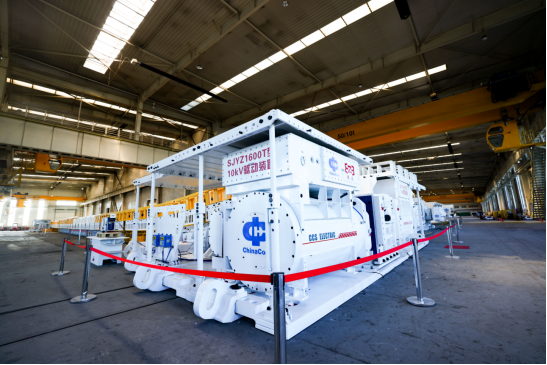
国内首套大采高10kV智能高效刮板输送成套装备在中煤张煤机公司下线
Zhong Guo Neng Yuan Wang· 2026-01-19 03:27
Core Viewpoint - The collaboration between Guoneng Shendong Coal Group and Zhongmei Zhang Coal Machine Company has led to the successful development of China's first set of high-efficiency scraper conveyor equipment with independent intellectual property rights, which meets international advanced standards and addresses the mining industry's needs for high-capacity and long-distance operations [1][5]. Group 1: Equipment Features - The newly developed equipment features an integrated 10kV high-voltage permanent magnet motor, inverter, reducer, and tight chain motor, forming a highly efficient transmission system that significantly reduces energy loss during operation [3]. - The equipment is designed to operate in harsh mining conditions, utilizing a modular high-pressure cabin design with customized insulation materials to enhance environmental performance and insulation reliability [4]. - A comprehensive intelligent monitoring system is integrated into the equipment, allowing for real-time detection of potential risks such as high-voltage insulation anomalies and component wear, thus enabling precise predictive maintenance [5]. Group 2: Industry Impact - This equipment aligns with the principles of "innovation leading, green development," breaking through voltage limitations to enhance power supply quality in mining operations, thereby supporting the high-quality development of the coal industry [5]. - The advancements in this technology are expected to significantly improve operational efficiency and reduce operational costs, contributing to the modernization of mining practices [3][5].

福耀玻璃在安徽成立饰件智能科技公司,注册资本3亿
Zhong Guo Neng Yuan Wang· 2026-01-19 02:44
Core Viewpoint - Fuyao Glass (600660) has established a new subsidiary, Fuyao Decorative Parts (Anhui) Intelligent Technology Co., Ltd., focusing on automotive components and smart vehicle equipment manufacturing [1] Company Summary - The new company is fully owned by Fuyao Glass, indicating a strategic expansion into the automotive parts sector [1] - The registered capital of the new subsidiary is 300 million RMB, reflecting a significant investment in the automotive industry [1] Industry Summary - The business scope includes manufacturing and retail of automotive parts, research and development of automotive components, and smart vehicle equipment [1] - The company also plans to engage in the manufacturing and sales of railway locomotive and vehicle parts, diversifying its operational focus [1]

宁德时代在马鞍山成立新能源公司,注册资本455万
Zhong Guo Neng Yuan Wang· 2026-01-19 02:44
天眼查工商信息显示,近日,马鞍山润安新能源有限公司成立,法定代表人为戴维,注册资本455万人 民币,经营范围含发电业务、输电业务、供(配)电业务,建设工程施工,新兴能源技术研发,太阳能发 电技术服务,热力生产和供应,合同能源管理,在线能源计量技术研发,在线能源监测技术研发等。股 东信息显示,该公司由宁德时代(300750)旗下时代绿色能源有限公司全资持股。 ...
朝暮轮转间,坚守从未停歇
Zhong Guo Neng Yuan Wang· 2026-01-19 02:39
t 激活发展动能 0 d ... 19 ... C an ures 1 |78 190 9 E 十二时辰,时序分明。从晨光熹微到夜色沉沉,每个时辰里,都有神东煤炭奋斗者的身影奔忙。他们伴 着日月星辰扎根岗位。他们在百米井下、在厂区现场,守护生产;在时光的刻度上镌刻责任担当;在平 凡的坚守里,共同谱写能源保供的奋斗交响曲,用十二时辰的不间断守护,暖万家灯火。 ...

环保企业布局上游矿业,开辟第二增长曲线 | 投研报告
Zhong Guo Neng Yuan Wang· 2026-01-19 02:39
Market Overview - The environmental protection sector rose by 0.3% as of January 16, outperforming the broader market, while the Shanghai Composite Index fell by 0.45% to 4101.91 [1][2] - The top three performing sectors were computer and electronics (both up 3.8%) and non-ferrous metals (up 3.0%), while the bottom three were defense and military (-4.9%), real estate (-3.5%), and agriculture, forestry, animal husbandry, and fishery (-3.3%) [1][2] Subsector Performance - Water sector increased by 0.35% - Water treatment sector rose by 2.60% - Air pollution control sector decreased by 3.87% - Sanitation sector fell by 0.63% - Waste incineration sector grew by 1.16% - Resource recycling sector declined by 1.18% - Other solid waste sectors dropped by 0.64% - Monitoring/testing/instrumentation sector increased by 0.40% - Environmental restoration sector rose by 0.41% - Environmental equipment sector surged by 4.28% [1][2] Industry Dynamics - On January 16, six departments, including the Ministry of Industry and Information Technology, jointly issued the "Interim Measures for the Recycling and Comprehensive Utilization of Waste Power Batteries from New Energy Vehicles" to enhance supervision and management of the recycling and utilization of waste batteries [3] - The Ministry of Industry and Information Technology also issued a notice on the "Guidelines for the Construction and Application of Industrial Green Microgrids (2026-2030)" to promote low-carbon transformation in industrial energy use [3] Strategic Developments - Environmental companies are actively acquiring mineral rights and engaging in technological collaborations to secure upstream mineral resources, which is expected to create synergies and stabilize production costs [4] - High Energy Environment plans to acquire a 45.2% stake in three mining companies, gaining exploration rights for several gold mines with a proven gold metal amount of 4474 kg [4] - Other companies like Beijite and Longjing Environmental Protection are also expanding into the mining sector, indicating a trend towards vertical integration in the industry [4] Investment Recommendations - The "14th Five-Year Plan" emphasizes environmental quality and industrial green low-carbon development, suggesting sustained high demand for energy conservation and resource recycling [5] - Water and waste incineration sectors are expected to maintain stable profitability and positive cash flow, benefiting from market reforms [5] - Key recommendations include: Huanlan Environment, Xingrong Environment, and Hongcheng Environment; companies to watch include: Wangneng Environment, Junxin Co., Wuhan Holdings, Yingke Recycling, High Energy Environment, and Qinda Environmental Protection [5]
地缘局势推升避险需求,贵金属上行动能充足
Zhong Guo Neng Yuan Wang· 2026-01-19 02:27
Group 1 - The core viewpoint of the report indicates a strong upward trend in precious metal prices, particularly gold and silver, over the past two weeks [1][2] - London spot gold increased by 5.93% to $4611.05 per ounce, while the Shanghai Futures Exchange (SHFE) gold rose by 5.60% to ¥1032.32 per gram, with SHFE gold holdings up by 10.39% to 347,100 contracts [1][2] - London spot silver surged by 22.35% to $90.80 per ounce, and SHFE silver climbed by 31.68% to ¥22,483 per kilogram, with SHFE silver holdings increasing by 12.21% to 719,100 contracts [1][2] Group 2 - The recent rise in gold and silver prices is attributed to several factors, including weaker-than-expected U.S. non-farm payroll growth and a stable unemployment rate [3] - The CME's adjustment of margin requirements for precious metal contracts, shifting from fixed amounts to a percentage of contract value, may lead to increased market volatility and liquidity tightening [3] - Geopolitical tensions, such as U.S. military actions in Venezuela, are expected to provide strong momentum for gold prices in the medium term [4] Group 3 - Long-term trends suggest that the combination of "rate cut trades" and "Trump 2.0" will continue to support gold prices, with central bank purchases providing a strong bottom support [5] - The People's Bank of China has increased its gold reserves for 14 consecutive months, reaching 74.15 million ounces by the end of December 2025, indicating a bullish trend for gold [5] - The report maintains a "positive" rating for the precious metals sector and recommends a focus on specific stocks, including Zijin Mining International, Chifeng Jilong Gold Mining, and others [6]
台积电CapEx指引印证AI需求,关注算力产业链上游机遇 | 投研报告
Zhong Guo Neng Yuan Wang· 2026-01-19 02:15
Group 1: TSMC Performance and Projections - TSMC reported a net profit of NT$505.7 billion for Q4 2025, a year-on-year increase of 35.0%, exceeding market expectations of NT$467.0 billion [3] - The company anticipates a nearly 30% growth in sales (in USD) for 2026, driven by strong customer demand [3] - TSMC plans to increase its capital expenditure for 2026 to between $52 billion and $56 billion, indicating a significant rise in spending over the next three years [3] Group 2: Semiconductor Industry Trends - The semiconductor sector has seen substantial growth, with the Shenwan Electronics Secondary Index showing year-to-date increases of 16.51% for semiconductors and 13.30% for other electronics [1] - The 8-inch wafer foundry prices are expected to rise due to steady growth in AI-related Power IC demand and increased orders for 2026 [4] - The utilization rate of 8-inch wafer foundries is projected to improve, supported by rising demand for AI applications, which will drive both volume and price increases in the semiconductor supply chain [4] Group 3: Stock Performance of Key Companies - Notable stock performance this week includes TSMC up by 5.80%, while Qualcomm saw a decline of 10.33% [2] - Other companies like Micron Technology and Intel also experienced gains of 5.12% and 3.10% respectively, while major players like Apple and Tesla faced declines [2]

宏观波动加剧,坚定看好金属行情
Zhong Guo Neng Yuan Wang· 2026-01-19 02:12
Group 1: Market Overview - COMEX gold price increased by 2.26% to $4620.5 per ounce, influenced by geopolitical risks, resulting in a strong market fluctuation [4] - LME copper price rose by 1.41% to $13148.5 per ton, while Shanghai copper decreased by 0.63% to ¥100,800 per ton [2] - LME aluminum price increased by 0.71% to $3171.5 per ton, while Shanghai aluminum fell by 1.66% to ¥23,900 per ton [3] Group 2: Supply and Demand Dynamics - Copper inventory in major regions increased by 17.2% week-on-week, with a year-on-year increase of 212,800 tons [2] - Domestic aluminum oxide production capacity reached 110.32 million tons per year, with an operating rate of 80.82% [3] - Rare earth exports in November increased by 12% month-on-month and 28% year-on-year, reaching a historical high for the same period [5] Group 3: Price Movements - The price of praseodymium and neodymium oxide rose by 8.01% this week [5] - Tungsten concentrate price increased by 6.33% due to tight supply conditions [5] - Lithium carbonate price rose by 20.1% to ¥158,300 per ton, while lithium hydroxide price increased by 21.2% to ¥153,700 per ton [5] Group 4: Industry Insights - The copper wire and cable industry is expected to see a decrease in operating rates due to weak downstream consumption [2] - High aluminum prices are suppressing downstream consumption and industry operating rates [3] - The demand for enameled wire is supported by the peak season effect in the home appliance industry [2]
中国人民银行拓展碳减排支持工具支持领域,推动经济社会发展全面绿色转型
Zhong Guo Neng Yuan Wang· 2026-01-19 02:11
Core Insights - The total number of ESG bonds issued in China has reached 3,911, with a total outstanding amount of 5.76 trillion RMB, where green bonds account for the largest share at 62.28% [1][3] - In the current month, 58 ESG bonds were issued, amounting to 34 billion RMB, while in the past year, 1,267 ESG bonds were issued with a total value of 1,372 billion RMB [1][3] Domestic Developments - The People's Bank of China is expanding the carbon reduction support tool to include projects with direct carbon reduction effects, such as energy-saving renovations and green upgrades, with an annual operation limit of 800 billion RMB [2] - The quarterly operation volume will be determined based on monetary policy needs and the loan issuance by financial institutions [2] International Developments - Starting January 1, 2026, the EU will implement a carbon border adjustment mechanism (CBAM), requiring importers to pay carbon taxes on high-carbon products, which necessitates compliance from non-EU exporters [2] - Chinese exporters must provide necessary information regarding carbon emissions and third-party verification to facilitate customs clearance [2] ESG Product Tracking - There are currently 955 ESG products in the market with a total net asset value of 1,173.33 billion RMB, where ESG strategy products represent the largest share at 45.01% [3] - In the past year, 189 ESG public funds were issued, totaling 71.178 billion units [3] - The market has 1,221 ESG bank wealth management products, with pure ESG products making up 53.48% [3] Index Tracking - As of January 16, 2026, most major ESG indices have underperformed compared to the market, with the Wind All A Sustainable ESG index showing the highest increase of 0.1% [4] - Over the past year, major ESG indices have generally increased, with the Wind All A Sustainable ESG index rising by 28.99% [4] Expert Opinions - An expert from the University of International Business and Economics emphasizes the need to understand the upgraded ESG regulatory requirements, highlighting the competitive pressures faced by Chinese supply chains due to stricter international rules [5][6] - The expert notes that the evolution of ESG regulations reflects a normal competitive balancing mechanism among nations, with historical precedents in trade standards [6]
