Guo Ji Jin Rong Bao

Search documents
国民养老保险再增资,4家地方国资股东入局
Guo Ji Jin Rong Bao· 2025-12-24 09:38
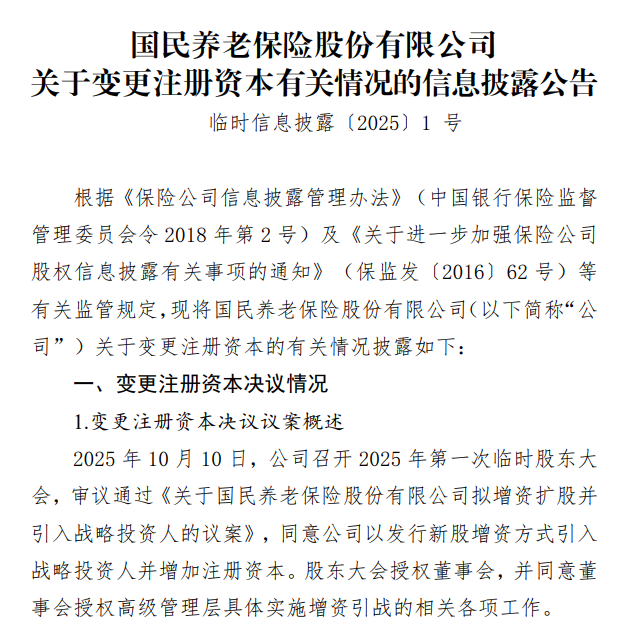
专业养老险公司接力增资。 目前,该增资方案尚待监管批准后生效。 引入四家地方国资股东 回溯来看,今年10月,国民养老保险在北京产权交易所披露增资项目,拟征集投资方数量不超过5 个,拟募集资金对应持股比例或股份数不超过4.71亿股,用于补充一级核心资本,支持主营业务发展。 国民养老保险股份有限公司(下称"国民养老保险")近日披露公告称,公司计划增资扩股并引入战 略投资人,拟增资总金额为5亿元,拟发行3.36亿股,拟增加注册资本3.36亿元,增资后公司注册资本为 117.14亿元。 公开资料显示,国民养老成立于2022年3月,是首批"个人养老金"和"商业养老金"双试点的专业养 老保险机构,也被称为养老第三支柱"国家队",初始注册资本达111.5亿元。 从股权结构来看,该公司的股东较为多元化,包括工农中建交和邮储等六家国有大型银行理财子公 司,中信、招商、兴业、民生、华夏等五家股份制银行理财子公司及相关下属公司,中信证券、中金公 司、泰康人寿等大型证券保险机构及下属公司,以及国新资本、京投公司、熙诚资本控股等国内投资及 实业领域知名企业。 值得一提的是,本次增资扩股已是国民养保险老成立以来的第二轮增资。2024年1 ...

再出手!中邮保险举牌四川路桥
Guo Ji Jin Rong Bao· 2025-12-24 09:18
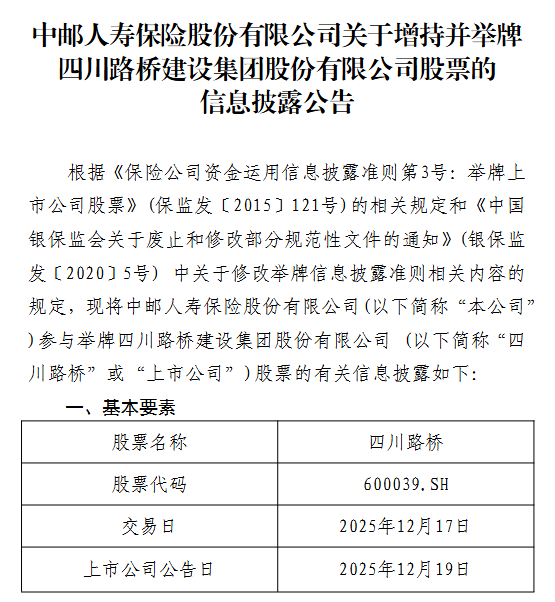
Core Viewpoint - Insurance capital is actively entering the market, with Zhongyou Insurance increasing its stake in Sichuan Road and Bridge Group to 5%, triggering a shareholding notification [1][3]. Company Summary - Zhongyou Insurance held 434.67 million shares of Sichuan Road and Bridge before the increase, representing 4.9987% of the total share capital. After purchasing an additional 114,300 shares on December 17, the total shares held increased to 434.78 million, equating to 5% of the total share capital [3]. - The market value of Zhongyou Insurance's holdings in Sichuan Road and Bridge is approximately 4.3 billion yuan, which constitutes 0.63% of the company's total assets as of the end of Q3 2025 [3][4]. - Zhongyou Insurance is a life insurance company controlled by China Post Group, with a registered capital of 32.643 billion yuan, officially established in September 2009 [3]. Financial Performance - For the first three quarters of 2025, Zhongyou Insurance reported insurance business revenue of 151.31 billion yuan, a year-on-year increase of 17.66%. However, net profit decreased by 15.56% to 9.129 billion yuan [4]. - As of the end of Q2, the core and comprehensive solvency ratios were 92.53% and 165.01%, respectively [4]. Industry Overview - Zhongyou Insurance's recent actions reflect a broader trend in the insurance industry, with 27 listed companies being targeted by insurance capital in 2023, totaling 35 instances of shareholding notifications, marking a recent high [4]. - Analysts attribute the surge in insurance capital's shareholding activities to three main factors: the pressure of potential "interest margin losses" due to low interest rates and asset scarcity, changes in accounting standards that enhance profit stability, and supportive policies encouraging long-term capital investment in the stock market [5].

焦点科技:控股股东沈锦华质押1.39%股份
Guo Ji Jin Rong Bao· 2025-12-24 09:04
Core Viewpoint - The controlling shareholder of Focus Technology, Shen Jinhua, has pledged 1.4 million shares to China Galaxy Securities, which represents 2.99% of his holdings and 1.39% of the company's total share capital, for personal funding needs [1] Summary by Relevant Sections - **Share Pledge Details** - Shen Jinhua will pledge 1.4 million shares until December 22, 2028 [1] - The total pledged shares amount to 4.4 million, with a total holding of 147 million shares, representing 46.42% of the company [1] - **Unpledged Shares** - The unpledged shares total 110 million, with 77.31% of these shares subject to lock-up and freeze [1] - **Risk Assessment** - The pledged shares do not pose a risk of forced liquidation and will not change the control of the company [1]

美国三季度GDP增速超预期,家庭债务创新高
Guo Ji Jin Rong Bao· 2025-12-24 08:20
Core Insights - The U.S. GDP grew by 4.3% in Q3, marking the fastest growth in two years, driven primarily by consumer spending and significant investments in artificial intelligence infrastructure [1][2] Consumer Spending - Consumer spending in Q3 saw an annualized growth rate of 3.5%, becoming the main engine of economic growth, with notable contributions from healthcare services, international travel, legal services, and technology products [2][3] - The top 10% of income earners in the U.S. accounted for nearly half of total consumer spending, supported by a booming stock market that bolstered high-end consumption and service demand [2][3] Artificial Intelligence Investment - Investment in artificial intelligence has slowed from previous highs but still contributed significantly to economic growth, with AI-related investments and high-income household consumption together accounting for nearly 70% of the growth in the quarter [3][4] Economic Imbalances - The economic growth is characterized by imbalances, with consumer confidence indices remaining low and durable goods spending slowing down, reflecting public concerns over high prices and the job market [3][4] - Non-residential fixed asset investment showed signs of weakness, and residential investment declined for the second consecutive quarter, with an annualized drop of 5.1% [3][4] Inflation and Income Dynamics - The core Personal Consumption Expenditures (PCE) price index rose to an annualized rate of 2.9%, up from 2.6% in the previous quarter, indicating a slight uptick in inflation [3][4] - After adjusting for inflation, disposable personal income remained flat, suggesting that income growth is barely keeping pace with rising prices, which is particularly challenging for low-income households [3][4] Household Debt Trends - U.S. household debt reached a record high of $18.6 trillion in Q3 2025, with mortgage debt being the largest component at $13.07 trillion [4][5] - The credit market is experiencing a "K-shaped" divergence, where low-income households face increasing financial pressure, while high-income borrowers benefit from stock market gains and rising property values [5]
打造开放新高地!浦东引领区研讨会为改革发展献策
Guo Ji Jin Rong Bao· 2025-12-24 08:08
Core Viewpoint - The article discusses the 35th anniversary of the Pudong development and the 5th anniversary of its role as a leading area for socialist modernization, highlighting expert recommendations for future economic and social development in Pudong [1][5]. Group 1: High-Level Reform and Opening Up - Experts suggest that Pudong should focus on targeted reforms in market access, service trade, and overseas investment to convert institutional advantages into high-quality development and competitive advantages in international cooperation [4]. - The emphasis is on activating new momentum for high-quality development through high-level reform and opening up [4]. Group 2: Innovation and Economic Transformation - Recommendations include accelerating the establishment of a vibrant and open innovation ecosystem to achieve breakthroughs in high-level technological self-reliance and new productive forces [4][5]. - Pudong is encouraged to focus on strategic fields such as integrated circuits, life sciences, and artificial intelligence to overcome technological barriers and enhance basic research investment [5][6]. Group 3: Global Resource Allocation - Experts recommend that Pudong play a central role in the new development pattern and domestic-international dual circulation, leveraging its strengths in attracting and exporting resources [4]. Group 4: Urban Governance and Social Development - Suggestions include transitioning urban governance from merely addressing problems to building an institutional ecosystem, enhancing social governance, and innovating public services to promote common prosperity [4]. Group 5: Party Building and Leadership - The importance of strong party building as a means to ensure high-quality development is emphasized, with a call for Pudong to contribute significantly to the modernization of the socialist state and the realization of the Chinese Dream [4].

美军大举增兵!巴西常驻联合国代表:美国应立即停止在加勒比地区行动
Guo Ji Jin Rong Bao· 2025-12-24 00:58
Group 1 - The United States has deployed multiple special operations aircraft to the Caribbean region, increasing pressure on the Venezuelan government [1] - At least 10 CV-22 Osprey tiltrotor aircraft have arrived in the Caribbean from Cannon Air Force Base in New Mexico, along with personnel and equipment [1][2] - The exact number of personnel and equipment transported remains unclear, but the military bases involved host several U.S. special operations forces [2] Group 2 - Brazil's UN representative criticized the U.S. actions as a violation of the UN Charter and called for an immediate halt to these activities [2] - Brazilian President Lula expressed willingness to mediate tensions between the U.S. and Venezuela, emphasizing the need for cooperation [2] - The U.S. has recently deployed several naval vessels in the Caribbean under the pretext of anti-drug operations, further escalating tensions with Venezuela [2]
裁撤充电桩!销量遇“滑铁卢”后 保时捷中国降本求生
Guo Ji Jin Rong Bao· 2025-12-23 16:43
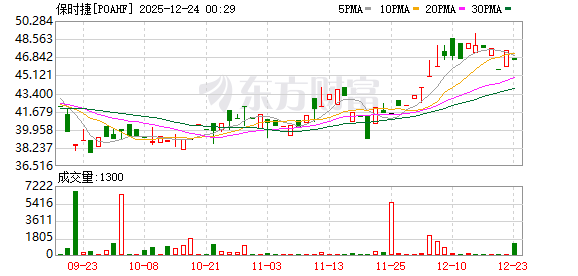
Core Viewpoint - Porsche is attempting to navigate a declining market share in China through strategic adjustments, including the cessation of its proprietary charging service network by March 1, 2026 [2][3] Group 1: Charging Service Changes - Porsche China announced the discontinuation of its "Porsche Enjoy Charging" service, which includes all self-built high-power charging stations, to better adapt to changing market conditions and user charging habits [3] - The decision affects approximately 200 charging stations, while other charging options, such as those at Porsche centers and third-party stations, will remain operational [5] - The move is seen as a cost-cutting measure, as the high operational costs of charging stations can reach millions, and the usage frequency of the proprietary network has been low [5] Group 2: Sales Performance and Market Position - In the first 11 months of the year, Porsche's sales in China totaled 37,200 units, a year-on-year decline of 22.89%, with electric vehicle sales at 2,585 units, down 21.83%, resulting in a penetration rate of only 7% [6] - Porsche's market share in China has significantly decreased, with sales dropping 15% in 2023 to 79,300 units, and further declining by 28% in 2024 to 56,900 units, leading to a market share of 18.31% [7] - The company is facing increasing pressure, with a 26% drop in sales in the first three quarters of 2025 compared to 2021, and a significant decline in global revenue and profit margins [7] Group 3: Strategic Reflections and Future Plans - The CEO of the Volkswagen Group, which owns Porsche, emphasized that the company will not exit the Chinese market and is considering launching exclusive models for Chinese buyers [7] - Porsche's recent performance has prompted a reflection on its production and export strategy, which has not adapted well to the structural changes in the Chinese market [10] - The company is exploring local production to reduce costs and improve competitiveness, potentially leveraging local technology from companies like XPeng to enhance its electric vehicle offerings [12]
突然卖爆!中证A500ETF为何成资金“必争之地”?
Guo Ji Jin Rong Bao· 2025-12-23 16:10
近期,中证A500ETF的突然疯狂"吸金",吸引了行业多方关注。自12月初以来,多只中证 A500ETF场内成交明显放量,且实现了较大份额的净流入。 Wind数据显示,截至12月22日,本月以来,有4只股票型ETF区间净流入额超百亿元,均为中证 A500ETF,分别属于南方、华泰柏瑞、华夏和国泰基金旗下,合计净流入额超530亿元。 相比之下,银行、证券、军工等行业主题ETF,以及少部分沪深300ETF却被资金"冷落",区间净流 出位居同类前列。 业内人士向《国际金融报》记者表示,从当前市场风格和政策导向来看,中证A500指数具备成为 明年宽基配置重点的潜力,因此吸引了资金持续流入。 近一个月持续被爆买 中证A500ETF正被大量资金疯狂涌入。 上述四只中证A500ETF本月以来合计净流入额超530亿元。相比之下,银行、证券、军工等行业主 题ETF,以及少部分沪深300ETF却被资金"冷落",区间净流出位居同类前列。 从份额变化来看,截至12月22日,南方中证A500ETF和华泰柏瑞中证A500ETF本月以来"吸金"最 猛,份额增长位居股票型ETF前二,分别达到146.31亿份和126.03亿份;华夏中证A50 ...
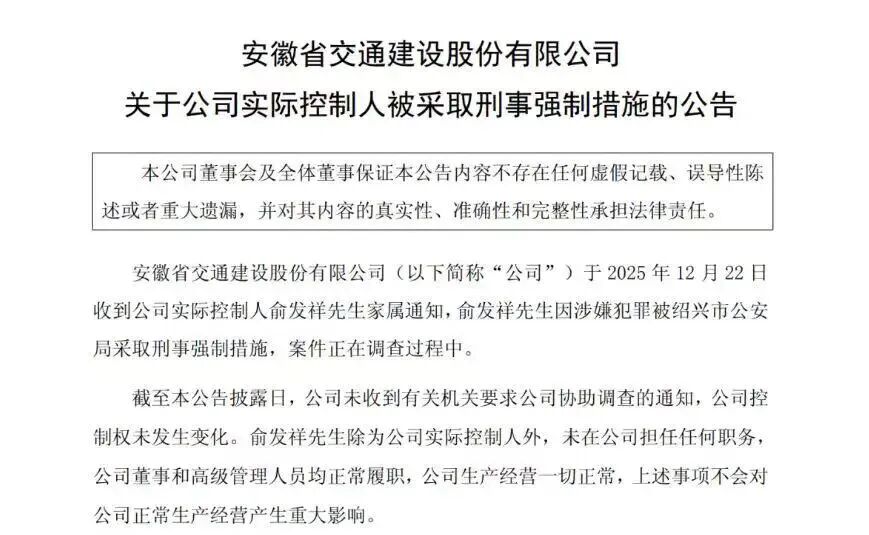
“祥源系”超百亿元金融产品陷兑付危机,实控人俞发祥被采取刑事强制措施
Guo Ji Jin Rong Bao· 2025-12-23 16:00
Core Viewpoint - The "Xiangyuan System" is facing a liquidity crisis with over 10 billion yuan in financial products reported to be overdue for redemption, leading to police intervention and the detention of the actual controller, Yu Faxiang [1][3][9]. Group 1: Company Overview - Xiangyuan Holding Group, under Yu Faxiang, has two publicly listed companies: Xiangyuan Cultural Tourism and Jiaojian Co., which announced that Yu Faxiang is under criminal detention by the Shaoxing Public Security Bureau [1][5]. - Yu Faxiang, born in 1971, is the chairman of Xiangyuan Holding and has a significant stake in multiple listed companies, including Haichang Ocean Park, which he acquired for 2.295 billion HKD [5][6]. Group 2: Financial Crisis Details - In mid-October, financial products related to the Xiangyuan System were reported to be overdue, with Xiangyuan Holding admitting to liquidity issues in early December [3][9]. - The overdue financial products are estimated to exceed 10 billion yuan, with investors expressing concerns about the company's ability to liquidate assets for redemption and the high management fees charged by the Zhejiang Financial Asset Trading Center [3][9]. Group 3: Company Operations and Impact - Despite the legal issues surrounding Yu Faxiang, both Xiangyuan Cultural Tourism and Jiaojian Co. stated that their operations remain normal and that there has been no significant impact on their business [5][11]. - The total assets of Xiangyuan Holding are reported to be 60 billion yuan, with liabilities exceeding 40 billion yuan, exacerbated by a downturn in the real estate market and the cancellation of the trading qualifications of the Zhejiang Financial Asset Trading Center [10].
见证历史!金价又“爆”了
Guo Ji Jin Rong Bao· 2025-12-23 15:24
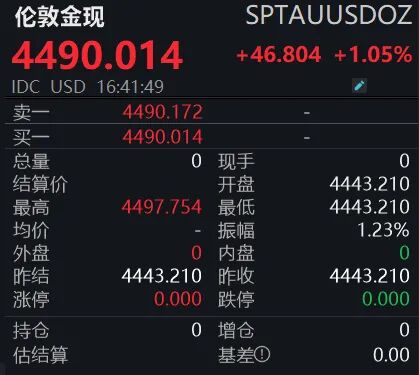
金价"狂飙"。 二是美元信用担忧与央行战略性购金。2022年俄罗斯外汇储备遭遇冻结后,黄金作为"非主权信用风险 资产"的储备价值凸显。在美国政府债务规模持续膨胀的背景下,全球央行基于外汇储备多元化和资产 安全性的长期战略,持续增持黄金并减少在伦敦等传统金融中心的托管规模,结构性购金潮为金价提供 了坚实支撑。 受国际金价大涨影响,国内首饰金价今日出现明显上涨。多家黄金品牌隔夜齐涨,每克上调35至36元, 部分饰品金价首破1400元/克,再刷国内纪录。 同日,上海黄金交易所发布《关于继续加强近期市场风险控制工作的通知》。公告指出,近期影响市场 不稳定的因素较多,贵金属价格波动剧烈。请各会员提高风险防范意识,要继续做好风险应急预案,维 护市场平稳运行。同时,提示投资者做好风险防范工作,合理控制仓位,理性投资。 对于本轮金价大涨,市场人士认为这是多重因素共振的结果。中安鼎盛投资合伙人陈伯仲分析指出, 2025年美国关税政策引发的避险情绪、全球央行持续增持黄金的趋势、美联储降息预期带来的流动性支 撑,以及资金对美国债务担忧的避险需求等多方面力量共同推动金价走高。 海通期货研究所顾佳男将今年贵金属市场的核心交易逻辑归纳为 ...