
Jing Ji Guan Cha Wang

Search documents
打造消灭癌细胞的“超级守护者” 中国科学家最新成果为癌症免疫疗法提供新思路
Jing Ji Guan Cha Wang· 2026-02-18 16:47
这种方法无需依赖TCR分子的三维结构信息。只需对筛选出的多个"关键按钮"进行同步改造,即可增强 TCR分子"抓住"癌细胞的能力,从而将T细胞打造成效率超群的"超级守护者"。经改造的T细胞活化水平 更高、杀伤力更强,且能精准辨别敌我、避免误伤健康细胞。 目前,该研究在动物模型中疗效显著,为开发新一代高效、精准的癌症免疫疗法提供了崭新的思路。 经济观察网据央视新闻客户端消息,在我们的人体免疫系统中,T细胞犹如一支守护健康的"特种部 队",负责执行全身细胞的"安全检查"。而T细胞表面的T细胞受体(TCR)分子,正是执行任务的核心"安 检仪"。然而,天然TCR分子的"识别灵敏度"有限,一些狡猾的癌细胞可能成为"漏网之鱼"。 针对这一难题,中国科学院分子细胞科学卓越创新中心(生物化学与细胞生物学研究所)赵祥研究团队与 合作者开发出"组氨酸扫描法",能快速定位TCR分子中负责识别癌细胞并启动清除程序的"关键位点"。 对这些位点进行"改造升级"后,TCR分子便化身为高灵敏度的增强版"安检仪",显著提升了T细胞清除 癌细胞的能力。该策略已在小鼠实验中展现出良好的抗癌效果。相关研究成果2月19日在国际学术期刊 《细胞》发表。 ...
回西安过年,轻食者的高碳水挑战
Jing Ji Guan Cha Wang· 2026-02-18 12:49
人是一种饮食生物。对于我来说,在高蛋白低热量的食谱之外,那些油香四溢的诱惑,其实从未真正远离。 农历腊月二十三,我从北京回到了西安,这是我在上大学之前生活了18年的城市。下午4点多,CA1201航班落地咸阳机场T2的那一刻,空气里就有一种熟悉 的感觉。 母亲在家里等我,联系我的第一句话是:"晚上我给你炖了羊肉,还想吃啥?" 我本能地想说"中午已经吃了不少了,晚上不用吃太多了",但话到嘴边,变成了:"都行。" 热量与味蕾 过去两年,我在北京减重57斤之后,把自己训练成了一个合格的轻食主义者。鸡胸肉是白色的,牛肉是红色的,西兰花是绿色的,藜麦是颗粒状的,这一切 都可以在饭碗里井然有序地排列。 我学会了快速心算卡路里,学会了拒绝糖油混合物,学会了在朋友递过来薯片时微笑摆手。身体轻盈了,体检报告干净了,只是偶尔在深夜,会梦见一些模 糊的、油汪汪的东西。 在北京以及西安以外的其他城市,肉夹馍算是最很常见的食物,但它们更多是酥脆掉渣的潼关肉夹馍,而不是需要用上白吉馍的西安肉夹馍。 高中母校北边那家肉夹馍老店,从我记事起就存在,白吉馍是现烤的,外硬内软,有嚼劲,肉是炖了很久、肥瘦相间的,剁碎了夹进去,油脂渗进馍的纹 理。 ...

千问“一句话下单”00后占比超40%,福利延续每日首单必减
Jing Ji Guan Cha Wang· 2026-02-18 11:02
在购票、出行等需要多步骤判断的场景中,00后的活跃度更远超其他年龄层。仅景区门票预订一项,就 有50%的一句话指令来自00后。 千问C端事业群总裁吴嘉近日表示,未曾预料到用户参与活动的热情如此之高,越来越多用户已经开始 主动尝试使用千问完成消费,"千问帮我"正从几次免单尝鲜变成每天的AI生活习惯。 目前,千问春节活动仍在延续,面向所有人推出"每日首单必减",最低3.8元,同时还能叠加淘宝闪 购、飞猪、大麦等平台的原有优惠,持续推进AI生活成为日常。 2月18日,千问APP公布,通过千问"一句话下单"的用户中,00后占比高达40%,成为最活跃的群体, 其中来自广东、山东、河南三地的00后最为突出。在点外卖、订酒旅、买电影票核心消费场景中,00后 占比均位居首位,"千问帮我"正从尝鲜体验成为年轻人的日常习惯。 半个月前,千问推出"春节大免单"活动,火爆全网。活动期间,全国有超过1.3亿人第一次体验AI下 单,说了50亿次"千问帮我",千问一跃成为国民级AI助手。 其中00后作为数字原住民,率先拥抱这一AI时代的新生活方式,占比高达40%,特别是广东、山东、河 南三地的年轻用户尝试最为踊跃。 与过去需要在多个APP ...

国有大行主导手机银行市场,生态嵌入构筑护城河
Jing Ji Guan Cha Wang· 2026-02-18 05:47
Core Insights - The Chinese mobile banking market is entering a stage of stock competition in 2025, with monthly active users (MAU) stabilizing between 648 million and 739 million [2] - State-owned commercial banks dominate the market due to their ecological embedding advantages, with Agricultural Bank of China leading at 249 million MAU, followed by Industrial and Commercial Bank of China (194 million) and China Construction Bank (109 million) [2] - Private banks are expected to collectively exit the top 50 MAU rankings in 2025 due to a lack of offline branch support and local living ecosystems [2] Group 1: Major Players - Agricultural Bank of China has the highest MAU at 249 million, followed by Industrial and Commercial Bank of China with 194 million and China Construction Bank with 109 million, forming the first tier of banks [2] - China Bank and Postal Savings Bank have MAUs exceeding 50 million, constituting the second tier [2] - China Merchants Bank leads the joint-stock banks with 71.85 million MAU, while Ping An Bank and CITIC Bank form the second tier, with other joint-stock banks generally below 20 million MAU [2] Group 2: Market Dynamics - The core advantage of state-owned banks lies in their "full-scenario integration" capabilities, embedding services deeply into high-frequency life scenarios such as government affairs, social security, healthcare, and education [2] - Agricultural Bank of China extends its services to rural areas through intelligent service matching and customer customization, while Industrial and Commercial Bank of China utilizes its "Gong Xiao Zhi" model for interactive service [2] - Regional banks like Jiangsu Bank, Beijing Bank, and Ningbo Bank show stable performance by focusing on local markets, with some rural commercial banks like Fujian Rural Credit exceeding 4.5 million MAU, indicating the sustainability of localized operations in the stock market [2]




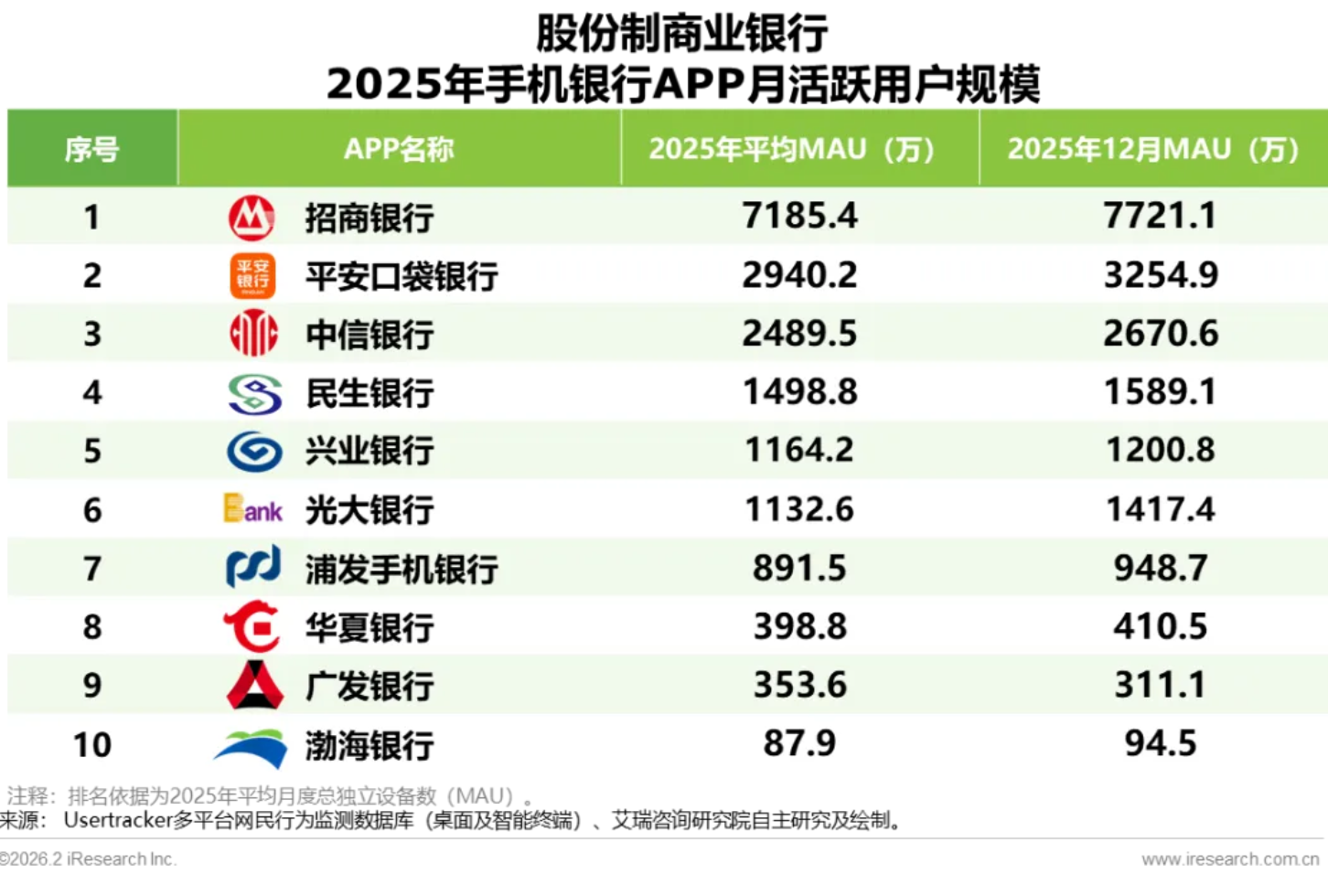
手机银行TOP50再无民营 生态壁垒高筑草根绝迹
Jing Ji Guan Cha Wang· 2026-02-18 05:47
Core Insights - The monthly active users (MAU) of mobile banking apps in China have stabilized between 648 million and 739 million, indicating that user growth has reached a ceiling, marking the end of a decade-long traffic dividend period [2] - User behavior has shifted significantly, with average session duration decreasing from 4.9 minutes in 2023 to approximately 2.7 minutes by mid-2025, reflecting a preference for high-frequency, short-duration, and function-oriented usage [2] - Major state-owned banks have solidified their market dominance, with all six major state-owned banks ranking in the top ten for MAU, led by Agricultural Bank of China with 249 million MAU [2] Industry Dynamics - The core competitive advantage of state-owned banks lies in their "full-scenario integration" capabilities, providing financial services deeply embedded in public services such as government, social security, healthcare, and education [3] - Joint-stock banks are adopting specialized development strategies, with China Merchants Bank leading its peers with 71.85 million MAU, while Ping An Bank and Citic Bank are leveraging AI technology to enhance service processes and maintain user engagement [3] - Local banks are experiencing polarization, with some city commercial banks maintaining MAU above 3 million due to their deep understanding of local markets, while private banks like WeBank and MYbank have fallen out of the top 50 due to challenges in customer acquisition and retention [3] Future Trends - As the industry standard for single-session usage time becomes 3 minutes, banks must rethink their value creation strategies [4] - AI-driven service process optimization, real-time risk control systems, and multi-device collaboration within ecosystems are reshaping the competitive landscape [4] - Key factors for institutional success in the future will include precise user insights, prudent risk management, and robust ecosystem integration capabilities [4]



流量红利枯竭 存量博弈下银行APP被迫断臂求生
Jing Ji Guan Cha Wang· 2026-02-18 05:44
Core Insights - The Chinese mobile banking market is transitioning from "scale expansion" to "value cultivation," indicating a saturation of user growth and the end of the traffic dividend period [2] - Different types of banks are exhibiting varied development trends in this new landscape [2] State-Owned Commercial Banks - The six major state-owned banks dominate the mobile banking market, with Agricultural Bank of China leading with over 250 million monthly active users (MAUs) [2] - The top three banks, including Industrial and Commercial Bank of China and China Construction Bank, have MAUs of nearly 200 million and over 100 million, respectively [2] - All six major banks reported positive month-on-month growth in MAUs, with ICBC leading at a 6.1% growth rate [2] Joint-Stock Commercial Banks - Joint-stock banks are seeking to carve out a niche in the saturated market, with China Merchants Bank leading among them with over 70 million MAUs [3] - Some banks like Everbright Bank and CITIC Bank showed significant month-on-month growth rates of 11.0% and 9.2%, respectively [3] - The performance of joint-stock banks is mixed, with some experiencing negative growth [3] Urban Commercial Banks - Urban commercial banks are growing rapidly, with 17 banks making it to the top 50 list, led by Ningbo Bank with 3.644 million MAUs and a growth rate of 43.9% [3] - The growth is attributed to localized strategies that enhance customer engagement [3] Rural Commercial Banks and Credit Cooperatives - Rural commercial banks and credit cooperatives also performed well, with 17 banks in the top 50, led by Fujian Rural Credit with 781.6 thousand average MAUs [4] - 12 out of these 17 banks reported positive month-on-month growth [4] Private Banks - Private banks are facing significant challenges, with only WeBank making it to the top 50 list in the first half of 2025, experiencing a 27.3% decline in MAUs [4] - The competitive landscape has shifted, making it difficult for online-only private banks to maintain their initial advantages [4] Conclusion - State-owned banks leverage "ecosystem" advantages to solidify their market position, while joint-stock banks focus on "professional" opportunities [5] - Urban commercial banks establish a strong local presence, whereas private banks struggle to survive in the competitive environment [5] - The future of banking will require a focus on creating irreplaceable value for users through technology and insights into user behavior [5]

2.7分钟定生死 手机银行存量厮杀谁在“断臂”,谁在“吃肉”?
Jing Ji Guan Cha Wang· 2026-02-18 04:57
Core Insights - The report by iResearch indicates that the monthly active users (MAU) of mobile banking apps in China have stabilized after fluctuating between 648 million and 739 million, signaling a ceiling in user growth and a shift from acquiring new users to enhancing existing user engagement [2] - User behavior is undergoing a structural reversal, with the effective daily usage time per device dropping from 4.9 minutes in 2023 to around 2.7 minutes by mid-2025, leading to a focus on high-frequency, short-duration, and functional usage [2] - Financial institutions are compelled to streamline operations and focus resources on core transaction scenarios to survive in this competitive landscape, where efficiency and precision are paramount [2] Mobile Banking Market Overview - The top three banks in terms of MAU are Agricultural Bank of China (2.49 billion), Industrial and Commercial Bank of China (1.94 billion), and China Construction Bank (1.09 billion), with all six major state-owned banks ranking in the top ten [3][5][6] - Private banks, represented by WeBank and MYbank, have faced significant setbacks, with many dropping out of the top 50 MAU rankings by 2025 [4] Competitive Landscape - State-owned banks are solidifying their dominance through extensive customer bases and integrated ecosystems, leveraging services embedded in high-frequency life scenarios such as government services and healthcare [7] - Joint-stock commercial banks are adopting a "specialized and precise" survival strategy, with China Merchants Bank leading among them with 71.85 million MAU, focusing on wealth management and intelligent interaction [8][10] - Regional banks are thriving by deeply engaging with local markets, while private banks struggle due to high customer acquisition costs and lack of local ecosystem support [13][14] Future Outlook - The mobile banking market is transitioning from a phase of scale expansion to one of value cultivation, with state-owned banks building moats through ecosystems, joint-stock banks seeking niches through specialization, and regional banks solidifying their local roots [14] - The ability to create irreplaceable value in a limited user engagement environment will be crucial, with technology applications such as AI reshaping service processes and enhancing risk management [15][16]

中国创新药产业加速迈向全球价值链核心
Jing Ji Guan Cha Wang· 2026-02-18 03:24
类似的深度合作范式在2025年已多点开花。三生制药与辉瑞就PD-1/VEGF双抗达成合作,创下当时首付 款纪录;恒瑞医药(600276)将包括核心产品在内的多个项目海外权益授予GSK,潜在总额达125亿美 元;而信达与武田的合作更是开创了按比例共担成本、共享利润的"双向奔赴"新模式。这些交易已超越 单一产品输出,覆盖从技术平台、临床开发到商业化的全链条,标志着中国药企正实现从"产品供应 商"到"综合能力伙伴"的跨越。 中国创新药产业正在迈入一个全新的发展阶段,实现了从"引进模仿"向"创新输出"的关键转变。这一变 化不仅体现在对外授权交易(BD)的显著增长上,更意味着中国在全球创新药领域中的话语权和影响 力持续增强。2026年初,中国创新药对外授权交易市场延续了此前的强劲增长势头,第一季度交易金额 已突破332.8亿美元,首付款规模甚至超过了2025年单季度最高水平,这不仅刷新了历史纪录,也标志 着中国创新药产业正从全球创新价值链的跟随者转变为引领者。 中国创新药BD交易的迅速扩张并非偶然,而是多重因素共同作用的结果。一方面,全球医药产业正面 临"专利悬崖"和"创新需求"的双重压力。预计到2030年,全球将有超 ...

创新药出海开年跑出“加速度”:产业迈入2.0时代
Jing Ji Guan Cha Wang· 2026-02-18 02:45
Core Insights - The Chinese innovative pharmaceutical industry has entered the 2.0 era, shifting from "import imitation" to "innovation output," with new forms like license-out and new co indicating a transformation in internationalization [1] - In the first quarter of 2026, the total transaction amount for Chinese innovative drug licensing (BD) exceeded $33.28 billion, surpassing the highest quarterly level of 2025, marking a shift from a "follower" to a core driver in the global innovation value chain [1][2] - The explosive growth in BD transactions is attributed to multiple factors, including the global pharmaceutical industry's "patent cliff" and "innovation demand," alongside China's recognized R&D efficiency and clinical capabilities [1] Transaction Growth - In 2025, the total value of China's innovative drug license-out transactions reached $140.27 billion, a significant increase from $2.56 billion in 2017, accounting for 49% of global innovative drug licensing transactions, surpassing the U.S. for the first time [2] - In January 2026, the upfront payment scale approached half of the total for 2025, with total transaction amounts reaching 22% of 2025's total [2] - The quality of transactions is also improving, with frequent occurrences of upfront payments exceeding $100 million and 37 transactions exceeding $1 billion, second only to the U.S. [2] Transaction Structure - The upgrade in transaction structure is a core feature of China's innovative drug internationalization, with traditional "selling seedlings" models being replaced by "technology platform output" and "global R&D collaboration" [2][3] - Notable collaborations include Innovent Biologics and Eli Lilly, where the partnership is based on a new molecule, demonstrating deep trust in China's R&D capabilities [2] Strategic Transformation - Leading pharmaceutical companies are adopting a dual strategy of "independent R&D + global licensing," creating a sustainable innovation ecosystem [3] - Examples include BeiGene's revenue surpassing 36 billion yuan in 2025, showcasing strong commercialization capabilities, and other companies achieving breakeven for the first time [3] Financial Performance - Over 70% of innovative pharmaceutical companies achieved revenue growth in 2025, with cash flow from BD transactions and IPO funding providing substantial resources for the industry [4] - The combination of domestic market cash flow and global licensing is creating a dual-driven model that reduces financial risks and accelerates the conversion of innovative results [4] Industry Ecosystem - The internationalization of innovative drugs is reshaping the global pharmaceutical landscape, with predictions of the emergence of global Chinese pharmaceutical giants [4] - Collaborations like that between Innovent Biologics and Takeda illustrate the strategic partnerships that enhance project advancement efficiency [4] Investment Trends - The innovative drug sector has seen a correction over the past two quarters, but long-term prospects for quality targets remain favorable, suggesting increased allocation [5] - The "dumbbell strategy" proposed by CICC highlights the dual characteristics of "innovation output" and "steady growth" in the Chinese innovative drug industry [5][6] Market Dynamics - An increasing number of Chinese innovative pharmaceutical companies are transitioning from "license-in" to proactive "license-out," achieving record high transaction amounts and gaining recognition in international markets [6] - Horizontal cooperation and integration among domestic pharmaceutical companies are accelerating to optimize resource allocation and address market competition and regulatory challenges [6]
中闽能源:区域政策与行业转型成关注焦点
Jing Ji Guan Cha Wang· 2026-02-17 23:28
Industry Policy and Environment - Fujian Province's policy support emphasizes the construction of transportation logistics infrastructure and the establishment of cross-strait hub channels, which directly benefits local energy companies like Zhongmin Energy, potentially enhancing regional economic vitality and investment expectations [1] - The "14th Five-Year Plan" clearly supports the development of new energy, indicating a long-term opportunity for Zhongmin Energy in the context of the industry's transition towards clean energy [1] Stock Price and Fund Performance - On December 5, 2025, Zhongmin Energy's stock price increased by 5% with a net inflow of 14.62 million yuan from main funds, reflecting a rise in short-term investor interest [2] - As of December 5, 2025, the company's price-to-earnings ratio (TTM) was 20.33, which is within the reasonable range for the industry [2] Industry and Risk Analysis - Significant fluctuations in global natural gas prices were reported, with the U.S. HH price experiencing a week-on-week decline of 74.4% in January 2026, which may impact the cost and demand for energy companies [3] - Analysts from Everbright Securities and CITIC Construction Investment noted that the Fujian sector is expected to see an overall valuation increase driven by policy dividends and industrial upgrades, but caution is advised regarding the implementation of policies and the operational efficiency of companies [3] Future Development - The realization of regional policy dividends requires specific project implementations; if these do not meet expectations, it may negatively affect stock performance [4] - The energy industry is facing intensified competition during its transition, necessitating companies to adapt to technological iterations and market pressures [4]
