
Jin Rong Shi Bao

Search documents
举保险之力筑牢农业强国建设根基
Jin Rong Shi Bao· 2026-01-07 02:44
Group 1 - The core focus of the Central Rural Work Conference is on agricultural modernization and the construction of an agricultural powerhouse, with key tasks outlined for the new round of grain production capacity enhancement actions, disaster prevention capabilities, and the establishment of mechanisms to prevent poverty [1] - Agricultural insurance is emphasized as a stabilizer for risk management in agriculture, requiring comprehensive upgrades in quality, service models, and system construction to support the foundation of agricultural powerhouse construction [1] - The meeting highlights the importance of food security, urging agricultural insurance to align with the grain production capacity enhancement actions to ensure a stable food supply for the population [1] Group 2 - The traditional agricultural insurance model is shifting from post-disaster compensation to a comprehensive prevention approach, necessitating the establishment of a closed-loop model for monitoring, risk intervention, and rapid claims [2] - Future implementation of this model requires deeper collaboration between insurance and meteorological/agricultural departments, expanding coverage of weather index insurance and catastrophe insurance [2] - The integration of disaster prevention costs into insurance coverage is essential to encourage proactive risk management among farmers, enhancing the resilience of agricultural production [2] Group 3 - Consolidating the achievements of poverty alleviation is a baseline task for rural revitalization, with natural disasters and economic fluctuations identified as key risks for returning to poverty [3] - The establishment of a regular mechanism to prevent poverty is crucial for extending the service chain of agricultural insurance and expanding its coverage [3] - The insurance industry is encouraged to connect with national poverty monitoring systems to dynamically identify and provide risk warnings for vulnerable groups [3] Group 4 - Developing new agricultural productivity fundamentally involves enhancing production efficiency and quality through technological empowerment, requiring a shift from traditional service models in agricultural insurance [4] - Key strategies include building a standardized agricultural insurance database, integrating digital technologies like AI and blockchain, and creating collaborative service platforms for new agricultural productivity forms [4] - The agricultural insurance sector is expected to innovate continuously to support the construction of an agricultural powerhouse, ensuring a stable path towards agricultural modernization [4]
落子管理式医疗 人保健康管理有限公司成立
Jin Rong Shi Bao· 2026-01-07 02:44
Core Insights - China People's Health Insurance Co., Ltd. has established a wholly-owned non-financial subsidiary, People's Health Management Co., Ltd., with a registered capital of 200 million yuan, marking a significant step in the construction of a comprehensive health and elderly care ecosystem [1] - The establishment of the health management subsidiary is a key initiative for the professional health insurance company to implement "managed healthcare," aiming to reduce risks and promote a shift from "passive healthcare" to "proactive health" [1] Group 1 - The establishment of the health management company is the first approved by the National Financial Supervision Administration since its formation in 2023, following the approvals from the former China Banking and Insurance Regulatory Commission in 2019 [1] - The company aims to create a new business model that integrates "insurance + health services + technology," focusing on a comprehensive health management service system to effectively lower the incidence of diseases and disabilities [1] - The company is committed to building a first-class health management company that contributes to the "Healthy China" initiative by providing equitable, systematic, and high-quality health services [2] Group 2 - The chairman of China People's Health Insurance emphasizes the importance of a new health service guarantee system that combines prevention, management, and protection, aligning with the national strategy for health development [2] - The company plans to establish a nationwide self-owned medical health service network and upgrade its unified health management platform, focusing on a full lifecycle health service system centered around internet hospitals [3] - The health management company will serve as a hub for collaboration among medical institutions, pharmaceutical companies, insurance firms, and technology enterprises, aiming to enhance the health and well-being of families [3]

充实钱袋子 提供好服务
Jin Rong Shi Bao· 2026-01-07 02:44
Group 1 - The core viewpoint of the articles emphasizes the importance of enhancing pension funds and improving care services in response to the aging population in China, with China Life providing a comprehensive financial solution [1] Group 2 - To enrich pension funds, China Life proposes a strategy of "one increase and one decrease," where "increase" refers to professional investment to enhance pension reserves, managing over 750 billion yuan in basic pension insurance funds and over 2.1 trillion yuan in enterprise annuities [2] - The "decrease" aspect involves various insurance products to alleviate personal pension expenditure burdens, exemplified by a case where an elderly individual reduced their out-of-pocket expenses from 41% to 8% through insurance claims [2][3] Group 3 - China Life has launched a series of insurance products specifically for the elderly, covering common risks such as death, accidents, and medical expenses, thereby addressing the health and accident risks faced by the elderly population [3] Group 4 - The company has developed a three-tiered pension product system combining institutional, community, and home care services, with the "Guoshou Jiayuan" brand offering various types of senior living communities [4] - The "Guoshou Jiayuan" community in Suzhou exemplifies high-quality elder care, providing comprehensive health and wellness services, and has expanded its presence in multiple cities to cater to diverse elderly needs [4] Group 5 - The initiatives in pension insurance and community services contribute to the emerging "silver economy," with a significant increase in registered companies in the elderly products and services sector, indicating a shift from "sunset industry" to "sunrise industry" [5] - China Life is actively supporting the elderly industry by establishing a 10 billion yuan fund focused on the "silver economy," aiming for systematic investment in this sector [6]

网络安全保险 如何织密风险时代“安全网”
Jin Rong Shi Bao· 2026-01-07 02:44
Core Insights - The article emphasizes the need for a collaborative industry ecosystem for cybersecurity insurance, highlighting that technological innovation and data sharing are foundational elements [1][6] - It discusses the launch of a new cybersecurity insurance product in Hong Kong, designed to comply with the 2025 Critical Infrastructure (Computer Systems) Ordinance [1][2] Group 1: Industry Challenges - Cybersecurity insurance is defined as a property insurance that compensates for economic losses and legal liabilities resulting from cybersecurity incidents, covering a wide range of events such as ransomware attacks and data breaches [3] - The current pilot programs in China have seen over 1,500 policies issued, with a total premium exceeding 150 million yuan and total coverage nearing 11.5 billion yuan, indicating a strong market demand [4] - Despite clear demand, the industry faces challenges such as pricing difficulties due to a lack of historical loss data and the evolving nature of cyber threats [4][5] Group 2: Solutions and Recommendations - The article suggests that enhancing cybersecurity risk quantification technology and encouraging cross-sector collaboration among insurance companies, cybersecurity firms, and research institutions is essential for developing accurate risk assessment models [1][6] - It highlights the importance of establishing clear standards and guidelines for risk assessment, as seen with the release of new standards by the Shenzhen Cybersecurity and Information Security Industry Association [6][7] - Regulatory guidance and pilot programs are seen as accelerators for the industry, with a focus on expanding coverage to small and medium-sized enterprises [7] - Continuous optimization of insurance product design is necessary, with a call for clear definitions of key terms and effective communication during underwriting [7]
消费金融行业 合作机构管理迎严考
Jin Rong Shi Bao· 2026-01-07 02:32
Core Insights - The article highlights the increasing regulatory scrutiny in the consumer finance industry, particularly focusing on the management of cooperative institutions, which has become a frequent issue leading to administrative penalties [1][2][4]. Group 1: Regulatory Actions - In 2025, seven consumer finance companies received penalties from the financial regulatory authority for inadequate management of cooperative institutions, with a total fine amounting to 5.6 million yuan [2]. - Notable penalties include Beijing Sunshine Consumer Finance fined 1.4 million yuan for multiple violations related to cooperative management, and Xiamen Jinmeixin Consumer Finance fined 1.2 million yuan for third-party management issues [2][3]. Group 2: Industry Challenges - The consumer finance sector faces challenges such as aggressive competition and the need for compliance, with some institutions lowering entry barriers and collaborating with platforms associated with negative practices [4][6]. - Issues like outsourcing collection processes have led to consumer rights violations, resulting in increased complaints and reputational damage for institutions [4]. Group 3: Compliance and Transformation - Strengthening cooperative institution management is deemed essential for the sustainable development of the consumer finance industry, with a focus on balancing scale and compliance [4][6]. - The introduction of the "Consumer Finance Company Regulatory Rating Measures" in late 2024 emphasizes the importance of cooperative institution management in regulatory assessments, linking it to business entry and resource allocation [4][5]. - Companies are increasingly disclosing their cooperative lending platform lists, with an average of 21.66 platforms per company, reflecting a proactive approach to regulatory compliance [5][6].
首席合规官 为非银机构稳健发展注入新力量
Jin Rong Shi Bao· 2026-01-07 02:32
Core Viewpoint - The importance of compliance for the stable development of financial institutions has become increasingly prominent under the backdrop of stringent regulation and risk prevention. The "Compliance Management Measures for Financial Institutions" will take effect on March 1, 2025, emphasizing the establishment of a compliance culture starting from the top management and involving all employees [1] Group 1: Compliance Officer Appointment - A one-year transition period has been set for financial institutions to comply with the new regulations, with many non-bank institutions already appointing Chief Compliance Officers (CCOs) [1] - As of now, various financial institutions such as trust companies, financial leasing firms, and consumer finance companies have initiated the appointment of CCOs, with regulatory approvals accelerating [1] - The first CCO in the financial leasing industry post-regulation is Ma Chi from Kunlun Financial Leasing, approved by the Financial Regulatory Bureau at the end of December 2024 [2] Group 2: Trust Companies and Financial Companies - Several trust companies have successfully appointed CCOs, including Lujiazui Trust and Shanxi Trust, with approvals from local regulatory authorities [3] - The trend of appointing CCOs is also evident in corporate financial companies, with multiple firms like Anhui Jiaokong Financial Company and others across key sectors such as energy and transportation establishing CCO positions [4] Group 3: Compliance Management Framework - In 2025, financial regulatory authorities have issued various management measures and guidelines aimed at clarifying business boundaries and reinforcing accountability, thereby establishing a structured compliance management framework [5] - The regulatory environment for non-bank institutions in 2025 is characterized by a dual focus on "system improvement and enforcement enhancement," shifting compliance management from mere formal compliance to substantive compliance [6] Group 4: Industry-Specific Compliance Practices - Different non-bank institutions are exploring compliance practices tailored to their specific regulatory requirements, such as trust companies enhancing management in areas like related transactions and fund flows [7] - Consumer finance companies are focusing on consumer rights protection through mechanisms like a "white list" of partner institutions and AI-driven fraud prevention systems [7] - Financial leasing companies are strengthening their compliance measures in project due diligence and asset management to prevent issues like false leasing [7]
坚定功能定位 走好中国特色金融发展之路
Jin Rong Shi Bao· 2026-01-07 02:32
党的二十届四中全会是在以中国式现代化全面推进强国建设关键时期召开的一次具有全局性、历史 性意义的重要会议。如何深入学习贯彻党的二十届四中全会精神,推动金融资产管理公司高质量发展, 更好地发挥防范化解风险和支持实体经济发展的独特功能?对此,《金融时报》记者专访了中信集团党 委委员、副总经理兼中信金融资产党委书记、董事长刘正均。 刘正均:党的二十届四中全会深刻把握党和国家事业发展所处的历史方位,回答了"十五五"时期确 保基本实现社会主义现代化取得决定性进展的一系列方向性、根本性重大问题,对"十五五"时期加快建 设金融强国提出明确要求,为新时代新征程做好金融工作提供了根本遵循。金融资产管理公司作为我国 金融体系内具有逆周期救助、化解金融风险、畅通要素循环特殊功能的重要组成部分,必须深刻把握全 会的重大意义、核心要义和实践要求,为推动金融强国建设取得新的重大进展作出积极贡献。 深刻领会全会的重大政治意义。全会为推进"十五五"发展谋篇布局,为接续推进第二个百年奋斗目 标凝心聚力,必将对党和国家事业发展产生重大而深远的影响。我们要充分认识全会的重大里程碑意 义,坚定拥护"两个确立",坚决做到"两个维护",切实把思想和行动 ...


事关黄金业务!工行宣布:上调!
Jin Rong Shi Bao· 2026-01-07 02:26
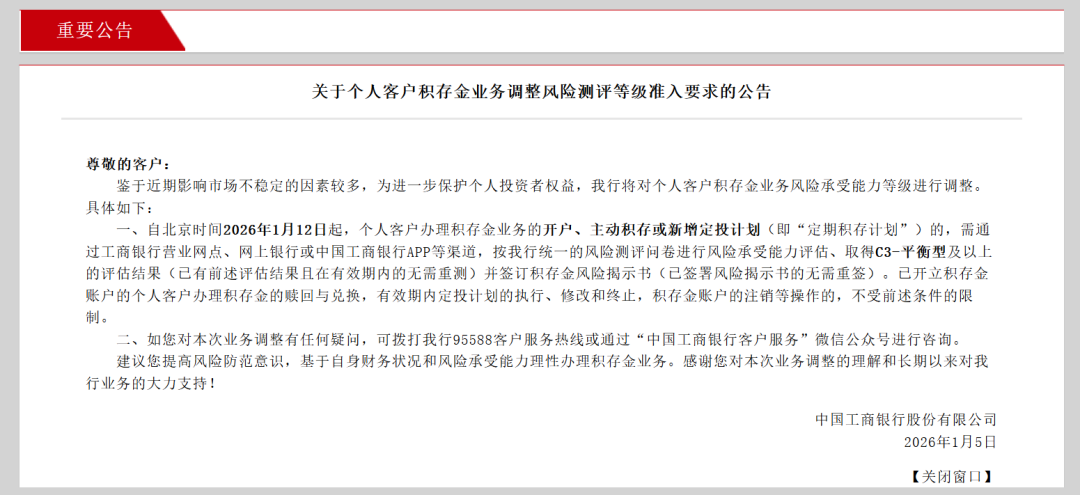
Core Viewpoint - Major state-owned banks in China are tightening the risk assessment requirements for personal gold accumulation business to protect individual investors amid market instability [1][3]. Group 1: Policy Changes - Starting from January 12, 2026, personal clients must undergo a risk assessment and achieve a minimum rating of C3-Balanced or above to engage in gold accumulation activities [3]. - Existing clients with valid risk assessment results are exempt from re-evaluation for transactions such as redemption and account cancellation [3]. Group 2: Industry Trends - Other banks, including Ningbo Bank and Citic Bank, have also raised the risk assessment thresholds for gold accumulation products, indicating a broader trend in the banking sector [4]. - The minimum investment amount for gold accumulation products has been increasing, with many banks raising the threshold to 1,000 yuan since 2025 [4]. Group 3: Market Context - The tightening of gold accumulation business is closely linked to the rising gold prices, which have continued to increase into 2026, with spot gold surpassing 4,400 USD per ounce on January 5, 2026, marking a 1.9% daily increase [4].

健康险风险减量能否破局
Jin Rong Shi Bao· 2026-01-07 02:25
Core Insights - The insurance industry is transitioning from traditional financial compensation models to a customer-centric service model, driven by aging populations and diverse health needs [1][2] - The establishment of health management companies is becoming a standard configuration in health insurance, with companies like Renbao Health and China Pacific Insurance leading the way [2][3] - Health management services are essential for sustainable development in health insurance, focusing on proactive risk reduction and customer engagement [5][6] Group 1 - Renbao Health's health management subsidiary was officially established in Beijing, aiming to integrate health management services as a key method for risk reduction [1] - In the first half of 2025, Renbao Health's health management services generated revenue of 159 million yuan, serving over 4.8 million customers, reflecting a year-on-year growth of 21.4% [2] - The integration of health management services into insurance products is becoming standard, even for basic insurance offerings [2][3] Group 2 - Major insurance companies are enhancing their core business through health management, with China Pacific Insurance focusing on high-end customer needs in health management and rehabilitation [3][5] - The shift from passive claims to active health management is crucial for the health insurance sector, aiming to lower claim rates and improve customer retention [5][6] - The low user awareness and service utilization rates present significant challenges for the industry, despite the recognized importance of health management [6][7] Group 3 - Regulatory guidance has been issued to promote the integration of health insurance and health management, emphasizing a new health service guarantee system [7] - Artificial intelligence (AI) is seen as a key solution to enhance health management efficiency and effectiveness, with applications in personalized health interventions [8] - The deep integration of AI technology into health management services is expected to address challenges in service delivery and improve overall health outcomes [8]



商业不动产REITs试点正式启幕
Jin Rong Shi Bao· 2026-01-07 02:17
Core Viewpoint - The introduction of commercial real estate REITs marks a new phase in China's REITs market, transitioning towards a parallel development of commercial real estate and infrastructure REITs [1][7]. Group 1: Market Development - China's REITs market has steadily developed over five years, with 78 listed REITs raising a total of 209.9 billion yuan and a total market capitalization of 219.9 billion yuan as of December 27, 2025 [2]. - The China Securities REITs total return index increased by 19% since 2024, indicating that REITs are becoming an important asset class [2]. - The market's expansion into commercial real estate is driven by the substantial existing stock of commercial properties and the need for financing channels [2][3]. Group 2: Policy Framework - The announcement by the China Securities Regulatory Commission (CSRC) outlines the core institutional arrangements for commercial real estate REITs, including product definitions, fund registration, and operational management requirements [4]. - The accompanying notification emphasizes enhancing market norms and resilience while serving the real economy, focusing on expanding supply and optimizing mechanisms [4][5]. - The policy encourages the integration of assets with similar functions and supports financial institutions with strong governance and asset management experience to participate in the REITs market [5]. Group 3: Future Outlook - The launch of commercial real estate REITs is seen as a significant step towards a dual-track review system, which is expected to improve review efficiency and accelerate market expansion [7]. - Analysts believe that the new regulations will lead to a scalable development phase for the REITs market, particularly in commercial real estate, which has considerable growth potential [7].