Di Yi Cai Jing Zi Xun

Search documents
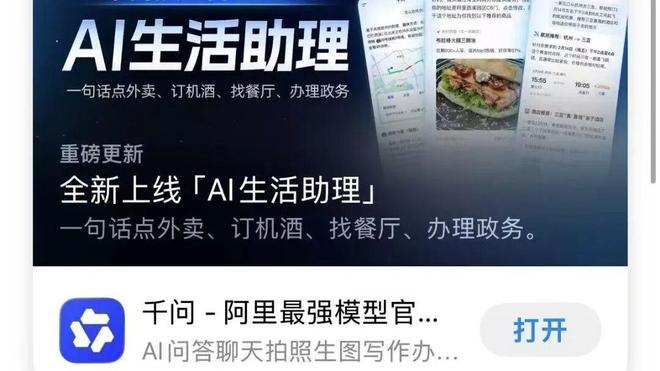
阿里千问加入“一句话点外卖”
Di Yi Cai Jing Zi Xun· 2026-01-15 02:58
Core Viewpoint - The article discusses the launch of the Qianwen App's integration with Alibaba's ecosystem, enabling AI-driven shopping functionalities such as food delivery, purchasing items, and booking flights, marking a significant step in the AI era's competitive landscape [2][5]. Group 1: Qianwen App Features - On January 15, Qianwen App announced full integration with Alibaba's services, allowing users to perform tasks like ordering food and shopping through AI [2]. - Users can interact with Qianwen by simply stating their requests, such as "help me order a cup of coffee," which then utilizes location data to recommend nearby options [2][5]. - The app has improved its response time significantly, reducing the time to generate delivery options from nearly 30 seconds to about 10 seconds, enhancing user experience [5]. Group 2: Strategic Importance - Qianwen is viewed by Alibaba's management as a critical player in the "future battle of the AI era," with plans to develop it into a super app that integrates various life scenarios such as navigation, food delivery, and shopping [6]. - The establishment of the Qianwen C-end business group aims to consolidate Alibaba's AI capabilities and create a comprehensive AI entry point for users [6]. Group 3: Competitive Landscape - The competition in the AI conversational assistant space is intensifying, with Alibaba aiming to differentiate itself by moving beyond traditional dialogue interfaces to create a more integrated ecosystem [7]. - The integration of services like Gaode and Taobao Flash Purchase into Qianwen signifies a strategic shift towards creating a seamless user experience while addressing challenges related to privacy and security [7].


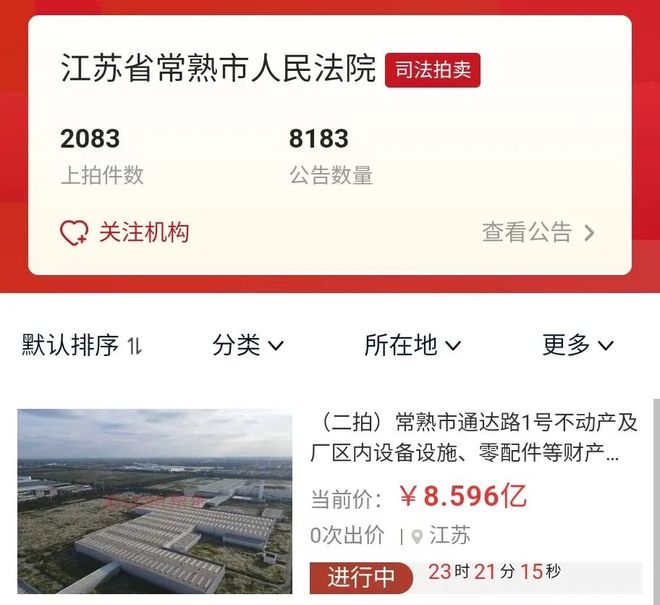
姚振华举报的资产,0人出价竞拍
Di Yi Cai Jing Zi Xun· 2026-01-15 02:58
Group 1 - The auction for Qoros Automotive's Changshu factory commenced on January 15, with a starting price of 859.6 million yuan [1] - As of 10:35 AM on January 15, only one person registered for the auction, while over 20,000 people viewed the event, but no bids were placed [1] - The auction is scheduled to conclude on January 16 at 10 AM [1] Group 2 - Qoros Automotive's actual controller, Yao Zhenhua, publicly protested against the second auction on January 14 [1]
5年悬案与2亿追索:迅雷重启诉讼,指控前CEO陈磊隐秘掏空公司
Di Yi Cai Jing Zi Xun· 2026-01-15 02:40
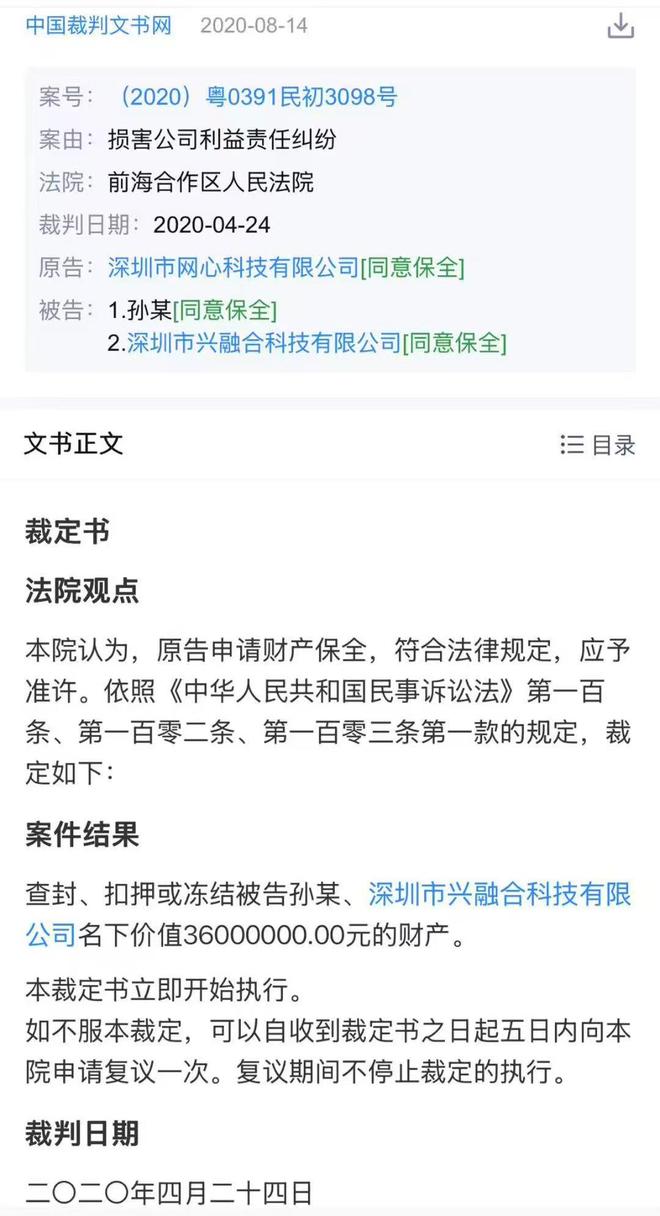
1月15日,第一财经记者独家获悉,时隔超五年,迅雷公司及其子公司网心科技,以"损害公司利益 责任纠纷"为由,对前CEO陈磊及其核心团队提起民事诉讼,追索金额高达2亿元。目前该案已被深圳相 关法院受理立案。 这场横跨超五年的纠纷核心,直指一家名为"兴融合"的公司。原告指控该公司为前CEO陈磊实控 的"影子体系",并由此构建了一条隐秘的利益输送链条。 事实上,早在2020年10月8日,迅雷公司发布公告称,公司前CEO陈磊涉嫌职务侵占事宜,已被深 圳市公安局立案侦查,并在公告最后呼吁陈磊尽快回国配合调查。 2020年,迅雷新管理层对公司进行审计时发现:一家名为兴融合的迅雷带宽供应商实际为陈磊个人 控制的公司,他已通过各种手段,向兴融合转移了数额巨大的资金。 天眼查显示,深圳市兴融合科技有限公司成立于2018年。 2018年底,陈磊安排人从工商代理手中 购买了兴融合公司股权,并安排其可控人员代持兴融合股份。 从兴融合与迅雷及子公司的合作过往来看,2019年1月1日,迅雷子公司网心科技与兴融合签订资源 节点服务协议。从2019年1月至2020年初,网心累计向兴融合支付了约1.7亿元资源节点采购费。 迅雷方面指控,兴融合 ...

线上直播精彩回顾丨浮沤危悬?多元布局!渣打2026年全球及中国市场展望
Di Yi Cai Jing Zi Xun· 2026-01-15 02:25
Core Insights - Standard Chartered Bank, in collaboration with Yicai Media, held an online event titled "Standard Chartered Wealth Management 2026 Global and China Market Outlook," focusing on wealth strategies amid complex market conditions [1][2] - The event emphasized three core themes for 2026: the performance of risk assets, the debate surrounding AI bubbles, and the need for diversified investment strategies [2][12] Group 1: Global and China Market Outlook - The global economy is expected to experience a soft landing in 2026, favoring risk assets, but investors should diversify across regions to mitigate risks associated with a potential dollar shift [7][16] - The Chinese stock market is projected to benefit from policy dividends under the "14th Five-Year Plan," while U.S. stock valuations are high, necessitating a diversified asset allocation strategy [7][18] - Investors are advised to increase allocations to alternative investments, particularly gold, to enhance portfolio resilience against risks [7][21] Group 2: Investment Themes and Strategies - Theme 1: Stocks - AI-driven earnings growth is anticipated to overcome high valuation pressures, making it a favorable time for diversified stock allocations, particularly in the U.S. and Asia [18][19] - Theme 2: Bonds - Emerging market bonds are expected to outperform developed market bonds, with non-U.S. debt offering attractive yields as U.S. interest rates decline [19][20] - Theme 3: Diversified Assets - Gold is projected to continue its upward trend, with a forecast of reaching $4,800 per ounce in the next 12 months, serving as a stabilizing asset in investment portfolios [21][22] Group 3: AI Bubble Discussion - The current AI hype may not represent a bubble, as the industry is still in its early stages, with significant potential for value creation in the long term [26][29] - The discussion highlighted the need for technological breakthroughs and sustainable development in the AI sector to realize its full potential [29][30] - The focus should be on identifying genuine structural opportunities within the market, rather than merely speculating on potential bubbles [30]
白银突然大跌
Di Yi Cai Jing Zi Xun· 2026-01-15 02:18
更多最新消息: 1月15日,现货白银短线快速跳水,截至09:39,跌幅扩大至6%,跌破88美元/盎司。COMEX白银跌超 5%。 ...
白银超越英伟达升至全球第二资产
Di Yi Cai Jing Zi Xun· 2026-01-15 02:15
2026.01.15 本文字数:2139,阅读时长大约4分钟 作者 |第一财经 樊志菁 此前,英伟达凭借人工智能概念股热潮,一直在全球金融市场占据领先地位。但长期被视为传统避险资 产的白银,依托贵金属属性与工业实用价值的双重加持,上演了一场出人意料的逆袭。 从历史上看,黄金一直是这两种贵金属中价值更高的品种,在金融与贸易领域常被奉为 "金本位"的标 杆。然而,随着市场趋势与工业需求的转变,白银的价值正在被挖掘。 据企业市值数据平台companiesmarketcap 显示,持续创下历史新高的白银,在周三市值突破5万亿美 元,超过英伟达成功跻身全球价值第二高的资产,仅次于黄金。 首先通胀会侵蚀纸币储蓄的价值,促使更多人投向白银等有形资产。而地缘政治不确定性以及最新升级 的美联储独立性担忧的局面,可能会为白银价格进一步冲高创造必要条件。 全球央行与政府政策对贵金属的价值有着显著影响。历史上,央行一直将黄金作为储备资产,但如今部 分投资者和政府对白银的兴趣正日益浓厚。若央行采取行动丰富储备资产组合,也可能增加对白银的需 求,从而影响其市场价格。 推动白银这一轮涨势的并非只有避险资产需求。供需平衡是一个不可忽视的因素 ...


美国银行业“矛头”指向特朗普
Di Yi Cai Jing Zi Xun· 2026-01-15 02:05
Core Viewpoint - The U.S. banking sector is experiencing strong growth in net interest income and trading activities, yet stock prices are declining due to concerns over President Trump's credit card policy and skepticism regarding the government's lawsuit against Federal Reserve Chairman Jerome Powell [2]. Group 1: Loan Demand and Economic Resilience - Analysts from S&P Global Market Intelligence express optimism for the banking industry's growth momentum through 2026, estimating a significant increase in overall loan volume by 5.3% year-on-year by the end of 2025 [3]. - Despite the Trump administration's tariffs, the U.S. economy and consumers show resilience, partly due to the AI industry boom and the Federal Reserve's interest rate cuts, with expectations of two more rate cuts this year [3]. - Bank of America reports an 8% year-on-year increase in average loan volume, with net interest income reaching a record high of $15.9 billion, indicating positive signals for both the banking sector and the overall economy [3]. - JPMorgan Chase's loan volume increased by 9% year-on-year in Q4, with CEO Jamie Dimon expressing optimism about the economic outlook for the next six to twelve months [3]. Group 2: Credit Card Rate Cap Concerns - The banking sector faces potential growth challenges amid rising geopolitical tensions and policy uncertainties, particularly regarding President Trump's unexpected proposal to cap credit card interest rates at 10% [5]. - Bank executives worry that setting a cap on credit card rates could lead to tighter credit availability, negatively impacting economic growth [6]. - Bank of America CEO Brian Moynihan warns that a cap on credit card rates could restrict access to credit for those who need it most [6]. - Citigroup CFO Mark Mason notes that the lack of specific implementation details makes it premature to assess the potential impact of the rate cap policy [6]. Group 3: Defending Federal Reserve Independence - Following the investigation into Federal Reserve Chairman Powell by the Trump administration, many in the banking sector advocate for the Fed's independence, citing potential economic uncertainties from political interference [7]. - JPMorgan CEO Dimon warns that political meddling in the Fed's decisions could raise market inflation expectations and lead to higher interest rates in the long run [7]. - Bank of America and Citigroup executives emphasize the critical importance of the Fed's independence for the U.S. economy [8].


A股集体低开,商业航天板块集体调整
Di Yi Cai Jing Zi Xun· 2026-01-15 01:58
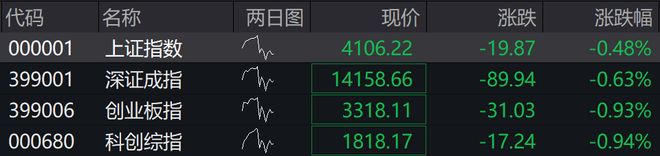
Market Overview - The commercial aerospace sector experienced a collective adjustment, with companies like Tongyu Communication and Fenghuo Communication hitting the daily limit down, while Jili Rigging fell over 8% [1] - The A-share market opened lower, with the Shanghai Composite Index down 0.48%, the Shenzhen Component Index down 0.63%, and the ChiNext Index down 0.93% [1][2] - The AI application sector saw a decline, with CRO, commercial aerospace, brain-computer interface, nuclear fusion, and Yushu Robotics concepts leading the losses [2] Company Specifics - Tianpu Co. opened near the daily limit down after receiving an inquiry letter from the Shanghai Stock Exchange regarding its main business and executive qualifications [2] - Ctrip Group's stock fell nearly 15% following an investigation by the market regulatory authority, while other companies like Tongcheng Travel and Xpeng Motors also saw declines of over 2% [4][6] Index Performance - The Shanghai Composite Index was at 4106.22, down 19.87 points or 0.48% [2] - The Shenzhen Component Index was at 14158.66, down 89.94 points or 0.63% [2] - The ChiNext Index was at 3318.11, down 31.03 points or 0.93% [2] - The Science and Technology Innovation Index was at 1818.17, down 17.24 points or 0.94% [2]



港股携程集团,大跌
Di Yi Cai Jing Zi Xun· 2026-01-15 01:51
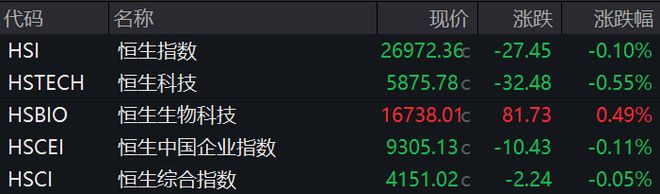
Market Overview - On January 15, the Hong Kong Hang Seng Index opened down 0.10%, while the Hang Seng Tech Index fell by 0.55% [1] - The Hang Seng Index is currently at 26,972.36, down by 27.45 points [2] - The Hang Seng Tech Index stands at 5,875.78, decreasing by 32.48 points [2] - The Hang Seng China Enterprises Index is at 9,305.13, down by 10.43 points [2] - The Hang Seng Composite Index is at 4,151.02, down by 2.24 points [2] Sector Performance - Real estate, transportation, and food & beverage sectors showed the highest gains, while steel, semiconductors, and media sectors experienced the largest declines [1] - Ctrip Group opened down nearly 15% and has since fallen over 20% due to an investigation by the State Administration for Market Regulation regarding alleged monopolistic behavior [1] Company Specifics - Ctrip Group is cooperating with regulatory authorities and ensuring normal operations across its business [1] - In the tech sector, JD Health rose nearly 3%, and Baidu Group increased by nearly 1%, while Tongcheng Travel and Xpeng Motors fell over 2% [4] - JD Health is currently priced at 71.70, reflecting a 2.94% increase, while Baidu Group is at 146.40, up by 0.90% [6]

迅雷重启诉讼,指控前CEO陈磊隐秘掏空公司
Di Yi Cai Jing Zi Xun· 2026-01-15 01:12
2026.01.15 本文字数:3471,阅读时长大约6分钟 作者 |第一财经 刘佳 郑栩彤 1月15日,第一财经记者独家获悉,时隔超五年,迅雷公司及其子公司网心科技,以"损害公司利益责任 纠纷"为由,对前CEO陈磊及其核心团队提起民事诉讼,追索金额高达2亿元。目前该案已被深圳相关法 院受理立案。 这场横跨超五年的纠纷核心,直指一家名为"兴融合"的公司。原告指控该公司为前CEO陈磊实控的"影 子体系",并由此构建了一条隐秘的利益输送链条。 事实上,早在2020年10月8日,迅雷公司发布公告称,公司前CEO陈磊涉嫌职务侵占事宜,已被深圳市 公安局立案侦查,并在公告最后呼吁陈磊尽快回国配合调查。 一位接近人士对第一财经记者独家透露,核心当事人陈磊自2020年出境后,一直长期居留海外,导致迅 雷发起的各项追讨维权行动面临严重的取证障碍。2022年底,因客观局限,公安机关立案后因无法获取 充足证据而撤案。 如今民事追偿程序的重启,标志着这场始于2020年、因核心当事人滞留海外而一度陷入僵局的内部风暴 与权力纠葛,进入了新的民事追偿的法律阶段。 第一财经记者独家了解到,本次民事诉讼的被告,除核心人物陈磊外,还包括前迅雷 ...