
Zhong Guo Huan Jing Bao

Search documents
宣城宁国市生态环境分局多措并举助力青年党员成长成才
Zhong Guo Huan Jing Bao· 2025-10-16 05:43
Core Viewpoint - The ecological environment bureau of Ningguo City, Xuancheng, Anhui Province, emphasizes the cultivation of young party members to enhance their political commitment and professional skills, aiming to build a capable and responsible youth team for ecological protection and pollution prevention efforts [1][2] Group 1: Theoretical Foundation - The bureau prioritizes political construction by organizing in-depth studies of the Party's innovative theories and policies related to ecological civilization, enhancing the political awareness and execution capabilities of young party members [1] - Activities such as thematic reading classes and party day events are conducted to deepen the understanding of the significance of the "two establishments" and strengthen the "four consciousnesses" [1] Group 2: Mentorship and Capacity Building - A mentorship program is implemented where experienced mid-level cadres or business backbones are paired with young party members for one-on-one guidance, focusing on political, business, and personal development [1] - This initiative aims to help young members quickly adapt to their roles and improve their professional skills [1] Group 3: Engagement and Skill Development - The bureau organizes activities like "Young Cadres on Stage" to encourage young party members to share experiences and discuss challenges, fostering their thinking and expression abilities [2] - Skills competitions related to core business areas such as ecological monitoring and law enforcement are held to stimulate enthusiasm for professional excellence among young members [2] - An external learning mechanism is established to facilitate participation in training outside the city, encouraging exposure to advanced practices in regions like the Yangtze River Delta [2] Group 4: Future Plans - The bureau plans to continuously improve the long-term mechanism for cultivating young party members, creating better conditions and broader platforms for their growth and success [2]
黑龙江“十五五”规划编制工作座谈会强调 把生态优先、绿色发展理念贯穿规划始终
Zhong Guo Huan Jing Bao· 2025-10-16 03:46
Core Points - The meeting focused on the preparation of the "15th Five-Year Plan" for Heilongjiang, emphasizing the implementation of Xi Jinping's cultural and ecological civilization thoughts [1][2] - Experts from various sectors provided suggestions on cultural construction, ecological development, and the integration of culture and tourism [1][2] Group 1: Cultural and Ecological Development - The meeting highlighted the importance of political leadership in promoting cultural and ecological revitalization in Heilongjiang [2] - There is a strong emphasis on integrating ecological priorities and green development throughout the "15th Five-Year Plan" [2] - The plan aims to enhance the value realization of ecological products and build a higher-level green and beautiful Heilongjiang [2] Group 2: Cultural Industry and Tourism - The meeting called for the inheritance and promotion of the Daqing Spirit and Beidahuang Spirit to foster cultural and cultural industry development [2] - There is a focus on developing distinctive cultural tourism, leveraging cultural elements to enhance tourism and vice versa [2] - The plan aims to expand the influence of ice and snow culture and economy, capitalizing on the "post-Winter Olympics" effect [2]
家风故事|“红色”堤坝和两代人的答卷
Zhong Guo Huan Jing Bao· 2025-10-16 03:30
我的家乡是粤东红色革命老区的一个小山村,位于美丽的汀江河畔,一道蜿蜒两公里的堤坝守护了家乡 40余年。从懵懂少年迈入成熟中年,一切都在变,但不变的是那条堤坝在我脑海中的"红色"印记。她给 我永不磨灭的情怀和无穷的力量,激励我不断进取,努力交出优秀的答卷。 尽管阔别家乡多年,脑海中仍时常浮现这条堤坝将洪水阻拦于村外、守护百姓房屋和农田安全的情景。 这条"红色"堤坝诠释了团结一心、众志成城、无私奉献、攻坚克难的奋斗精神,并伴随我的成长,一直 激励着我不断努力进取。 为彻底治理洪灾,党和政府决定派一个由1000多人组成的农田基本建设团支援建设。为确保工程顺利实 施,公社任命父亲为大队党支部书记、大队长,开启了他为大队建设和村民服务的青春征程。 大学毕业后,我进入了生态环境系统工作,一干就是25年。无论在哪个岗位,我都时时以共产党员的标 准严格要求自己,在平凡的岗位上踏踏实实工作,全身心投入蓝天、碧水、净土保卫战。现在,年近50 岁的我又按照组织的安排,到了镇街一线工作,从事乡村振兴工作。我将埋头苦干,攻坚克难,努力将 这里的绿水青山变成金山银山,在启航新征程、奋进新时代中展现应有的风采,交出合格的答卷。 作者单位: ...
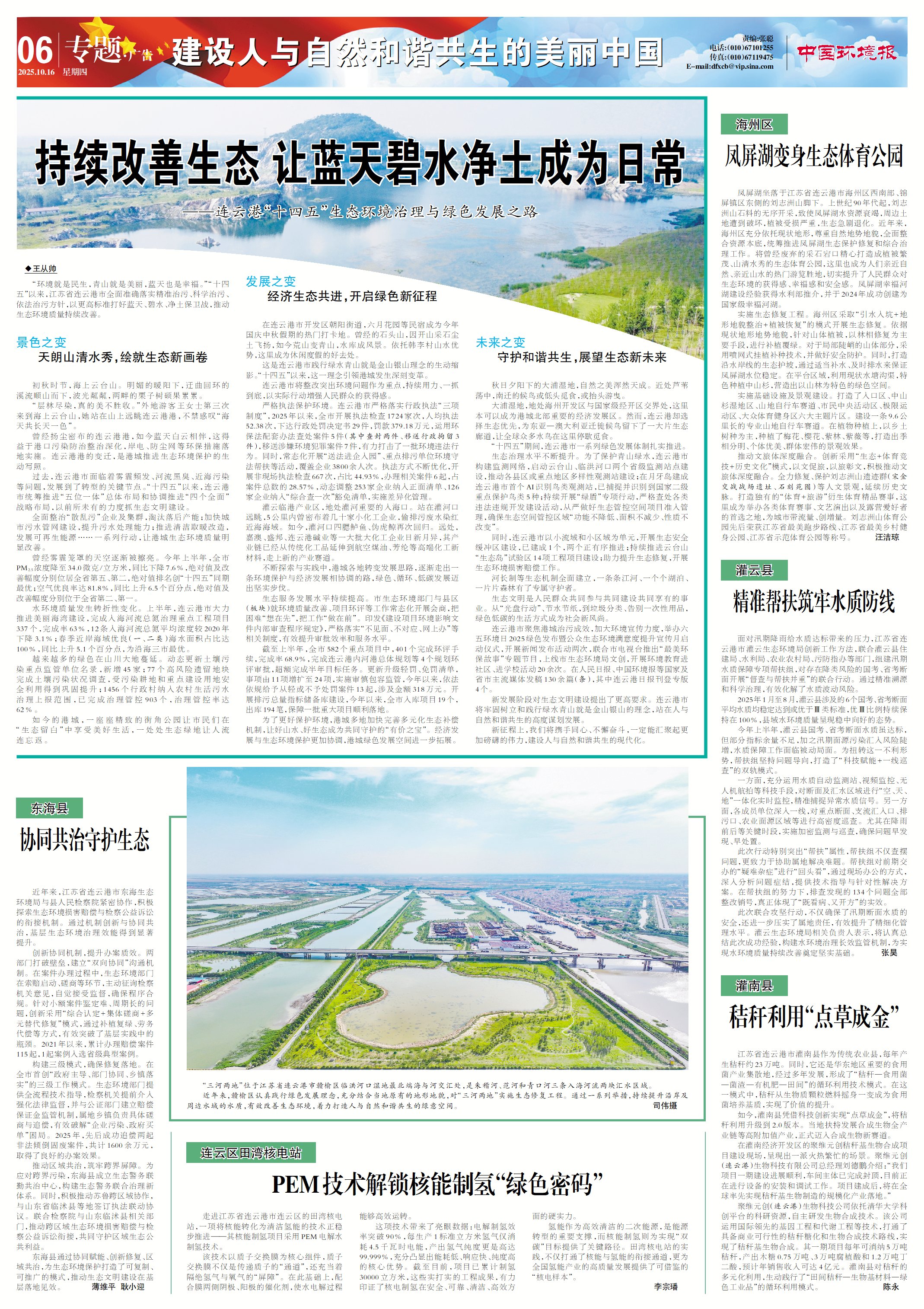
持续改善生态 让蓝天碧水净土成为日常——连云港“十四五”生态环境治理与绿色发展之路
Zhong Guo Huan Jing Bao· 2025-10-16 01:45
Core Viewpoint - The article emphasizes the significant improvements in ecological environment quality in Lianyungang City, Jiangsu Province, driven by the implementation of strict pollution control measures and a commitment to sustainable development [2][10][24]. Environmental Improvements - Lianyungang City has effectively implemented precise pollution control, scientific governance, and legal enforcement since the "14th Five-Year Plan," leading to continuous improvements in air and water quality [2][10]. - The PM2.5 concentration in the city decreased to 34.0 micrograms per cubic meter in the first half of the year, a year-on-year decline of 7.6%, ranking fifth in the province for absolute value and second for improvement [4][12]. - The air quality rate reached 81.8%, an increase of 6.5 percentage points year-on-year, marking the best performance in the province [4][12]. - Significant progress was made in water quality, with 337 key projects for nitrogen control completed, achieving a completion rate of 63% [13]. Economic and Ecological Development - The city has transformed its development model, balancing economic growth with environmental protection, and has seen a shift from traditional industries to high-end chemical materials [6][18]. - The implementation of strict environmental laws has led to numerous inspections and penalties for violations, enhancing public awareness and compliance among businesses [17][18]. - The city has also focused on enhancing ecological services and improving project approval efficiency, with 401 out of 582 key projects completing environmental assessments [18]. Community Engagement and Awareness - Lianyungang City has actively promoted environmental awareness through various campaigns and educational programs, fostering a culture of sustainability among its residents [23]. - The community's participation in ecological initiatives has been encouraged, with a focus on reducing waste and promoting green living practices [23][24]. Future Outlook - The city aims to continue its commitment to ecological civilization, ensuring that economic development aligns with environmental sustainability, and enhancing the quality of life for its residents [24][25].


南京所有机中心党支部探索建立“党建五维融合工作法”
Zhong Guo Huan Jing Bao· 2025-10-16 01:45
Core Viewpoint - The article highlights the development and implementation of the "Five-Dimensional Integration Work Method" by the Party Branch of the Rural Environment and Organic Food Development Research Center, which aims to enhance the standardization and scientific level of branch work, thereby promoting high-quality development in the organic sector [1][2][3][4][5]. Group 1: Leadership and Political Direction - The Party Branch has created a distinctive brand "I Speak Organic Standards," integrating party policies with rural revitalization strategies, resulting in 155 customized training sessions attended by over 21,000 participants in three years, significantly improving organic management and talent reserves [1]. - The establishment of the largest organic sorghum production base for Moutai liquor, covering over one million acres, has increased farmers' income and gained trust from local governments and enterprises [1]. Group 2: Internal Motivation and Community Engagement - A "Three-in-One" driving mechanism has been established, enhancing the role of ordinary party members and transforming them from participants to planners in annual theme party day activities [2]. - The Party Branch has successfully connected organic product sales worth 300 million yuan with new retail partners, demonstrating strong community engagement and collaboration [2]. Group 3: Innovation and Green Development - The Party Branch has developed a "Five Learning Mechanism" to create a closed-loop learning system, focusing on agricultural carbon reduction and solid carbon research under the "dual carbon" strategy [3]. - The Party Branch has supported Jiangsu Province in completing its first agricultural carbon credit transaction, turning agricultural carbon credits into financial assets [3]. Group 4: Coordinated Development and Market Strategy - The Party Branch has implemented a "Dual Circulation Empowerment Work Method," coordinating domestic and international organic certification markets, with domestic organic code issuance accounting for approximately 40% of the national total over three years [4]. - The Party Branch has established cooperation with over 40 countries along the Belt and Road, focusing on compliance with international regulations and standards [4]. Group 5: Supervision and Integrity - A "Four Must" supervision mechanism has been introduced to embed integrity supervision throughout the organic certification process, resulting in the issuance of 750 integrity certification notices and the collection of 650 self-inspection forms in the first half of 2025 [5]. - The Party Branch has maintained a clear boundary in professional conduct, refusing to participate in business banquets related to certification services [5].
推进全面绿色转型 加快形成绿色生产力
Zhong Guo Huan Jing Bao· 2025-10-16 01:43
Core Viewpoint - The article emphasizes the importance of promoting green and low-carbon development as a key aspect of high-quality development and a fundamental strategy for addressing ecological issues in China [1] Group 1: Economic and Social Development - The 20th National Congress of the Communist Party of China has included accelerating the comprehensive green transformation of economic and social development as a goal for deepening reforms [1] - The government work report for 2025 highlights the need to synergistically promote carbon reduction, pollution reduction, and green growth [1] Group 2: Technological Transformation - Technological transformation is identified as the core driving force for comprehensive green transformation, characterized by substitution, efficiency enhancement, and creation effects [2] - By 2024, the share of clean energy consumption in China is expected to reach 28.6%, with non-fossil energy consumption accounting for 19.8% [2] - China's photovoltaic component production has ranked first globally for 16 consecutive years, supplying 70% of the world's photovoltaic components and 60% of wind power equipment [2] Group 3: Institutional Innovation - A systematic institutional framework has been established through property rights, pricing mechanisms, and judicial collaboration [3] - The carbon emissions trading market in China achieved a cumulative transaction volume of 189 million tons and a transaction value of 18.114 billion yuan in 2024 [3] - The introduction of a coal power capacity pricing mechanism is expected to significantly increase the exit rate of high-energy-consuming industries [3] Group 4: Market System - The market system serves as an effective carrier for comprehensive green transformation, focusing on factor flow, product iteration, and capital circulation [4] - By August 2024, the carbon emissions trading market had a cumulative transaction volume of nearly 700 million tons and a transaction value of approximately 48 billion yuan [5] - In 2024, the issuance of green bonds in China reached 681.433 billion yuan, with a custody scale of 2.09 trillion yuan, reflecting a 5.57% year-on-year growth [5] Group 5: Challenges and Future Directions - Despite significant progress in green transformation, challenges remain in key technology autonomy, regional development imbalances, and international green trade rules [6] - Continuous open innovation and the establishment of a fair and inclusive international cooperation mechanism for green transformation are essential for China to fulfill its role in global ecological civilization construction [6]
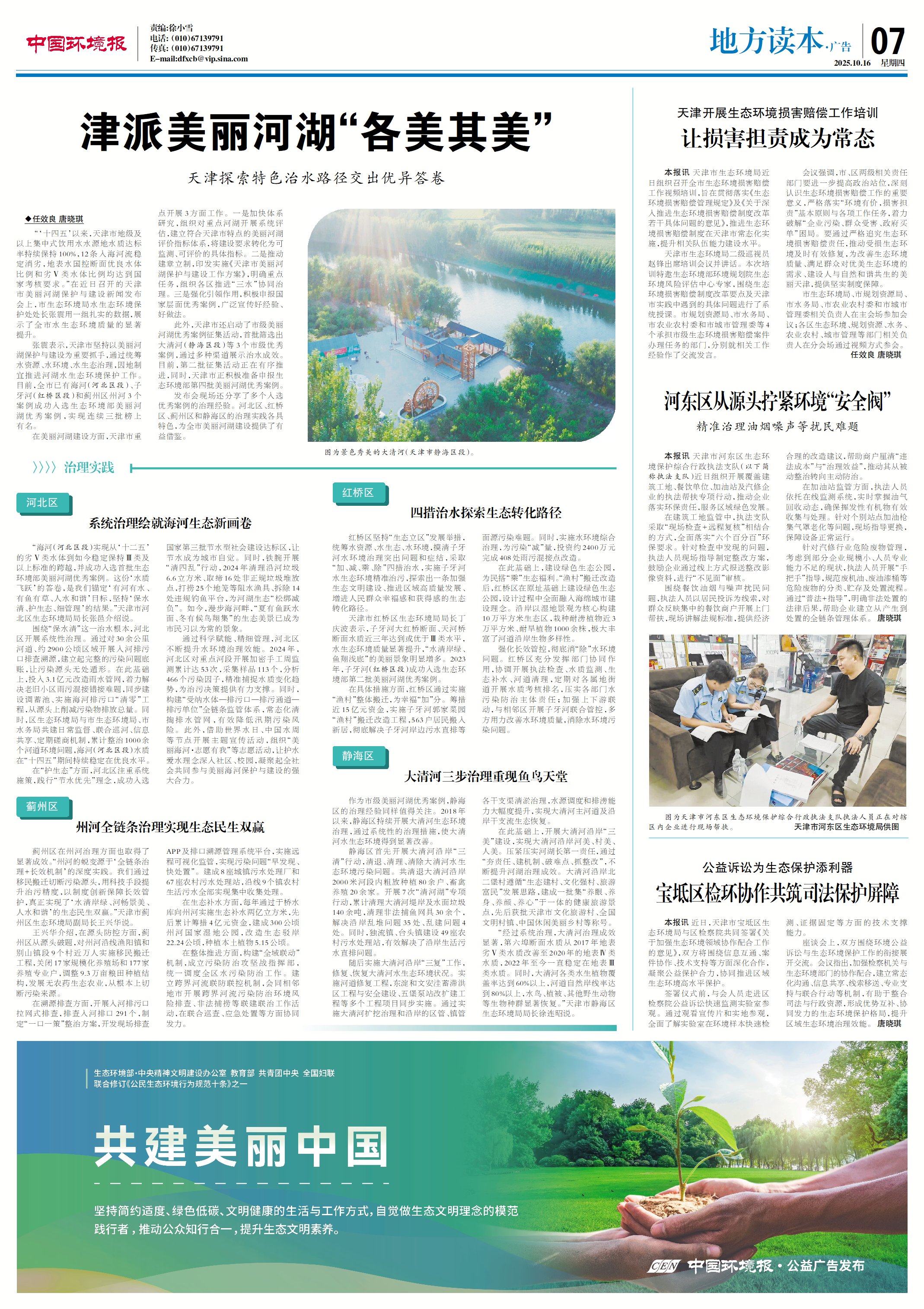
津派美丽河湖“各美其美”
Zhong Guo Huan Jing Bao· 2025-10-16 01:32
Core Insights - Tianjin has achieved a 100% compliance rate for drinking water sources since the 14th Five-Year Plan, with significant improvements in water quality across various rivers and lakes [2][11] - The city has implemented a comprehensive approach to water resource management, focusing on ecological protection and sustainable development [2][12] Water Quality Improvement - The quality of drinking water sources in Tianjin has consistently met national standards, with 12 rivers showing improved water quality [2][11] - The proportion of good quality surface water and the reduction of inferior quality water bodies have met national assessment requirements [2][11] Key Initiatives - Tianjin is focusing on three main areas for the construction of beautiful rivers and lakes: developing a tailored evaluation system, establishing regulatory frameworks, and promoting successful case studies [12] - The city has launched a campaign to collect excellent case studies for beautiful rivers and lakes, with the first batch including three notable examples [3][12] Case Studies and Practices - Hebei District has transformed the Haihe River from inferior quality to stable Class III or better, recognized as an excellent case by the Ministry of Ecology and Environment [6][14] - Red Bridge District has improved the water quality of the Ziya River, achieving Class III standards, and has been recognized for its ecological initiatives [7][16] - The Cijiang District has implemented comprehensive governance of the Zhou River, focusing on pollution source control and ecological restoration [18][19] Financial Investments - Hebei District has invested 310 million yuan in rainwater network upgrades and pollution source management [6][14] - Red Bridge District has allocated nearly 1.5 billion yuan for the relocation and improvement of fishing villages along the Ziya River [16][17] Ecological Restoration - The ecological environment of the Daqing River has significantly improved through systematic governance, including the removal of pollution sources and the establishment of wastewater treatment facilities [20][21] - The Zhou River has seen a comprehensive approach to governance, including the relocation of residents and the establishment of wetland parks to enhance biodiversity [18][19]
家风故事|中国核安全与环境文化促进会毛玉如:从“煤都灰霾”到“一城清朗”
Zhong Guo Huan Jing Bao· 2025-10-16 00:20
Core Insights - The transformation of Taiyuan from a heavily polluted city reliant on coal to a cleaner environment with natural gas and improved air quality is highlighted, showcasing significant advancements in both living standards and ecological conditions [2] Group 1: Historical Context - In the early 1980s, coal stoves were essential for heating and cooking in Taiyuan, leading families to collect unburned coal for efficiency and cost-saving [1] - The practice of collecting burnt coal, known as "picking up burnt coal," reflects a culture of thriftiness and resourcefulness among the residents [1] Group 2: Environmental Changes - By the mid-1980s, the introduction of honeycomb coal reduced the need for traditional coal stoves, marking a shift towards cleaner energy sources [2] - The transition to natural gas and other cleaner energy forms has significantly improved air quality, transforming Taiyuan from a heavily polluted area to one with clear skies, referred to as "Taiyuan Blue" [2] Group 3: Personal and Collective Responsibility - The narrative emphasizes that while living standards have improved, the ingrained values of thrift and appreciation for resources remain unchanged [2] - The importance of individual actions in environmental protection is stressed, indicating that collective efforts are necessary to maintain a sustainable and beautiful living environment [2]
支部工作法|把握好支部工作中的三个“真”
Zhong Guo Huan Jing Bao· 2025-10-15 23:20
Core Viewpoint - The article emphasizes the importance of grassroots party organizations in ensuring effective governance and nuclear safety management, highlighting the need for a strong connection between party work and practical operations in the nuclear sector [1][2][3]. Group 1: Party Organization and Governance - The party organization plays a crucial role in addressing the most pressing issues at the grassroots level, with a focus on enhancing the effectiveness of party branches [1]. - The North China Nuclear and Radiation Safety Supervision Station has established a "Four Consistency" mechanism to integrate party work with business operations, ensuring that both are planned, deployed, supervised, and assessed together [3][4]. - The party branch has implemented a system of regular supervision and checks to ensure compliance with integrity and discipline requirements [3]. Group 2: Theoretical Learning and Application - The party branch emphasizes the importance of deep theoretical learning, encouraging members to study Marxist classics and apply these principles in practical scenarios [2][4]. - A structured learning plan has been developed to address fragmented theoretical learning, with monthly classes covering key topics to foster a common understanding among members [2][3]. Group 3: Practical Implementation and Results - The party branch has successfully improved nuclear safety management levels in the capital region, focusing on root cause analysis and comprehensive solutions to management issues [4][8]. - A series of practical measures have been taken to address long-standing issues, reducing unresolved problems from 46 to 8 through systematic follow-ups and corrective actions [8][9]. - The implementation of a "follow-the-class" supervision model has enhanced oversight, ensuring continuous monitoring of nuclear facilities [8][9]. Group 4: Community Engagement and Support - The party branch promotes a people-centered approach, encouraging members to empathize with the needs of the community and grassroots workers [5][6]. - Open and collaborative activities have been organized to strengthen communication and cooperation between the supervision station and operational units, fostering a shared commitment to nuclear safety [6][7]. Group 5: Commitment to Nuclear Safety - The party branch prioritizes nuclear safety, with all members committed to maintaining high standards of oversight and accountability [9]. - Continuous efforts are made to address practical challenges in nuclear facility management, including the development of guidelines for retirement and change management [9][10].
从哪些方面入手破解青岛水资源短缺问题?
Zhong Guo Huan Jing Bao· 2025-10-15 08:20
Core Viewpoint - The report emphasizes the urgent need for sustainable water resource management in Qingdao, a key coastal city in northern China, due to severe water shortages that hinder green and high-quality development [1] Group 1: Current Water Resource Challenges - Qingdao's per capita water resource is only 9.5% of the national average, highlighting a critical limitation for local development [1] - Total water usage in Qingdao increased by 4.186 million cubic meters in 2023, while agricultural water usage decreased by 660,000 cubic meters, indicating intensified competition for water resources [1] - The over-extraction of groundwater is a significant issue, with shallow groundwater storage in plain areas decreasing by 116 million cubic meters year-on-year, leading to increased pollution risks and ecological degradation [1] Group 2: Proposed Solutions - Expanding water sources is fundamental, including large-scale seawater utilization and rainwater resource management, alongside the development of seawater desalination and recycled water systems [2] - Comprehensive water conservation strategies are essential, focusing on optimizing industrial layouts, promoting low-water consumption industries, and enhancing agricultural water efficiency [2] - Implementing smart management and regulatory frameworks, such as tiered water pricing and real-time monitoring systems, is crucial for sustainable water resource management [2] Group 3: Legal and Social Frameworks - There is a need to revise water conservation regulations and establish stricter water usage standards, integrating water resource management indicators into government performance evaluations [3] - Encouraging public participation and creating a collaborative governance system involving government, market, and society is vital for improving sustainable water resource utilization [3]