Xin Lang Ji Jin

Search documents
有色指数怎么选?有色强势领涨两市!紫金矿业涨超3%,有色龙头ETF(159876)猛拉3.7%站稳全部均线!
Xin Lang Ji Jin· 2025-11-13 02:37
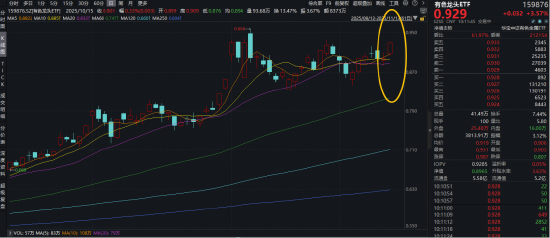
Group 1 - The non-ferrous metal sector is leading the market, with the Non-Ferrous Metal Leader ETF (159876) reaching a peak increase of 3.79% in early trading, currently up 3.57% and maintaining all moving averages [1] - Key stocks such as Guocheng Mining and Yongxing Materials have seen significant gains, with increases of over 9% and 7% respectively, while other stocks like Yahua Group and Xingye Silver Tin also experienced substantial rises [1] - Major weighted stocks including Zijin Mining and Luoyang Molybdenum have increased by over 3%, with Northern Rare Earth and Shandong Gold rising by more than 1% [1] Group 2 - According to Dongfang Securities, the non-ferrous metal sector is entering a new cycle driven by supply-demand balance, influenced by global monetary easing and the strategic importance of resources [3] - The Non-Ferrous Metal Leader ETF (159876) has outperformed its peers, with a cumulative increase of 181.27% since its base date, significantly surpassing other non-ferrous metal indices [5][6] - The index associated with the Non-Ferrous Metal Leader ETF is expected to see a year-on-year net profit growth of 54.5% in 2025, leading among similar indices, and a continued growth of 21.0% in 2026, indicating strong mid-term growth potential [6] Group 3 - The Non-Ferrous Metal Leader ETF (159876) and its linked funds provide a diversified investment approach, covering various metals such as copper, aluminum, gold, rare earths, and lithium, which helps mitigate risks compared to investing in a single metal [8] - The weightings of different metals in the index as of the end of October are as follows: copper (27.7%), aluminum (14.4%), gold (13.2%), rare earths (10.2%), and lithium (9.1%) [8]


主力500亿狂买!化工板块掀涨停潮,化工ETF(516020)盘中涨近3%!
Xin Lang Ji Jin· 2025-11-13 02:34
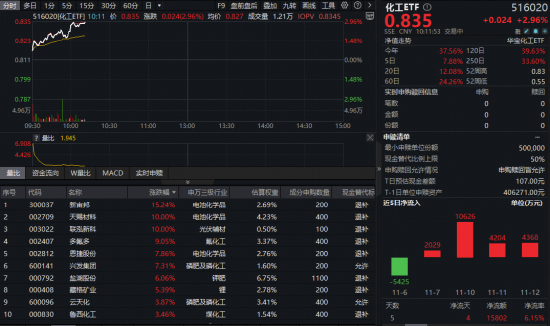
Group 1 - The chemical sector is experiencing a significant rally, with stocks like Tianqi Lithium and Lianhong New Materials hitting the daily limit, and New Zobon rising over 15% [1] - The Chemical ETF (516020) reflects this trend, showing a price increase of 2.96% [1] - Major inflows into the basic chemical sector reached 11.632 billion, with a total of 50.034 billion over the past five days, leading among 30 sectors [5] Group 2 - New Zobon has announced its strategic investment in Shilei Fluorine Materials, which produces lithium hexafluorophosphate, a key material for lithium-ion battery electrolytes, with current production capacity at 24,000 tons per year, expected to increase to 36,000 tons by the end of 2025 [2] - The rising price of lithium hexafluorophosphate is gradually being reflected in electrolyte pricing, with new contracts set to consider the latest raw material prices, enhancing transmission efficiency [2] Group 3 - Analysts suggest that the chemical sector is currently undervalued, with potential for upward movement due to oil price rebounds and ongoing efforts to reduce "involution" competition [3] - The Chemical ETF (516020) tracks the CSI sub-industry index, covering various segments of the chemical industry, with nearly 50% of its holdings in large-cap stocks like Wanhua Chemical and Salt Lake Potash [3] - The ETF provides a more efficient way to invest in the chemical sector, with options for investors to access through linked funds [3]
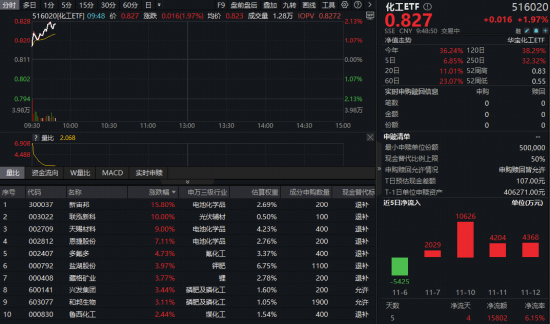
六氟磷酸锂价格继续飙涨!锂电产业链爆发,化工ETF(516020)猛拉超2%!龙头股大面积躁动
Xin Lang Ji Jin· 2025-11-13 02:09
Group 1 - The chemical sector continues to show strong performance, with the Chemical ETF (516020) rising by 1.97% as of the latest report, reaching a peak intraday increase of 2.1% [1][2] - Lithium battery stocks have surged, with notable gains from companies such as Lianhong Xinke, which hit the daily limit, and others like Xinzhou Bang and Tianci Materials, which rose by over 15% and 9% respectively [1][2] - The price of lithium hexafluorophosphate has skyrocketed, with some market quotes reaching 150,000 CNY per ton, doubling since mid-October due to a mismatch between supply and demand [2][3] Group 2 - The price increase of lithium hexafluorophosphate is affecting the electrolyte segment, creating a positive feedback loop within the industry, with a short-term expectation of a tight supply-demand balance [3] - As of November 12, the Chemical ETF (516020) has a price-to-book ratio of 2.41, indicating a relatively low valuation compared to the past decade, suggesting a favorable long-term investment opportunity [3] - Looking ahead, the basic chemical sector is expected to see an upward trend starting in 2026, driven by improved domestic and external demand, alongside a reduction in capital expenditure growth since June 2025 [4] Group 3 - The Chemical ETF (516020) tracks the CSI segmented chemical industry index, covering various sub-sectors, with nearly 50% of its holdings in large-cap stocks like Wanhua Chemical and Salt Lake Co., allowing investors to capitalize on strong market leaders [4] - Investors can also consider the Chemical ETF linked funds (Class A 012537/Class C 012538) for exposure to the chemical sector [4]





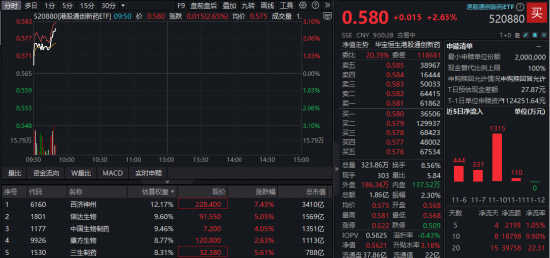
业绩引爆,百济神州飙涨逾7%续创三年新高!高弹性港股通创新药ETF(520880)逆市冲高3%!
Xin Lang Ji Jin· 2025-11-13 02:06
Group 1 - The overall Hong Kong stock market experienced a pullback, but the innovative drug sector, led by BeiGene, showed resilience with a significant increase in stock prices, with BeiGene rising over 7% to reach a three-year high [1] - The Hong Kong Stock Connect Innovative Drug ETF (520880) saw a 3% increase, indicating strong investor interest in innovative drug companies despite the market downturn [1] - BeiGene's total revenue for Q3 2025 reached $1.4 billion, a 41% year-on-year increase, exceeding market expectations, primarily driven by its self-developed product, Zebrutinib, which contributed over $1 billion in revenue for the first time, marking a 50.8% increase [1] Group 2 - Pfizer's acquisition of weight-loss drug developer Metsera for $10 billion highlights the intensifying competition among multinational corporations (MNCs) for innovative drug pipelines, increasing the attractiveness of Chinese innovative drug companies for international collaboration [2] - The trend of Chinese innovative drugs going global is clear, with ongoing drug review reforms and supportive policies contributing to the industry's transition from imitation to innovation, marking the entry into a 2.0 era [2] - The Hong Kong Stock Connect Innovative Drug ETF (520880) is recommended as a primary investment option, featuring a pure focus on innovative drug companies, with over 71% of its top ten holdings representing leading firms in the sector [2][3] Group 3 - The top ten holdings of the Hong Kong Stock Connect Innovative Drug ETF (520880) account for 71.65% of the total weight, showcasing a significant concentration in leading companies [3] - The ETF has surpassed a scale of 2 billion yuan, with an average daily trading volume of 474 million yuan since its inception, making it the largest and most liquid ETF tracking the same index [3]
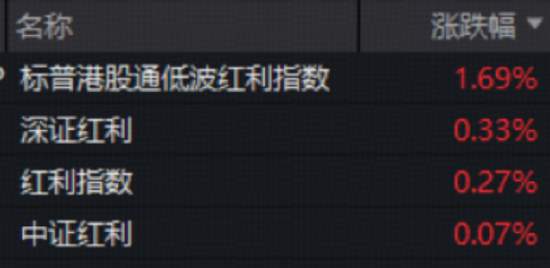
高股息“港港好”?连续9日吸金,港股通红利ETF(159220)11月12日场内大涨1.91%,又双叒叕创收盘价新高!
Xin Lang Ji Jin· 2025-11-13 01:39
Market Overview - On November 12, A-shares experienced fluctuations, with the Shanghai Composite Index hovering around the 4000-point mark, while Hong Kong stocks strengthened, with the Hang Seng Index rising by 0.85% [1] - The Hong Kong Dividend ETF (159220), which passively tracks the S&P Hong Kong Low Volatility Dividend Index, surged by 1.91%, outperforming mainstream dividend indices in A-shares [1] Performance Metrics - The S&P Hong Kong Low Volatility Dividend Index increased by 1.69%, while other indices such as the Shenzhen Dividend Index and the CSI Dividend Index saw smaller gains of 0.33% and 0.07%, respectively [2] - The Hong Kong Dividend ETF has achieved a new closing price high for six consecutive trading days since November 5, indicating strong momentum in dividend assets [2] Fund Inflows and Investor Behavior - The Hong Kong Dividend ETF has seen a net inflow of funds for nine consecutive days, driven by significant buying from southbound funds, which recorded a net inflow of HKD 66.53 billion on November 10, with total net inflows exceeding HKD 1.3 trillion for the year [3][4] - The ETF's transparency, low fees, and trading convenience have made it increasingly popular among investors [3] Index Composition and Dividend Potential - The S&P Hong Kong Low Volatility Dividend Index includes a mix of large-cap and mid-cap stocks, with over half of its constituents being state-owned enterprises, which are expected to benefit from favorable policies related to state-owned enterprise market value management [4] - In the first half of 2025, 713 Hong Kong companies announced dividends totaling HKD 812.7 billion, a year-on-year increase of 31.35%, indicating a strong dividend-paying trend in the market [4] Dividend Yield Comparison - As of the end of October 2025, the Hong Kong Dividend ETF's underlying index had a dividend yield of 5.54%, significantly higher than the yields of the CSI Dividend Index (4.80%), CSI Low Volatility Dividend Index (4.74%), and Shanghai Dividend Index (5.31%) [6]
华商基金FOF名将掌舵 华商汇享多元配置3个月持有混合(FOF)11月17日发行
Xin Lang Ji Jin· 2025-11-13 01:14
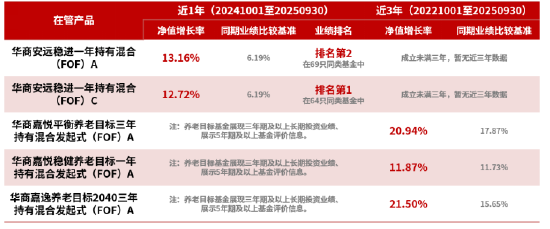
Core Viewpoint - The long-term performance of FOF products managed by Sun Zhiyuan from Huashang Fund demonstrates strong investment capabilities, with several products significantly outperforming their benchmarks as of September 30, 2025 [1][2]. Performance Summary - Sun Zhiyuan's FOF products have shown impressive results, with the Huashang Anyuan Stable One-Year Holding Mixed (FOF) A class achieving a net value growth rate of 13.16% and C class at 12.72%, both surpassing the benchmark of 6.19% [2][3]. - In the same timeframe, the Huashang Jiayue Balanced Pension Target Three-Year Holding Mixed (FOF) A class recorded a growth rate of 20.94%, exceeding the benchmark of 17.87% [2][3]. - The Huashang Jiayi Pension Target 2040 Three-Year Holding Mixed (FOF) A class achieved a growth rate of 21.50%, significantly higher than the benchmark of 15.65% [2][3]. Investment Strategy and Support - The strong performance is attributed to a mature investment research system and a robust platform, with Sun Zhiyuan employing a clear investment methodology that includes market trend models and a three-dimensional evaluation system for fund managers [4]. - Huashang Fund has received a 5A rating from Tianxiang Investment Advisors for its comprehensive three-year performance, indicating strong management capabilities [4][9]. Upcoming Fund Launch - The Huashang Huixiang Multi-Asset Three-Month Holding Mixed (FOF), managed by Sun Zhiyuan, is set to launch on November 17, 2025, aiming to provide long-term stable returns [5][6].
稀缺价值战将蓝小康担纲,中欧鑫悦回报一年持有期正式发行
Xin Lang Ji Jin· 2025-11-13 01:14
Group 1 - The "14th Five-Year Plan" has been officially implemented, providing direction for China's economic and social development over the next five years, creating new opportunities and challenges for the capital market [1] - The Shanghai Composite Index has recently surpassed the 4000-point mark, continuing to fluctuate above 3900 points, indicating a relatively high historical level for the A-share market [1] - The new fund, China Europe Xin Yue Return One-Year Holding Mixed Securities Investment Fund, aims to provide a stable investment option in the equity market through balanced allocation and strict risk control, with an equity investment ratio of 40%-80% [1][2] Group 2 - The fund's one-year holding period is designed to help investors "stay in the market" and reduce anxiety caused by short-term volatility, thereby enhancing the overall investment experience [2] - The fund will be managed by Lan Xiaokang, a veteran with over 14 years of experience in the securities industry, focusing on a low-valuation value strategy to identify quality companies with growth potential [2][3] - The fund's investment strategy includes a full-market stock selection approach, aiming to build a portfolio that balances defensive capabilities and growth potential [1][2] Group 3 - The China Europe Hongli Youxiang A fund, managed by Lan Xiaokang since April 2018, has consistently outperformed its benchmark and the Shanghai Composite Index over multiple market cycles, with a maximum drawdown of -25% [3] - Lan Xiaokang anticipates a comprehensive market upturn, with investment opportunities in both traditional industries and new productive forces, particularly focusing on sectors with low PB valuations [3][4] - The fund has received five-star ratings from several authoritative rating agencies, reflecting its long-term stable performance [3][5]
小红日报|孚日股份再涨停,标普红利ETF(562060)标的指数收涨0.21%
Xin Lang Ji Jin· 2025-11-13 01:01
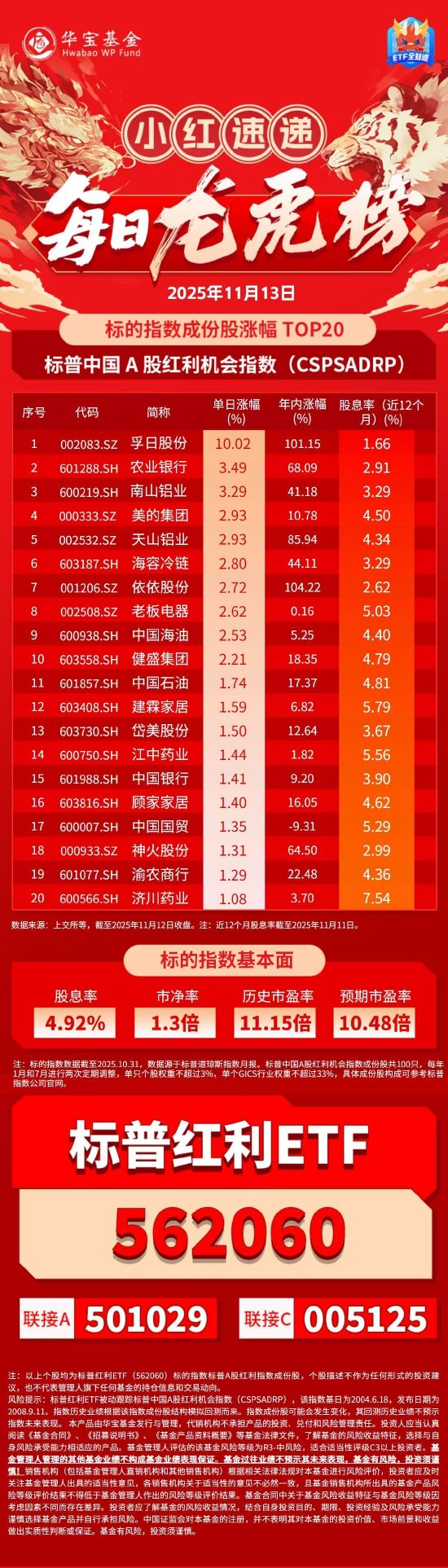
Core Insights - The article highlights the top-performing stocks in the S&P China A-Share Dividend Opportunity Index, showcasing significant daily and year-to-date gains along with dividend yields [1] Group 1: Stock Performance - The top stock, Xue Ri Co., Ltd. (002083.SZ), experienced a daily increase of 10.02% and a remarkable year-to-date gain of 101.15% with a dividend yield of 1.66% [1] - Agricultural Bank of China (601288.SH) saw a daily rise of 3.49% and a year-to-date increase of 68.09%, offering a dividend yield of 2.91% [1] - Nanshan Aluminum (600219.SH) recorded a daily gain of 3.29% and a year-to-date increase of 41.18%, with a dividend yield of 3.29% [1] Group 2: Dividend Yields - Midea Group (000333.SZ) has a dividend yield of 4.50%, with a year-to-date increase of 10.78% and a daily rise of 2.93% [1] - Tianshan Aluminum (002532.SZ) offers a dividend yield of 4.34%, with a year-to-date gain of 85.94% and a daily increase of 2.93% [1] - Boss Electric (002508.SZ) has a dividend yield of 5.03%, with a minimal year-to-date increase of 0.16% and a daily rise of 2.62% [1]

哑铃、哑铃,缺一不行
Xin Lang Ji Jin· 2025-11-13 00:54
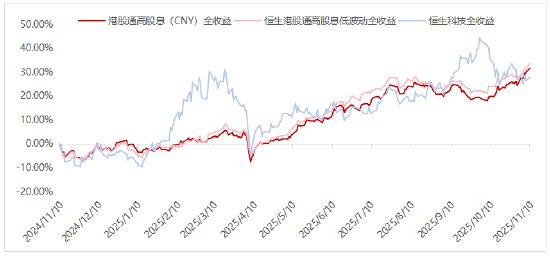
Core Viewpoint - The Hong Kong dividend assets have shown strong performance, rivaling the technology sector, with significant increases in key dividend indices over the past year [1][4]. Performance of Dividend Indices - The Hong Kong Stock Connect High Dividend (CNY) and the Hang Seng High Dividend Low Volatility indices have reached historical highs, with annual increases of 31.65% and 33.57% respectively, outperforming the Hang Seng Technology Total Return Index, which rose by 28.02% during the same period [1][4]. Market Dynamics - The divergence between the technology and dividend sectors began in October 2025, influenced by external factors such as the escalating US-China tariff disputes and government shutdown risks, leading to a shift in investor sentiment towards more defensive dividend assets [4][5]. - The technology sector's high valuations and lack of new catalysts during a policy and earnings vacuum have prompted funds to move towards more reasonably valued dividend stocks [4]. Southbound Capital Inflows - Despite market volatility, southbound capital has consistently flowed into Hong Kong stocks, with net inflows exceeding 1.3 trillion HKD in 2025, marking a record high since the launch of the Stock Connect [6][7]. - The financial, energy, consumer discretionary, and telecommunications sectors have attracted the most southbound capital, indicating a growing interest in dividend assets [7]. Institutional Investment Trends - Insurance capital has increasingly targeted dividend assets, with 36 instances of stake acquisitions in 2025, surpassing previous highs and focusing on stable, high-dividend sectors such as banking and utilities [8][9]. - The dividend yields of the Hong Kong Stock Connect High Dividend (CNY) and the Hang Seng High Dividend Low Volatility indices stand at 5.53% and 5.69%, significantly higher than comparable A-share indices [9]. Investment Strategy - In the current low-interest-rate environment, the dividend yields from Hong Kong stocks present a compelling alternative to domestic bonds, which yield only 1.81% [9]. - The Hong Kong dividend ETFs have shown strong performance, with the Hong Kong Stock Connect High Dividend ETF achieving a 69.51% return since its inception, outperforming its benchmark [15][16].
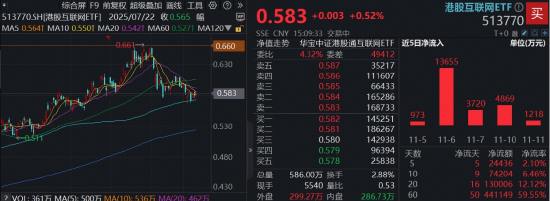
手机销量连续三年斩获国产第一!小米集团领涨,港股互联网沿5日线缓慢爬升,耐心资金抢筹513770
Xin Lang Ji Jin· 2025-11-12 12:27
Core Viewpoint - The Hong Kong stock market showed a mixed performance with the Hang Seng Technology Index rising by 0.16%, driven by strong performances from companies like Xiaomi and Tencent, while Alibaba saw a decline of over 2% [1][3]. Group 1: Market Performance - The Hong Kong Internet ETF (513770) experienced a cumulative inflow of 742 million yuan over the past 10 days, with 9 out of 10 days seeing increased investment [3]. - Xiaomi's automotive business exceeded market expectations, with approximately 110,000 units delivered in Q3, indicating a potential shift to profitability [3]. - The overall market sentiment in November is driven by strong fundamentals, with growth-oriented assets in the Hong Kong market showing resilience [3]. Group 2: Upcoming Earnings Reports - Major internet companies are set to release their latest quarterly earnings, with expectations for Tencent's revenue and net profit to grow by 13%, reaching 188.6 billion yuan and 67.9 billion yuan respectively [3]. - Alibaba is projected to report a revenue of 38.52 billion yuan for the quarter, reflecting a year-on-year growth of 30.1%, supported by continued investment in its cloud services [3][4]. Group 3: ETF and Index Insights - The Hong Kong Internet ETF (513770) has a current scale exceeding 11.8 billion yuan, with an average daily trading volume of over 600 million yuan, indicating strong liquidity [7]. - The index that the ETF tracks has a lower valuation compared to other indices, with a price-to-earnings ratio of 24.44, which is significantly lower than the NASDAQ 100 and ChiNext [6]. - The top three holdings in the ETF are Alibaba (18.89%), Tencent (17.01%), and Xiaomi (10.05%), collectively accounting for over 73% of the total holdings [4][5].