
Xin Lang Ji Jin

Search documents
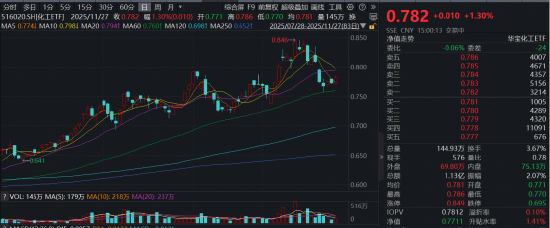
科技股冲高回落,电子板块惊现百亿买单!化工悄然逆袭,516020收涨1.3%,银行再秀防御力,银行ETF放量转阳
Xin Lang Ji Jin· 2025-11-27 11:53
中信建投证券认为,当前市场或处于"三期叠加"阶段:牛市中段整固期,景气验证关键期,业绩政策空 窗期,市场震荡轮动和资金年底止盈等特征也会进一步放大。策略层面,短期考虑以择机布局为主,时 点上等待12月中上旬的美联储议息会议和中央经济工作会议落地,期间若调整较充分也可逢低吸筹。 【ETF全知道热点收评】下面重点聊聊化工、银行、电子等几个板块的交易和基本面情况。 周四(11月27日),大盘全天冲高回落,沪指微涨0.29%报收3875.26点,创业板指回吐逾2%收跌 0.44%。个股整体涨跌参半,全市场成交额1.72万亿元,连续2日小幅缩量。 | | 序号 代码 | 类型 名称 | 现价 | 涨跌幅 ▼ | 提慣 | 成交额 | | --- | --- | --- | --- | --- | --- | --- | | 1 | 516020 | 主 化工ETF | 0.782 c | 1.30% | 2.07% | 1.13亿 | | 2 | 562060 | 策 标普红利ETF | 0.605 c | 0.50% | 0.83% | 3173.13万 | | 3 | 512800 | 行 银行ETF | 0.84 ...


头部电解液企业订单火爆,化工ETF(516020)收涨1.3%,机构:2026年化工行业或迎周期拐点向上
Xin Lang Ji Jin· 2025-11-27 11:53
Core Viewpoint - The chemical sector has shown significant strength in the market, outperforming major indices like the Shanghai Composite and CSI 300, driven by a "de-involution" trend and favorable supply-demand dynamics [1][2][7]. Group 1: Market Performance - The Shanghai Composite Index weakened towards the end of the trading day, while the ChiNext Index turned negative, with the chemical sector leading the gains [1]. - The Chemical ETF (516020) experienced a daily increase of 1.30%, with a trading volume of 1.13 billion yuan [1]. - The cumulative increase of the Chemical ETF's underlying index reached 26.07% year-to-date, significantly outperforming the Shanghai Composite Index (15.62%) and the CSI 300 Index (14.75%) [2][3]. Group 2: Stock Performance - Notable stocks in the chemical sector included Xin Fengming, which rose by 5.75%, and several others like Lu Xi Chemical and Wan Hua Chemical, which saw increases of over 3% [2][4]. - The trading volume and transaction amounts for leading stocks indicate strong investor interest, with Wan Hua Chemical achieving a transaction amount of 2.464 billion yuan [2]. Group 3: Industry Trends - The solid-state battery concept remains active, with a significant increase in lithium battery material demand, as evidenced by the rise in electrolyte prices from approximately 19,400 yuan/ton at the beginning of the year to 54,250 yuan/ton recently [5]. - The current price-to-book ratio of the chemical sector stands at 2.27, indicating a relatively low valuation compared to historical levels, suggesting potential for long-term investment [5]. Group 4: Future Outlook - The chemical industry is expected to experience a dual uplift in performance and valuation due to the "de-involution" trend, with leading companies likely to gain market share through improved management and energy efficiency [7]. - Analysts predict that the chemical sector may see a cyclical upturn starting in 2026, driven by supply-side reforms and increased demand, particularly as the U.S. enters a rate-cutting cycle [7]. Group 5: Investment Strategy - Investors are encouraged to consider the Chemical ETF (516020) for efficient exposure to the sector, as it tracks the CSI Sub-Industry Chemical Index and includes a diversified portfolio of leading stocks [8].





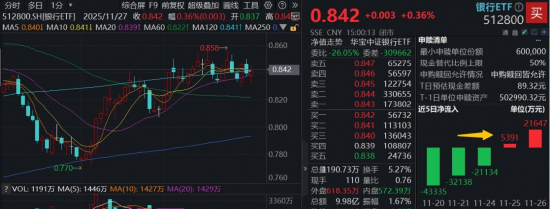
银行低调助攻,农业银行涨超2%!规模最大银行ETF(512800)放量转阳,2.7亿资金掉头涌入
Xin Lang Ji Jin· 2025-11-27 11:49
Group 1 - The banking sector is currently seen as a defensive investment, with several banks showing positive performance, such as Agricultural Bank rising over 2% [1] - The largest bank ETF (512800) has shown resilience, recovering from early losses and closing up 0.36%, indicating strong market interest [1][3] - The banking sector's price-to-book (PB) ratio is at 0.73, significantly lower than international peers, suggesting potential for valuation recovery [3] Group 2 - Institutional investors are increasingly favoring the banking sector, with insurance funds continuing to increase their holdings, indicating ongoing investment value [3] - The recent performance of the bank ETF (512800) reflects a growing interest, with a fund size increase to 206.15 billion, up 131.27 billion since the beginning of the year [5] - The bank ETF has seen a net inflow of 2.7 billion over the past two days, highlighting strong demand for banking sector investments [3]


谷歌产业链含量21%!“纪连海”发力走高+消费电子迎政策利好,电子ETF(515260)最高上探3.5%
Xin Lang Ji Jin· 2025-11-27 11:49
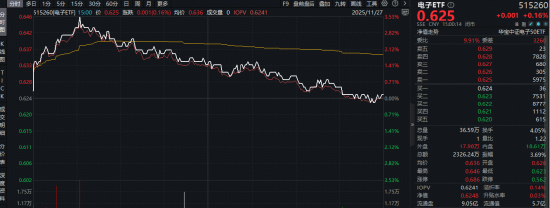
Core Insights - The electronic sector has seen a significant inflow of over 10.7 billion in capital, driven by a new consumption promotion plan issued by six government departments [1][4] - The electronic ETF (515260) experienced a peak increase of 3.53% in early trading, ultimately closing with a slight gain of 0.16%, marking a three-day consecutive rise [1][4] Sector Performance - Leading companies in the consumer electronics segment, such as Anker Innovations, surged over 4%, while semiconductor leaders like Wentai Technology and Zhaoyi Innovation also saw gains exceeding 2% [3][4] - Notable stocks included Cambrian, which rose by 5%, and Industrial Fulian, which peaked at over 7% during trading [3][4] Policy Impact - The Ministry of Industry and Information Technology and other departments released a plan to enhance the adaptability of consumer goods supply and demand, encouraging the development of smart appliances and AI products [4][5] - This policy is expected to benefit the consumer electronics sector significantly [4] Industry Outlook - Global tech giant Google has garnered attention due to technological breakthroughs and performance growth, with its supply chain accounting for 21.91% of the electronic ETF's index as of the end of October [5] - The electronic industry is currently in an innovation phase, with expectations for rapid growth driven by breakthroughs in terminal innovation and performance release [5] Investment Tools - The electronic ETF (515260) and its linked funds are designed to passively track the electronic 50 index, focusing on sectors like semiconductors and consumer electronics [5]



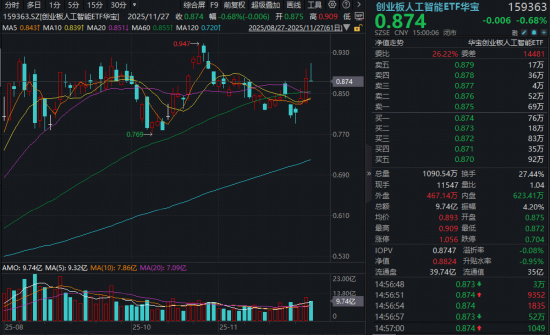
暴力反弹后,光模块CPO高低轮动,创业板人工智能ETF(159363)振幅超4%!行业“量增价优”前景可期
Xin Lang Ji Jin· 2025-11-27 11:45
Core Insights - The A-share market showed a significant decrease in trading volume, with the ChiNext index briefly rising over 2% before closing in the red, indicating a volatile trading environment [1] - The light module CPO sector experienced a rebound followed by selling pressure, with leading stocks like Zhongji Xuchuang hitting new highs before retreating [1] - The long-term investment logic for the light module CPO industry remains clear, driven by global demand for computing power and technological advancements [3] Demand Side - The global competition for computing power is driving demand, with capital expenditures from major overseas cloud companies projected to reach $363.3 billion by 2025, a 63% year-on-year increase [3] - The introduction of Google's TPU to challenge Nvidia's GPU is expected to further stimulate the market, with expectations for increased production of 800G and 1.6T light modules by 2026 [3] Supply Side - Accelerated technological iterations are expected to alleviate supply constraints, with leading light module manufacturers actively expanding global production capacity [3] - The shortage of optical devices is improving, leading to anticipated growth in performance for light module manufacturers [3] Pricing Dynamics - The light module industry is experiencing a "volume increase and price improvement" scenario, with the price of 1.6T light modules rising from approximately $1,200 to over $2,000 [3] - Demand for 800G and lower products remains strong, with a noticeable slowdown in price declines, indicating a stabilization trend [3] Investment Opportunities - Institutions continue to favor investment opportunities in the AI computing power industry chain, with a focus on the first AI-themed ETF tracking the ChiNext index [4] - The ETF has over 70% of its portfolio allocated to computing power and more than 20% to AI applications, positioning it to effectively capture trends in the AI sector [4]



UP向上,投资有温度︱2025年投资者服务活动第四站:市场波动加剧,投资该如何“排兵布阵”?
Xin Lang Ji Jin· 2025-11-27 10:42
Core Insights - The initiative "UP向上,投资有温度" by 中信保诚基金 aims to provide comprehensive wealth management support for investors throughout their life cycle through systematic financial knowledge dissemination and professional investment decision-making [1] Group 1: Market Conditions and Investor Behavior - Investors are currently facing uncertainty in the market, leading to common questions about whether to sell funds after recovering losses or how to select funds amidst market fluctuations [3] - A prevalent issue among investors is the cycle of buying when prices rise and selling when they fall, often driven by emotional responses rather than the underlying investment products [5] Group 2: Investment Strategies and Tools - To build a more resilient investment portfolio, the event introduced practical tools and concepts to shift from "feeling-based investing" to "data-driven decision-making" [6] - The "correlation coefficient" is highlighted as a key indicator for measuring asset interdependence, emphasizing the importance of diversification to avoid concentrated risk [7] - The "KDJ indicator" is presented as a tool for gauging market sentiment, particularly noting that a negative J value may indicate a potential buying opportunity for long-term investors [10] Group 3: Core Asset Selection - The 中证A500 index is recommended as an ideal core asset for ordinary investors due to its risk diversification, transparency, and low cost, representing a broader view of the Chinese economy [8] - Since its inception, the 中证A500 index has shown a growth of 454.81% with an annualized volatility of 8.83%, covering 35 secondary and 91 tertiary industries, thus providing a comprehensive representation of China's economic transformation [9] Group 4: Investment Philosophy - The event concluded with the notion that investment success relies more on discipline and philosophy rather than luck, advocating for a diversified asset allocation that aligns with individual risk tolerance [11]
UP向上,投资有温度︱2025年投资者服务活动第5站:从政策到行业,看懂基金投资的“五碗面”
Xin Lang Ji Jin· 2025-11-27 10:42
Core Viewpoint - The article emphasizes the importance of understanding the "Five Bowls of Noodles" (economic, policy, funding, overseas, and technical aspects) to navigate the current market complexities and make informed investment decisions [3][5][6]. Economic Aspect - The economic cycle is crucial for asset allocation, with the current phase identified as a "weak recovery" [5]. - The Merrill Lynch Investment Clock categorizes economic conditions into four stages: recession, recovery, overheating, and stagflation, each suggesting different fund allocations [5]. - Historical performance data shows fluctuations in the Shanghai Composite Index and various fund indices from 2019 to 2025, indicating the impact of economic cycles on investment returns [5]. Policy Aspect - The Chinese stock market is closely linked to macroeconomic policies and industry guidance, with significant policies historically providing clear direction for market movements [6][7]. - The 2025 "14th Five-Year Plan" emphasizes "technological innovation + self-control," targeting a GDP growth rate of 4.7% and focusing on sectors like AI and deep-sea economy [7]. Funding Aspect - Recent monetary policy changes, including interest rate cuts by the People's Bank of China and the Federal Reserve, have improved global liquidity, positively affecting the A-share market [8][9]. - Historical data shows that previous rate cuts have led to significant increases in the Shanghai Composite Index, indicating a strong correlation between monetary policy and market performance [9]. Overseas Aspect - External factors such as U.S.-China relations and global central bank gold purchasing trends are influencing market risk appetite [10]. - The trade surplus with the U.S. has increased, and China's gold reserves have reached a 20-year high, providing a buffer against geopolitical tensions [10]. Technical Aspect - Technical indicators, including index trends and trading volume, are essential for understanding short-term market rhythms [11]. Investment Strategy - The article suggests a diversified investment strategy based on individual risk tolerance, recommending a mix of technology-focused ETFs, broad index funds, and fixed-income products to balance risk and return [13][15].
UP向上,投资有温度︱长寿时代下的资产配置新机遇
Xin Lang Ji Jin· 2025-11-27 10:42
Group 1 - The core concept of the article emphasizes the importance of asset allocation planning in the context of an aging population and the challenges posed by declining pension replacement rates [3][4] - The initiative "UP向上,投资有温度" by 中信保诚基金 aims to provide comprehensive wealth management support throughout the investor's life cycle, focusing on investor education and professional investment decision-making [1][8] - The event in Hainan specifically addressed the new opportunities for asset allocation in the "longevity era," highlighting the need for proactive financial planning to ensure adequate retirement resources [3][4] Group 2 - The article discusses the demographic changes in China, including a significant drop in birth rates and an increase in life expectancy, which are leading to a declining pension dependency ratio, projected to fall to 2.3:1 in the future [3][4] - It emphasizes that diversified asset allocation is essential for achieving stable retirement outcomes, as relying solely on social security is insufficient for maintaining a quality lifestyle [4][6] - Public funds are positioned as a crucial component in addressing the pension funding gap and enhancing the pension security system, with a diverse product matrix that caters to various retirement needs [6][7] Group 3 - As of September 30, 2025, the number of personal pension funds has reached 302, with over 98% of these funds generating positive returns since their inception, providing investors with a wider range of retirement investment options [7] - The article highlights that public funds not only serve as financial products but also play a vital role in building a multi-tiered and sustainable pension security framework, complementing basic pension insurance and corporate annuities [7][8] - The company plans to continue its initiatives to support investors in their asset allocation journey, ensuring that retirement expectations are met with solid financial backing [8]
UP向上,投资有温度︱2025年投资者服务活动第三站:市场波动中,比预测涨跌更重要的事
Xin Lang Ji Jin· 2025-11-27 10:39
Core Insights - The event "UP向上,投资有温度" by 中信保诚基金 aims to provide comprehensive wealth management support through systematic financial education and professional investment decision-making [1] Group 1: Investment Philosophy - The unpredictability of short-term market movements highlights the importance of focusing on cost and safety margins rather than market trends [4] - Investors should prioritize long-term trends and distinguish between short-term noise and long-term signals to avoid confusion and anxiety [5] Group 2: Asset Allocation - Asset allocation serves as a fundamental framework to navigate market uncertainties, emphasizing the need for a scientific and rational strategy [6] - A well-structured asset allocation plan can help control costs, diversify risks, and anchor long-term goals, making it essential for investors to establish such a framework [7] Group 3: Practical Investment Strategies - Transitioning from prediction to planning allows investors to manage different market scenarios through asset allocation, transforming investment from speculation to disciplined financial planning [10] - Diversifying investments across various asset classes can effectively reduce the impact of market downturns on overall assets, leading to a smoother investment journey [10] - A well-communicated asset allocation strategy can help investors resist emotional impulses during market volatility, maintaining focus on long-term objectives [10]
中信保诚基金“债券+”︱债券+的进阶答案:告别简单叠加,拥抱策略工具箱
Xin Lang Ji Jin· 2025-11-27 08:13
Core Insights - The "Bond+" strategy is evolving beyond a simple bond-stock pairing to a comprehensive set of dynamic and diversified investment strategies, aiming to provide tailored solutions for investors with varying risk appetites [1][9] Group 1: Strategy Overview - "Bond+" products from CITIC Prudential Fund include multiple bond-based mixed-asset products designed to enhance returns through a toolbox of strategies, including convertible bonds, differentiated equities, IPOs, and quantitative methods [1][9] - The strategy is underpinned by the negative correlation between domestic bonds and major stock indices, which helps to smooth portfolio volatility through asset pairing [1][2] Group 2: Historical Performance - Historical data shows that a constant proportion of stock and bond allocation (e.g., 15/85) has demonstrated strong performance, achieving positive returns in most years, except for a slight decline during extreme market volatility in 2022 [6][7] - The performance of various stock-bond ratio portfolios indicates that strategies based on negative correlation can capture gains in bull markets while providing stability in downturns [7][8] Group 3: Market Conditions and Future Outlook - As of Q3 2025, the scale of secondary bond funds has rapidly increased to 1.32 trillion yuan, contributing to a total scale of 2.5 trillion yuan for fixed-income + funds, indicating a favorable environment for "Bond+" products [13] - The market conditions, including improving corporate earnings and supportive policies, along with a limited upward space for interest rates, create an ideal environment for the "Bond+" strategy to reduce volatility through asset allocation [13][14]
