Xin Lang Ji Jin

Search documents
AI算力上太空!“港股芯片”持续吸金
Xin Lang Ji Jin· 2025-11-28 01:52
Group 1 - Beijing plans to construct and operate a large-scale centralized data center system with over 1 GW power capacity in a 700-800 km orbit to support AI computing in space [1] - The data center system will consist of subsystems for space computing, relay transmission, and ground control, with construction divided into three phases from 2025 to 2035 [1] - East Wu Securities highlights that companies with comprehensive AI stack capabilities will benefit from the growing demand for computing power, indicating a robust market space for computing infrastructure [1] Group 2 - The Hong Kong stock market's semiconductor industry chain showed resilience, with the first ETF focused on the "Hong Kong chip" industry gaining 0.55% [2][4] - The ETF (159131) is composed of 70% hardware and 30% software, heavily investing in semiconductor, electronics, and computer software sectors, with significant weights in companies like SMIC and Xiaomi [4] - The ETF aims to capture the momentum of the AI hard technology sector in Hong Kong, excluding major internet companies for a sharper focus [4]

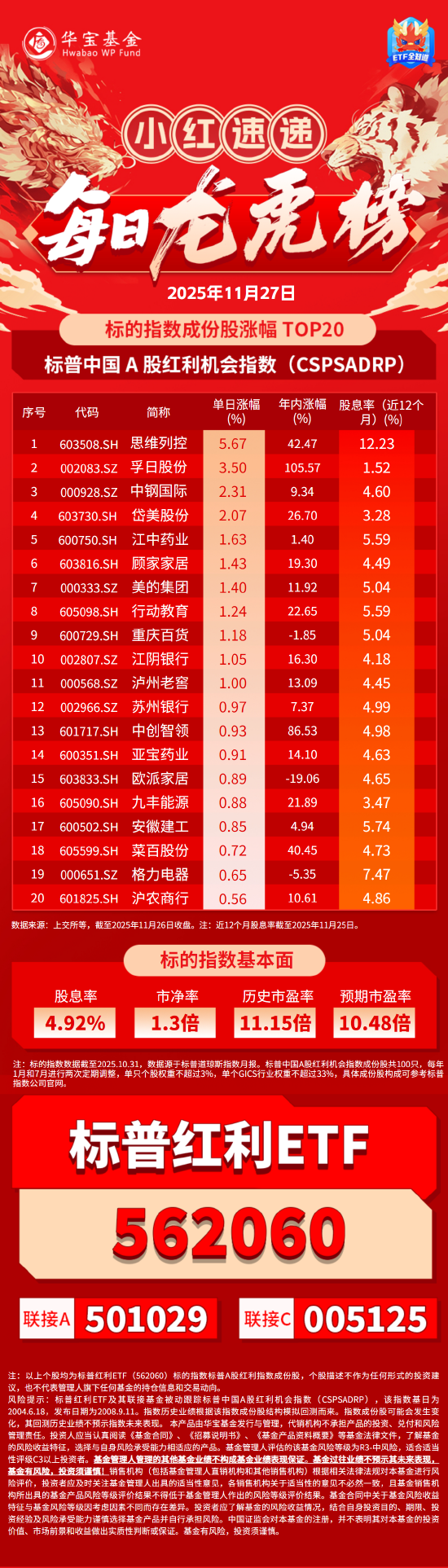
小红日报|孚日股份再现涨停,标普红利ETF(562060)标的指数收涨0.48%
Xin Lang Ji Jin· 2025-11-28 01:07
Group 1 - The article provides a summary of various companies' financial metrics, including dividend yield, price-to-book ratio, historical price-to-earnings ratio, and expected price-to-earnings ratio [2] - The data is sourced from the Shanghai Stock Exchange and is as of the market close on November 26, 2025, with the dividend yield data reflecting the period up to November 25, 2025 [2] Group 2 - Specific companies mentioned include Cai Zhi Co., Ltd. with a dividend yield of 0.72%, Gree Electric Appliances with a dividend yield of 0.65%, and Hu Nong Commercial Bank with a dividend yield of 0.56% [2] - The historical price-to-earnings ratios and expected price-to-earnings ratios for these companies are also provided, indicating their market valuation trends [2]



【早盘三分钟】11月28日ETF早知道
Xin Lang Ji Jin· 2025-11-28 01:03
Core Insights - The chemical industry is expected to experience a cyclical turning point in 2026, driven by a reduction in supply due to negative capital expenditure trends and the clearing of outdated overseas production capacity [4][6] - The electronic sector has seen significant inflows of over 10.7 billion in main funds, with policies encouraging the development of smart consumer electronics, which is expected to boost the sector [6] Group 1: Chemical Industry - The average price of electrolytic solution reached 54,250 yuan per ton as of November 25, up from approximately 19,400 yuan per ton at the beginning of the year, indicating a substantial price increase [4] - Major electrolytic solution companies are experiencing a surge in orders, with some contracts extending to 2028, reflecting strong demand [4] - The chemical sector has shown superior performance this year, attributed to the "anti-involution" trend, which is expected to lead to a recovery in valuations and earnings growth [6] Group 2: Electronic Sector - The electronic sector attracted the highest amount of main fund inflows among 31 primary industries, with notable increases in stock prices for companies like Cambrian and Industrial Fulian, which rose by over 5% and 7% respectively [6] - The Ministry of Industry and Information Technology, along with five other departments, issued a plan to enhance the adaptability of supply and demand in consumer goods, promoting the development of smart home appliances and AI products [6]

红利风向标|大盘冲高回落,低估值红利板块持续火热
Xin Lang Ji Jin· 2025-11-28 01:03
Core Viewpoint - The article discusses the performance of various low-volatility dividend indices in the Hong Kong and A-share markets, highlighting their recent returns and volatility metrics. Group 1: Index Performance - The S&P Hong Kong Stock Connect Low Volatility Dividend Index has shown a near-term performance of -0.02% over the past week, 0.80% over the past year, and a significant 31.67% increase over the past year, with an annualized volatility of 12.64% [3]. - The A500 Low Volatility Dividend ETF (159296) tracked the CSI A500 Low Volatility Dividend Index, reporting a performance of -0.25% over the past week and a 6.63% increase over the past year, with an annualized volatility of 0.77% [3]. - The CSI 800 Low Volatility Dividend Index, followed by the 800 Low Volatility Dividend ETF (159355), recorded a performance of 0.18% over the past day and a 4.47% increase over the past week, with an annualized volatility of 9.81% [3]. Group 2: Comparison with Shanghai Composite Index - The performance of the indices is compared with the Shanghai Composite Index, which has shown a performance of 1.05% over the past week and a decline of 2.83% over the past year, indicating a contrasting trend [3]. - The Shanghai Composite Index has a year-to-date performance of 12.05% and an annualized volatility of 17.09%, which is higher than that of the low-volatility dividend indices [3].

跟踪人工智能指数中的“锋利之矛”!“科创创业人工智能ETF华泰柏瑞”重磅发售
Xin Lang Ji Jin· 2025-11-28 00:53
Core Viewpoint - The launch of the first dual-innovation artificial intelligence ETF by Huatai-PB is expected to provide investors with a streamlined way to invest in cutting-edge technology and seize opportunities in the AI era [1][2]. Group 1: ETF Launch and Performance - The Huatai-PB dual-innovation artificial intelligence ETF (159139) was quickly launched on November 28, 2025, following its approval on November 21, 2025 [1]. - The index tracked by this ETF, the CSI Dual-Innovation Artificial Intelligence Index, has shown a year-to-date increase of 77.69% as of November 25, 2025, outperforming other AI indices during the same period [2]. - The CSI Dual-Innovation Artificial Intelligence Index includes 50 listed companies involved in AI foundational resources, technology, and applications, providing a comprehensive representation of the AI industry [2][3]. Group 2: Management and Industry Position - Huatai-PB Fund, a pioneer in the ETF market with over 19 years of experience, manages the largest ETF in the A-share market, the CSI 300 ETF (510300), with a total ETF management scale of 603.6 billion yuan as of October 2025 [3][4]. - The company has actively engaged in hard technology investments, enhancing its product offerings with various ETFs focused on different sectors, including the newly launched AI ETF [4]. Group 3: Market Context - The increasing global competitiveness and investment value of Chinese technology assets have prompted Huatai-PB to expand its hard technology investment tools, providing investors with diverse allocation options [4].

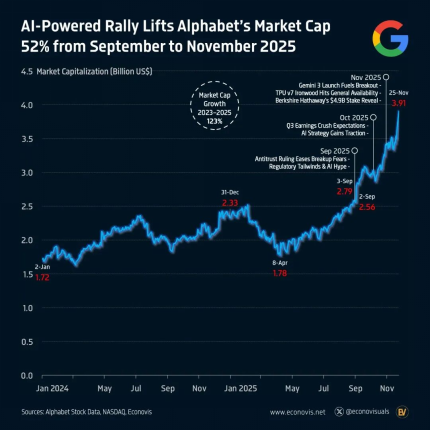
谷歌特斯拉“神仙打架”,自动驾驶红利怎么抓?
Xin Lang Ji Jin· 2025-11-28 00:50
Group 1 - Alphabet has become the fourth company globally to surpass a market capitalization of $3 trillion, joining Apple, Microsoft, and Nvidia [3] - The rapid increase in Alphabet's market value, which rose over $1.34 trillion in just two months, is attributed to multiple disruptive actions reshaping the tech industry [1][4] - Key drivers of Alphabet's stock surge include favorable antitrust rulings, positive regulatory environment, optimistic sentiment towards AI, and strong Q3 earnings exceeding expectations [4] Group 2 - Waymo, Google's autonomous driving division, operates over 2,500 vehicles and has achieved over 100 million miles of fully autonomous driving, with plans to expand its service to over 20 cities [7][9] - Waymo's business model combines ride-hailing services with technology licensing, marking a significant step towards the commercialization of autonomous driving [8] - In contrast, Tesla's approach focuses on a pure vision technology route, with plans to deploy 1,000 Robotaxis by the end of 2025, aiming for a fleet of 1 million Robotaxis across the U.S. [9][10] Group 3 - The competition between Waymo and Tesla represents a significant technological rivalry that will shape the future of the trillion-dollar autonomous driving market, with 2026 being a pivotal year for both companies [10] - Waymo's multi-sensor fusion approach is more costly, while Tesla's pure vision strategy offers long-term cost advantages and scalability [10] - The ongoing expansion of Waymo's services, including plans for international testing in London, highlights its commitment to leading in the autonomous driving sector [9]


ETF日报:此前受存储成本上涨预期影响,消费电子板块经历了短期回调,当前估值水平适中,关注消费电子ETF
Xin Lang Ji Jin· 2025-11-27 14:35
Market Overview - The Shanghai Composite Index closed up 0.29% at 3875.26 points, while the Shenzhen Component Index fell 0.25% and the ChiNext Index dropped 0.44%. The market experienced a high of over 2% in the morning before retreating [1] - The total trading volume in A-shares was 1.72 trillion yuan, slightly down from 1.8 trillion yuan the previous day [1] Integrated Circuit Sector - The Integrated Circuit ETF saw a strong performance, initially rising nearly 4% before closing up 1.28%. This was attributed to the growing market recognition of domestic computing power and the involvement of certain manufacturers in Google's Optical Circuit Switch (OCS) supply chain [2][7] - OCS technology allows for direct transmission of data using light, avoiding the need for conversion to electrical signals, which results in lower power consumption and latency. However, the technology is still maturing and lacks a complete industrial chain [2] Consumer Electronics Sector - The Consumer Electronics ETF rose by 0.36%, driven by favorable policies and new product launches. The Ministry of Industry and Information Technology, along with five other departments, issued a plan to enhance the adaptability of supply and demand in consumer goods, categorizing consumer electronics and smart wearable products as key consumption areas [9] - Global demand for consumer electronics is gradually recovering, with smartphone revenue expected to grow by 5% year-on-year by Q3 2025, reaching a historical high [9] Lithium Battery Sector - The lithium battery industry saw significant gains, particularly in solid-state battery concepts. The price of electrolyte has risen to 55,750 yuan per ton, an increase of approximately 180% since the beginning of the year, while the price of lithium hexafluorophosphate has reached 165,500 yuan per ton [11] - A major development in solid-state batteries includes the establishment of the first large-capacity solid-state battery production line in China, which is currently in small-scale testing. Full-scale production is anticipated around 2030, although challenges remain in technology and cost [11]

科技股冲高回落,电子板块惊现百亿买单!化工悄然逆袭,516020收涨1.3%,银行再秀防御力,银行ETF放量转阳
Xin Lang Ji Jin· 2025-11-27 11:53
中信建投证券认为,当前市场或处于"三期叠加"阶段:牛市中段整固期,景气验证关键期,业绩政策空 窗期,市场震荡轮动和资金年底止盈等特征也会进一步放大。策略层面,短期考虑以择机布局为主,时 点上等待12月中上旬的美联储议息会议和中央经济工作会议落地,期间若调整较充分也可逢低吸筹。 【ETF全知道热点收评】下面重点聊聊化工、银行、电子等几个板块的交易和基本面情况。 周四(11月27日),大盘全天冲高回落,沪指微涨0.29%报收3875.26点,创业板指回吐逾2%收跌 0.44%。个股整体涨跌参半,全市场成交额1.72万亿元,连续2日小幅缩量。 | | 序号 代码 | 类型 名称 | 现价 | 涨跌幅 ▼ | 提慣 | 成交额 | | --- | --- | --- | --- | --- | --- | --- | | 1 | 516020 | 主 化工ETF | 0.782 c | 1.30% | 2.07% | 1.13亿 | | 2 | 562060 | 策 标普红利ETF | 0.605 c | 0.50% | 0.83% | 3173.13万 | | 3 | 512800 | 行 银行ETF | 0.84 ...

头部电解液企业订单火爆,化工ETF(516020)收涨1.3%,机构:2026年化工行业或迎周期拐点向上
Xin Lang Ji Jin· 2025-11-27 11:53
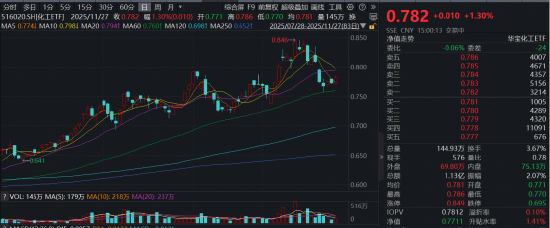
Core Viewpoint - The chemical sector has shown significant strength in the market, outperforming major indices like the Shanghai Composite and CSI 300, driven by a "de-involution" trend and favorable supply-demand dynamics [1][2][7]. Group 1: Market Performance - The Shanghai Composite Index weakened towards the end of the trading day, while the ChiNext Index turned negative, with the chemical sector leading the gains [1]. - The Chemical ETF (516020) experienced a daily increase of 1.30%, with a trading volume of 1.13 billion yuan [1]. - The cumulative increase of the Chemical ETF's underlying index reached 26.07% year-to-date, significantly outperforming the Shanghai Composite Index (15.62%) and the CSI 300 Index (14.75%) [2][3]. Group 2: Stock Performance - Notable stocks in the chemical sector included Xin Fengming, which rose by 5.75%, and several others like Lu Xi Chemical and Wan Hua Chemical, which saw increases of over 3% [2][4]. - The trading volume and transaction amounts for leading stocks indicate strong investor interest, with Wan Hua Chemical achieving a transaction amount of 2.464 billion yuan [2]. Group 3: Industry Trends - The solid-state battery concept remains active, with a significant increase in lithium battery material demand, as evidenced by the rise in electrolyte prices from approximately 19,400 yuan/ton at the beginning of the year to 54,250 yuan/ton recently [5]. - The current price-to-book ratio of the chemical sector stands at 2.27, indicating a relatively low valuation compared to historical levels, suggesting potential for long-term investment [5]. Group 4: Future Outlook - The chemical industry is expected to experience a dual uplift in performance and valuation due to the "de-involution" trend, with leading companies likely to gain market share through improved management and energy efficiency [7]. - Analysts predict that the chemical sector may see a cyclical upturn starting in 2026, driven by supply-side reforms and increased demand, particularly as the U.S. enters a rate-cutting cycle [7]. Group 5: Investment Strategy - Investors are encouraged to consider the Chemical ETF (516020) for efficient exposure to the sector, as it tracks the CSI Sub-Industry Chemical Index and includes a diversified portfolio of leading stocks [8].





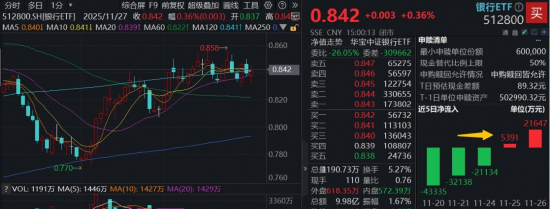
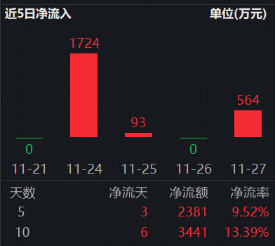
银行低调助攻,农业银行涨超2%!规模最大银行ETF(512800)放量转阳,2.7亿资金掉头涌入
Xin Lang Ji Jin· 2025-11-27 11:49
Group 1 - The banking sector is currently seen as a defensive investment, with several banks showing positive performance, such as Agricultural Bank rising over 2% [1] - The largest bank ETF (512800) has shown resilience, recovering from early losses and closing up 0.36%, indicating strong market interest [1][3] - The banking sector's price-to-book (PB) ratio is at 0.73, significantly lower than international peers, suggesting potential for valuation recovery [3] Group 2 - Institutional investors are increasingly favoring the banking sector, with insurance funds continuing to increase their holdings, indicating ongoing investment value [3] - The recent performance of the bank ETF (512800) reflects a growing interest, with a fund size increase to 206.15 billion, up 131.27 billion since the beginning of the year [5] - The bank ETF has seen a net inflow of 2.7 billion over the past two days, highlighting strong demand for banking sector investments [3]