Tai Mei Ti A P P

Search documents
科锐国际曾诚:AI闹人才荒?根源是人才战略没跟上|2025 ITValue Summit 数字价值年会
Tai Mei Ti A P P· 2025-09-15 10:51
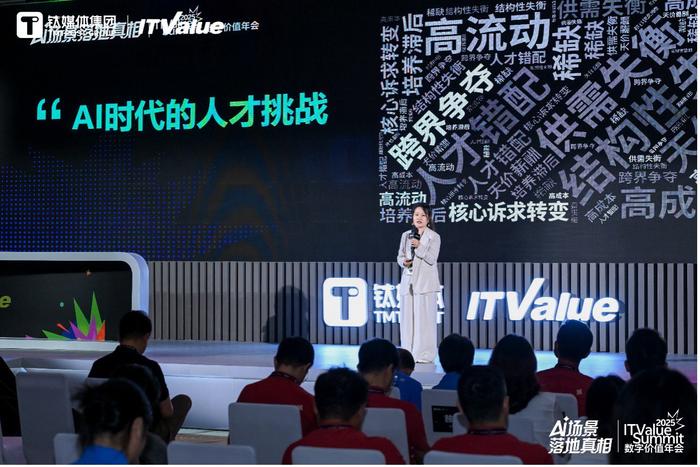
Group 1 - The core challenge for companies in the AI era is not just technology but the alignment of talent strategy with business strategy [3][8] - AI job demand has doubled year-on-year, with only 20% of the required talent being suitable for the roles [2][8] - Companies need to shift from "buying talent" to "creating talent" by focusing on internal training and development [3][10] Group 2 - A successful case was shared where a traditional manufacturing company built a complete talent system by identifying internal potential and providing targeted training [3][10] - AI-native companies may struggle to attract talent if their organizational structure is not well-defined, highlighting the importance of matching talent with company needs [3][12] - The younger generation of AI entrepreneurs values practical skills and hands-on experience over traditional qualifications [4][14] Group 3 - Companies must create an agile talent ecosystem that combines full-time employees, outsourced consultants, and digital workers [15] - The importance of aligning talent with strategic goals is emphasized, as many CEOs are dissatisfied with the pace of AI implementation [13][14] - The future of talent acquisition will require a dynamic approach, continuously tracking and adapting to the needs of the organization [14][15]


A股游戏五强大洗牌:世纪华通领跑,巨人跃居第二,三七互娱押注10款SLG
Tai Mei Ti A P P· 2025-09-15 09:44
Core Viewpoint - The A-share gaming landscape has changed in the first half of the year, with Century Huatong leading significantly in revenue, followed by 37 Interactive Entertainment and Perfect World returning to the top three [3][5]. Revenue Performance - Century Huatong achieved revenue of 17.207 billion yuan, a year-on-year increase of 85.5%, far surpassing 37 Interactive Entertainment's revenue of 8.486 billion yuan [3]. - Perfect World reported revenue of 3.691 billion yuan, up 33.74%, primarily driven by a surge in film and television revenue, which reached 767 million yuan (up 756.35%) [3]. - Only Century Huatong and Perfect World maintained high growth among the top five gaming companies, while 37 Interactive Entertainment and Shenzhou Taiyue experienced revenue declines [3]. Profitability Analysis - Century Huatong emerged as the most profitable gaming stock in A-shares, with a net profit exceeding 2.6 billion yuan, the only company in the sector to surpass 2 billion yuan in net profit [4]. - 37 Interactive Entertainment ranked second with a net profit exceeding 1 billion yuan, while Heiying Network, Giant Network, and Gibit each reported net profits exceeding 600 million yuan [4]. - Century Huatong's net profit surged by 129%, while Gibit and Heiying Network also saw significant increases [4]. Market Capitalization - Century Huatong's market capitalization exceeded 140 billion yuan, reclaiming its position as the top gaming stock, followed by Giant Network at over 80 billion yuan and Heiying Network at over 50 billion yuan [4]. - 37 Interactive Entertainment fell to fourth place in market capitalization [4]. Overseas Revenue Insights - Century Huatong's overseas revenue reached 8.958 billion yuan, leading significantly, while 37 Interactive Entertainment and Shenzhou Taiyue each exceeded 2 billion yuan [7]. - Heiying Network and Perfect World had overseas revenues around 200 million yuan, indicating a reliance on the domestic market [7]. Product Development Focus - The leading A-share gaming companies are focusing on high-quality IP development to mitigate market risks and enhance user attraction [10]. - The SLG (strategy game) genre remains a core focus, with 37 Interactive Entertainment having 10 SLG products in development [11]. - The trend of launching both APP and mini-program versions simultaneously is becoming mainstream in the industry, with companies like Shenzhou Taiyue adapting to market demands [12].


【生态环境周观察】《原子能法》正式颁布;宁德时代计划复产宜春锂矿;《新型储能规模化建设专项行动方案》出炉
Tai Mei Ti A P P· 2025-09-15 08:57
Policy - The "Nuclear Energy Law" has been officially promulgated, effective from January 15, 2026, marking China's first fundamental law in the nuclear energy sector, encouraging controlled nuclear fusion research and technology development [2] - The draft of the Ecological Environment Code's third part has been submitted for review, focusing on general principles, ecological protection, and green low-carbon development [3] - The "New Energy Storage Scale Construction Special Action Plan (2025-2027)" aims for a new energy storage capacity of over 180 million kilowatts by 2027, with direct project investments of approximately 250 billion yuan [4] - A notification was issued to improve pricing mechanisms for nearby consumption of renewable energy, requiring that renewable energy self-consumption should account for at least 60% of total available generation [5] - The "Chengyu Hydrogen Corridor Construction Plan" is being developed to connect logistics hubs and promote large-scale freight demonstration projects in the Chengdu-Chongqing area [6] - Fujian Province has launched an action plan for comprehensive green transformation of economic and social development, aiming for significant progress by 2030 and a mature green low-carbon circular economy by 2035 [8] Events - The third round of the fourth batch of central ecological and environmental protection inspections has been completed, revealing issues such as blind approval of high-pollution projects and inadequate ecological protection in sensitive areas [9] - CATL plans to resume production at its Yichun lithium mine, which was previously shut down due to mining rights issues, with progress on mining rights expected to be faster than market predictions [10] - Goldwind Technology announced plans to invest in a wind power hydrogen and methanol integration project in Inner Mongolia, with a total investment of approximately 18.92 billion yuan [11] - A report indicates that China is expected to reach its power carbon peak by 2025, contingent on achieving specific renewable energy installation targets by 2030 [12] - The China Hydrogen Price Index has been officially released, marking a significant step in the market-oriented development of the hydrogen energy industry [13]


AI时代入口竞争的巨变:从场景心智到角色心智
Tai Mei Ti A P P· 2025-09-14 12:31
Group 1: Core Concepts - The core competition in the internet era is centered around "scene mentality," where companies that dominate high-frequency scenarios can establish entry advantages [1] - In the AI era, the competition shifts from "scene mentality" to "role mentality," where the focus is on becoming a trusted role that can cover multiple scenarios [2][3] Group 2: Consumer Side (ToC) - AI assistants are expected to replace fragmented scenario-based applications, allowing users to perform various tasks through a single role, enhancing personalization and emotional connection [4] - The emotional aspect of role mentality creates a stronger barrier compared to scene mentality, as users are more likely to develop dependency on an AI assistant [4] Group 3: Business Side (ToB) - In enterprise services, AI is evolving from single-point tools to fulfilling specific roles within organizations, enhancing operational efficiency [5][6] - AI enterprise assistants can automate various tasks across departments, becoming central figures in organizational processes [6][7] Group 4: Role of Digital Employees and Virtual Executives - Repetitive tasks are increasingly being replaced by digital employees, which can continuously learn and improve efficiency [8][11] - Virtual executives, such as AI CMO and AI CFO, are emerging as integral parts of organizations, assisting in strategic decision-making and operational management [8][11] Group 5: Business Implications of Role Mentality - The value of role mentality lies in its ability to facilitate cross-scenario migration and establish trust barriers, making it crucial for companies to create a strong role positioning in the minds of users and enterprises [9][10]
对话京东方董事长陈炎顺:AI焕新增长,3年500亿研发不是单打独斗
Tai Mei Ti A P P· 2025-09-14 06:53
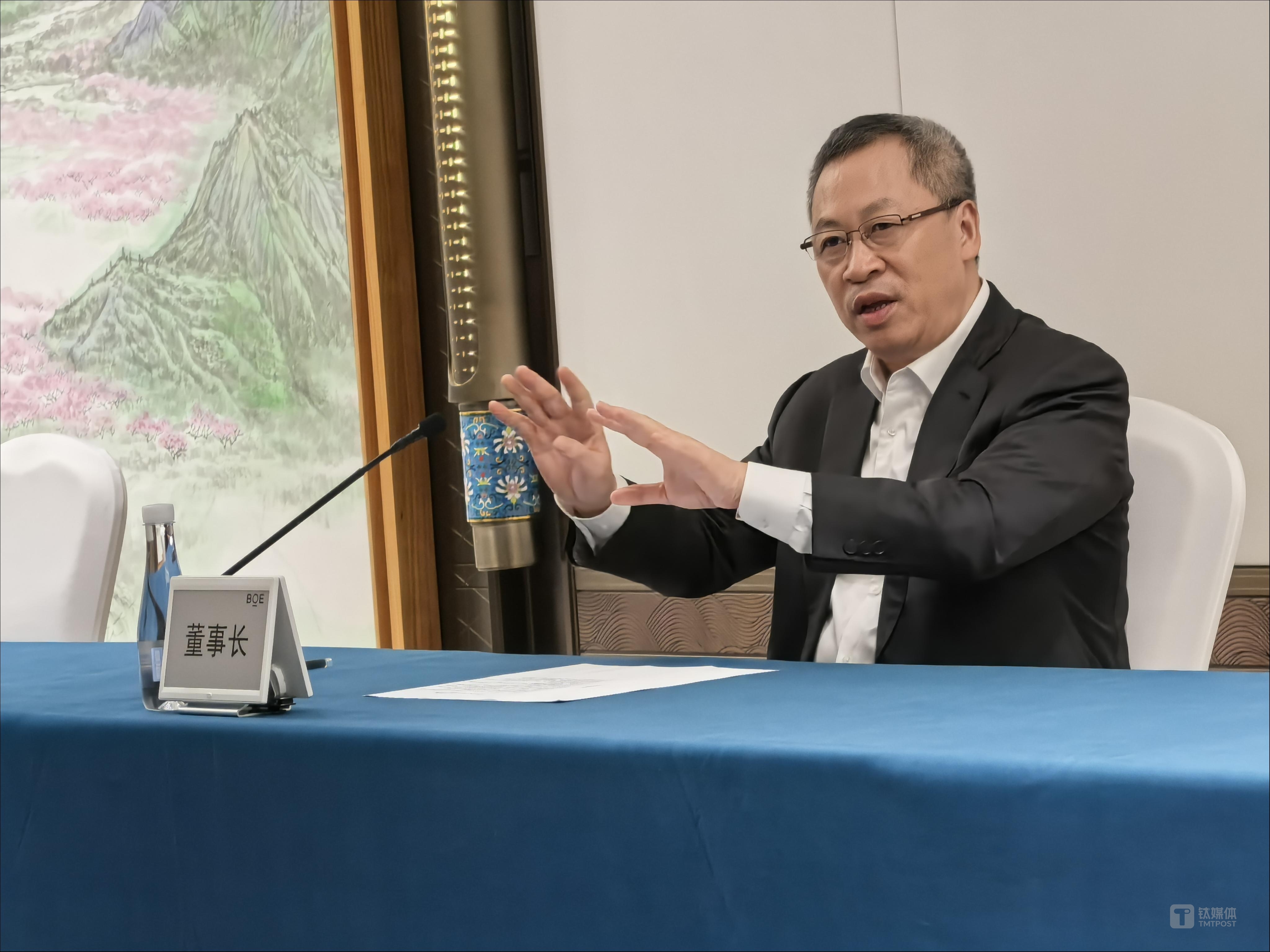
Group 1 - BOE plans to invest 50 billion yuan in R&D and 500 billion yuan in procurement over the next three years to support technological breakthroughs and industry upgrades [1][6] - The Chinese display industry has transitioned from a period of significant fluctuations to a weak cycle of minor adjustments, prompting companies to adapt to market changes and leverage new technologies [1][4] - AI is integrated into BOE's overall development strategy, with a commitment to allocate 0.5% of revenue for AI R&D [4][6] Group 2 - The "N Curve" theory proposed by BOE aims to identify new growth points amid fluctuating cycles, emphasizing the dual explosion of technological leaps and industry penetration driven by AI [4][5] - AI's integration into manufacturing processes is expected to reduce testing costs, shorten R&D cycles, and enhance product quality through automated detection systems [5][6] - BOE has invested over 40 billion yuan in R&D and 370 billion yuan in procurement over the past three years, with over 250 collaborative projects launched [6][7] Group 3 - The company plans to establish marketing and R&D institutions globally to explore market opportunities and strengthen its international service capabilities [7] - The focus on AI is not just an internal initiative but also involves collaboration with numerous partners to drive industry transformation [7] - The projected annual investment in AI, based on 2024 revenue of 198.38 billion yuan, will be approximately 1 billion yuan [7]

加拿大留子回国买iPhone,“反向海淘”的苹果,有多香?
Tai Mei Ti A P P· 2025-09-14 05:01
Core Insights - The launch of the iPhone 17 series has generated significant excitement, with pre-order volumes on platforms like Tmall and JD.com showing a nearly threefold increase compared to previous models [1][2] - The trend of "reverse purchasing" has emerged, where consumers are willing to pay a premium for iPhone 17 models from regions like Hong Kong due to differences in pricing and features [1][4] - The cancellation of physical SIM card slots in certain regional versions of the iPhone 17 has led to increased demand for models that still support physical SIM cards, particularly among overseas Chinese students [4][5] Group 1 - The iPhone 17 series has seen a surge in pre-orders, with over 2 million units booked within six hours of launch on JD.com [1] - Consumers are increasingly savvy, comparing specifications and prices across different regions, leading to a rise in cross-border purchasing [3][6] - The price differences for specific models, such as the 512GB iPhone 17 being cheaper by approximately 140 yuan in Hong Kong compared to mainland China, are driving demand for cross-regional purchases [8][14] Group 2 - The trend of reverse purchasing is not new but has evolved; consumers are now more focused on specific features and configurations rather than just price [4][14] - The iPhone's branding and technological positioning have made it a cultural symbol, influencing consumer behavior and the demand for new models [14] - The iPhone remains a "hard currency" in the resale market, with significant demand for each new release, indicating a robust secondary market for these devices [10][12] Group 3 - The iPhone 17's removal of the physical SIM card slot in certain versions has created challenges for users who rely on domestic SIM cards, prompting them to seek alternative models [4][5] - The iPhone 17's appeal is further enhanced by its advanced features, which are not available in the domestic versions, leading to a willingness to pay higher prices for models that meet specific needs [14][18] - The complexities of warranty and after-sales service for imported models pose risks for consumers, as many overseas versions do not qualify for official repairs in China [18]


皮卡战争下半场:奇瑞威麟用“油电平权”挑战全球产业规则
Tai Mei Ti A P P· 2025-09-13 07:13
Core Insights - The article highlights the potential of the pickup truck market, which has been largely overlooked compared to the booming electric vehicle sector, indicating a significant opportunity for Chinese brands like Chery's RELY Wuling to penetrate this market [2][3] - The global pickup truck market is dominated by American and Japanese manufacturers, particularly in the high-end segment, where Ford and Toyota hold 89% of the market share for trucks priced over $100,000 [2][3] - Chery's RELY Wuling aims to disrupt this market by introducing a comprehensive energy strategy that includes fuel, hybrid, and electric options, addressing the transitional needs of consumers [3][4] Industry Analysis - The global pickup truck sales are projected to reach approximately 5.5 million units in 2023, with diesel vehicles accounting for 78% of sales, particularly in Southeast Asia and Latin America [2] - The Chinese hybrid pickup market is expected to reach 28.01 billion yuan (approximately $4.1 billion) by 2024, while the global hybrid pickup market is projected to reach 87.53 billion yuan (approximately $12.5 billion) [3] - By 2030, the global hybrid pickup market is forecasted to grow to 167.26 billion yuan (approximately $24 billion), indicating a shift towards hybrid solutions rather than full electric options [3] Technological Innovations - Chery's RELY Wuling is addressing three major pain points in the pickup industry: diesel engine drawbacks, electric vehicle pricing, and limited customization options [5][11] - The company has developed a diesel hybrid engine that significantly improves performance and comfort, addressing common complaints about diesel vehicles [6][10] - The introduction of a CTC integrated battery chassis aims to reduce costs and achieve price parity between electric and fuel vehicles, potentially making the RELY R08 EV the first electric pickup to match the price of its fuel counterparts [11][13] Market Positioning - Chery's RELY Wuling is attempting to redefine the pickup truck's image from a utilitarian tool to a versatile lifestyle platform, emphasizing user customization and engagement [14][15] - The company has adopted a user-centric approach in its development process, achieving a 300% increase in R&D efficiency by directly incorporating user feedback into product design [16][18] - By leveraging flexible manufacturing capabilities, RELY Wuling can customize vehicles for different regional markets without incurring significant additional costs, challenging traditional pricing strategies of multinational competitors [18][20] Cultural Rebranding - The article discusses the cultural challenges faced by Chinese brands in the pickup market, traditionally dominated by American imagery and values [15][20] - Chery's RELY Wuling aims to create a new cultural narrative around its vehicles, using the "Qilin" symbol to resonate with Eastern philosophies and appeal to emerging markets [20][22] - This cultural shift is seen as essential for establishing a competitive edge and gaining market share in a sector where brand loyalty is deeply rooted [20][22]

「创新场景50」年度最佳场景实践TOP 15榜单重磅发布
Tai Mei Ti A P P· 2025-09-13 07:13
Core Insights - The next phase of AI will focus on generating returns rather than just providing tools, emphasizing the need for AI to integrate with various business scenarios to demonstrate its value and profitability [1] - The selection of AI application scenarios is crucial for the success of corporate AI strategies, with a focus on technical maturity and value positioning [2] Group 1: AI Application Scenarios - Companies should prioritize AI applications in scenarios with high data maturity and mature AI technology that address core business pain points, optimizing costs and increasing revenues [1][2] - Effective scenario selection allows companies to concentrate resources strategically, enhancing competitiveness in the market [2] Group 2: Characteristics of Valuable Scenarios - Valuable AI scenarios should possess innovation, deep integration into business systems, and reusability to solve common industry problems with low replication costs [2] - The "Innovation Scene 50" initiative by TiMedia aims to recognize breakthrough scenarios in new technologies and fields that have demonstrated practical application value [2] Group 3: Awarded Scenarios - **Intelligent Education Scenario**: iFLYTEK's AI learning machine offers personalized learning through a closed-loop system, enhancing educational outcomes [4] - **Automotive Finance Scenario**: Yixin's AI model integrates various capabilities to automate the entire automotive finance process, improving efficiency [5] - **Human Resources Scenario**: Core International's AI recruitment model enhances the recruitment process through automation and data analysis, improving efficiency and accuracy [6] - **Multimodal Interaction Scenario**: Alibaba Cloud's development kit customizes intent recognition models for AI hardware, enhancing application capabilities [7] - **AI Marketing Scenario**: Hisense's collaboration with Amazon Cloud Technology enables rapid generation of advertising materials, creating new revenue streams [8] - **Intelligent Investment Advisory Scenario**: Jiufang Zhitu's AI model facilitates diverse investment advisory needs, achieving high user satisfaction [9] - **AI Wealth Management Scenario**: Yingmi Qieman's service standardizes financial capabilities for efficient AI integration [10] - **Retail Customer Service Scenario**: NetEase Cloud's AI model enhances customer service through dynamic understanding of customer intent [11] - **Energy Trading Scenario**: Yuanli Guangnian's AI model autonomously monitors market conditions and executes strategies [12] - **Compliance Quality Inspection Scenario**: Zhongguancun KJ's AI system improves quality inspection accuracy and compliance in the securities industry [13] - **Medical Diagnosis Scenario**: Wisdom Eye Technology's AI platform achieves high diagnostic accuracy through advanced technology integration [14] - **Intelligent Cockpit Scenario**: Mianbi Intelligent's AI assistant offers a native experience for in-car applications [15] - **Store Product Management Scenario**: Multi-point Smart's AI system significantly reduces waste and improves sales rates in fresh produce [16] - **Express Logistics Scenario**: Shenzhen Qianhai's AI system integrates multiple models for efficient logistics management [17][18] - **Smart Transportation Scenario**: Shanshu Technology's AI decision-making platform optimizes resource allocation in transportation [19]
杨瑞甫:锂离子电池负极材料的发展演变与未来趋势 | 钛资本新能源组
Tai Mei Ti A P P· 2025-09-13 04:40
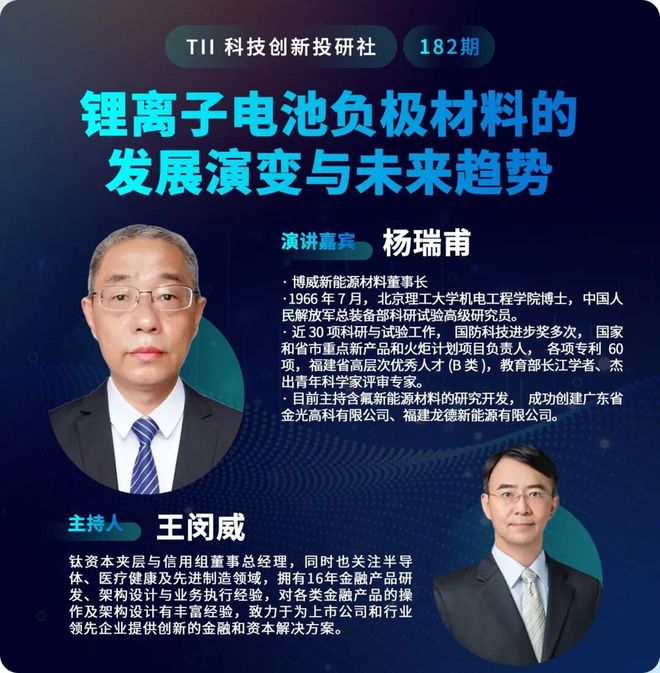
Group 1 - The rapid development of the new energy industry has significantly increased the market scale of lithium-ion batteries, with an annual growth rate exceeding 20% in recent years [5] - In 2024, the shipment volume of cathode materials is expected to reach 3.2 million tons, while anode materials will exceed 2.1 million tons, indicating a strong growth trend [5] - Graphite anodes dominate the market, accounting for over 95% of the total, while silicon-based and other composite anodes represent less than 5% [5] Group 2 - Graphite anodes possess a hexagonal layered structure that allows lithium ions to embed and extract easily, making them suitable for battery charging and discharging cycles [6] - The theoretical specific capacity of graphite is 372 mAh/g, with commercial products typically ranging from 330 to 360 mAh/g, meeting energy density needs for most applications [7] - Graphite anodes exhibit excellent cycling performance, with lifespans exceeding 1000 cycles for consumer electronics and over 3000 cycles for power batteries [7] Group 3 - Despite their advantages, graphite anodes face limitations, including a capacity ceiling close to their theoretical value, which restricts their use in high-energy-density applications like electric vehicles [8] - Fast charging performance is limited due to kinetic constraints, leading to potential safety hazards from lithium dendrite formation [8] - Low-temperature adaptability is poor, with capacity loss exceeding 30% at -30°C, limiting their use in cold environments [8] Group 4 - The industry is exploring alloy materials with higher capacities, such as silicon, phosphorus, tin, and aluminum, which can significantly exceed the capacity of graphite [9] - Silicon-based anodes have undergone four generations of technological iterations, focusing on improving volume expansion, cycling life, and initial efficiency [9][10] - By 2030, silicon-based anodes are expected to achieve a market penetration of 30%, with phosphorus-based materials expanding in high-end applications [9] Group 5 - The first generation of silicon-based anodes utilized a physical modification approach, resulting in a core-shell structure that reduced volume expansion but had short cycling life and low initial coulombic efficiency [11][12] - The second generation improved cycling stability and capacity through chemical modification, but still faced challenges with initial efficiency and conductivity [13][14] - The third generation introduced pre-lithiation techniques, significantly enhancing initial efficiency and cycling life, but increased complexity and costs [15][16] Group 6 - The fourth generation of silicon-based anodes employs a porous carbon framework to stabilize silicon particles and enhance conductivity, achieving a balance between capacity, cycling, and cost [17][18] - This generation shows significant improvements in specific capacity, volume expansion, initial efficiency, and cycling performance, making it a promising direction for future applications [19] - However, challenges remain regarding production costs, structural stability over long cycles, and electrolyte compatibility [20] Group 7 - The demand for silicon-carbon composite materials is expected to grow significantly, with projections indicating a market space of hundreds of billions by 2030 [24] - Companies like Zhangjiagang Bowei are positioning themselves as collaborative suppliers, leveraging their technological advantages to partner with leading firms in the industry [25] - The industry is currently in the early stages of commercialization, with ongoing efforts to optimize production processes and expand application scenarios [21][24]
突遭制裁!美国政府将复旦微电等23个中国实体列入“黑名单”,清单总量已超千家
Tai Mei Ti A P P· 2025-09-13 02:39
Core Points - The U.S. Department of Commerce has added 32 entities to its Entity List, including 23 from China, due to concerns over national security and foreign policy interests [2][4][10] - Among the listed entities, notable companies include Fudan Microelectronics and various semiconductor-related organizations, which are now subject to strict export controls [2][8] - The U.S. has been tightening export controls on advanced AI and semiconductor technologies since 2018, with significant expansions under both the Trump and Biden administrations [4][5][6] Group 1: U.S. Export Controls - The Bureau of Industry and Security (BIS) has mandated that all items subject to the Export Administration Regulations (EAR) require a license for the listed entities, with a presumption of denial for such licenses [3][5] - The recent actions are part of a broader strategy to limit China's access to advanced computing and semiconductor manufacturing capabilities [4][6] - The number of Chinese entities on the BIS Entity List has significantly increased, with 1,065 entries as of March 31, 2025, representing nearly one-third of the total entries [10][11] Group 2: Impact on Companies - Fudan Microelectronics, a leading Chinese semiconductor company, has been significantly impacted by the new restrictions, which may hinder its ability to source necessary technology from abroad [8][12] - The Chinese Academy of Sciences' Aerospace Information Research Institute is also among the listed entities, indicating a focus on advanced technology sectors [9][12] - The overall trend shows a growing number of Chinese companies facing export restrictions, with 2,641 license applications approved and 1,293 denied or withdrawn from 2018 to 2023 [10]