傅里叶的猫

Search documents
人工智能分析2025年第一季度AI现状
傅里叶的猫· 2025-06-05 12:25
今天大家都在谈MS的这篇DeepSeek R2分析的报告,提前曝光了R2的性能和参数,我们简单总结一 下这个报告的核心内容: DeepSeek R2 使用了多达 1.2 万亿个参数,采用了新颖的架构,实现了运行成本的显著降低。其采用 混合专家混合(MoE)架构,有 780 亿个活跃参数。 并且R2 使用华为的 Ascend 910B 芯片进行训练,而非 NVIDIA 的芯片。 R2 增强了多语言覆盖能 力,能流畅处理非英语语言;扩展了强化学习,利用更大的数据集,使模型能够进行更具逻辑性和 更像人类的推理;增加了多模态功能,能够处理文本、图像、语音和视频数据;实现了推理时的缩 放,通过采用通用奖励模型(GRM),在推理过程中增加计算资源,从而提高了输出质量。 R2 具有高成本效益,输入成本为每百万代币 0.07 美元,输出成本为每百万代币 0.27 美元,而 R1 的 输入成本为 0.15-0.16 美元,输出成本为 2.19 美元。 由于这篇报告讲的人已经很多了,我们就不赘述了,而且报告也放到了星球中,有兴趣的朋友可以 到星球中看原文。 今天这篇文章来看另一篇AI的分析,Artificial Analysis ...


HBM 深度剖析
傅里叶的猫· 2025-06-04 11:43
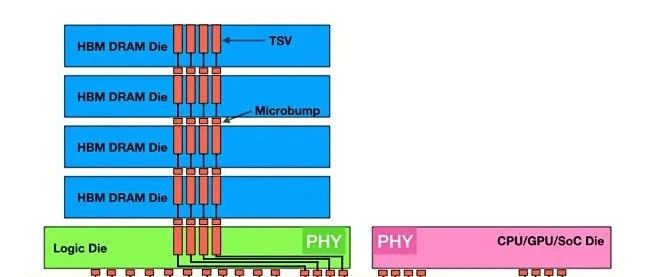
Core Viewpoint - The article discusses the increasing importance of High Bandwidth Memory (HBM) in the AI chip sector, highlighting its advantages and the competitive landscape among major players like SK Hynix, Samsung, and Micron. Group 1: Importance of HBM - HBM is crucial in the era of generative AI as memory bandwidth often limits model training rather than computational power [4] - The memory demand in Transformer models grows quadratically with sequence length, making bandwidth a significant bottleneck [4] - HBM offers superior performance, with bandwidth reaching several terabytes per second, over 20 times faster than conventional DDR memory [5] Group 2: HBM Technology Development - Each generation of AI chip upgrades relies on HBM iterations for performance enhancement, with NVIDIA GPUs showing significant capacity increases [9] - HBM capacity has increased by 50% from H100 to H200 and B200 to B300, with HBM4 doubling the channel count from 8 to 16 [9] - The HBM market is expected to grow rapidly, with a projected CAGR of 50% from 2024 to 2028 [10] Group 3: Market Leaders and Competitive Landscape - SK Hynix currently leads the HBM market with over 60% market share, primarily supplying high-end HBM to NVIDIA [14] - The MR-MUF technology used by SK Hynix offers better thermal performance and higher yield compared to Samsung's TC-NCF technology [15][18] - Samsung faces challenges in HBM production due to issues with its front-end technology and lower yield rates [20][22] Group 4: Future Trends and Innovations - The shift from planar DRAM processes to advanced FinFET logic nodes in HBM4 is expected to enhance performance and energy efficiency [23] - Samsung plans to manufacture HBM4 base chips using its 4nm process, while SK Hynix and Micron will outsource to TSMC [25] - Hybrid bonding technology is emerging as a disruptive innovation in HBM, potentially changing the competitive landscape [32] Group 5: Chinese Market Developments - Chinese companies like ChangXin Memory Technologies (CXMT) and Yangtze Memory Technologies (YMTC) are making strides in HBM technology, although they currently lag behind global leaders [42] - CXMT aims to start mass production of HBM2 by late 2024, with plans for HBM3 and HBM3E in subsequent years [44] - The ability of Chinese firms to adopt hybrid bonding technology could significantly accelerate their HBM development [48][49]

外资顶尖投行研报分享
傅里叶的猫· 2025-06-04 11:43
还有专注于半导体行业分析的SemiAnalysis的全部分析报告: 星球中每日还会更新Seeking Alpha、Substack、 stratechery的精选付费文章, 现在星球中领券后只需要 390元,即可每天都能看到上百篇外资顶尖投行科技行业的分析报告和每天的精选报告,无论是我们自 己做投资,还是对行业有更深入的研究,都是非常值得的。 想要看外资研报的同学,给大家推荐一个星球,在星球中每天都会上传几百篇外资顶尖投行的原文研 报:大摩、小摩、UBS、高盛、Jefferies、HSBC、花旗、BARCLAYS 等。 ...

从冷战时期的出口管制到AI芯片战
傅里叶的猫· 2025-06-03 14:38
Core Viewpoint - The article discusses the historical context of modern computing export restrictions, drawing parallels between the current US-China AI chip competition and the Cold War-era CoCom export control mechanisms, emphasizing the challenges of enforcement and the strategic implications for both nations [1][2][3]. Group 1: Historical Context - The CoCom (Coordinating Committee for Multilateral Export Controls) was established in 1949 as a response to the Soviet Union's nuclear capabilities, creating a comprehensive technology embargo system to control the export of strategic materials and technologies, particularly computing devices [3][4]. - The effectiveness of CoCom was undermined by non-compliance, disagreements among member countries, and the financial interests of technology exporters, leading to significant loopholes in enforcement [5][7]. Group 2: Current Implications - The current US perception of China mirrors the 1950s view of the Soviet Union, but the geopolitical landscape has changed significantly, with China possessing economic leverage and a more integrated role in the semiconductor supply chain [10][15]. - The article highlights that while CoCom faced execution challenges, the current semiconductor control efforts may encounter even greater difficulties due to the interconnected global trade networks and the economic ties of key partners with China [15]. Group 3: Lessons from CoCom - Effective technology restrictions require multilateral enforcement, as unilateral controls may have inherent limitations; historical examples show that coordination among major technology and manufacturing nations is crucial [14]. - A robust tracking and verification system is essential for effective enforcement of export controls, as past failures often stemmed from the inability to monitor the movement of controlled technologies [14]. - The article suggests that even under ideal conditions, CoCom struggled with execution, indicating that expectations for current export control measures may need to be adjusted given the complexities of today's geopolitical environment [14][15].

外资顶尖投行研报分享
傅里叶的猫· 2025-06-02 14:19
Group 1 - The article recommends a platform where users can access hundreds of original research reports from top foreign investment banks daily, including firms like Morgan Stanley, JPMorgan, UBS, Goldman Sachs, Jefferies, HSBC, Citigroup, and Barclays [1] - The platform also provides comprehensive analysis reports focused on the semiconductor industry from SemiAnalysis, along with selected paid articles from Seeking Alpha, Substack, and Stratechery [3] - The subscription to the platform is currently available for 390 yuan after discounts, offering access to a wealth of technology industry analysis reports and selected daily reports, which is deemed valuable for both personal investment and deeper industry research [3]

聊一聊博通
傅里叶的猫· 2025-06-02 14:19
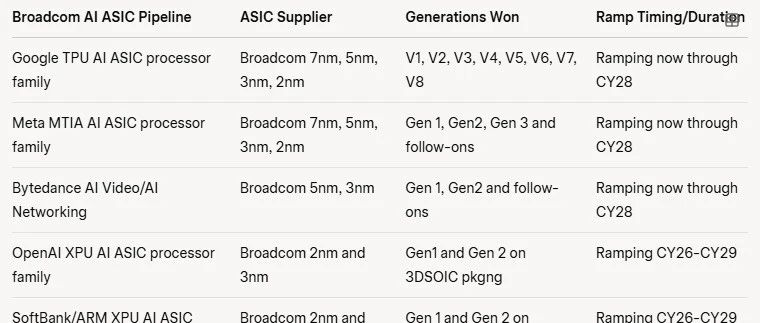
从去年年底博通市值突破万亿美元后,就一直想聊一聊博通,准备后面把博通这家公司的业务好好 梳理一下,今天这篇文章,我们根据博通在5月30日举办的投资者网络研讨会的内容,先简单聊一聊 博通。 博通的Tomahawk 6 3nm芯片组已准备好在2025年下半年量产。这款芯片不仅是全球最复杂、性能最 高的交换芯片,支持102Tbps吞吐量,还采用了博通顶尖的200Gbps SERDES I/O技术。Tomahawk 6 不仅支持传统横向扩展,还扩展到新的纵向扩展用例,满足通用云、AI/机器学习和企业数据中心等 多种网络工作负载需求。这使得博通在竞争中始终保持1-2步的领先优势。 在AI芯片和网络半导体领域,博通有着无可撼动的领先地位。AI芯片主要分为两个大类,一个是 GPU,当然就是英伟达是绝对的龙头,另一类就是ASIC,也就是AI专用芯片,像Google和亚马逊的 AI芯片都是跟博通合作开发的;除了AI芯片,博通的网络芯片也是业内的龙头。 根据最新报告,博通预计2025财年AI相关总收入将达到190亿至200亿美元,同比增长超60%,完全 符合其三年目标市场规模(SAM)复合年增长率60-65%的预期。这不仅彰显了 ...

英伟达财务模型分析--钱都挣在了哪里?
傅里叶的猫· 2025-06-01 15:22
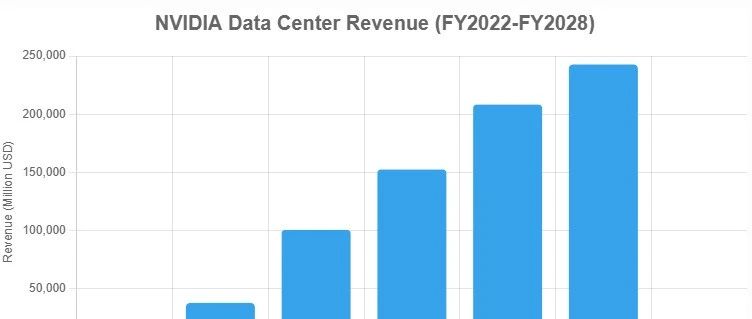
Core Viewpoint - Nvidia's Q1 financial report indicates strong revenue growth driven by data center and gaming segments, despite challenges from inventory write-downs related to the H20 chip [1][22][25] Data Center Business - In Q1, Nvidia's data center revenue reached $39.11 billion, a year-over-year increase of 73.3%, primarily driven by the Blackwell product line [2][4] - The data center segment's revenue is projected to grow significantly, with estimates of $100.69 billion for FY2024 and $152.5 billion for FY2025, reflecting a compound annual growth rate of approximately 208% from FY2022 [4][9] - The product mix is shifting, with the H100/H200 series expected to dominate revenue contributions in the coming years, while the A100's share declines [6][9] Gaming Business - The gaming segment experienced fluctuations, with revenue of $3.375 billion in FY2022, surging to $11.186 billion in FY2023, and slightly declining to $9.781 billion in FY2024 [12][15] - GeForce products remain the core of the gaming business, contributing 80%-85% of revenue, with expectations of $9.536 billion in FY2025 [13][15] - Future forecasts indicate potential revenue of $14.043 billion in FY2026, but with risks from competition and market saturation [15][16] Automotive Business - Nvidia's automotive revenue has grown from $566 million in FY2022 to an expected $2.42 billion in FY2025, driven by demand for autonomous driving and AI applications [18][20] - The DRIVE platform is central to this growth, with significant orders from over 25 automakers, and projections of $3.845 billion in FY2026 [19][20] China Market Impact - Recent U.S. export restrictions on the H20 chip have significantly impacted Nvidia's business in China, leading to a $4.5 billion inventory write-down [22][24] - Despite these challenges, global demand for AI chips remains strong, with Nvidia's infrastructure still in high demand [22][23] Financial Guidance - For Q2 FY2026, Nvidia expects revenue to reach $45 billion, with a GAAP gross margin of 71.8%, despite the anticipated impact of the H20 chip ban [25]

外资顶尖投行研报分享
傅里叶的猫· 2025-05-30 15:44
还有专注于半导体行业分析的SemiAnalysis的全部分析报告: 星球中每日还会更新Seeking Alpha、Substack、 stratechery的精选付费文章, 现在星球中领券后只需要 390元,即可每天都能看到上百篇外资顶尖投行科技行业的分析报告和每天的精选报告,无论是我们自 己做投资,还是对行业有更深入的研究,都是非常值得的。 想要看外资研报的同学,给大家推荐一个星球,在星球中每天都会上传几百篇外资顶尖投行的原文研 报:大摩、小摩、UBS、高盛、Jefferies、HSBC、花旗、BARCLAYS 等。 ...

EDA禁售,国内的芯片设计公司如何应对?
傅里叶的猫· 2025-05-30 15:44
Group 1 - The core viewpoint is that there may still be room for negotiation regarding the EDA ban, as the current policy seems too extreme and unexpected [1] - Domestic EDA companies have made significant progress in covering various chip design, verification, and production scenarios, but there are still many bugs in their tools [2] - The notion that EDA bans will not affect many companies due to the use of pirated licenses is incorrect, as EDA tools are closely tied to foundry process design kits (PDK), which frequently update and validate licenses [3] Group 2 - Common strategies to cope with EDA tool shortages include registering overseas companies to purchase software and chips, establishing offshore R&D centers in regions with looser restrictions, and collaborating with foreign companies for production [7] - The best approach for acquiring IP is to buy it outright; if that is not feasible, companies must still rely on overseas sources [5]




如果EDA断供,国产EDA够用吗?
傅里叶的猫· 2025-05-29 15:16
Core Viewpoint - The article discusses the recent news regarding the supply disruption of EDA tools and emphasizes that a complete supply cut is unlikely, as it would signify a decoupling of the semiconductor industries between China and the U.S. The article also highlights the current dominance of three major EDA companies and the challenges faced by domestic EDA firms in China [1][3]. Industry Overview - The EDA industry is relatively small compared to other segments of the semiconductor industry, with the three leading companies—Synopsys, Cadence, and Siemens EDA—holding approximately 70% of the global market share. Synopsys accounts for about 32%, Cadence for 30%, and Siemens EDA for 13% [3][6]. - The largest EDA companies have market capitalizations around $70 billion, with Synopsys projected to generate revenues of $6 billion and net profits of $2 billion in 2024, indicating that EDA is not a high-margin industry [6][3]. EDA Tools and Market Segmentation - EDA tools are categorized into manufacturing EDA and design EDA, with manufacturing EDA being crucial for matching advancements in semiconductor process nodes [9][11]. - The Chinese manufacturing EDA market is expected to reach 4.22 billion yuan by 2028, with a compound annual growth rate (CAGR) of 21.2%, outpacing global growth due to increasing domestic demand [13]. Key Players in EDA - Synopsys has historically maintained a leading position in the EDA market, although it was recently surpassed in market value by Cadence. This shift is attributed to strategic moves, including the former CEO of Cadence joining Intel [15][18]. - Domestic EDA companies, while still lagging behind their U.S. counterparts, are numerous and competitive across various segments. However, only a few are expected to emerge as strong players due to the industry's limited size [19][28]. Domestic EDA Tools - Major domestic EDA companies like Huada Empyrean and others have developed comprehensive tools for analog IC design and wafer manufacturing, covering a wide range of processes [20][22]. - Despite the presence of domestic alternatives, there are significant gaps in quality and reliability compared to established foreign tools, leading many companies to prefer more expensive foreign solutions to mitigate risks [28][29].