私募排排网

Search documents
金银铜罕见同创历史新高!16家有色金属公司被外资、公募共同抢筹!9家股价翻倍
私募排排网· 2025-12-25 10:00
Core Viewpoint - The non-ferrous metals sector is experiencing a structural bull market driven by global monetary easing, geopolitical risks, and tight supply-demand dynamics, with significant price increases in various metals such as gold, silver, copper, palladium, and platinum [2][3][4]. Supply Constraints and Demand Drivers - The recent strength in the non-ferrous metals sector is attributed to global monetary easing expectations, geopolitical tensions, and tight supply-demand conditions [2]. - On the demand side, emerging industries are expected to drive incremental demand for non-ferrous metals, with copper consumption in China projected to reach 15.4 million tons by 2025, particularly from sectors like new energy vehicles, photovoltaics, wind power, and artificial intelligence, estimated to consume 3.8 to 4 million tons [3]. - On the supply side, global copper production has faced continuous disruptions, and the supply tightness is expected to deepen by 2026. Domestic aluminum production capacity is limited, and export quotas on rare metals like antimony and rare earths have further constrained supply [4]. Market Performance and Company Insights - In the A-share market, several non-ferrous metal companies have seen significant stock price increases, with companies like Tianli Composite and Western Materials rising over 150% in the past month. Year-to-date, companies such as Tianli Composite, China Tungsten High-tech, and Zijin Mining have doubled in value [2]. - The non-ferrous metals industry reported a total revenue of 2.82 trillion yuan in the first three quarters of 2025, a year-on-year increase of 9.3%, with net profits rising by 41.55% to 151.29 billion yuan [12]. - Companies like Chuangjiang New Material and Shenghe Resources have shown exceptional performance, with net profit growth exceeding 40% year-on-year, indicating strong operational results in the sector [12][13]. Institutional Holdings - As of the end of Q3 2025, 116 non-ferrous metal companies were held by public funds, with 48 having a holding ratio exceeding 3%. Additionally, 82 companies were held by foreign capital, with 26 exceeding the same threshold. Notably, 16 companies had both foreign and public fund holdings above 3%, with significant stock price increases [9][10].



十大量化策略产品榜出炉!龙旗、平方和、黑翼、信弘天禾、进化论等均有上榜!
私募排排网· 2025-12-25 07:00
Core Viewpoint - The article discusses the increasing prevalence of quantitative investment strategies across various asset classes, highlighting the performance of different quantitative strategies and their respective products in 2023 [2][3]. Group 1: Overview of Quantitative Investment Strategies - Quantitative investment has become common in single assets like stocks, commodities, and futures, with private fund managers exploring various strategies such as options, arbitrage, and FOF [2]. - There are 14 secondary strategies under quantitative investment, with the top ten being quantitative long, quantitative CTA, market-neutral, composite strategies, options strategies, arbitrage strategies, convertible bond trading strategies, macro strategies, long-short equity, and FOF [2][3]. Group 2: Performance Metrics - As of the end of November, 1,793 quantitative products had an average return of 27.29% for the year, with 825 quantitative long strategies achieving an impressive average return of 41.12% [3]. - The average Sharpe ratio for all quantitative products was 2.28, indicating a favorable risk-adjusted return [3]. Group 3: Top Performing Quantitative Strategies - **Quantitative Long Strategy**: The top three products in this category are from Zhuhai Zhengfeng, Shuizhuoquan Asset, and Jiuming Investment, with Zhuhai Zhengfeng's product achieving the highest excess return [5][6]. - **Quantitative CTA Strategy**: Leading products are from Jingying Zhito, Huacheng Private Equity, and Xincheng (Beijing) Private Equity, with Jingying Zhito's product showing significant returns [13][14]. - **Market-Neutral Strategy**: The top products are from Jianlong Capital, Zhongyou Yong'an Asset, and Guangdong Jingcheng Private Equity, with Jianlong Capital's product leading in returns [15][16]. - **Composite Strategy**: The top three products are from Tianhui (Shanghai) Private Equity, Yiku Capital, and Rongwei Investment Fund, with Tianhui's product showing strong performance [18][19]. - **Options Strategy**: Leading products are from Haiseng Fund, Junfu Investment, and Rong Tansuo Fund, with Haiseng's product achieving notable returns [21][22]. - **Macro Strategy**: The top products are from Yiqiao Asset, Hangzhou Bolian Asset Management, and Hainan Wuliang Capital, with Yiqiao's product leading in returns [23][24]. Group 4: Other Notable Strategies - **Arbitrage Strategy**: This strategy utilizes price discrepancies in financial markets to generate returns through automated trading [27]. - **Convertible Bond Trading Strategy**: This strategy focuses on analyzing and trading convertible bonds to capture investment opportunities [28]. - **FOF Strategy**: This combines quantitative methods with fund-of-funds investment to achieve risk diversification and enhanced returns [29]. - **Long-Short Equity Strategy**: This strategy involves holding both long and short positions in stocks to optimize returns in varying market conditions [30].

桥水之后看Two Sigma?31家外资私募名单曝光,腾胜投资火了
私募排排网· 2025-12-25 03:37
Core Viewpoint - China, as the world's second-largest economy, has a vast market size and rapidly growing wealth management demand, particularly among high-net-worth individuals seeking diversified investment opportunities, which has attracted foreign private equity firms with unique investment strategies and global perspectives [2]. Group 1: Overview of Foreign Private Equity Firms - There are 31 foreign-owned private securities investment fund managers in China, with a majority being small firms with assets under 500 million [3]. - Among these, only three are considered top-tier, with Bridgewater (China) Investment being the only firm with over 10 billion in assets, while Two Sigma's Tengsheng Investment and DeShaw Investment are classified as near 10 billion [3]. Group 2: Performance and Strategies - Tengsheng Investment, backed by Two Sigma, launched a "CTA+ Index Enhancement" product that quickly attracted significant investment, highlighting the demand for high-quality CTA strategies in the domestic market [10]. - The performance of foreign private equity products shows that four out of five products are based on subjective long/short strategies, with one being a pure bond strategy [6]. Group 3: Notable Firms and Products - Morningstar (Shenzhen) Investment has shown impressive performance, with three of its products yielding over ***% in the past six months, all managed by Cheng Haoran [7][8]. - Tengsheng Investment, established in November 2018, has a current asset range of 50-100 billion and is fully controlled by Two Sigma, which has a total asset management scale exceeding 60 billion [10]. Group 4: Talent Pool and Background - There are 894 fund managers with overseas experience in the Chinese private equity sector, with 27 managing firms with over 500 million in assets and at least three products meeting ranking criteria [15]. - Notably, several prominent private equity managers in China have backgrounds with Two Sigma, indicating its influence on the local investment landscape [11].

千亿液冷龙头诞生!英伟达、谷歌芯片功耗飙升引爆散热革命,这些A股公司有望受益!
私募排排网· 2025-12-24 12:00
Core Viewpoint - The A-share market has rebounded after a two-month consolidation, with the AI computing power industry chain experiencing significant growth, particularly in liquid cooling technology, which is expected to see substantial market expansion by 2026 [2][14]. Group 1: AI Computing Power and Liquid Cooling Technology - The stock price of CPO leader Xinyi Sheng reached a historical high of 466.66 yuan, marking a tenfold increase from its lowest price of 46.56 yuan on April 9 [2]. - Liquid cooling technology is becoming a trend in the cooling sector due to its advantages over traditional air cooling, including lower energy consumption and noise, as well as improved cooling efficiency [3][14]. - Google’s TPU v7 chip has a power consumption of 980W, necessitating the use of liquid cooling systems, which will increase the value of these systems [3][7]. Group 2: Market Growth and Projections - The liquid cooling market is projected to reach a scale of 24-29 billion USD by 2026, driven by the expected shipment of 2.2-2.3 million Google TPU v7 chips [7]. - The Chinese liquid cooling server market is expected to grow to 2.37 billion USD in 2024, a 67% increase from 2023, with a compound annual growth rate of 47.6% from 2023 to 2028 [14]. - The penetration rate of liquid cooling in servers is currently at 5%, indicating significant growth potential in the coming years [14]. Group 3: Company Performance and Stock Insights - A-share liquid cooling concept stocks have shown strong performance, with companies like Hongfuhuan and Yidong Electronics seeing over 40% growth in the last three months [16]. - Hongfuhuan focuses on liquid cooling products for networking and servers, having established partnerships with major domestic and international clients [16]. - Yidong Electronics has a strong integrated advantage in the liquid cooling sector, having achieved mass production of AI chip cooling components [16].

复合策略最新10强揭晓!榜首喜世润看涨黄金至8000美元!国源信达、昭融汇利上榜
私募排排网· 2025-12-24 10:00
Core Viewpoint - The article discusses the advantages of composite strategies in investment management, highlighting their ability to reduce risk and stabilize returns compared to single strategies. It emphasizes the performance of composite strategy products in the private equity market, showcasing their growing popularity and effectiveness in achieving superior returns [2][3]. Summary by Sections Composite Strategy Overview - Composite strategies involve the simultaneous use of multiple investment strategies to achieve better risk-adjusted returns. The goal is to create a synergistic effect where the combined performance exceeds that of individual strategies [2]. Performance Metrics - As of December 12, 2025, there are 428 composite strategy products with reported performance this year, ranking third in quantity after quantitative long and subjective long strategies. The average return for composite strategies this year is 26.52%, placing them fifth among 16 secondary strategies [2][3]. Secondary Strategy Performance - The performance of various secondary strategies is as follows: - Quantitative Long: 913 products, 39.07% average return - Subjective Long: 2262 products, 35.33% average return - Subjective CTA: 197 products, 28.84% average return - Composite Strategy: 428 products, 26.52% average return - Overall average return across all strategies is 28.92% [3]. Company Size Analysis - Among private equity firms, those with assets between 50-100 billion have the highest average return for composite strategies at 34.39%. The median return is highest for firms over 100 billion at 25.63% [4]. Top Performing Products - In the top private equity category, the leading composite strategy product is managed by Xishirun Investment, achieving an average return of ***%. The second place is held by Guoyuan Xinda, with three products listed among the top ten [5][6]. Insights from Fund Managers - Guoyuan Xinda's product, managed by Zhang Gengyuan, has shown strong performance, benefiting from his extensive experience in global macroeconomic assessment and value-driven trend investing [8]. Mid-Sized Private Equity Performance - For firms with assets between 10-50 billion, the average return for composite strategies is 21.42%, with a median of 17.07%. The top products in this category have a performance threshold of ***% [9][10]. Small Private Equity Performance - In the 0-10 billion category, composite strategies have an average return of 27.85% and a median of 19.86%. The top products in this segment also have a performance threshold of ***% [13][14]. Conclusion - The article highlights the growing trend and effectiveness of composite strategies in the private equity market, showcasing their potential for higher returns and stability across different company sizes and strategy types [2][3][4].
从“茅台铁粉”到“AI坚守者”!但斌“1亿赌约”的底气似乎仍在!(附A股持仓动向)
私募排排网· 2025-12-24 07:00
Core Viewpoint - The article discusses the investment strategies of Dan Bin, a prominent figure in China's capital market, who has shifted his focus from traditional sectors like liquor to the AI industry, emphasizing long-term investment in great companies [2][3]. Group 1: Investment Strategy - Dan Bin has transitioned his investment focus from the Chinese liquor market to global AI companies, particularly in the U.S., since 2022 [3][8]. - His private equity fund, Dongfang Gangwan, has achieved impressive returns, leading among over 100 billion private equity funds with an average return of ***% over the past three years [3][4]. - The fund's top holdings include major AI players like Nvidia and Google, reflecting a strategy of investing in companies with long-term certainty and significant market influence [10][11]. Group 2: Performance and Holdings - As of the end of Q3 2025, Dongfang Gangwan held 17 U.S. stocks with a total market value of $12.92 billion, with Nvidia being the largest position [6][7]. - The fund's three top-performing products over the past three years have also shown significant returns, with each achieving returns of ***% [4]. - Nvidia's stock has increased over tenfold since 2022, raising questions about potential market bubbles similar to past events in the liquor sector [8][9]. Group 3: Market Outlook - Dan Bin believes the current AI wave is not a bubble but rather the beginning of a long-term cycle, akin to the tech boom of the late 1990s, suggesting that AI will be a transformative force for at least the next decade [8][9]. - He warns against missing out on this era, emphasizing the importance of recognizing and adapting to significant market changes [9][10].



私募“双十基金”达53只,但斌占2只!九坤、明汯旗下产品近5年领跑量化多头!
私募排排网· 2025-12-24 03:53
Core Insights - The article emphasizes the importance of long-term performance in investment strategies, highlighting that while short-term gains may be influenced by market beta, true investment skill is tested through long-term returns over 5 to 10 years [2] - It identifies 53 "Double Ten Funds" that have achieved over 10% annualized returns in the past decade, representing approximately 50.48% of the total funds analyzed [3] Group 1: Double Ten Funds - As of November 2025, there are 105 private funds that have been established for over 10 years, with 53 classified as "Double Ten Funds" due to their annualized returns exceeding 10% over the past decade [3] - Among these, 13 funds are managed by firms with over 10 billion in assets, with notable contributions from Hainan Xiwa and other firms [3] Group 2: Performance Rankings - The article lists top-performing funds across various strategies, including subjective long/short, macro strategies, and multi-asset approaches, with specific funds highlighted for their performance metrics [4][6][9][12][19] - For instance, the "Xiwa Small Cow 1" and "Xiwa Small Cow 5" funds are noted for their strong performance in the subjective long/short category [4] Group 3: Investment Strategies - The article categorizes funds into strategies such as quantitative long/short, subjective long/short, CTA (Commodity Trading Advisor), and multi-asset, providing insights into their respective performances and average annualized returns [8][17][22] - It notes that the average annualized return for quantitative long/short funds over the past five years is significant, with several funds from major firms like JiKun and MingHuan leading the rankings [8][12] Group 4: Key Players and Trends - Notable investors like Dan Bin from Dongfang Gangwan are highlighted for their focus on AI investments, particularly in companies like Nvidia, indicating a strategic shift towards technology-driven sectors [5] - The article also mentions the increasing relevance of AI and its potential for long-term investment opportunities, suggesting that concerns about market bubbles may be premature [5]

嘉宾阵容出炉!第二十届私募基金发展论坛启幕在即,不容错过!
私募排排网· 2025-12-24 03:53
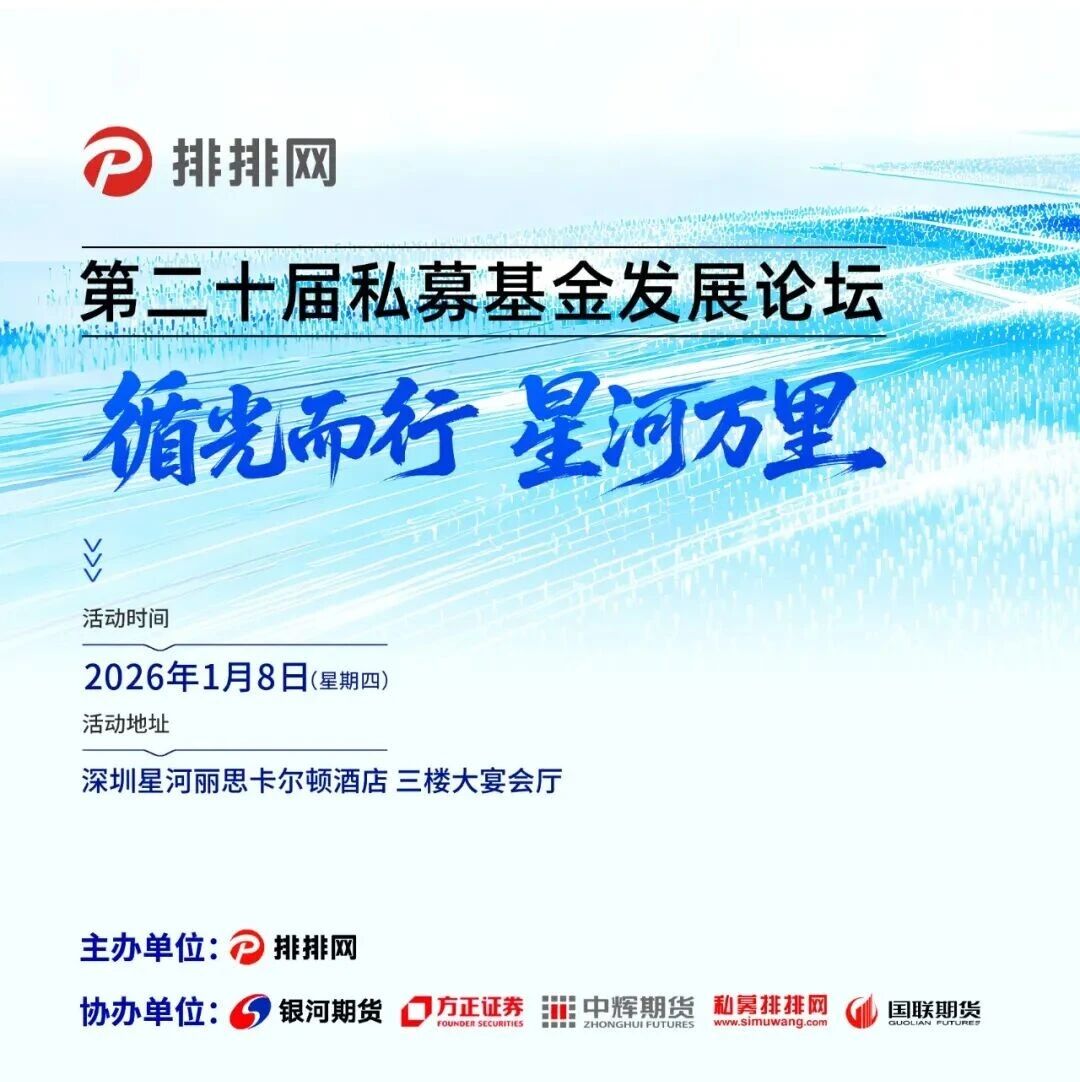
Core Viewpoint - The A-share market is expected to steadily rise in 2025, with significant growth in the private equity fund industry, showcasing resilience and vitality amidst a changing macroeconomic landscape [1] Group 1: Forum Overview - The 20th Private Fund Development Forum will be held on January 8, 2026, in Shenzhen, focusing on the theme "Following the Light, Stars Across the Galaxy" to create a high-level industry exchange platform [1] - The forum aims to gather various stakeholders, including securities firms, futures companies, and private equity funds, to analyze market trends and investment strategies for 2026 [1] Group 2: Key Speakers and Sessions - Lin Li, General Manager of the Fund Sales Company at 排排网, will deliver the opening speech, providing deep insights into industry development [1] - Notable speakers include Liu Zhao, Deputy Director of the Index and Quantitative Investment Department at 博时基金, and Shi Jianghui, General Manager of 国源信达, who will share their unique perspectives on the market and industry [1] Group 3: Roundtable Discussions - The forum features three major themed roundtable discussions focusing on quantitative investment, equity markets, and CTA strategies [2] - The first roundtable, hosted by Chen Hao, will discuss the explosion of quantitative performance, AI-enabled investment, and the competitive paths for small and medium-sized institutions [2] - The second roundtable, led by Du Haoran, will explore the 2026 stock market trends, including market logic, hot sector opportunities, and AI application practices [2] - The third roundtable, moderated by Wang Jiazhen, will address the drivers of CTA performance recovery and the investment logic of precious metals [2] Group 4: Networking Opportunities - The forum introduces the "排排圆桌派—Capital Connection Garden Party" to facilitate efficient interactions between over 20 institutional investors and 80 quality private equity firms [3] - This event aims to foster collaboration and mutual growth among participants, encouraging them to seize industry development opportunities [3]
AI应用大年将至?但斌、陈宇等知名投资人一致看好2026年行情!
私募排排网· 2025-12-23 12:38
Core Viewpoint - The article highlights the rapid growth and transformative impact of artificial intelligence (AI) on various industries since the launch of ChatGPT by OpenAI in 2022, emphasizing the significant investment opportunities and market responses driven by AI applications [2]. Group 1: AI Industry Investment Surge - Global AI industry investment has exceeded $1.3 trillion from 2020 to 2024, with an average annual investment of approximately $258 billion, representing a more than threefold increase compared to the $590 million average from 2015 to 2019 [3]. - The demand for AI applications is rapidly increasing, exemplified by the "AI+ healthcare" application "Ant Financial's Aifuku," which reached over 15 million monthly active users shortly after its release, significantly impacting related stocks in the capital market [3]. Group 2: AI Application Efficiency and Market Dynamics - AI models are showing substantial improvements in vertical fields such as healthcare, with accuracy in imaging diagnostics increasing by about 30%, and efficiency in medical record generation improving by up to 50% [4]. - The positive outlook for "AI+ applications" is supported by advancements in technology maturity, policy backing, market demand, and industry chain collaboration, creating a sustainable development path [4][5]. Group 3: Capital Market Sentiment - Notable investors like Dan Bin express strong optimism about AI applications, suggesting that the current discussions around an "AI bubble" are premature, and predicting 2026 as a pivotal year for AI application growth [6]. - Major investment firms, including Berkshire Hathaway and Fidelity, have increased their stakes in companies like Google, signaling strong confidence in the future of AI applications [10]. Group 4: AI Application Directions and Related Stocks - The article identifies seven key directions for AI applications, including AI+ office, AI+ gaming, AI+ healthcare, AI+ industrial, AI+ education, AI+ finance, and AI+ media, with specific A-share beneficiaries highlighted for each sector [12]. - For instance, the AI+ office software market in China is projected to reach approximately 30.86 billion yuan in 2024, with a compound annual growth rate of 109.09% expected by 2028 [12].

私募FOF:四大优势助力破解投资中的“优中选优”难题!
私募排排网· 2025-12-23 10:08
本文首发于公众号"私募排排网"。 (点击↑↑ 上图查看详情 ) 在资产管理行业中,私募基金已逐渐成为高净值人群和机构投资者资产配置的重要组成部分。然而,面对市场上成千上万、风格各异的私募产 品,如何选择、配置和管理,已成为投资者面临的重大挑战。私募FOF(Fund of Funds,基金中的基金)正是在这种背景下应运而生的解决方 案。 私募 FOF通过投资多个私募基金实现资产多元化配置,它通过专业化的"二次分散"和"优中选优"机制,在分散风险、专业筛选、灵活性等方面 展现出显著优势 , 为投资者提供了独特的价值 。 分散风险:力争构建安全边际的"防护网" 一 私募 FOF的核心优势在于其强大的风险分散能力 。私募FOF的基金经理通常会根据宏观经济周期、市场风格变化,筛选不同策略、不同赛道、 不同管理人的优质私募产品构建组合。无论是量化选股、主观多头、套利策略,还是股票、债券、商品等不同资产类别,都能被纳入FOF的配置 框架中。 这种 "策略+资产"的双重分散模式,有助于降低单一产品、单一策略的波动风险 ——当某一策略陷入低迷时,其他策略的盈利或可以对冲亏 损,力争让组合净值走势更平稳。例如,当股票市场大幅下跌 ...