
中汽协会数据

Search documents
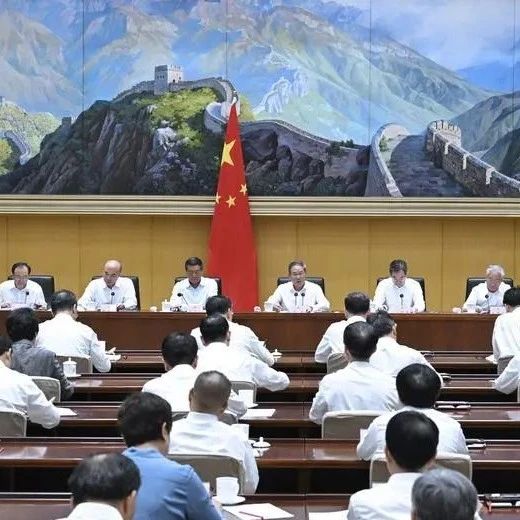
李强主持召开国务院第九次全体会议
中汽协会数据· 2025-08-19 09:01
Core Viewpoint - The meeting emphasized the need to consolidate and expand the positive momentum of economic recovery and strive to achieve the annual economic and social development goals set by the government [2][4]. Group 1: Economic Performance - The Chinese economy has shown steady progress and high-quality development under the strong leadership of the central government, overcoming difficulties and challenges [4]. - There is a recognition of both the achievements made and the risks and challenges faced in the current economic environment, necessitating a balanced understanding of the situation [4]. Group 2: Policy Implementation - There is a call to enhance the effectiveness of macroeconomic policy implementation, ensuring policies are targeted and responsive to market concerns to stabilize market expectations [5]. - The focus is on strengthening domestic circulation to counter uncertainties in international circulation, stimulating consumption, and expanding effective investment [5]. Group 3: Market and Investment - The government aims to consolidate the real estate market's stabilization and promote urban renewal projects to release improvement demand [5]. - There is an emphasis on deepening reform and opening up to enhance development momentum, particularly through innovation in technology and industry [5]. Group 4: Administrative Efficiency - Local governments are urged to improve administrative efficiency and optimize regulatory and service frameworks to create favorable conditions for businesses and citizens [6]. - The importance of practical problem-solving and enhancing government work quality is highlighted [6].

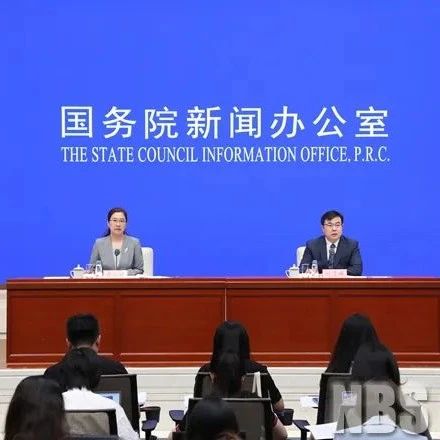
国家统计局新闻发言人就2025年7月份国民经济运行情况答记者问
中汽协会数据· 2025-08-18 08:02
Core Viewpoint - The economic performance in July 2025 demonstrates resilience and vitality despite external pressures and adverse weather conditions, with steady growth in production, consumption, and investment, alongside stable employment and prices [7][10][20]. Economic Performance Overview - The industrial output in July showed a year-on-year increase of 5.7%, with the equipment manufacturing sector growing by 8.4%, indicating strong industrial growth [7][51]. - The service sector also performed well, with a production index growth of 5.8% in July, driven by increased tourism and related services [7][15]. - Social retail sales increased by 3.7% year-on-year in July, with a notable 4% growth in goods retail [8][14]. - Fixed asset investment grew by 1.6% from January to July, with significant contributions from equipment updates and manufacturing investments [8][45]. Trade and Employment - The total import and export volume increased by 6.7% year-on-year in July, reflecting the resilience of foreign trade despite a complex international environment [8][31]. - The urban unemployment rate remained stable at 5.2%, indicating a steady employment situation [9][20]. New Growth Drivers - High-tech manufacturing saw a 9.3% increase in output, with significant growth in sectors like integrated circuits and new energy vehicles [10][38]. - The digital economy is rapidly developing, with a 8.4% increase in digital product manufacturing in July [10][38]. Consumer Trends - Consumer demand is being stimulated by policies such as the "old for new" consumption initiative, leading to increased sales in home appliances and cultural products [8][14]. - The service sector is experiencing growth, particularly in tourism and digital services, with a notable increase in transportation and cultural service indices [15][56]. Investment Landscape - Investment in manufacturing is growing, with a 6.2% increase in manufacturing investment from January to July, particularly in textiles and automotive sectors [45][46]. - Infrastructure investment is also on the rise, with water management and information transmission sectors seeing significant growth [46][47]. Policy Impact - The implementation of proactive macroeconomic policies is supporting production and investment growth, with a focus on stabilizing employment and market expectations [10][23]. - The government's commitment to deepening reform and opening up is enhancing the resilience and vitality of the economy [21][32].
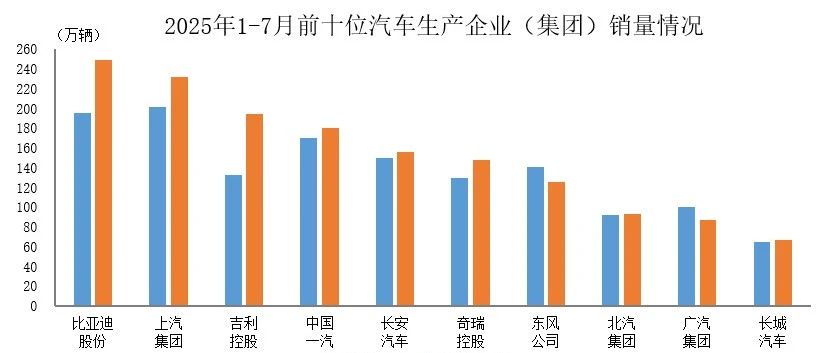
数据简报 | 2025年1-7月前十位汽车生产企业(集团)销售情况简析
中汽协会数据· 2025-08-18 08:02
Group 1 - The core viewpoint of the article highlights that among the ten companies analyzed, Dongfeng Motor and GAC Group experienced a decline in sales compared to the same period last year, while other companies showed varying degrees of growth [1] - According to the China Association of Automobile Manufacturers, the top ten automotive companies (groups) sold a total of 15.354 million vehicles from January to July 2025, accounting for 84% of the total automotive sales [3]


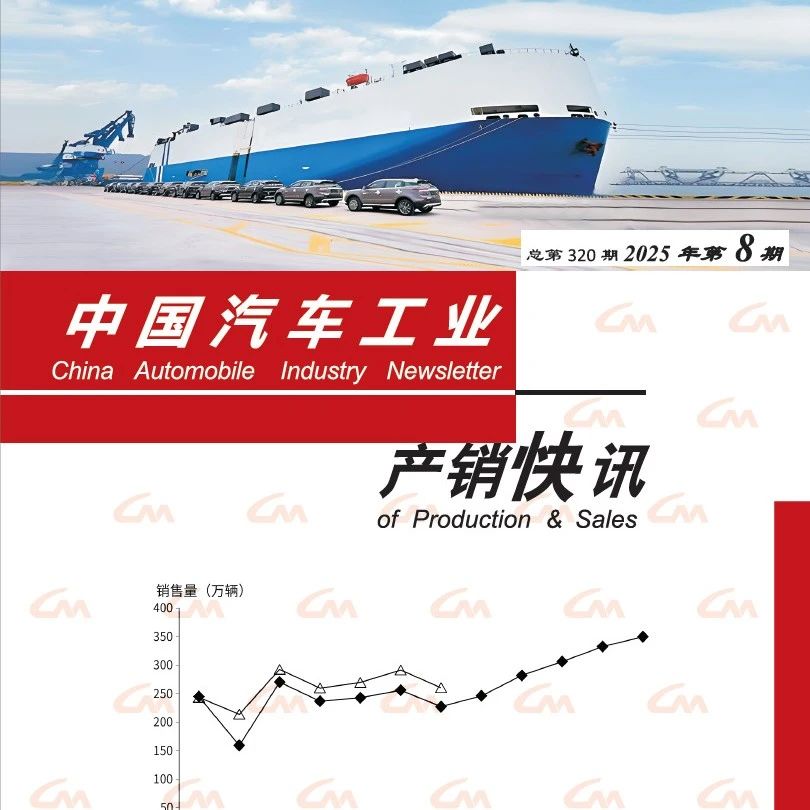
数据简报 | 2025年7月汽车出口情况简析
中汽协会数据· 2025-08-15 04:07
Core Viewpoint - The article discusses the trends in China's automotive exports, highlighting both the growth and decline in various segments, particularly focusing on passenger vehicles, commercial vehicles, traditional fuel vehicles, and new energy vehicles. Summary by Sections Overall Automotive Exports - In July 2025, automotive exports reached 575,000 units, showing a month-on-month decrease of 2.8% but a year-on-year increase of 22.6% [3] - From January to July 2025, total automotive exports amounted to 3.68 million units, reflecting a year-on-year growth of 12.8% [3] Passenger Vehicle Exports - In July 2025, passenger vehicle exports were 499,000 units, with a month-on-month decline of 0.5% and a year-on-year increase of 25.2% [4] - For the first seven months of 2025, passenger vehicle exports totaled 3.103 million units, marking a year-on-year growth of 13.3% [2] Commercial Vehicle Exports - In July 2025, commercial vehicle exports stood at 76,000 units, experiencing a month-on-month decline of 16% but a year-on-year increase of 8% [5] - From January to July 2025, commercial vehicle exports reached 577,000 units, with a year-on-year growth of 10.2% [5] Traditional Fuel Vehicle Exports - In July 2025, traditional fuel vehicle exports were 350,000 units, showing a month-on-month decrease of 9.6% and a year-on-year decline of 4.3% [6] - For the first seven months of 2025, traditional fuel vehicle exports totaled 2.373 million units, reflecting a year-on-year decrease of 7% [6] New Energy Vehicle Exports - In July 2025, new energy vehicle exports reached 225,000 units, with a month-on-month increase of 10% and a year-on-year growth of 120% [8] - From January to July 2025, new energy vehicle exports amounted to 1.308 million units, showing a significant year-on-year increase of 84.6% [7]
数据简报 | 2025年7月新能源汽车产销情况简析
中汽协会数据· 2025-08-15 04:07
Core Viewpoint - The article highlights the significant growth in the production and sales of new energy vehicles (NEVs) in China, indicating a strong upward trend in the industry. Group 1: Production and Sales Data - In July 2025, the production and sales of NEVs reached 1.243 million and 1.262 million units respectively, showing year-on-year growth of 26.3% and 27.4% [5] - From January to July 2025, NEV production and sales totaled 8.232 million and 8.22 million units, reflecting year-on-year increases of 39.2% and 38.5% [3] - Domestic sales of NEVs in July 2025 were 1.037 million units, which is a month-on-month decrease of 7.8% but a year-on-year increase of 16.9% [6] Group 2: Export Performance - In the first seven months of 2025, NEV exports reached 1.308 million units, marking a year-on-year growth of 84.6% [7] - In July 2025, NEV exports amounted to 225,000 units, showing a month-on-month increase of 10% and a year-on-year increase of 120% [10] Group 3: Domestic Market Insights - For the first seven months of 2025, domestic sales of NEVs were 6.913 million units, which is a year-on-year increase of 32.3% [4]
【数据发布】7月份国民经济保持稳中有进发展态势
中汽协会数据· 2025-08-15 04:07
Core Viewpoint - In July, the national economy maintained a steady and progressive development trend, with continuous growth in production and demand, overall stability in employment and prices, and significant achievements in high-quality development [2][11]. Group 1: Industrial Production - In July, the industrial added value of large-scale enterprises increased by 5.7% year-on-year and 0.38% month-on-month [3]. - The manufacturing sector grew by 6.2%, with equipment manufacturing and high-tech manufacturing increasing by 8.4% and 9.3%, respectively [3]. - The profit of large-scale industrial enterprises from January to June was 34,365 billion yuan, a year-on-year decrease of 1.8% [3]. Group 2: Service Sector - The service production index increased by 5.8% year-on-year in July, with significant growth in information transmission, software, and financial services [4]. - The business activity index for the service sector was at 50.0%, indicating stable business conditions [4]. Group 3: Market Sales - In July, the total retail sales of consumer goods reached 38,780 billion yuan, a year-on-year increase of 3.7% [5]. - Online retail sales amounted to 86,835 billion yuan, growing by 9.2% year-on-year, with physical goods online retail sales at 70,790 billion yuan [6]. Group 4: Fixed Asset Investment - From January to July, fixed asset investment (excluding rural households) was 288,229 billion yuan, a year-on-year increase of 1.6% [7]. - Manufacturing investment grew by 6.2%, while real estate development investment decreased by 12.0% [7]. Group 5: Trade and Exports - In July, the total value of goods imports and exports reached 39,102 billion yuan, a year-on-year increase of 6.7% [8]. - Exports grew by 8.0%, while imports increased by 4.8% [8]. Group 6: Employment - The urban surveyed unemployment rate in July was 5.2%, with a seasonal increase of 0.2 percentage points from the previous month [9]. - The average weekly working hours for employees were 48.5 hours [9]. Group 7: Consumer Prices - In July, the Consumer Price Index (CPI) remained flat year-on-year, with a month-on-month increase of 0.4% [10]. - The core CPI, excluding food and energy prices, rose by 0.8% year-on-year [11].

数据简报 | 2025年7月商用车产销情况简析
中汽协会数据· 2025-08-14 07:53
Core Viewpoint - The commercial vehicle market in China experienced a mixed performance in July 2025, with a significant month-on-month decline in production and sales, while year-on-year figures showed growth in both categories [1][3][5]. Summary by Sections Commercial Vehicle Performance - In July 2025, commercial vehicle production and sales reached 298,000 and 306,000 units respectively, reflecting a month-on-month decrease of 15.8% and 17.1%, but a year-on-year increase of 16.3% and 14.1% [3]. - From January to July 2025, commercial vehicle production and sales totaled 2.397 million and 2.428 million units, marking a year-on-year growth of 6% and 3.9% [5]. Bus Performance - In July 2025, bus production and sales were 44,000 and 42,000 units, showing a month-on-month decline of 12.3% and 21.2%, while year-on-year growth was recorded at 23.7% and 16.3% [4]. - From January to July 2025, bus production and sales reached 305,000 and 307,000 units, with year-on-year increases of 10.3% and 9.7% [6]. Truck Performance - In July 2025, truck production and sales were 254,000 and 264,000 units, with month-on-month declines of 16.3% and 16.4%, but year-on-year growth of 15.1% and 13.8% [8]. - From January to July 2025, truck production and sales totaled 2.092 million and 2.121 million units, reflecting year-on-year growth of 5.4% and 3.1% [8].
两部门征求意见:辅助驾驶不能当自动驾驶 未经备案OTA不得升级
中汽协会数据· 2025-08-14 07:53
Core Viewpoint - The article discusses the draft notice from the State Administration for Market Regulation and the Ministry of Industry and Information Technology regarding the strengthening of recall management, production consistency supervision, and standardized publicity for intelligent connected new energy vehicles. Group 1: Safety and Monitoring Requirements - Companies are required to display safety prompts and usage instructions for combined driving assistance systems prominently in vehicle apps and user manuals to prevent drivers from misinterpreting these features as autonomous driving capabilities [2] - Companies must develop and implement driver monitoring, warning, and intervention functions that prioritize safety, ensuring timely alerts and control measures when drivers disengage from dynamic driving tasks [2][4] Group 2: Defect Monitoring and Reporting - Companies should enhance defect information monitoring for intelligent connected new energy vehicles to mitigate risks from cyberattacks and vulnerabilities, with the market regulator conducting investigations into safety incidents [4] - Companies are prohibited from disabling driver monitoring and warning functions through user actions or system logic, with special investigations into deficiencies in these areas [4] Group 3: Compliance and Information Disclosure - Companies must accurately report key information regarding combined driving assistance systems and energy storage devices in the vehicle qualification certificate system, and must not conduct OTA upgrades without proper filing [5] - Companies are required to provide truthful and comprehensive information about the automation levels, system capabilities, and boundaries of intelligent connected new energy vehicles to ensure consumers have a correct understanding [5] Group 4: Marketing and Advertising Regulations - Companies must not imply that combined driving assistance systems can be viewed as autonomous driving systems or exaggerate their capabilities, preventing driver misuse [7] - The market regulator will intensify supervision of advertising and promotional activities that mislead consumers regarding the capabilities of combined driving assistance systems, and will conduct joint investigations with the Ministry of Industry and Information Technology [7] Group 5: Incident Reporting and Accountability - Companies must promptly report safety incidents and collisions involving combined driving assistance systems, with the market regulator and relevant departments conducting thorough investigations into these reports [7]

数据简报 | 2025年7月乘用车产销情况简析
中汽协会数据· 2025-08-13 08:23
Core Viewpoint - The article highlights the positive impact of the vehicle trade-in policy and the continuous launch of new models, contributing to stable growth in the passenger car market in July 2025, with year-on-year sales increases. Group 1: Production and Sales Data - In July 2025, passenger car production and sales reached 2.293 million and 2.287 million units respectively, showing a month-on-month decline of 6% and 9.8%, but a year-on-year increase of 13% and 14.7% [3] - From January to July 2025, passenger car production and sales totaled 15.838 million and 15.841 million units, reflecting year-on-year growth of 13.8% and 13.4% [3][10] - In July 2025, among major passenger car types, the production of crossover vehicles saw rapid growth while sales slightly declined; all four major types of passenger cars experienced varying degrees of year-on-year growth, with crossover vehicles showing the most significant increase [6] Group 2: Export Data - In July 2025, passenger car exports totaled 499,000 units, representing a month-on-month decrease of 0.5% but a year-on-year increase of 25.2% [7] - From January to July 2025, passenger car exports reached 3.103 million units, marking a year-on-year growth of 13.3% [8] Group 3: Domestic Sales Data - In July 2025, domestic sales of passenger cars amounted to 1.788 million units, showing a month-on-month decline of 12.1% but a year-on-year increase of 12.1% [9] - From January to July 2025, domestic sales of passenger cars totaled 12.738 million units, reflecting a year-on-year growth of 13.4% [10]
个人消费贷贴息申请条件、办理流程→
中汽协会数据· 2025-08-13 08:23
Core Viewpoint - The article discusses the new personal consumption loan interest subsidy policy introduced by the Chinese government, aimed at stimulating consumer spending by providing financial support for various types of consumer loans [1][2]. Summary by Sections Application Conditions - Residents must demonstrate genuine consumption behavior to qualify for the personal consumption loan interest subsidy. The subsidy applies to both small daily expenses and larger purchases such as vehicles, home renovations, and appliances. Services like travel, healthcare, and education are also included. Each individual can receive a maximum subsidy of 500 yuan per loan, with multiple loans eligible for cumulative benefits [1]. Subsidy Rules - For single loans under 50,000 yuan, the subsidy is calculated based on the actual amount borrowed. Cumulatively, a maximum of 1,000 yuan can be received from the same lending institution. For loans exceeding 50,000 yuan, the subsidy is capped at 5,000 yuan, with a total maximum of 3,000 yuan when combined with smaller loans [2]. Specific Processing Procedures - Borrowers must authorize the lending institution to access transaction information related to their loan accounts when applying for personal consumption loans. Existing loan agreements can be supplemented to grant this authorization. The lending institution will calculate the subsidy based on actual consumption and apply it directly to the interest payments, allowing borrowers to receive updates via SMS or mobile apps without additional steps [3]. Example Scenario - A consumer taking a personal consumption loan of 200,000 yuan for home renovation at an interest rate of 3% would typically pay 6,000 yuan in interest annually. With a 1% subsidy, the interest payment could be reduced by 2,000 yuan, resulting in a one-third reduction in interest costs. The administrative burden is minimized for borrowers, as the lending institutions and local governments handle the subsidy calculations and applications [4][5].
