GEELY AUTO(00175)

Search documents
吉利汽车(00175.HK)12月18日耗资3179.7万港元回购190.8万股
Ge Long Hui· 2025-12-18 11:33
格隆汇12月18日丨吉利汽车(00175.HK)发布公告,2025年12月18日耗资3179.7万港元回购190.8万股,回 购价格每股16.26-16.8港元。 ...
吉利汽车(00175)12月18日斥资3179.71万港元回购190.8万股
智通财经网· 2025-12-18 11:33
智通财经APP讯,吉利汽车(00175)发布公告,于2025年12月18日,该公司斥资3179.71万港元回购190.8 万股股份,每股回购价格为16.26-16.8港元。 ...
吉利汽车(00175) - 翌日披露报表
2025-12-18 11:22
表格類別: 股票 狀態: 新提交 公司名稱: 吉利汽車控股有限公司 FF305 翌日披露報表 (股份發行人 ── 已發行股份或庫存股份變動、股份購回及/或在場内出售庫存股份) 呈交日期: 2025年12月18日 如上市發行人的已發行股份或庫存股份出現變動而須根據《香港聯合交易所有限公司(「香港聯交所」)證券上市規則》(「《主板上市規則》」)第13.25A條 / 《香港聯合交易所有限公司GEM證券 上市規則》(「《GEM上市規則》」)第17.27A條作出披露,必須填妥第一章節 。 | 第一章節 | | | | | | | | | | | --- | --- | --- | --- | --- | --- | --- | --- | --- | --- | | 1. 股份分類 | | 普通股 | 股份類別 | 不適用 | | | 於香港聯交所上市 | 是 | | | 證券代號 (如上市) | | 00175 | 說明 | | | | | | | | 多櫃檯證券代號 | | 80175 | RMB 說明 | | | | | | | | A. 已發行股份或庫存股份變動 | | | | | | | | | | | | ...
吉利汽车(00175) - 於二零二五年十二月十八日下午四时三十分举行之股东特别大会之投票表决结果
2025-12-18 11:05
香港交易及結算所有限公司及香港聯合交易所有限公司對本公佈之內容概不負責,對其 準確性或完整性亦不發表任何聲明,並表明不會就因本公佈全部或任何部份內容而產生 或因倚賴該等內容而引致之任何損失承擔任何責任。 GEELY AUTOMOBILE HOLDINGS LIMITED 175 80175 於二零二五年十二月十八日下午四時三十分舉行之 股東特別大會之投票表決結果 董事會欣然宣佈於二零二五年十二月十八日下午四時三十分舉行之股東特別大會上提 呈之所有決議案已獲獨立股東以投票表決方式正式通過為普通決議案。 茲提述吉利汽車控股有限公司(「本公司」)日期均為二零二五年十一月二十八日之有關持 續關連交易之通函(「通函」)及股東特別大會通告(「通告」)。除文義另有所指外,本公佈 所用詞彙與該通函所界定者具有相同涵義。 於二零二五年十二月十八日下午四時三十分舉行之股東特別大會之投票表決結果 於股東特別大會當日,桂生悅先生及其聯繫人合共持有18,707,000股股份(佔本公司已發 行股本總額約0.18%,控制與股份有關的投票權或有權對該等投票權行使控制權),及淦 家閱先生及其聯繫人合共持有4,371,800股股份(佔本公司已發 ...
「二次创业」大戏拉开帷幕
3 6 Ke· 2025-12-18 03:31
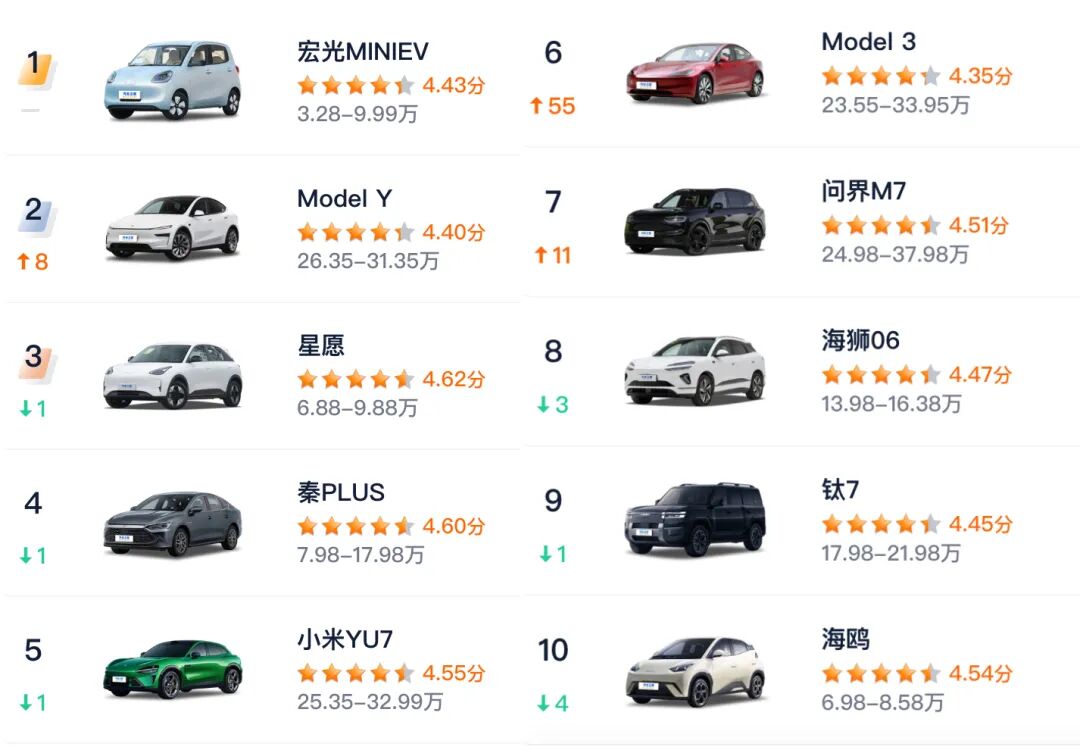
Core Insights - The rapid growth of the new energy vehicle market in China has led to a significant division in the automotive market, with distinct trends emerging in the price segments below and above 200,000 yuan [1][2][5] Market Trends - In November, vehicles priced above 200,000 yuan occupied four spots in the sales rankings, with the Model Y selling over 47,000 units and the AITO M7 selling over 25,000 units [1] - Conversely, vehicles priced below 100,000 yuan also claimed four spots, with the Hongguang MINIEV selling over 56,000 units and the BYD Seagull selling over 21,000 units [2] - The market has bifurcated into segments below 100,000 yuan and above 200,000 yuan, leaving the 100,000-200,000 yuan segment relatively quiet [2][5] Sales Performance - The top-selling models in the overall automotive market for November included the Hongguang MINIEV, Model Y, and others, with significant sales figures indicating a preference for lower-priced vehicles [4] - The sales figures for electric vehicles showed a notable increase, with pure electric vehicles selling 7,155 units and plug-in hybrids 28,213 units [4] Consumer Behavior - The shift in consumer behavior reflects a change from purchasing vehicles out of necessity to buying based on emotional appeal, particularly in the above 200,000 yuan market [7] - The lower-priced market is seeing a mix of consumption downgrade and upgrade, with traditional brands like Geely and BYD dominating this segment, while new entrants struggle to penetrate [7][8] Competitive Landscape - New energy vehicle brands such as Xiaomi and Hongmeng Zhixing are gaining traction, with Xiaomi achieving over 40,000 units sold in November, marking its entry into the top three for the first time [9][10] - Traditional automakers are facing challenges in the above 200,000 yuan market, where they need to enhance their overall offerings to regain competitive advantage [19][20] Industry Evolution - The automotive industry is undergoing a "second entrepreneurship," with traditional manufacturers transitioning from fuel vehicles to smart new energy vehicles, while new entrants are establishing themselves in the market [20]





杭州锻造智能网联汽车“世界级地标”
Hang Zhou Ri Bao· 2025-12-18 02:07
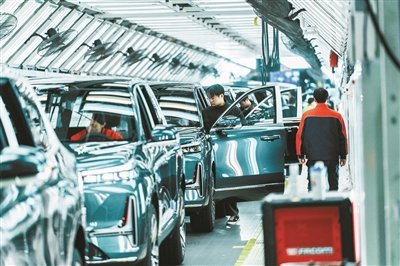
Core Insights - The article highlights the rapid development and implementation of the intelligent connected vehicle industry in Hangzhou, showcasing its transformation from manufacturing to a global technology leader in mobility solutions [4][10]. Group 1: Manufacturing Capabilities - The Geely Qiantang base produces several hundred vehicles daily, with a new car rolling off the line every two minutes [2][6]. - The facility features advanced automation, including a nearly 7,000-ton servo stamping line capable of producing nearly 1,000 stamped parts per hour [5]. - The production line supports mixed production of various powertrain models, including fuel, pure electric, plug-in hybrid, and battery swap vehicles [5][6]. Group 2: Technological Advancements - The vehicles produced, particularly the Galaxy series, are equipped with the Flyme Auto 2.0 intelligent cockpit system and Qualcomm Snapdragon high-performance chips, enhancing user interaction and driving assistance capabilities [6][7]. - A simulation testing environment allows for the generation of vast amounts of training data for autonomous driving systems, improving efficiency by 500 times and reducing the need for real-world testing by approximately 30% [7][11]. Group 3: Industry Ecosystem - Hangzhou has established a robust industrial ecosystem, connecting over 100 core component manufacturers with leading companies like Geely and Changan Ford, forming a billion-level industrial cluster [9][10]. - The city has implemented a "four-question model" to enhance collaboration between enterprises, government, educational institutions, and the market, facilitating the rapid transformation of research into production [8][9]. Group 4: Policy and Regulation - The introduction of the "Hangzhou Intelligent Connected Vehicle Testing and Application Promotion Regulations" positions Hangzhou as the first city in China to clarify the process for autonomous vehicle road testing [10][11]. - The city has issued 614 testing and application licenses, accumulating 5.92 million kilometers of testing mileage with a zero accident rate [10]. Group 5: Future Outlook - Hangzhou aims to leverage its advantages in "vehicle-road-cloud integration" to expand testing scenarios and promote the large-scale operation of Robotaxi services [12]. - The city is focused on developing high-value core areas such as vehicle-grade chips and advanced algorithms, fostering innovation through collaborative efforts [12][13].
AI加速“上车” 智能汽车操作系统迈向千亿级市场
Xin Hua Cai Jing· 2025-12-18 01:09
Core Insights - Major automotive companies are increasingly adopting AI as a core strategy for future development, with significant investments in AI technologies and models [1] - The automotive software industry is undergoing structural changes, shifting the value focus from traditional hardware manufacturing to software and services, with projections indicating a rise in software profit share from 6% in 2020 to 25% by 2030 [2][3] - The integration of software is fostering a new ecosystem that bridges various sectors, enhancing collaboration and resource efficiency across the automotive industry [3][4] Group 1: Industry Trends - The automotive software industry's value is transitioning from a "one-time sale" model to a "full-cycle service" model, with hardware profit share decreasing from 79% in 2020 to an expected 59% by 2030 [2] - The commercial value of in-vehicle operating systems is becoming increasingly significant, with the market projected to reach approximately 600 billion yuan by 2025 and exceed 1 trillion yuan by 2030 [3] - The future of automotive software development is expected to focus on integration, moving towards highly adaptive intelligent operating systems that support comprehensive resource management [4] Group 2: Challenges and Solutions - The automotive industry faces challenges in establishing a unified and open software and hardware ecosystem, with varying levels of openness and interface standards among chip manufacturers [7] - Collaboration between companies remains inefficient, often requiring extensive customization and debugging, which hampers the overall efficiency of solutions [7] - The industry is encouraged to adopt open-source models to build a unified technical foundation, reducing costs and fostering innovation through community collaboration [5][9] Group 3: Future Directions - The integration of advanced safety features and the expansion of collaborative boundaries are essential for building sustainable competitive advantages in the automotive sector [11] - The industry is exploring the incorporation of satellite technology into existing vehicle-road-cloud systems to enhance data and computational networks [12] - The relationship between AI and the automotive industry is expected to evolve, with AI becoming a critical component in the development of intelligent vehicles and applications [12]

格隆汇港股回购榜 | 12月17日
Jin Rong Jie· 2025-12-18 00:35
Summary of Key Points Core Viewpoint - A total of 40 companies, including Tencent Holdings and Kuaishou, conducted share buybacks on December 17, 2025, with Tencent leading in both the number of shares repurchased and the total amount spent [1][2]. Group 1: Buyback Details - Tencent Holdings (00700) repurchased 1.057 million shares for a total of 636 million [2]. - Kuaishou-W (01024) repurchased 1.283 million shares for a total of 83.037 million [2]. - Other notable companies include Geely Automobile (00175) with 2.316 million shares repurchased for 38.6146 million, and China COSCO Shipping Holdings (01919) with 2.8575 million shares for 38.613 million [2]. Group 2: Cumulative Buyback Data - Tencent's cumulative buyback reached 93.586 million shares, accounting for 1.018% of its total share capital [2]. - Kuaishou's cumulative buyback was 11.2787 million shares, representing 0.263% of its total share capital [2]. - China Feihe (06186) had a significant cumulative buyback of 239 million shares, which is 2.638% of its total share capital [2]. Group 3: Other Companies' Buyback Performance - Companies like Country Garden Services (06098) and Mindray Bio-Medical Electronics (02367) also participated, with buybacks of 3.697 million and 0.4 million shares respectively [2]. - Noteworthy is the buyback percentage of Kangchen Pharmaceutical (01681) at 15.953%, indicating a strong commitment to returning value to shareholders [2]. - The buyback activities reflect a broader trend among companies to enhance shareholder value amid market conditions [1][2].



技术优势助品牌转型,海外销售成关键动力,瑞银研报:中国车企全球市占率2030年有望达1/3
Huan Qiu Shi Bao· 2025-12-17 22:57
Core Insights - UBS predicts that Chinese automakers are expected to capture one-third of the global automotive market by 2030, up from one-fourth this year, driven by advantages in electric vehicle technology, an improving distribution network, and increasing brand recognition [1][2] Market Share Projections - By 2030, Chinese automakers' global market share is projected to rise from below 20% in 2022 and 25% this year to over 33% [2] - In Western Europe, the market share of Chinese automakers is expected to grow from approximately 5% to 15% [2] - Chinese automakers are anticipated to achieve a 25% market share in other global markets [2] Globalization Strategy 2.0 - Chinese automakers are entering a "Globalization Strategy 2.0" phase, focusing on enhancing brand recognition and expanding localized manufacturing [4] - The overseas sales currently account for 20% of the total sales in the Chinese automotive industry, contributing 40%-50% of revenue for some companies [4] Competitive Landscape - Chinese electric vehicle manufacturers are increasingly comparable to typical Western brands, with significant growth in market share despite rising protectionism in developed markets [6] - The retail price of Chinese electric vehicles in overseas markets has reached around $30,000, aligning with mid-range brands [6] Future Outlook - By 2030, the market share of Chinese domestic brands in the local market is expected to rise from approximately 50% in 2022 to 85% [6] - The report emphasizes the need for Chinese automakers to build brand trust, expand sales channels, and accelerate local production overseas to navigate market volatility and competition [6]



Geely Auto: Progress Goes Unrewarded As Investors Fret Over The Health Of China's Market
Seeking Alpha· 2025-12-17 22:01
Group 1 - The automotive sector in China is facing investor nervousness due to lackluster consumer spending throughout the year, which has worsened recently [1] - The decline in consumer confidence suggests that big-ticket expenditures, such as automobiles, are likely to be negatively impacted [1]