
GEELY AUTO(00175)

Search documents
向全行业开放共享 吉利全球全域安全中心发布
Jing Ji Guan Cha Wang· 2025-12-14 04:03
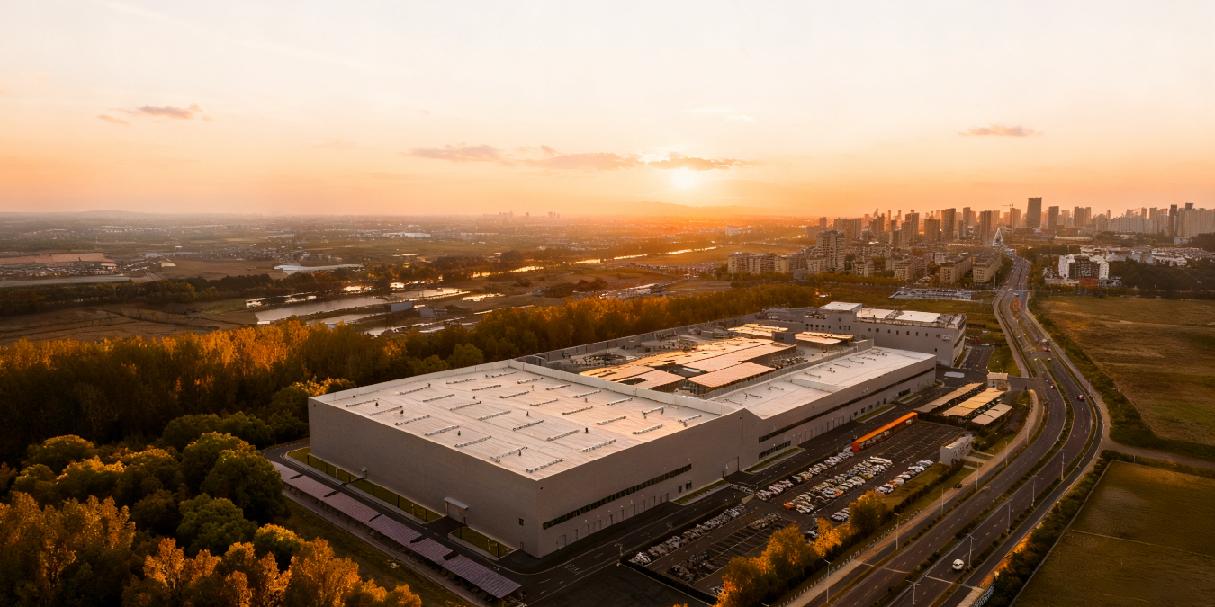
Core Insights - Geely has established a global safety center that has achieved several Guinness World Records, including the largest automotive safety laboratory and the longest indoor vehicle collision test track [2] - The center's verification capabilities cover various safety testing areas, including passive safety, active safety, and digital safety, among others [2] - Geely's commitment to automotive safety spans nearly 30 years, with a focus on high-quality and safe vehicles [4][5] Group 1: Global Safety Center - The Geely Global Safety Center is recognized for its extensive verification capabilities, including the world's largest multi-angle vehicle collision test area, which allows for comprehensive safety testing [2] - The center features 27 different testing functions, catering to safety regulations across multiple regions, including China, Europe, and the United States [2] Group 2: Safety Development Initiatives - Geely has collaborated with various industry and academic institutions to release a white paper on intelligent vehicle safety, emphasizing a human-centered approach to safety development [4] - The company has developed a "Full Domain Safety 2.0" technology system that expands the focus from vehicle safety to an ecosystem perspective, integrating various safety domains [5][11] Group 3: Future Directions - Geely aims to leverage the Full Domain Safety 2.0 technology system to push the boundaries of global automotive safety standards and technology [11] - The company plans to share its safety technology patents and research outcomes with the industry to promote equitable safety and enhance the consumer experience [11]


浙江新增38家制造业质量标杆企业
Xin Hua Wang· 2025-12-14 01:44
Group 1 - The core viewpoint of the article highlights the recognition of 38 manufacturing enterprises in Zhejiang as quality benchmarks, with 6 provincial-level enterprises upgraded to national-level status, showcasing the province's commitment to quality management in manufacturing [1][2] - The selected benchmark enterprises demonstrate significant advancements in quality management through technological, managerial, and business model innovations, serving as exemplary cases for others in the industry [1][2] - Zhejiang's initiative to establish manufacturing quality benchmarks is part of a broader strategy to enhance the province's manufacturing quality and brand, aiming to cultivate enterprises with superior products, strong brands, and modern governance [2][3] Group 2 - The provincial government plans to strengthen support and promotion for quality benchmark enterprises that show significant application results and value, encouraging other companies to adopt best practices in quality management [3] - The focus will be on building a gradient system from provincial to national levels, empowering the development of world-class manufacturing clusters and enhancing competitiveness [2][3] - The initiative aligns with the implementation of the "Quality Brand Enhancement Plan" in Zhejiang, aiming to elevate the overall quality standards in the manufacturing sector [2][3]


11月国内乘用车销量同比下滑,一汽大众重回第三
凤凰网财经· 2025-12-13 13:05
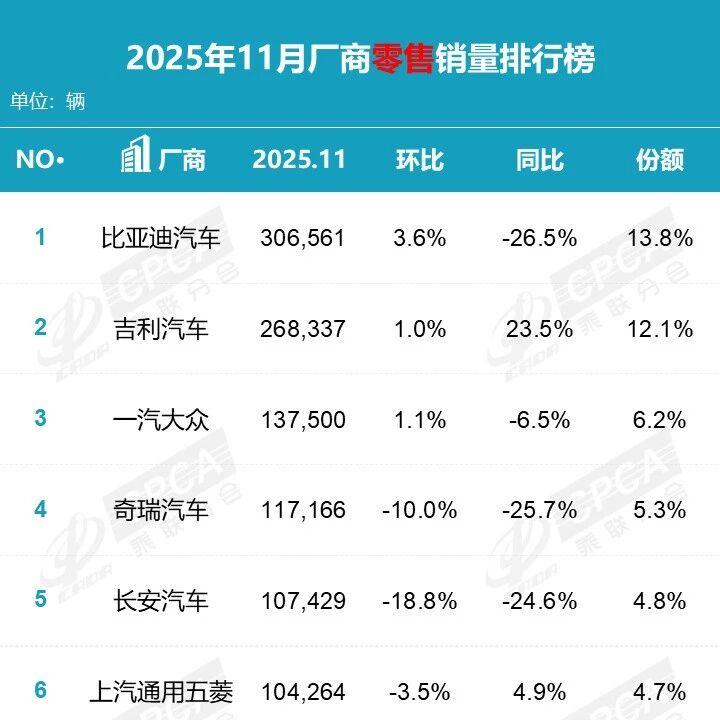
Core Viewpoint - The domestic passenger car sales in China experienced a decline in November, with a year-on-year decrease of 6.5%, indicating a slowdown in the market during a critical sales period [2][3]. Group 1: Sales Performance - In November, the domestic passenger car sales reached 2.414 million units, showing a month-on-month increase of 1% but a year-on-year decline of 6.5% [2]. - The retail sales in the narrow passenger car market were 2.225 million units, reflecting a year-on-year decrease of 8.1% and a month-on-month decrease of 1.1% [3]. - The overall sales decline is attributed to factors such as policy withdrawal, reduced stimulus effects, and increased comparison bases [4]. Group 2: Manufacturer Rankings - BYD maintained the top position in retail sales with 306,600 units in November, a month-on-month increase of 3.6% but a year-on-year decline of 26.5% [5]. - Geely Automotive ranked second with sales of 268,300 units, showing a year-on-year increase of 23.5% and a month-on-month increase of 1% [5]. - FAW-Volkswagen returned to the top three with sales of 137,500 units, surpassing Chery [7]. Group 3: Export Growth - November marked a historic milestone with total automobile exports exceeding 700,000 units, reaching 728,000 units, a month-on-month increase of 9.3% and a year-on-year increase of 48.5% [9]. - Passenger car exports were 624,000 units, with a year-on-year growth of 48.7%, indicating a strong performance in overseas markets [9]. - The export of new energy vehicles reached 300,000 units, representing a year-on-year increase of 2.6 times, highlighting the growing acceptance of Chinese electric vehicles in international markets [10]. Group 4: Future Outlook - The automotive industry anticipates challenges in 2026 due to the upcoming reduction of new energy vehicle purchase tax, which may pressure market growth [11]. - Despite short-term caution regarding domestic demand and price competition, long-term growth is expected to be driven by continuous technological innovation and global expansion [11].

腾势D9达成30万辆交付,吉利全球全域安全中心正式启用 |一周车闻
Di Yi Cai Jing· 2025-12-13 11:53
Group 1 - The core point of the news highlights significant developments in the automotive industry, including the delivery milestones of electric vehicles, new carbon reduction targets from major manufacturers, and the introduction of innovative safety and technology features in new models [2][3][4][5][6][8][9][10][11] Group 2 - Tengshi D9 has achieved 300,000 deliveries since its launch in 2022, becoming the top-selling MPV in China for 2023 and 2024, breaking a 20-year monopoly of joint venture brands [2] - BMW aims to reduce carbon emissions by at least 60 million tons by 2035 compared to 2019 levels, increasing its previous target for 2030 by 50% [3] - Geely has opened a global safety center with an investment of 2 billion yuan, focusing on comprehensive vehicle safety testing, which is crucial as competition intensifies in the automotive market [4] - GAC Honda hosted the 2025 Zao Dream Festival, showcasing classic and modified models to engage younger consumers and strengthen brand perception [5] - Volvo's XC70 has surpassed 10,000 sales within 70 days of its launch, indicating strong market interest in its new luxury hybrid model [6][7] - Lantu's new model, L, has been launched with advanced features and a price range of 279,900 to 309,900 yuan, targeting the luxury mid-large hybrid sedan market [8] - Dongfeng Nissan's N6 has been launched with a price range of 99,900 to 129,900 yuan, featuring advanced driving assistance systems and targeting the hybrid vehicle segment [9] - Geely Galaxy has introduced a new generation of super AI range extension technology with its high-end MPV, marking its entry into the range-extended electric vehicle market [10] - Beijing Automotive's Ruisheng has launched the M8 MPV with multiple power modes and competitive pricing, focusing on the 120,000 to 250,000 yuan MPV market [11]
创五项吉尼斯纪录, 吉利全球全域安全中心发布
Zhong Guo Qing Nian Bao· 2025-12-13 11:46
Core Insights - Geely Auto has launched a global all-domain safety center in Ningbo, Zhejiang, covering over 80,000 square meters and featuring 27 categories of safety testing capabilities, establishing five world records including the "largest automotive safety testing laboratory" [2] Group 1: Safety Center and Technology - The global all-domain safety center aims to meet comprehensive safety verification needs from complete vehicles to components [2] - Geely has introduced the "All-Domain Safety 2.0" technology system, which enhances the original four safety areas by integrating AI technology into nine safety systems and includes "public domain safety" considerations [2] Group 2: Industry Collaboration - Geely has partnered with 11 industry, academic, and research institutions, including the China Automotive Technology Research Center and Tsinghua University, to release the "Intelligent Vehicle All-Domain Safety Development White Paper" [2] - The white paper is designed to systematically plan the technological pathways for intelligent vehicle all-domain safety and provide a reference framework for industry safety system construction [2] Group 3: Open Sharing Initiative - The global all-domain safety center will be open for sharing with the entire industry, promoting the centralized utilization of automotive safety technology research resources [2] - This initiative aims to enhance the overall safety verification capabilities of both complete vehicle and component manufacturers [2]

吉利7100万放大验证,奇瑞安瓦获商用车1GWh:固态电池再迎实质进展
高工锂电· 2025-12-13 09:54
摘要 固态电池亟需场景跑通——没有真实工况与大容量验证,制造窗口、寿命与一致性都无法收敛。 在固态电池赛道沉寂一段时间后,吉利近期用一项"工程化动作"把话题重新拉回现实: 旗下浙江绿色智行科创有限公司启动2026—2027年度固态电池电芯研发物料招标。 反过来,只有把电池放进足够苛刻且足够真实的使用场景,让大容量样件在稳定性、阻抗与寿命上 形成可复现的数据闭环,成本才有机会从"不可控的试制成本"变成"可优化的制造成本"。 上周,另一条来自奇瑞体系的消息把固态电池推向"场景绑定":北美商用车企业Horizon Motors 披露与奇瑞汽车达成固态电池合作,将获得1GWh固态电池产能,用于Class 3–8零排放专用卡车 的量产部署,电池由奇瑞旗下安瓦新能源提供。 Horizon所描述的落地场景包括箱式货车、清扫车、冷藏车与市政车辆等高频运营车型,并强调该 类车队对续航与可靠性要求更高。 安瓦此前已对外披露其"新型固态"产线进展: 报道显示,安瓦在芜湖的GWh级产线首批工程样件于2025年7月下线,设计产能1.25GWh,并提 及样件通过GB38031-2025相关测试口径。 该公司产线集成涂布、复合、热封等工序 ...

吉利全球全域安全中心正式发布
Cai Jing Wang· 2025-12-13 09:02
Core Insights - Geely has officially launched its Global All-Domain Safety Center, which spans 82,000 square meters and cost over 2 billion yuan, aiming to create the world's largest comprehensive safety testing laboratory [1][3] - The company has introduced the "All-Domain Safety 2.0" technology system, focusing on an ecological perspective that integrates "people, vehicles, roads, clouds, and stars" [6][10] Group 1: Safety Center Features - The safety center includes various testing capabilities such as passive safety tests, active safety tests in adverse weather, and advanced driver assistance simulations, with a collision test track length of 293.39 meters [3] - It features a wind tunnel testing facility capable of simulating altitudes up to 5,200 meters and a collision testing area that allows for 0-180° collision tests, enhancing the realism of accident scenario simulations [3] - The center supports 27 types of testing functions, covering both passenger and commercial vehicles, and meets safety regulations for multiple regions including China, Europe, and the U.S. [3][4] Group 2: Collaborative Efforts and Industry Impact - Geely has opened the Global All-Domain Safety Center to the entire industry and collaborated with 11 institutions to release a white paper on intelligent vehicle safety development [4] - The company aims to provide a strategic and practical action plan for industry safety development, emphasizing a human-centered safety goal [4] Group 3: Technological Advancements - The "All-Domain Safety 2.0" system includes significant technological advancements such as a tire blowout stability control system and the industry's first G-AES automatic obstacle avoidance system [6][7] - In the field of new energy safety, Geely has integrated AI capabilities into its technologies, successfully passing various rigorous safety tests for its battery systems [7] Group 4: Historical Commitment to Safety - Geely's commitment to safety dates back to 2000, with a focus on producing high-quality, safe vehicles, reinforced by strategic acquisitions and the establishment of safety standards [9][10] - The recent launch of the safety center and technology system reflects Geely's dedication to its safety principles and its goal of achieving "safety equity" in the automotive industry [10]

吉利全球全域安全中心重磅发布 创五项世界纪录并向行业开放
Zheng Quan Ri Bao Wang· 2025-12-13 04:01
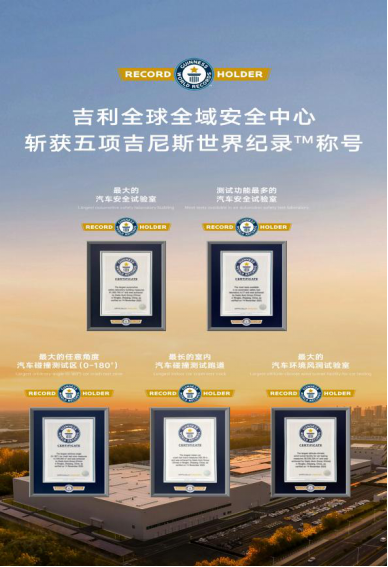
Core Viewpoint - Geely Auto has unveiled its Global All-Domain Safety Center, achieving five Guinness World Records and launching the "All-Domain Safety 2.0" technology system along with the "Intelligent Vehicle All-Domain Safety Development White Paper," promoting industry-wide collaboration in automotive safety [1][4]. Group 1: Global All-Domain Safety Center - The Global All-Domain Safety Center is the core of Geely's all-domain safety testing system, integrating Volvo's safety technology and built to the highest global safety standards [2]. - The center covers approximately 45,000 m² and includes the world's largest automotive safety testing laboratory, which exceeds 80,000 m², and features various testing capabilities across four safety domains: life, health, property, and privacy [2][3]. - It boasts the world's longest indoor automotive collision test track at 293.39 meters, designed for high-speed and adjustable deceleration tests, accommodating commercial vehicle testing and future global safety standard development [2]. Group 2: Testing Facilities and Capabilities - The center includes the world's largest automotive environmental wind tunnel testing facility, capable of simulating altitudes of up to 5,200 meters and various complex environmental tests [3]. - It features the world's largest arbitrary angle automotive collision testing area, allowing for 0-180° collision simulations to realistically replicate various accident scenarios [3]. - The center also has the world's most comprehensive automotive safety testing laboratory with 27 testing functions, meeting safety regulations from multiple countries and regions [3]. Group 3: All-Domain Safety 2.0 Technology System - Geely has launched the first industry "Intelligent Vehicle All-Domain Safety Development White Paper," focusing on human-centered safety goals and addressing the technological needs arising from intelligent vehicle scenarios [4]. - The "All-Domain Safety 2.0" technology system expands the safety perspective from vehicle safety to a broader "person-vehicle-road-cloud-star" ecosystem, aiming for zero casualties, zero health hazards, zero property loss, and zero privacy breaches [4]. - The system includes upgrades to nine safety systems and introduces a new "public domain safety" section, enhancing public safety awareness and standard co-construction [4]. Group 4: Technological Innovations - The "All-Domain Safety 2.0" technology system has already implemented several leading technologies, such as the tire blowout stability control system in the Geely Galaxy M9, which can precisely control the vehicle within 100 milliseconds [5]. - It features the industry's first G-AES universal obstacle continuous automatic avoidance assistance system, capable of emergency avoidance at speeds up to 150 km/h [5]. - In the new energy sector, the Shendun Jinzhang battery has passed multiple extreme tests exceeding national standards, while technologies like Thunder Electric Drive and AI-integrated vehicle-cloud systems enhance safety [5]. Group 5: Commitment to Safety - Geely Auto has invested over 250 billion yuan in R&D over nearly 30 years, establishing a leading global safety technology system with 1,562 automotive safety patents [7]. - The launch of the Global All-Domain Safety Center and the "All-Domain Safety 2.0" technology system reflects Geely's commitment to safety and industry responsibility [7]. - The company aims to continue pushing the boundaries of safety technology, sharing core achievements, and promoting equitable safety in smart mobility for consumers [7].
投资20亿、创五项吉尼斯纪录 吉利全球全域安全中心正式发布
Zheng Quan Shi Bao Wang· 2025-12-13 02:50
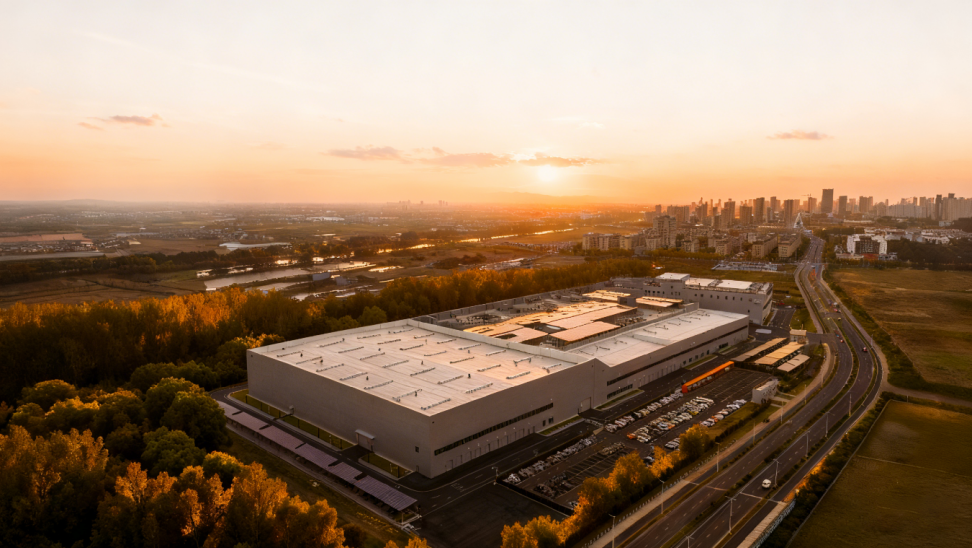
Core Insights - Geely has officially opened its Global All-Domain Safety Center, which represents an investment of 2 billion and covers an area of over 80,000 square meters, featuring 27 categories of testing capabilities [1][3] - The center has set five Guinness World Records, including the largest automotive safety testing laboratory and the longest indoor collision test track [1][3] Group 1 - The center aims to create a verification system that simulates the complexities and uncertainties of real-world scenarios, featuring the world's largest arbitrary angle automotive collision testing area [3] - Geely's Global All-Domain Safety Center will be open for sharing across the industry, allowing Geely to share nearly 30 years of experience in key areas such as new energy safety and advanced driver assistance systems [3][4] - The launch of the "All-Domain Safety 2.0" technology system integrates "All-Domain AI" to enhance nine safety systems, expanding the safety perspective from individual vehicles to a broader traffic ecosystem [3][4] Group 2 - Geely, in collaboration with 11 industry and academic institutions, has released the "Intelligent Vehicle All-Domain Safety Development White Paper" to promote systematic planning for the advancement of automotive safety technology [4] - The joint release of the Global All-Domain Safety Center and the "All-Domain Safety 2.0" technology system signifies Geely's commitment to automotive safety and the principle of "people-oriented" design [4] - Looking ahead, Geely plans to use the "All-Domain Safety 2.0" technology system as a guide to continuously push the boundaries of global automotive safety technology and standards [5]
吉利全球全域安全中心正式启用,以开放协同助力汽车安全产业升级
Zhong Guo Qi Che Bao Wang· 2025-12-13 00:58
Group 1 - Geely has officially launched its Global All-Domain Safety Center, which covers an area of over 80,000 square meters and includes 27 categories of testing capabilities, making it the largest and most functionally diverse automotive safety testing facility in the world, setting five Guinness World Records [2] - The center will be open for collaboration across the entire industry to promote resource sharing and technological synergy [2] Group 2 - The "All-Domain Safety 2.0" technology system was introduced, which expands the traditional vehicle safety perspective to an ecological safety view encompassing "people-vehicle-road-cloud-star" through the integration of AI technology [4] - Geely, in collaboration with 11 industry and academic institutions, has released the "Intelligent Vehicle All-Domain Safety Development White Paper" to guide the innovation of automotive safety technology and support the establishment of standardized safety systems for the high-quality development of China's automotive industry [4]
