GEELY AUTO(00175)

Search documents
50家港股公司出手回购(12月12日)
Zheng Quan Shi Bao Wang· 2025-12-15 01:52
Group 1 - On December 12, 50 Hong Kong-listed companies conducted share buybacks, totaling 35.48 million shares and an amount of 883 million HKD [1][2] - Tencent Holdings repurchased 1.044 million shares for 636 million HKD, with a year-to-date total buyback amount of 73.044 billion HKD [1][2] - China COSCO Shipping repurchased 4.461 million shares for 60.86 million HKD, with a year-to-date total buyback amount of 6.339 billion HKD [1][2] - Geely Automobile repurchased 1.362 million shares for 23.92 million HKD, with a year-to-date total buyback amount of 139 million HKD [1][2] Group 2 - The highest buyback amount on December 12 was from Tencent Holdings at 636 million HKD, followed by China COSCO Shipping at 60.86 million HKD [1][2] - The largest number of shares repurchased on December 12 was by Jinxin Fertility, with 7.722 million shares, followed by China Feihe and China COSCO Shipping with 5.655 million shares and 4.461 million shares respectively [1][2] - The buyback prices for Tencent Holdings ranged from a high of 616.00 HKD to a low of 601.50 HKD [1][2]


整合收官、红利释放,吉利开启“量增质升”新增长逻辑
Xin Hua Cai Jing· 2025-12-15 01:48
Core Viewpoint - Geely Automobile is nearing the completion of its major integration, with over 70% of Zeekr shareholders opting for stock exchange, indicating market confidence in the long-term value of the integrated Geely [1][2] Group 1: Transaction Details - Each Zeekr share can be exchanged for $2.687 in cash or 1.23 shares of Geely, while each Zeekr American Depositary Share can be exchanged for $26.87 in cash or 12.3 shares of Geely [2] - Approximately 70.8% of eligible Zeekr shareholders chose stock compensation, leading to the issuance of 777 million shares by Geely [2] - The cash compensation option was selected by about 29.2% of eligible shareholders, resulting in a total cash payment of approximately $701 million by Geely [2] Group 2: Strategic Significance - The merger allows Geely to cover mainstream, mid-to-high-end, and luxury segments, establishing a diverse power system of "fuel + pure electric + plug-in hybrid + hydrogen electric" [3] - The strategic merger is expected to enhance technological synergies and unify value points, improving capital efficiency and decision-making stability [3] Group 3: Financial Performance and Efficiency - Following the merger, Geely is expected to accelerate its high-end upgrade, potentially increasing gross margins and per-vehicle profits [4] - Geely's gross margin for Q3 was 16.6%, up 0.2 percentage points from the first half of the year, with core net profit per vehicle rising to 5,200 yuan [4] - Management has indicated that operational efficiency has improved, with management expense ratio dropping to 1.8% and R&D expense ratio to 6.1% [4] Group 4: Sales and Market Position - As of November 2025, Geely's cumulative sales reached 2.7878 million units, a 42% year-on-year increase, suggesting that the annual target of 3 million units will be exceeded [5] - The shift in the new energy vehicle purchase tax policy is expected to benefit Geely's fuel vehicle segment, while new models in the electric vehicle segment are performing well [5] Group 5: AI Integration - Geely is advancing its integration of AI technology across various domains, launching the industry's first "full-domain AI" technology system [6] - The company has established the "Intelligent Automotive Computing Alliance," enhancing its computing power to 23.5 EFLOPS [6] - Geely has accumulated 10 terabytes of token data and 40 billion automotive vertical data, supporting its AI initiatives [6] Group 6: Future Vision - Geely aims to transform into a leading technology company with strong intelligent manufacturing capabilities, positioning itself as a major player in the AI and automotive sectors [7] - The company envisions that every vehicle will serve as a connection point to the AI universe, potentially becoming one of the largest robotics companies globally [7]
智通港股回购统计|12月15日


智通财经网· 2025-12-15 01:25
Summary of Key Points Core Viewpoint - The article discusses the stock buyback activities of various companies, highlighting the amounts repurchased and their significance in terms of total shares outstanding. Group 1: Major Buybacks - Tencent Holdings (00700) had the largest buyback, repurchasing 1.044 million shares for a total of 636 million [1][2] - China Merchants Industry Holdings (01919) repurchased 4.461 million shares for 60.86 million, representing 2.986% of its total shares [2] - Geely Automobile (00175) bought back 1.362 million shares for 23.92 million, which is 0.078% of its total shares [2] Group 2: Notable Buyback Activities - China Feihe (06186) repurchased 5.655 million shares for 23.18 million, accounting for 2.605% of its total shares [2] - Yum China (09987) conducted two buybacks totaling 58,000 shares for 21.67 million, representing 4.750% of its total shares [2] - Kweichow Moutai (01951) repurchased 772,200 shares for 19.35 million, which is 0.280% of its total shares [2] Group 3: Other Companies Involved - Vitasoy International (00345) repurchased 2,000 shares for 13,300, which is 2.209% of its total shares [3] - Yanzhiyu (01497) bought back 200,000 shares for 1.39 million, representing 0.786% of its total shares [3] - Weigao Group (01066) repurchased 120,000 shares for 631,000, which is 5.179% of its total shares [3]
开源晨会-20251214




KAIYUAN SECURITIES· 2025-12-14 14:42
Group 1 - The report highlights the recent performance of various industries, with notable gains in sectors such as non-ferrous metals, electronics, and power equipment, while retail and real estate sectors faced declines [1][1][1] - The central economic work conference emphasized the importance of technological breakthroughs and supply-demand optimization, indicating a shift towards quality improvement in economic growth [11][12][19] - The commercial aerospace sector is experiencing significant growth, with the establishment of a dedicated regulatory body and a notable increase in the commercial aerospace index, which has risen by 46.52% since April 7 [47][48] Group 2 - The report indicates a seasonal recovery in social financing, with November seeing an increase of 24,885 billion yuan, driven primarily by government bond issuance [4][7] - The credit environment is showing signs of marginal improvement, particularly in corporate loans, which increased by 6,100 billion yuan in November, reflecting a recovery in demand [5][6] - The report notes that the retail sector is undergoing a transformation, with a focus on quality, as highlighted by the Ministry of Commerce's emphasis on retail quality upgrades [1][1][1] Group 3 - The report discusses the rising interest in inquiry transfers, which have seen a significant increase in both project numbers and transfer scale, indicating a growing trend in the market [51][52] - The technology sector is expected to remain a key focus, with upcoming events such as the Volcano Engine FORCE conference anticipated to showcase advancements in AI and cloud services [56]
吉利银河新能源汽车销售(临海)有限公司成立
Zheng Quan Ri Bao· 2025-12-14 13:44
Group 1 - The establishment of Geely Galaxy New Energy Vehicle Sales (Linhai) Co., Ltd. has been reported, with a registered capital of 10 million yuan [1] - The company's business scope includes the sales of new energy vehicles, wholesale of auto parts, and automobile sales [1] - Zhejiang Geely Holding Group Automobile Sales Co., Ltd. is the sole shareholder of the newly established company [1]
12月首周国内乘用车销量承压,出海持续加速
SINOLINK SECURITIES· 2025-12-14 12:37
Investment Rating - The report suggests a focus on opportunities arising from the themes of international expansion and smart technology, particularly in the automotive sector [1]. Core Insights - Short-term domestic demand is low, with retail sales of passenger vehicles declining year-on-year. However, exports of passenger vehicles have shown strong growth, indicating that international markets will be a long-term focus for the industry [1][12]. - The smart technology and robotics sectors are accelerating, with significant advancements in intelligent driving and AI integration in vehicles [15][18]. - The report recommends investing in companies like BYD, Geely, and Li Auto for international expansion, and companies like Horizon Robotics and Top Group for smart technology and robotics [1][18]. Summary by Sections Weekly Perspective - Domestic demand is weak, with November retail sales of passenger vehicles down 15.8% year-on-year. The report notes that the expected policy incentives have not yet materialized, contributing to this decline [11]. - Passenger vehicle exports reached 594,000 units in November, a 50% increase year-on-year, indicating a robust international market [12]. Industry Data Tracking - The Shanghai Composite Index decreased by 0.08%, while the automotive index increased by 0.16% this week. Notable stock performances included Superjet Co. (+39.0%) and Huamao Technology (+28.5%) [2][19]. - In November, wholesale passenger vehicle sales were 2.991 million units, a 1.7% increase year-on-year, while new energy vehicle sales were 1.694 million units, up 17.6% [4][34]. Industry Dynamics - The report highlights the rapid development of smart technology in vehicles, with over 60% penetration of L2 and above driving assistance systems in the market. The trend towards AI-driven smart cockpits is also noted [15]. - Robotics technology is advancing, with new products being launched by domestic manufacturers, indicating a shift towards commercialization in this sector [16][18].



十大关键词回顾2025年中国汽车市场
Xin Lang Cai Jing· 2025-12-14 10:06
Core Insights - The Chinese automotive industry is undergoing a structural transformation in 2025, shifting from price competition to technology-driven growth, and from domestic focus to global expansion, marking a new development stage [1] Group 1: Price War Aftermath - The price war in the automotive industry has entered its third year, with profit margins dropping to 4.5% in the first three quarters of 2025, below the 6% average of downstream industrial enterprises [3] - There are signs of easing in the price war, indicating a shift from vicious competition to rational development, as companies recognize that quality, service, and technological innovation are essential for long-term success [3] Group 2: 60-Day Payment Terms - Major automotive companies have adopted a 60-day payment term, reflecting a significant change in the industry ecosystem and addressing long-standing payment issues that strained supply chains [6] - This shift enhances the credit system within the supply chain, allowing suppliers to invest more in innovation and quality improvement, thus fostering a healthier industry environment [6] Group 3: 5-Second Acceleration Standard - A new regulation proposes that new vehicles must achieve a 0-100 km/h acceleration time of no more than 5 seconds, marking a fundamental shift in competitive logic within the automotive industry [9] - This standard encourages companies to focus on safety, user experience, and practical technology rather than extreme performance metrics [9] Group 4: 50% Penetration Rate of New Energy Vehicles - By November 2025, new energy vehicles accounted for 53.6% of domestic passenger car sales, indicating a shift from policy-driven to market-driven growth in the sector [11] - This milestone signifies that new energy vehicles have become mainstream, reshaping the industry landscape and prompting traditional automakers to accelerate their electrification strategies [11] Group 5: Subsidy Phase-Out - The phase-out of subsidies for new energy vehicles is set to begin in 2026, transitioning the industry from reliance on government support to market-driven growth [14] - This change is expected to enhance market competition and compel companies to improve product quality and cost control [14] Group 6: New Normal in Exports - In 2025, China's automotive exports are projected to exceed 6.8 million units, maintaining the top position globally for the third consecutive year, with a significant increase in new energy vehicle exports [16] - The export model is evolving from product trade to a more integrated approach involving industry chain and technology exports [16] Group 7: Smart Driving Popularization - 2025 marks the year of smart driving technology's widespread adoption, with significant advancements in urban navigation assistance systems [19] - Regulatory measures are being implemented to ensure safety and compliance, balancing innovation with social responsibility [19] Group 8: Joint Venture Counterattack - Traditional joint venture brands are launching a "localization 2.0" strategy to regain market share in the new energy era, focusing on deep localization and embracing electrification [21] - This strategy enhances competition and provides consumers with more quality choices while integrating the supply chain into the local ecosystem [21] Group 9: Battery Safety Concerns - Battery safety issues have escalated to a regulatory priority, with new standards mandating thermal monitoring and warning systems for battery packs [24] - These regulations aim to enhance safety and accountability in the industry, pushing companies to prioritize safety investments [24] Group 10: Retreat of Hidden Door Handles - The decline of hidden door handles reflects a broader industry reconsideration of "over-design" in automotive engineering, emphasizing safety and practicality over aesthetics [27] - New regulations require mechanical release functions for door handles, signaling a shift towards user-centric design principles [27]





崔东树:2025年全国汽车市场总体走势较强 新能源商用车景气度走高
智通财经网· 2025-12-14 09:49
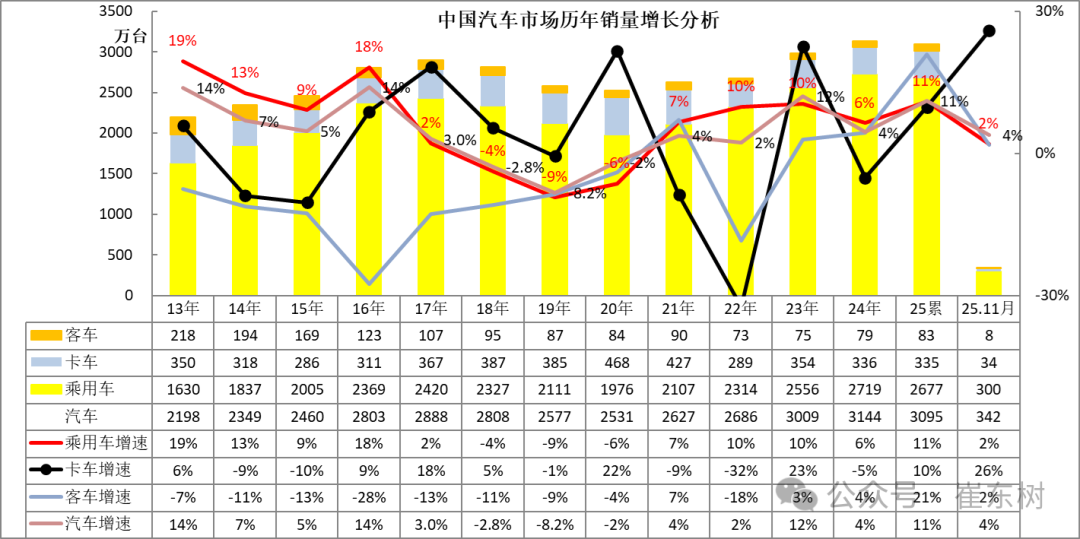
Core Viewpoint - The automotive market in China is expected to maintain strong growth in 2025, driven by government policies promoting consumption, with passenger vehicle growth projected at 11% and significant recovery in both truck and bus markets [1][2]. Group 1: Market Trends - The automotive market is experiencing a clear differentiation between passenger and commercial vehicles, with passenger vehicle consumption improving while commercial vehicle sales are weaker [4][6]. - In the first 11 months of 2025, total automotive sales reached 30.94 million units, with a cumulative growth rate of 11% [6]. - November 2025 saw total automotive sales of 3.42 million units, reflecting a year-on-year growth of 3% [6]. Group 2: Company Performance - There is significant performance differentiation among major automotive groups, with some state-owned enterprises lagging behind while companies like BYD and Chery show strong performance [9][12]. - The competitive landscape is shifting, with private enterprises like Geely, BYD, and Chery becoming the main players in the industry, indicating a sustainable trend [12][13]. Group 3: Passenger Vehicle Dynamics - Cumulative sales of narrow passenger vehicles reached 26.75 million units in the first 11 months of 2025, with an 11% growth rate [17]. - In November 2025, narrow passenger vehicle sales totaled 3 million units, showing a year-on-year increase of 2% [17][19]. - The retail sales of narrow passenger vehicles maintained a year-on-year growth of 5% since 2023, although a downward trend was observed from September 2025 [21]. Group 4: New Energy Vehicle Trends - In November 2025, sales of new energy passenger vehicles reached 1.71 million units, marking a year-on-year increase of 19% [24]. - Cumulative wholesale sales of new energy passenger vehicles from January to November 2025 reached 13.77 million units, reflecting a year-on-year growth of 28% [24][26]. Group 5: Commercial Vehicle Insights - The commercial vehicle market is characterized by structural growth driven by equipment renewal subsidies, with high subsidies accelerating the electrification of logistics and transportation [1][4]. - In the first 11 months of 2025, cumulative truck sales reached 3.35 million units, with a growth rate of 10% [37]. - November 2025 saw truck sales of 340,000 units, representing a year-on-year increase of 26% [37][39].
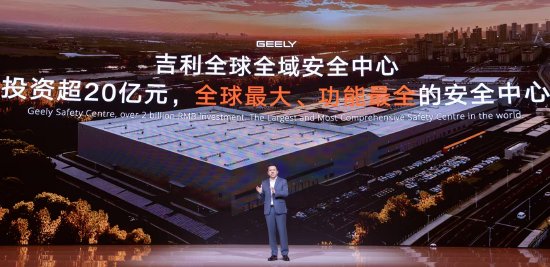
吉利全球全域安全中心发布:投资超20亿元,将面向全行业开放共享
Xin Lang Cai Jing· 2025-12-14 05:34
Core Insights - Geely has officially launched its Global All-Domain Safety Center and the "All-Domain Safety 2.0" technology system, integrating "All-Domain AI" to enhance automotive safety standards and practices [2][6] Group 1: Global All-Domain Safety Center - The Global All-Domain Safety Center has an investment exceeding 2 billion yuan and covers an area of approximately 45,000 square meters, making it the largest and most comprehensive safety testing facility globally [2][6] - The center's capabilities include testing for passive safety standards such as vehicle collision, system simulation, pedestrian protection, and component safety performance, as well as active safety, new energy safety, health safety, and digital safety [2][6] - The center is now open for sharing with the entire industry, promoting collaboration and innovation in automotive safety [2][6] Group 2: All-Domain Safety 2.0 Technology System - The "All-Domain Safety 2.0" technology system evolves from the previous safety framework, shifting focus from vehicle safety to an ecosystem perspective encompassing "human-vehicle-road-cloud-star" [3][7] - The system is guided by four safety visions: zero fatalities, zero health hazards, zero property losses, and zero privacy leaks, aiming to enhance overall safety in the automotive sector [3][7] - The technology system integrates nine upgraded safety systems, including driving safety, active safety, passive safety, rescue safety, health safety, new energy safety, anti-theft safety, digital safety, and public safety [3][7] Group 3: Industry Collaboration - Geely has collaborated with 11 industry and research institutions, including the China Automotive Technology and Research Center and Tsinghua University, to publish the "Intelligent Vehicle All-Domain Safety Development White Paper," which outlines a human-centered safety development agenda for the industry [2][6]
第二十届金扳手奖在京颁奖 多维助推汽车服务升级
Jing Ji Guan Cha Wang· 2025-12-14 05:21
Core Viewpoint - The 20th China Automotive Golden Wrench Award ceremony was held in Beijing, aiming to establish a value coordinate system for automotive services in China [1] Group 1: Award Categories - The awards are divided into four categories: independent brands, joint venture brands, luxury brands, and new energy brands [8] - GAC Trumpchi and Geely Auto won awards in the independent brand category [8] - GAC Toyota, GAC Honda, and FAW-Volkswagen received honors in the joint venture brand category [8] - FAW Audi and FAW Hongqi were recognized in the luxury brand category [8] - Zeekr and AITO won awards in the new energy brand category for their excellent service [8] Group 2: Special Awards - A special "20th Anniversary Excellence Contribution Award" was established, with ten brands including FAW-Volkswagen and BYD receiving recognition [8] - 100 outstanding dealers were awarded the "2025 Golden Wrench Service Top 100 Quality Selected Stores" based on the GES-150 service evaluation standard [8] - Eight senior technicians received the "20th Anniversary Craftsman Award," and seven dealers were named "20th Anniversary Service Benchmark Stores" [8] Group 3: Historical Context - The Golden Wrench Award was initiated in 2006 by China Automotive Market magazine and Sohu Auto, with the aim of promoting service integrity in the automotive industry [10] - The award has evolved over 20 years, initially focusing on traditional fuel vehicle after-sales service and expanding to include new energy brands and new media service scenarios [10] - The award's foundation is linked to the "3.15" joint declaration of integrity service by car companies, which began in 2018 [10]