
GEELY AUTO(00175)

Search documents
这个2月有点冷,国内车企销量洗牌
凤凰网财经· 2026-03-02 13:18
Core Viewpoint - The automotive market in February 2026 experienced a significant downturn, with all new energy vehicle manufacturers failing to exceed 30,000 units in monthly deliveries, marking a shift in market dynamics and highlighting the challenges faced by both new entrants and established brands [1][2]. Group 1: Sales Performance Overview - In February, BYD's sales reached 190,190 units, a 41% decline year-on-year, with domestic sales dropping to just over 90,000 units, indicating strong pressure from the seasonal downturn [4][5]. - Geely reported total sales of 206,160 units, showing a slight increase of 1% year-on-year, supported by a remarkable performance from its Zeekr brand, which saw a 70% increase in sales [6]. - Great Wall Motors sold 72,600 vehicles in February, down 7% year-on-year and 20% month-on-month, with 12,744 units being new energy vehicles [9]. Group 2: New Energy Vehicle Manufacturers - New energy vehicle manufacturers collectively faced significant challenges, with AITO and XPeng showing notable declines in sales, with AITO delivering approximately 18,000 units in February, a drop of nearly 50% from January [11]. - XPeng delivered 15,256 vehicles in February, reflecting a nearly 50% year-on-year decline and a 24% month-on-month drop, attributed to the aging of older models and product transition pains [12]. - In contrast, Li Auto delivered 26,421 vehicles, showing a slight year-on-year increase, while NIO achieved a substantial 57.6% year-on-year growth with 20,797 units delivered, driven by strong demand for its ES8 model [18][19]. Group 3: Market Dynamics and Future Outlook - The automotive market is experiencing a dual pressure of declining domestic demand and intense price competition, with over 20 brands, including BYD and Tesla, engaging in long-term low-interest promotions [23]. - Despite the challenges, opportunities exist in the form of decreasing battery costs and advancements in smart driving technology, which could enhance the penetration of new energy vehicles in the market [23]. - The export market is becoming increasingly vital for Chinese automotive brands, with BYD's exports exceeding 100,000 units in February, marking a potential shift in focus from domestic to international markets [5].






汽车图谱|2月出海销量高增:比亚迪、奇瑞超10万辆
Xin Jing Bao· 2026-03-02 12:48
Group 1 - The domestic car market in February experienced short-term fluctuations, but the positive trends of export growth and increasing penetration of new energy vehicles remain unchanged [1] - SAIC Motor led the industry with a delivery volume of 269,465 units, with exports and overseas sales reaching 99,000 units, a year-on-year increase of 46.12%, providing crucial support against domestic market volatility [1] - Chery Group's February sales reached 161,000 units, with exports accounting for 124,900 units, a year-on-year increase of 41.5%, marking ten consecutive months of single-month exports exceeding 100,000 units [1] Group 2 - New energy vehicle companies showed a mixed performance, with sales for Leap Motor, Li Auto, Zeekr, NIO, and Xiaomi around 20,000 units, while XPeng Motors sold 15,000 units [1] - The overall market pressure in February is viewed as a short-term fluctuation rather than a trend decline, with leading companies maintaining their fundamentals and the dual drivers of exports and new energy remaining strong [1] - The competitive landscape among new energy vehicle companies has evolved into a multi-stronghold scenario, characterized by alternating leadership [1] Group 3 - The release of subsequent policy benefits and the arrival of a new round of model cycles are expected to accelerate the recovery of the car market [2] - February sales data for major domestic car companies showed varying performance, with SAIC Motor's sales down 8.64% year-on-year, while BYD's sales dropped significantly by 41.09% [4] - New energy vehicle companies like Ideal and NIO reported year-on-year increases of 0.6% and 57.6%, respectively, while others like Xiaopeng and Lantu faced declines [4]


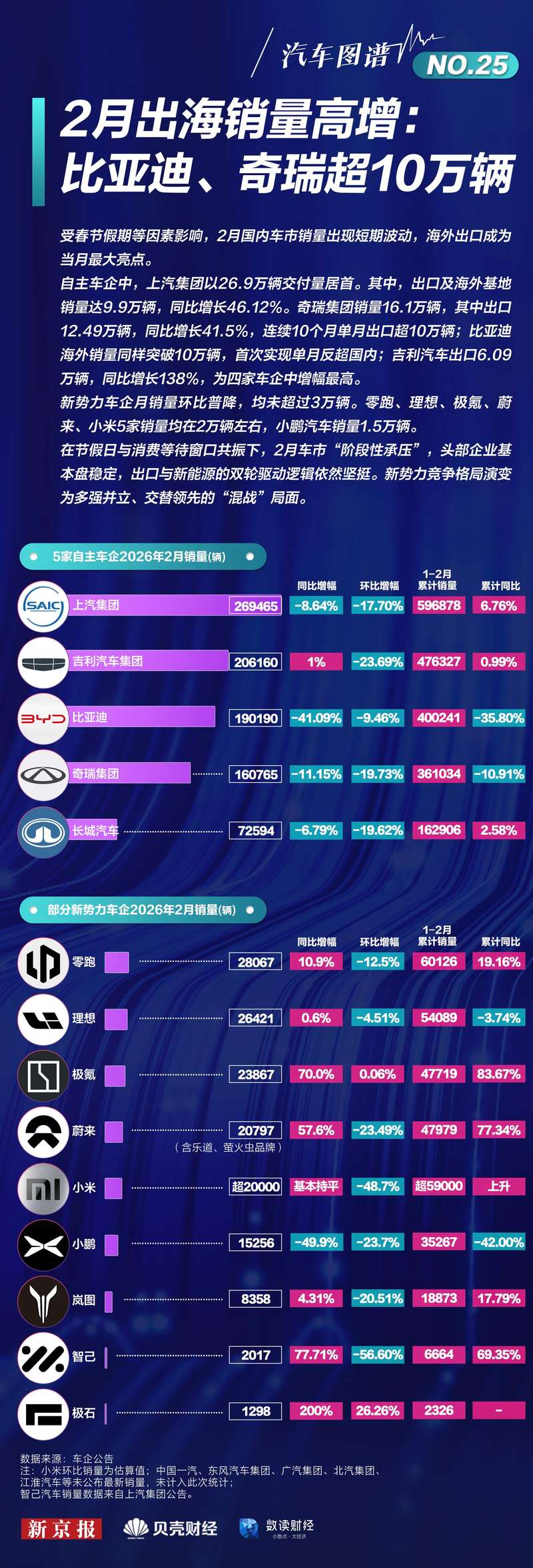
汽车图谱㉕|2月出海销量高增:比亚迪、奇瑞超10万辆
Bei Ke Cai Jing· 2026-03-02 12:38
Group 1 - The core viewpoint of the article indicates that while there was a short-term fluctuation in domestic car sales in February, the positive trends of export growth and increasing penetration of new energy vehicles remain unchanged [1][4]. - SAIC Motor Corporation led the domestic market with a delivery volume of 269,465 units, with exports and overseas sales reaching 99,000 units, a year-on-year increase of 46.12%, serving as a crucial support against domestic market fluctuations [2][8]. - Chery Group's February sales reached 161,000 units, with exports accounting for 124,900 units, marking a year-on-year growth of 41.5%, and achieving over 100,000 units in monthly exports for ten consecutive months [2][8]. Group 2 - New energy vehicle companies showed a "month-on-month decline" in sales, with five companies including Leap Motor, Li Auto, Zeekr, NIO, and Xiaomi each selling around 20,000 units, while XPeng Motors sold 15,000 units [3][10]. - The overall market pressure in February is viewed as a short-term fluctuation influenced by holiday effects and consumer waiting periods, rather than a trend of weakening [4][5]. - The competitive landscape among new energy vehicle companies has evolved into a "mixed battle" scenario with multiple strong players alternating in leadership [4][5].
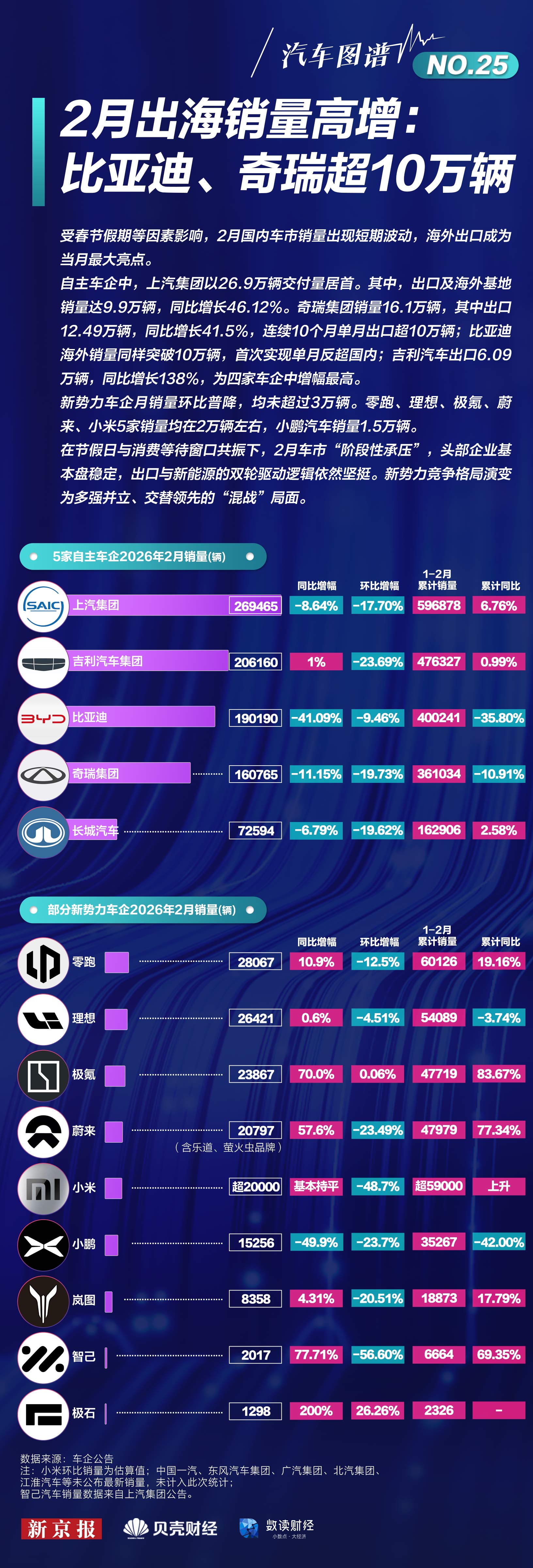
每天车闻:奇瑞、比亚迪、长城、吉利汽车发布2026年2月销量业绩
Xin Lang Cai Jing· 2026-03-02 11:48
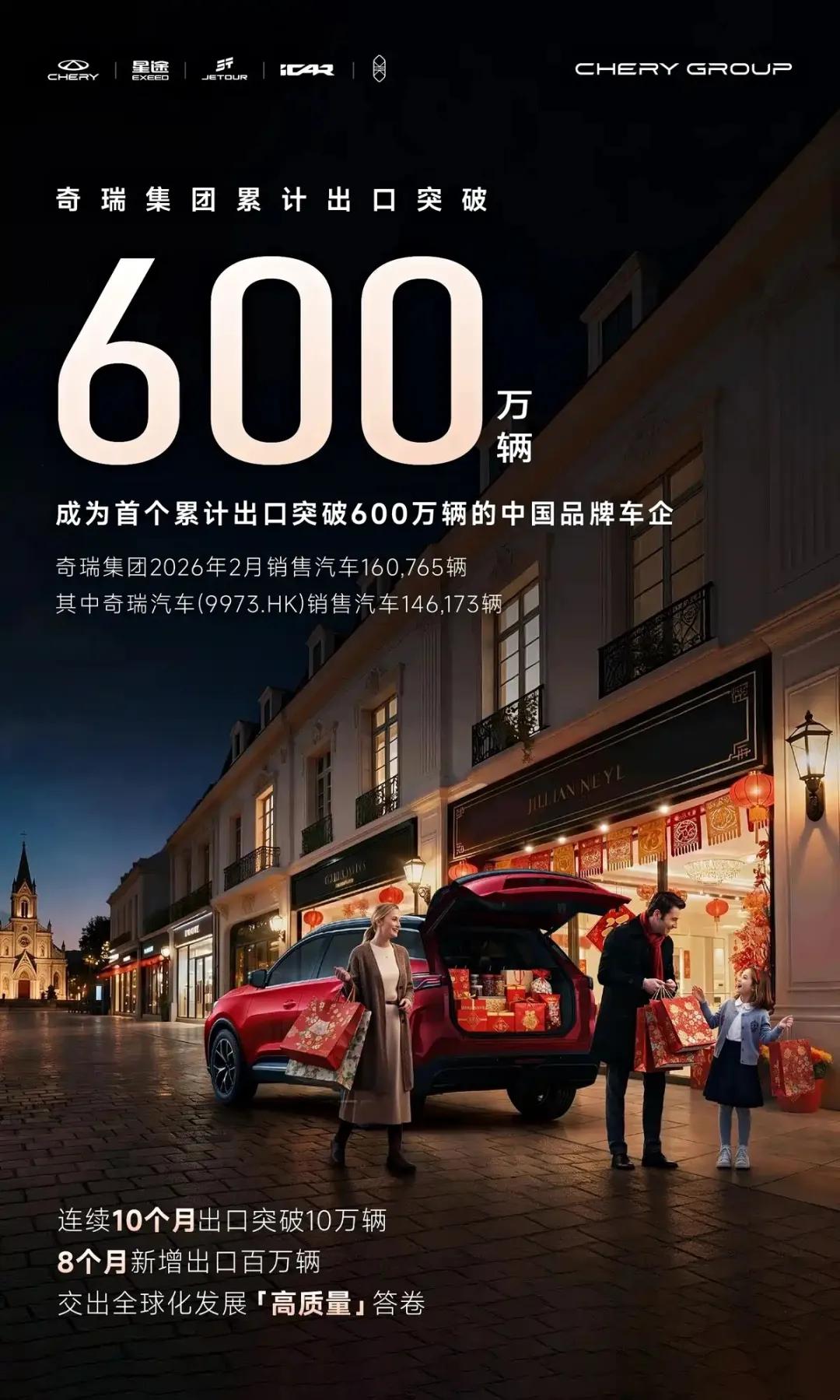
Group 1: Chery Group - Chery Group sold 160,765 vehicles in February, with Chery brand sales at 146,173 units [4][19] - The cumulative export of Chery Group has surpassed 6 million units, maintaining over 100,000 units in exports for 10 consecutive months, and achieving an additional million units in exports over the past 8 months [4][19] Group 2: BYD - BYD's sales in February reached 190,190 units, with passenger vehicle sales at 187,782 units and overseas sales of passenger vehicles and pickups at 100,151 units, marking a year-on-year increase of 41.4% [5][19] - In the first two months, BYD's cumulative sales totaled 400,241 units, with overseas sales of passenger vehicles and pickups at 200,160 units [21] Group 3: Great Wall Motors - Great Wall Motors sold 72,594 new vehicles in February, with overseas sales increasing by 37.36% year-on-year [9][22] - The total sales for the first two months reached 162,906 units, reflecting a year-on-year growth of 2.58% [22][28] - Specific brand performances include Haval brand sales of 43,660 units, WEY brand sales of 5,615 units (up 54.13%), and Tank brand sales of 10,036 units [14][28] Group 4: Geely Automobile - Geely Automobile's sales in February amounted to 206,160 units, with new energy vehicle sales at 117,488 units, representing 57% of total sales [15][29] - The overseas export sales saw a significant increase of 138% year-on-year [15][29] - Geely brand sales were 154,934 units, with Lynk & Co brand sales at 27,359 units and Zeekr brand sales at 23,867 units, showing a year-on-year growth of 70% [15][29]
吉利汽车(00175):1+2月出口表现强劲:吉利汽车(00175.HK)2月销量点评
Huachuang Securities· 2026-03-02 09:46
Investment Rating - The report maintains a "Strong Buy" rating for Geely Automobile (00175.HK) with a target price of HKD 26.13, indicating a potential upside of 62% from the current price of HKD 16.15 [2][6]. Core Insights - Geely's February sales reached 206,000 units, showing a year-on-year increase of 0.6% but a month-on-month decrease of 23.7%. Exports were particularly strong, with 61,000 units sold, a year-on-year increase of 140% [1]. - The company is expected to continue its growth trajectory with total revenue projected to reach RMB 241.1 billion in 2024, growing to RMB 479.4 billion by 2027, reflecting a compound annual growth rate (CAGR) of 33.5% [1][7]. - Net profit attributable to shareholders is forecasted to increase significantly from RMB 16.6 billion in 2024 to RMB 27.8 billion in 2027, with a remarkable growth rate of 213.3% in 2024 [1][7]. - The report highlights the launch of competitive new models and a strong focus on high-end products, which are expected to drive sales and profitability [6][7]. Financial Summary - Total revenue projections for Geely are as follows: - 2024: RMB 241,099 million - 2025: RMB 348,925 million - 2026: RMB 428,959 million - 2027: RMB 479,364 million - Net profit attributable to shareholders is projected to be: - 2024: RMB 16,632 million - 2025: RMB 17,402 million - 2026: RMB 25,046 million - 2027: RMB 27,813 million - Earnings per share (EPS) is expected to grow from RMB 1.65 in 2024 to RMB 2.57 in 2027 [1][7]. Market Performance - Geely's stock has shown resilience despite market challenges, with a current price-to-earnings (P/E) ratio of 6.2 for 2026, indicating a significant valuation opportunity compared to historical levels [6][7]. - The report anticipates a recovery in the automotive sector, driven by new model launches and improved retail conditions, which could enhance Geely's market position [6][7].
吉利汽车(00175)3月2日斥资8847.28万港元回购561.5万股
Zhi Tong Cai Jing· 2026-03-02 08:45
智通财经APP讯,吉利汽车(00175)发布公告,于2026年3月2日斥资约8847.28万港元回购561.5万股。 该信息由智通财经网提供 ...
吉利汽车(00175.HK)3月2日耗资8847.3万港元回购561.5万股
Ge Long Hui· 2026-03-02 08:41
格隆汇3月2日丨吉利汽车(00175.HK)发布公告,2026年3月2日耗资8847.3万港元回购561.5万股,回购价 格每股15.63-15.99港元。 ...
吉利汽车3月2日斥资8847.28万港元回购561.5万股
Zhi Tong Cai Jing· 2026-03-02 08:40
吉利汽车(00175)发布公告,于2026年3月2日斥资约8847.28万港元回购561.5万股。 ...
【快讯】每日快讯(2026年3月2日)
乘联分会· 2026-03-02 08:37
Domestic News - The Ministry of Transport is advancing the "Mobile+" card-free convenient highway passage service, emphasizing a pilot-first approach to enhance highway efficiency and optimize travel experiences [5] - Xiaomi Auto has opened 6 new stores in February, bringing the total to 488 across 141 cities, with plans for 2 more stores in March [6] - Geely's "Qianli Haohan" advanced driver assistance system is set to launch internationally this year, becoming the first high-level assistance system from China to be applied on a large scale overseas [7] - Ledo Auto reported that during the 2026 Spring Festival, users drove a total of 132 million kilometers, with over 251,970 battery swaps, saving more than 3 million yuan in service fees [8] - The Tengshi brand has officially entered the Philippine market, launching the Tengshi D9 as its first model [9] - The total orders for the Zhiji L4 Robotaxi have surpassed 420,000, with over 8 million kilometers driven [10] - Didi Autonomous Driving has established the "Deep Sky Voyager Laboratory" to focus on cutting-edge research in multi-modal models and reinforcement learning [11] - Huawei's HarmonyOS driving report indicated that over 90% of users preferred using the assistance driving feature during the Spring Festival, with the system preventing potential collisions 81,000 times [12] International News - Malaysia is projected to surpass Indonesia in automotive sales in 2025, becoming the largest automotive market in Southeast Asia, with new car registrations expected to reach approximately 780,000, a 12% increase year-on-year [14] - Mitsubishi confirmed plans to launch a hybrid vehicle in Indonesia in the second half of 2026, with local production expected [15][16] - Tesla will officially sell its vehicles in Morocco starting mid-2026, marking its first official presence in Africa [17] - VinFast has signed a memorandum of understanding with PlusX Electric to enhance electric vehicle charging infrastructure in the UAE [18][19] Commercial Vehicles - The Chao Long Yiwei 5 new energy heavy truck has been officially launched nationwide [20] - Supao Technology and Chuangcheng Leasing have entered a strategic cooperation to promote the large-scale application of new energy heavy trucks [21] - Jinlong's national standard information security T-BOX has passed three mandatory national certifications, marking a significant advancement in the localization of core components for intelligent connected vehicles [22] - Shaoyang, Hunan, has issued guidelines for the pilot application of unmanned delivery vehicles, aiming to ensure safety and promote industry efficiency [23]



吉利汽车(00175) - 翌日披露报表
2026-03-02 08:31
FF305 翌日披露報表 (股份發行人 ── 已發行股份或庫存股份變動、股份購回及/或在場内出售庫存股份) 表格類別: 股票 狀態: 新提交 公司名稱: 吉利汽車控股有限公司 呈交日期: 2026年3月2日 如上市發行人的已發行股份或庫存股份出現變動而須根據《香港聯合交易所有限公司(「香港聯交所」)證券上市規則》(「《主板上市規則》」)第13.25A條 / 《香港聯合交易所有限公司GEM證券 上市規則》(「《GEM上市規則》」)第17.27A條作出披露,必須填妥第一章節 。 | 第一章節 | | | | | | | | | --- | --- | --- | --- | --- | --- | --- | --- | | 1. 股份分類 | 普通股 | 股份類別 | 不適用 | | 於香港聯交所上市 | 是 | | | 證券代號 (如上市) | 00175 | 說明 | | | | | | | 多櫃檯證券代號 | 80175 | RMB 說明 | | | | | | | A. 已發行股份或庫存股份變動 | | | | | | | | | | | | 已發行股份(不包括庫存股份)變動 | | 庫存股份變動 | ...