
CHINA RES BEER(00291)

Search documents
进入存量市场竞争的啤酒业,取悦消费者变得更重要了
第一财经· 2026-03-12 08:43
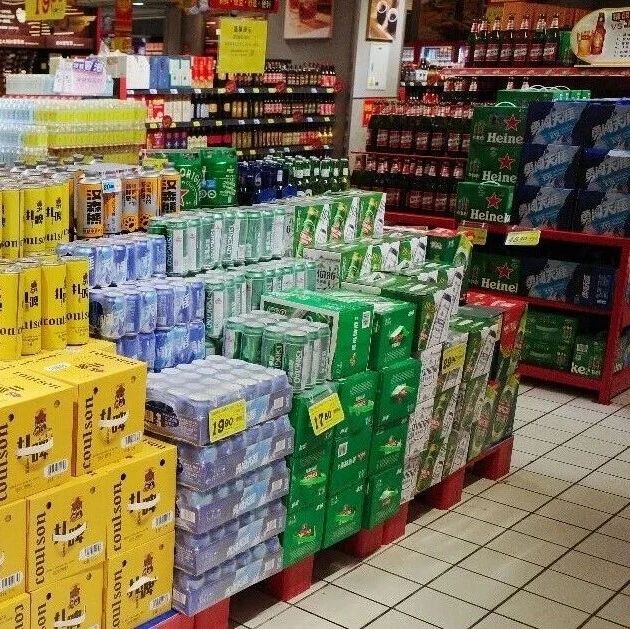
Core Viewpoint - The Chinese beer industry is experiencing a decline in production, with a total output of 35.36 million kiloliters in 2025, marking a 1.1% year-on-year decrease, and the performance among companies is increasingly divergent [3][4]. Group 1: Company Performance - Among the top five beer companies in China, four have released their 2025 annual reports or performance forecasts, with two showing growth and two experiencing declines [4]. - Chongqing Beer reported a revenue of 14.722 billion yuan in 2025, a 0.53% increase year-on-year, and a net profit of 1.231 billion yuan, up 10.43% [4]. - Yanjing Beer expects a net profit growth of 50% to 65% for 2025 [5]. - Budweiser APAC's revenue in 2025 decreased by 6.1% year-on-year, with normalized EBITDA down by 9.8% due to challenges in the Chinese market [5]. - China Resources Beer anticipates a net profit of approximately 2.92 billion to 3.35 billion yuan, reflecting a year-on-year decrease of about 29.6% to 38.6%, primarily due to goodwill impairment from its acquisition of a liquor company [5]. Group 2: Industry Trends - Prior to 2010, growth in the domestic beer sector was largely driven by mergers and acquisitions, while post-2015 growth has shifted towards premiumization and structural upgrades in product offerings [6]. - The beer industry has undergone significant restructuring in both product and distribution channels, with innovations in flavors and a shift towards non-on-premise sales channels [6]. - The industry is now in a mature phase characterized by low overall growth and structural support, making it increasingly difficult for companies to achieve higher profit growth [6]. Group 3: Consumer Preferences and Innovation - Companies are focusing more on consumer satisfaction, with an emphasis on enhancing product experiences rather than merely increasing consumption [7]. - Chongqing Beer launched over 30 new products in 2025, including craft beers and flavored beverages, to cater to younger consumers' preferences [7][8]. - The company is also optimizing its production system to improve efficiency and product delivery capabilities [8]. Group 4: Future Outlook - Budweiser APAC aims to reignite growth trends in China and rebuild market share, viewing the Chinese market as a significant opportunity for long-term profit growth [9]. - The company plans to enhance its product mix and accelerate the development of non-on-premise marketing channels while leveraging digitalization to improve execution and consumer engagement [9].





大和:华润啤酒核心净利润胜预期 维持行业首选 目标价36港元
Xin Lang Cai Jing· 2026-03-12 06:56
Core Viewpoint - Daiwa maintains China Resources Beer (00291) as its industry favorite due to high visibility in product mix and average price upgrades, benefiting from strong growth momentum of the premium brand Heineken and a higher-than-industry sales proportion in home channels [1][5] Company Summary - China Resources Beer forecasts a net profit of RMB 2.92 billion to RMB 3.35 billion for 2025, representing a year-on-year decline of 30% to 39% [1][5] - Excluding the impairment of the liquor business, Daiwa estimates the company's net profit for the year to be between RMB 5.89 billion and RMB 6.14 billion, with the midpoint being 5% higher than Daiwa's previous expectation of RMB 5.74 billion [1][5] Industry Summary - The service-oriented consumption, primarily in dining, performed better than market expectations in February, potentially driving a quicker recovery in beer consumption through on-premise channels [1][5] - The industry is expected to benefit from a low base effect due to the "anti-waste" initiative starting in May, paving the way for potentially better-than-expected performance during the summer beer consumption peak [1][5]
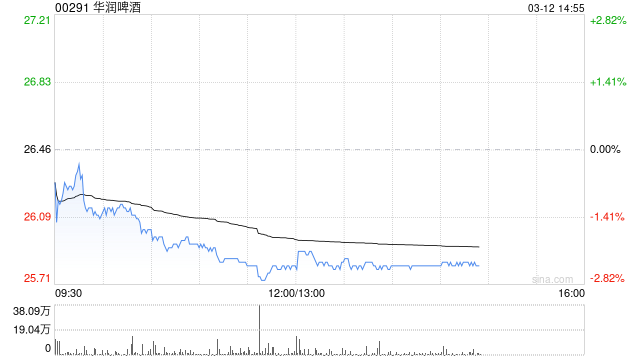
大行评级丨大和:重申华润啤酒“买入”评级,产品组合及平均售价升级的能见度较高
Ge Long Hui· 2026-03-12 06:26
Core Viewpoint - Daiwa's report indicates that China Resources Beer forecasts a net profit of 2.92 billion to 3.35 billion yuan for 2025, representing a year-on-year decline of 30% to 39% [1] Group 1: Financial Projections - Excluding the impairment of the liquor business, the estimated net profit for the year is between 5.89 billion to 6.14 billion yuan, with the median being 5% higher than Daiwa's expectation of 5.74 billion yuan [1] Group 2: Market Trends - The service-oriented consumption, primarily in dining, performed better than market expectations in February, potentially boosting the recovery of beer consumption in on-premise channels [1] - The industry is expected to benefit from a low base effect due to the "anti-waste" initiative starting in May, paving the way for potentially better-than-expected performance during the summer beer consumption peak [1] Group 3: Investment Recommendation - Daiwa maintains China Resources Beer as its top pick in the industry due to high visibility in product mix and average price upgrades, primarily benefiting from the strong growth momentum of the premium brand Heineken and a higher-than-industry share of home channel sales [1] - The "buy" rating is reiterated with a target price of 36 HKD [1]
大和:华润啤酒(00291)核心净利润胜预期 维持行业首选 目标价36港元
智通财经网· 2026-03-12 05:53
Group 1 - The core viewpoint of the article is that Daiwa maintains China Resources Beer (00291) as its industry favorite due to high visibility in product mix and average price upgrades, benefiting from strong growth in the premium brand Heineken and a higher-than-industry sales proportion in home channels [1] - The company forecasts a net profit of RMB 2.92 billion to RMB 3.35 billion for 2025, representing a year-on-year decline of 30% to 39%. Excluding the impairment of the liquor business, the estimated net profit for the year is RMB 5.89 billion to RMB 6.14 billion, which is 5% higher than the firm's expectation of RMB 5.74 billion [1] - The firm noted that service consumption, primarily in dining, performed better than market expectations in February, potentially leading to a quicker recovery in beer consumption through on-premise channels than previously anticipated [1] Group 2 - The industry is expected to benefit from a low base effect of the "anti-waste" initiative starting in May, paving the way for potentially better-than-expected performance during the summer beer consumption peak [1]
【光大食饮&海外】华润啤酒(0291.HK):白酒商誉减值落地,啤酒主业表现优异
Xin Lang Cai Jing· 2026-03-12 01:40
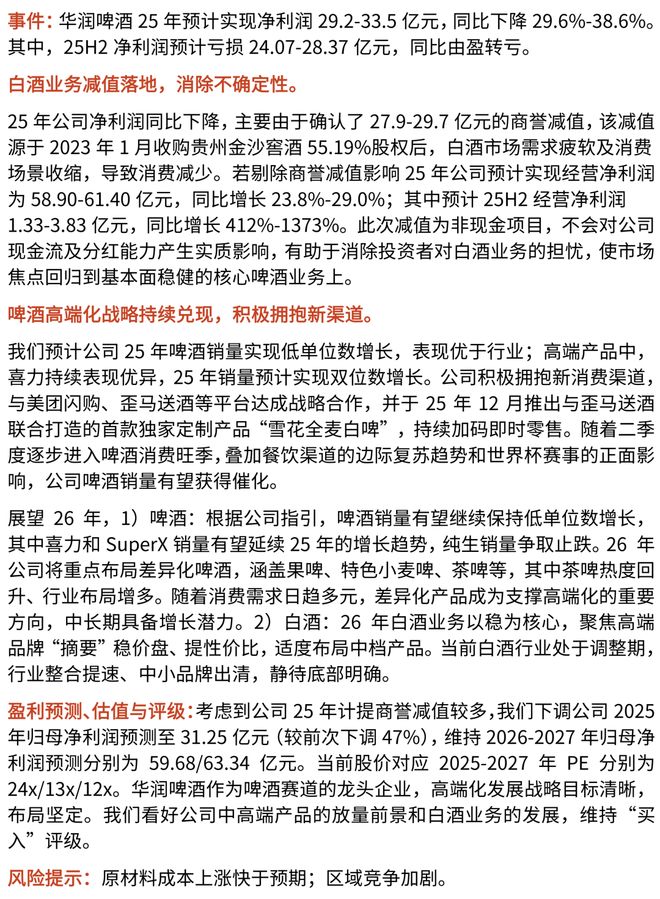
Core Viewpoint - The company, China Resources Beer (0291.HK), is expected to face a significant decline in net profit for 2025, primarily due to goodwill impairment related to its white liquor business, while its core beer business remains robust and is expected to grow in the long term [2][4]. Financial Performance - The projected net profit for 2025 is estimated to be between 2.92 billion and 3.35 billion RMB, representing a year-on-year decline of 29.6% to 38.6% [2]. - The second half of 2025 is expected to incur a net loss of 2.407 billion to 2.837 billion RMB, marking a shift from profit to loss [2]. - The company recognized a goodwill impairment of 2.79 billion to 2.97 billion RMB, attributed to the acquisition of a 55.19% stake in Guizhou Jinsha Jiao Liquor and a downturn in white liquor market demand [2][3]. - Excluding the impact of goodwill impairment, the operating net profit for 2025 is projected to be between 5.89 billion and 6.14 billion RMB, indicating a growth of 23.8% to 29.0% year-on-year [2]. Beer Business Outlook - The company anticipates low single-digit growth in beer sales for 2025, outperforming the industry average [3]. - High-end products, particularly Heineken, are expected to see double-digit growth in sales for 2025 [3]. - The company is actively engaging with new consumption channels, forming strategic partnerships with platforms like Meituan and launching exclusive products [3]. - The beer consumption peak season is expected to catalyze sales growth, aided by a recovery in dining channels and positive impacts from events like the World Cup [3]. Future Projections - For 2026, beer sales are expected to continue low single-digit growth, with a focus on differentiated products such as fruit beer and tea beer, which are gaining popularity [3]. - The white liquor business will focus on stabilizing high-end brands and moderately expanding mid-range products, as the industry undergoes consolidation [3]. Valuation and Estimates - The company's net profit forecast for 2025 has been revised down to 3.125 billion RMB, a 47% decrease from previous estimates, while projections for 2026 and 2027 remain at 5.968 billion and 6.334 billion RMB respectively [4]. - The current stock price corresponds to a price-to-earnings ratio of 24x for 2025 and 12x for 2026-2027 [4]. - The company is viewed positively due to its clear high-end development strategy and potential for growth in both beer and white liquor segments [4].
华润啤酒(00291.HK)2025年业绩预告点评
Huachuang Securities· 2026-03-11 10:30
Investment Rating - The report maintains a "Strong Buy" rating for China Resources Beer, with a target price of HKD 40 [2][7]. Core Views - The company is expected to achieve a net profit of HKD 29.2 to 33.5 billion for 2025, reflecting a decline of 29.6% to 38.6%. However, after adjusting for goodwill impairment related to the acquisition of 55.19% of Jinsha Liquor, the net profit is projected to be HKD 57.1 to 63.2 billion, representing a growth of 20.0% to 32.8% [2][7]. - The report highlights that the beer segment remains robust, with Heineken's sales expected to grow by approximately 20%. Key growth contributions are anticipated from Guangdong, Zhejiang, and Northeast regions, while the overall beer sales are expected to show low single-digit growth [7][8]. - The goodwill impairment of HKD 27.9 to 29.7 billion related to Jinsha Liquor is seen as a necessary step to relieve the financial burden on the company's balance sheet, allowing for a more focused operational strategy moving forward [7][8]. Financial Summary - Total revenue for 2024 is projected at HKD 38.635 billion, with a slight increase to HKD 39.640 billion in 2025, reflecting a year-on-year growth rate of 2.6% [3][13]. - The net profit for 2024 is estimated at HKD 4.739 billion, with a significant drop to HKD 3.332 billion in 2025, before rebounding to HKD 6.388 billion in 2026 [3][13]. - The earnings per share (EPS) is expected to decrease from HKD 1.46 in 2024 to HKD 1.03 in 2025, before increasing to HKD 1.97 in 2026 [3][13]. Market Position and Strategy - The report emphasizes that China Resources Beer is well-positioned in the market, with a focus on high-end product offerings and operational efficiency improvements through the "Three Precision" strategy [7][8]. - The company is expected to benefit from the recovery in the dining sector, which will support its core business and sales growth in the coming years [7][8]. - The report suggests that the valuation of China Resources Beer is currently attractive compared to its peers, indicating a potential for valuation recovery post-goodwill impairment [7][8].
富瑞:华润啤酒(00291)发盈警属预期之内 续列为首选股
智通财经网· 2026-03-11 09:35
Core Viewpoint - The report from Jefferies maintains a "Buy" rating for China Resources Beer (00291) with a target price of HKD 35.7, continuing to list it as one of its preferred stocks [1] Group 1: Financial Performance - Following the announcement of its interim results, the market had anticipated a profit warning from the company due to provisions related to its liquor business [1] - Excluding these provisions, the company's net profit for last year is expected to be between RMB 5.9 billion and RMB 6.1 billion, which is higher than market expectations [1] Group 2: Market Position and Sales Outlook - According to channel surveys, the company's channel inventory situation is healthy, leading to an expectation that its beer sales trends for January and February this year will outperform its peers [1]
富瑞:华润啤酒发盈警属预期之内 续列为首选股
Zhi Tong Cai Jing· 2026-03-11 09:22
Core Viewpoint - The report from Jefferies maintains a "Buy" rating for China Resources Beer (00291) with a target price of HKD 35.7, continuing to list it as one of its preferred stocks [1] Group 1: Financial Performance - Following the announcement of its interim results, the market had anticipated a profit warning due to provisions related to the liquor business [1] - Excluding these provisions, the company's net profit for last year is expected to be between RMB 5.9 billion and RMB 6.1 billion, which is above market expectations [1] Group 2: Market Position and Sales Outlook - According to channel surveys, due to healthy inventory levels, the company is expected to outperform its peers in beer sales trends for January and February this year [1]
华润啤酒(00291):主业扎实坚挺,白酒卸下包袱:华润啤酒(00291.HK)2025年业绩预告点评
Huachuang Securities· 2026-03-11 09:15
Investment Rating - The report maintains a "Strong Buy" rating for China Resources Beer [2][7]. Core Views - The company is expected to achieve a net profit of 2.92 to 3.35 billion HKD in 2025, representing a decline of 29.6% to 38.6% year-on-year. However, after adjusting for goodwill impairment related to the acquisition of 55.19% of Jinsha Liquor, the net profit is projected to be 5.71 to 6.32 billion HKD, reflecting a growth of 20.0% to 32.8% [2][7]. - The company has recognized a goodwill impairment of 2.79 to 2.97 billion HKD for Jinsha Liquor, which is expected to alleviate the financial burden on the balance sheet [2][7]. - The beer segment is anticipated to show stable performance, with Heineken's sales expected to grow by approximately 20%, driven by key regions such as Guangdong, Zhejiang, and Northeast China [2][7]. Financial Summary - Total revenue for 2024 is projected at 38.635 billion HKD, with a slight increase to 39.640 billion HKD in 2025, representing a year-on-year growth of 2.6% [3][13]. - The net profit for 2024 is estimated at 4.739 billion HKD, declining to 3.332 billion HKD in 2025, a decrease of 29.7% [3][13]. - Earnings per share (EPS) is expected to drop from 1.46 HKD in 2024 to 1.03 HKD in 2025, before rebounding to 1.97 HKD in 2026 [3][13]. - The price-to-earnings (P/E) ratio is projected to be 16 in 2024, increasing to 23 in 2025, and then decreasing to 12 in 2026 and 2027 [3][13]. Market Position and Outlook - The company is positioned favorably compared to other beer companies, with a significant potential for valuation recovery following the goodwill impairment [2][7]. - The report suggests that the company's core business fundamentals remain strong, with expectations for steady growth in beer sales driven by the recovery of the dining sector and ongoing premiumization efforts [2][7].
里昂:华润啤酒去年调整后纯利稍胜预期 评级“跑赢大市”
Zhi Tong Cai Jing· 2026-03-11 08:41
Core Viewpoint - The report from Citi maintains a target price of HKD 33.2 for China Resources Beer (00291) and rates it as "outperform" despite a profit warning indicating a 29.6% year-on-year decline in net profit to HKD 38.6 million due to unexpected liquor impairment losses [1] Financial Performance - The anticipated impairment loss is expected to account for 16.6% to 17.7% of the current goodwill balance, reflecting weak market demand for liquor following the acquisition of Sands [1] - Adjusted profit, after accounting for impairment losses, is projected to increase by 20% to 33% year-on-year, slightly exceeding the bank's and market expectations by 1% and 3% respectively [1] Long-term Outlook - The higher-than-expected liquor impairment is viewed positively for the company's long-term development as it reduces the likelihood of further impairment losses in the future [1] - The company is expected to maintain stable sales performance in the first two months of this year [1]