
SMIC(00981)

Search documents
AI+新材料全景图:新材料如何破局与重构中国AI ?(附企业清单)
材料汇· 2025-12-09 15:59
Core Viewpoint - The article emphasizes the critical role of material innovation in driving the next generation of AI computing power, highlighting the shift from traditional silicon-based materials to advanced materials that can meet the increasing demands of AI applications [2][53]. Group 1: Key Materials for AI Computing - Advanced channel materials are essential for semiconductor transistors, directly influencing speed, power consumption, and integration [4]. - AI chips require channel materials with high mobility, high switching ratio, high stability, low power consumption, low leakage current, and ultra-thin thickness [6]. - Various materials such as MoS₂, black phosphorus, InGaAs, germanium, and carbon nanotubes are identified as promising candidates for next-generation AI chips, each with specific performance metrics [7][10][11][12][14]. Group 2: Gate and Dielectric Materials - Gate and dielectric materials are crucial for controlling the flow of current in transistors, affecting switching speed, power consumption, and reliability [17]. - Hafnium oxide (HfO₂) and its doped variants are highlighted for their low leakage currents and high dielectric constants, suitable for advanced logic chips [18][20][21]. Group 3: Substrate Materials - Substrate materials provide physical support and thermal management for semiconductor chips, impacting performance and reliability [23]. - Silicon carbide (SiC) and gallium oxide (β-Ga₂O₃) are noted for their high breakdown fields and thermal conductivity, making them suitable for AI power modules [24][25]. Group 4: Non-volatile Storage Materials - Phase change materials and resistive switching materials are identified for their potential in next-generation memory applications, offering high speed and low power consumption [26][27]. Group 5: Advanced Packaging and Integration Materials - Materials for substrate and interconnects, such as silicon photonic intermediates and glass substrates, are crucial for enhancing signal transmission speed and reducing power loss [29][30]. - Diamond-based thermal management materials are highlighted for their superior heat dissipation capabilities, essential for high-performance AI chips [32]. Group 6: New Computing Paradigms - Photonic computing materials, such as lithium niobate and silicon-based photonic materials, are discussed for their potential to significantly increase processing speed while reducing energy consumption [35][36]. - Quantum computing materials, including superconductors and diamond nitrogen-vacancy centers, are essential for developing quantum computing hardware [38][39]. Group 7: Investment Logic - The investment opportunity lies in material innovation that can replace traditional silicon technologies, aligning with national strategies for semiconductor supply chain security [53]. - Focus areas for investment include advanced logic and storage materials, packaging and thermal management materials, and frontier materials for emerging computing paradigms [54]. Group 8: Conclusion - The article presents a comprehensive overview of the material innovations driving the AI computing revolution, emphasizing the importance of these advancements for China's semiconductor industry and global competitiveness [56].


存储器涨价影响几何?
Zheng Quan Ri Bao Zhi Sheng· 2025-12-09 15:35
Core Viewpoint - The global memory market has experienced a significant price increase since September, with mainstream memory prices rising over 300%, leading to cost pressures for consumer electronics companies like Xiaomi and HP [1][2]. Group 1: Market Dynamics - The current price surge in memory products is characterized by rapid speed, large magnitude, and a wide range of affected models, driven by strong demand from cloud service providers for both standard and AI servers [2][3]. - The demand for DRAM and NAND Flash memory in AI servers is significantly higher, with DRAM demand being approximately eight times that of standard servers and NAND Flash demand about three times [3]. - The memory industry is entering a new "super cycle," with expectations of continued high demand driven by advancements in artificial intelligence and data requirements [3][9]. Group 2: Impact on Industry Chain - Upstream companies, such as semiconductor equipment manufacturers, are benefiting from the price increase, with strong order volumes reported [4]. - Midstream companies are seeing revenue and profit growth due to rising product prices, with companies like Shenzhen Baiwei Storage Technology reporting a 68.06% year-on-year increase in revenue [5]. - Downstream consumer electronics manufacturers face significant challenges as memory price increases lead to higher overall production costs, potentially resulting in higher prices or reduced specifications for end products [5][6]. Group 3: Domestic Development and Innovation - China's data storage capacity is projected to reach 1580 exabytes by the end of 2024, with a focus on enhancing domestic manufacturing capabilities in key storage components [7][8]. - Domestic companies are making significant strides in the memory industry, with firms like Yangtze Memory Technologies and Changxin Memory Technologies rapidly increasing their market share and technological capabilities [8]. - Companies are actively investing in R&D and capacity expansion to capitalize on the current market cycle, with announcements of fundraising for high-end memory development and production projects [9].



港股通(深)净买入8.83亿港元
Zheng Quan Shi Bao Wang· 2025-12-09 14:41
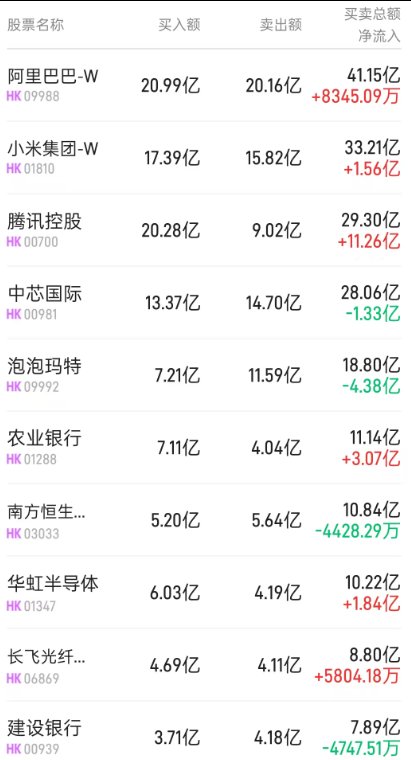
Market Overview - On December 9, the Hang Seng Index fell by 1.29%, closing at 25,434.23 points, with a net inflow of HKD 531 million through the southbound trading channel [1][2] - The total trading volume for the southbound trading on December 9 was HKD 96.695 billion, with a net buying of HKD 531 million [1] Southbound Trading Details - In the Shanghai Stock Exchange southbound trading, the total trading amount was HKD 60.3 billion, with a net selling of HKD 35.2 million; in the Shenzhen Stock Exchange, the total trading amount was HKD 36.396 billion, with a net buying of HKD 88.3 million [1] - The top active stocks in the southbound trading included Alibaba-W, Xiaomi Group-W, and Tencent Holdings, with trading amounts of HKD 41.15 billion, HKD 33.21 billion, and HKD 29.30 billion respectively [1][2] Stock Performance - In terms of net buying, Tencent Holdings led with a net buying amount of HKD 112.56 million, despite a closing price drop of 0.41% [1][2] - The stock with the highest net selling was Pop Mart, with a net selling amount of HKD 43.83 million, closing down by 5.04% [1][2] - In the Shenzhen Stock Exchange, Alibaba-W had a trading amount of HKD 32.37 billion, followed by Tencent Holdings and SMIC with amounts of HKD 19.87 billion and HKD 15.03 billion respectively [2] Summary of Active Stocks - The top ten active stocks in the southbound trading included: - Alibaba-W: Trading amount of HKD 411.5 million, net buying of HKD 83.45 million, down by 1.63% - Xiaomi Group-W: Trading amount of HKD 332.1 million, net buying of HKD 156.18 million, down by 3.10% - Tencent Holdings: Trading amount of HKD 293.0 million, net buying of HKD 112.56 million, down by 0.41% - Pop Mart: Trading amount of HKD 188.0 million, net selling of HKD 43.83 million, down by 5.04% [2]

智通港股通活跃成交|12月9日
智通财经网· 2025-12-09 11:03
Core Insights - On December 9, 2025, Alibaba-W (09988), Xiaomi Group-W (01810), and Tencent Holdings (00700) were the top three companies by trading volume in the southbound trading of the Stock Connect, with trading amounts of 4.115 billion, 3.321 billion, and 2.930 billion respectively [1] - In the Shenzhen-Hong Kong Stock Connect, Alibaba-W (09988), Tencent Holdings (00700), and SMIC (00981) led the trading volume, with amounts of 3.237 billion, 1.987 billion, and 1.503 billion respectively [1] Southbound Trading Highlights - **Top Active Companies in Southbound Trading (Shanghai-Hong Kong Stock Connect)** - Alibaba-W (09988): Trading amount of 4.115 billion, net inflow of 83.45 million [2] - Xiaomi Group-W (01810): Trading amount of 3.321 billion, net inflow of 156 million [2] - Tencent Holdings (00700): Trading amount of 2.930 billion, net inflow of 1.126 billion [2] - SMIC (00981): Trading amount of 2.806 billion, net outflow of 133 million [2] - Pop Mart (09992): Trading amount of 1.880 billion, net outflow of 438 million [2] - **Top Active Companies in Southbound Trading (Shenzhen-Hong Kong Stock Connect)** - Alibaba-W (09988): Trading amount of 3.237 billion, net inflow of 342 million [2] - Tencent Holdings (00700): Trading amount of 1.987 billion, net outflow of 248 million [2] - SMIC (00981): Trading amount of 1.503 billion, net inflow of 14.69 million [2] - Xiaomi Group-W (01810): Trading amount of 1.203 billion, net inflow of 384 million [2] - Pop Mart (09992): Trading amount of 1.016 billion, net outflow of 136 million [2]
港股科技投资迎来新“坐标”港交所科技100指数发布 联想、宁德时代等入选
智通财经网· 2025-12-09 10:25
Core Viewpoint - The Hong Kong Stock Exchange (HKEX) has launched the HKEX Technology 100 Index, marking its first technology-focused stock index for Hong Kong stocks [1][2] Group 1: Index Composition and Criteria - The HKEX Technology 100 Index includes the largest 100 technology companies listed on the Hong Kong Stock Exchange, covering sectors such as artificial intelligence, biotechnology, electric vehicles, information technology, internet, and robotics [1] - Component stocks must meet specific liquidity and R&D growth criteria: an average daily trading volume of at least HKD 20 million over the past six months and either R&D spending exceeding 3% of revenue or revenue growth exceeding 5% over the past two years [1][2] - Notable companies included in the index are Tencent Holdings, Alibaba Group, BYD Company, and Meituan, among others [1] Group 2: Index Calculation and Adjustment - The index uses a free-float market capitalization weighting method, with a maximum weight of 12% for any single component stock [2] - Component stocks will be adjusted biannually in June and December, with data cut-off dates on the last trading day of April and October each year [2] - Stocks with an average daily trading amount below HKD 20 million over the past six months or those ranking in the bottom 10% by trading volume will be excluded [2] Group 3: Market Implications - The index aims to identify technology stocks with market momentum and growth potential, which may enhance the development of related products in the mainland Chinese market [2] - It addresses the strong demand from mainland investors for opportunities in the Hong Kong technology sector, aligning with the investment needs of southbound capital [2]


港股科技投资迎来新“坐标”港交所科技100指数发布 联想(00992)、宁德时代(03750)等入选
智通财经网· 2025-12-09 10:22
Core Viewpoint - The Hong Kong Stock Exchange (HKEX) has launched the Hong Kong Stock Exchange Technology 100 Index, marking its first technology-focused stock index [1] Group 1: Index Composition and Criteria - The Technology 100 Index includes stocks that meet specific liquidity and R&D growth criteria: an average daily trading volume of at least HKD 20 million over the past six months and R&D expenditure accounting for over 3% of revenue or revenue growth exceeding 5% over the past two years [1][2] - Selected companies include major players such as Tencent Holdings, Alibaba Group, CATL, Lenovo Group, Xiaomi Group, BYD, Meituan, SMIC, and WuXi AppTec [1] Group 2: Index Methodology - The index is calculated using a free-float market capitalization weighting method, with a maximum weight of 12% for any single constituent [2] - Constituents will be reviewed and adjusted biannually in June and December, with data cut-off dates on the last trading day of April and October [2] - The index aims to select technology stocks with market interest and growth potential, catering to the demand from mainland investors for technology investment opportunities in the Hong Kong market [2]

港股科技投资迎来新“坐标”港交所科技100指数发布 腾讯、联想、宁德时代等入选
Ge Long Hui· 2025-12-09 10:17
Core Viewpoint - Hong Kong Exchanges and Clearing Limited (HKEX) has launched the Hang Seng Tech 100 Index, the first index for Hong Kong stocks, which tracks the performance of the largest 100 technology companies listed on the Hong Kong Stock Exchange [1] Group 1: Index Composition and Criteria - The Hang Seng Tech 100 Index includes companies that meet specific liquidity and growth criteria: a minimum average daily trading volume of HKD 20 million over the past six months and either R&D expenditure accounting for over 3% of revenue or revenue growth exceeding 5% over the past two years [1][2] - Selected companies include major players such as Tencent Holdings, Alibaba Group, BYD Company, and Xiaomi Group, among others [1] - The index covers six innovation themes: artificial intelligence, biotechnology and pharmaceuticals, electric vehicles and smart driving, information technology, internet, and robotics [1] Group 2: Index Methodology and Adjustments - The index uses a free-float market capitalization weighting method, with a cap of 12% on the weight of any single constituent [1] - Constituents are reviewed and adjusted biannually, with data cut-off dates at the end of April and October each year [1] Group 3: Liquidity and Fundamental Requirements - The index has strict liquidity and fundamental requirements: securities with an average daily trading amount below HKD 20 million or ranking in the bottom 10% by trading volume will be excluded [2] - Companies with R&D spending below 3% of revenue or revenue growth below 5% over the past two fiscal years will also be excluded, although companies listed under Chapter 18A or 18C may be exempt from these fundamental requirements [2] - This design aims to select technology stocks with market interest and growth potential, facilitating the development of related products in the mainland Chinese market and meeting the demand for technology investments from mainland investors [2]
北水动向|北水成交净买入5.31亿 科网股重获内资加仓 内银及芯片股继续分化
智通财经网· 2025-12-09 10:03
Core Insights - The Hong Kong stock market saw a net inflow of 531 million HKD from Northbound trading on December 9, with a net sell of 352 million HKD through the Shanghai Stock Connect and a net buy of 883 million HKD through the Shenzhen Stock Connect [1] Group 1: Stock Performance - Tencent (00700) received a net buy of 877 million HKD, while Alibaba (09988) had a net buy of 425 million HKD [5] - Xiaomi Group (01810) experienced a net buy of 539 million HKD [5] - Agricultural Bank (01288) saw a net buy of 306 million HKD, whereas China Construction Bank (00939) faced a net sell of 47.47 million HKD [6] - Huahong Semiconductor (01347) had a net buy of 250 million HKD, while SMIC (00981) experienced a net sell of 118 million HKD [6] - Innovent Biologics (01801) received a net buy of 179 million HKD [6] - Three Biopharmaceuticals (01530) faced a net sell of 91.39 million HKD due to a planned share placement [7] Group 2: Market Trends and Predictions - Analysts predict that AI integration will accelerate, benefiting Tencent through AI advertising and gaming, with expected revenue growth exceeding 10% and profit growth over 16% by fiscal year 2026 [5] - Xiaomi is expected to announce more AI developments that will enhance its ecosystem and support its "people, vehicle, home" strategy [5] - The banking sector is expected to see improved valuations as the negative impact of asset risks on financial indicators diminishes [6] - The U.S. will allow NVIDIA to sell AI chips to approved Chinese customers, which may influence the semiconductor market dynamics [6]
南向资金|腾讯控股获净买入8.78亿港元




Di Yi Cai Jing· 2025-12-09 09:57
南向资金净买入5.31亿港元,腾讯控股、小米集团-W、阿里巴巴-W净买入额位列前三,分别获净买入 8.78亿港元、5.40亿港元、4.25亿港元。净卖出方面,泡泡玛特、中芯国际、三生制药分别遭净卖出5.74 亿港元、1.18亿港元、0.91亿港元。 (本文来自第一财经) ...
中芯国际跌0.75%,成交额43.34亿元,今日主力净流入-4.40亿
Xin Lang Cai Jing· 2025-12-09 07:38
Core Viewpoint - SMIC's stock price decreased by 0.75% on December 9, with a trading volume of 4.334 billion yuan and a market capitalization of 930.593 billion yuan [1] Group 1: Company Overview - SMIC is the largest integrated circuit manufacturing enterprise group in mainland China, known for its advanced technology and comprehensive support [3] - The company specializes in integrated circuit wafer foundry services based on various technology nodes and platforms, offering design services, IP support, and photomask manufacturing [3] - As of September 30, 2025, SMIC reported a revenue of 49.51 billion yuan, representing a year-on-year growth of 18.22%, and a net profit of 3.818 billion yuan, with a growth of 41.09% [7] Group 2: Investment and Shareholding - The National Integrated Circuit Industry Investment Fund holds a 1.61% stake in SMIC [2] - As of September 30, 2025, the number of shareholders in SMIC increased to 336,200, with an average of 6,134 shares per shareholder, a decrease of 25.41% from the previous period [7] - Major shareholders include various ETFs, with notable reductions in holdings from several funds [8][9] Group 3: Market Activity - The main capital flow for SMIC showed a net outflow of 447 million yuan today, with no significant trend in capital movement [4] - The average trading cost of SMIC shares is 121.93 yuan, with the stock price approaching a resistance level of 119.22 yuan, indicating potential for a price correction if this level is not surpassed [6]