
SMIC(00981)

Search documents
未知机构:高盛中芯国际SMIC中芯国际2025年第四季度营业利润-20260213
未知机构· 2026-02-13 02:25
Summary of Conference Call on SMIC (Semiconductor Manufacturing International Corporation) Company Overview - **Company**: Semiconductor Manufacturing International Corporation (SMIC) - **Industry**: Semiconductor Manufacturing Key Points Capacity Expansion - In Q4 2025, SMIC's operating profit exceeded expectations, with the company adding 49,000 12-inch wafers per month for the entire year of 2025, while maintaining a high capacity utilization rate. This growth is attributed to the rising demand driven by AI trends, supply chain restructuring opportunities, and the "local production for local consumption" model [1] - For 2025, capital expenditures reached $2.4 billion, a 1% increase quarter-over-quarter, and $8.1 billion for the year, an 11% increase year-over-year, surpassing management's previous expectations of flat growth. This increase is primarily due to strong end-user demand and early equipment deliveries [2] - High demand for AI-related products, including domestic GPUs, data center power semiconductors, and edge AI device chips, is expected to drive capital expenditures to $9 billion in 2026, an 11% year-over-year increase [2] Revenue Growth - Revenue growth in 2026 will be primarily driven by AI and domestic demand. Despite rising storage costs leading to reduced orders from smartphone and consumer electronics clients, growth in AI and mid-to-high-end product orders is expected to offset this impact. Key areas of demand growth include storage-related semiconductors, data center connectivity (optical/electrical), and BCD process power semiconductors [3] - Management anticipates that domestic fabless companies will continue to gain market share in areas such as analog, source information, display drivers, CIS, storage, and MCUs. The target for Q1 2026 is to maintain capacity utilization at the Q4 2025 level of 95.7%, which is deemed achievable under solid demand support [3] Profitability Adjustments - Following the Q4 2025 performance and Q1 2026 guidance, net profit expectations for 2026-2029 have been revised down by 10%-14%, primarily due to adjustments in non-operating components. Revenue, gross margin, and operating profit expectations remain largely unchanged [4] - Although Q4 2025 operating profit exceeded expectations, net profit fell short due to higher-than-expected interest expenses and tax rates. Goldman Sachs has adopted a more cautious stance on non-operating components, particularly regarding interest rate assumptions, leading to the downward revision of net profit expectations [4]

半导体:中芯国际与华虹业绩解读-产能满载,下一季度增长前景平淡-Asia Semiconductors SMIC and Hua Hong results - Fully loaded a flat quarter ahead
2026-02-13 02:18
Summary of Conference Call on SMIC and Hua Hong Semiconductor Industry Overview - The conference call focused on the semiconductor industry, specifically the performance and outlook of two major companies: SMIC (Semiconductor Manufacturing International Corporation) and Hua Hong Semiconductor Limited. Key Points on SMIC 1. **4Q25 Financial Performance**: - Revenue reached **US$2.49 billion**, a **4.5% QoQ increase** supported by higher wafer shipments and improved product mix. Gross margin was **19.2%** with utilization at **95.7%** [2][14] 2. **1Q26 Guidance**: - SMIC expects flat revenue QoQ with a gross margin of **18-20%**. The company anticipates continued high utilization and similar capital expenditures in 2026 compared to 2025 [1][3] 3. **Challenges Ahead**: - Management indicated that 2026 will be challenging due to rising depreciation costs, projected to increase by **~30% YoY**. Despite short-term weaknesses in smartphone demand, medium-term demand driven by AI remains positive [3][11] 4. **Domestic Market Focus**: - Approximately **85%** of SMIC's revenue comes from China-based customers, with domestic revenue growing **18% YoY**. The company is benefiting from localization trends in various product segments [2][3] 5. **Target Price Adjustment**: - Target price raised to **HK$75** from **HK$53**, reflecting the company's leadership in advanced nodes and solid domestic demand [1][17] Key Points on Hua Hong 1. **4Q25 Financial Performance**: - Revenue was **US$659.9 million**, a **22.4% YoY increase** and **3.9% QoQ increase**, with a gross margin of **13%**. Utilization was exceptionally high at **103.8%** [9][22] 2. **1Q26 Guidance**: - Revenue is expected to be between **US$650-660 million** with a gross margin of **13-15%**. The company is progressing with capacity expansion, particularly in its 12-inch line [9][22] 3. **Demand Drivers**: - Demand is supported by AI-related applications and recovering consumer electronics, with over **80%** of revenue coming from China. Key growth areas include MCU, memory, and power management products [10][12] 4. **Target Price Adjustment**: - Target price increased to **HK$115** from **HK$105**, based on strong order momentum in discrete devices and power management, driven by AI hardware expansion [1][21] Additional Insights - **Market Dynamics**: Both companies are navigating a challenging environment with margin pressures due to rising costs and competitive dynamics. However, they are optimistic about the long-term growth potential driven by AI and domestic demand [1][3][12] - **Investment Ratings**: - Hua Hong is rated as a **Buy** due to its strong growth prospects, while SMIC is rated **Neutral** due to ongoing challenges and high depreciation costs [13][49] Conclusion - The semiconductor industry, particularly in China, is experiencing a mix of challenges and opportunities. Both SMIC and Hua Hong are positioned to benefit from domestic demand and AI-driven growth, although they face margin pressures and competitive dynamics.

半导体早参 | 深圳:以AI芯片为突破口做强半导体产业;中芯国际表示存储器、BCD供不应求,都在涨价
Mei Ri Jing Ji Xin Wen· 2026-02-13 01:59
Industry Overview - The Shenzhen Municipal Bureau of Industry and Information Technology has issued the "Artificial Intelligence + Advanced Manufacturing Action Plan (2026-2027)", aiming to promote the application of AI technology in key areas of the semiconductor industry, enhancing efficiency in chip design and software coding [1] - The plan focuses on developing high-performance, energy-efficient SoC chips for various AI terminal demands, including AI smartphones and intelligent robots, and supports the domestic replacement of automotive-grade AI chips for the new energy vehicle market [1] Company Updates - SMIC announced that its memory and BCD products are in high demand, leading to price increases [2] - Hua Hong Semiconductor reported a record high sales revenue of $659.9 million in Q4, a year-on-year increase of 22.4% and a quarter-on-quarter increase of 3.9%. The gross margin was 13.0%, up 1.6 percentage points year-on-year but down 0.5 percentage points quarter-on-quarter. The company expects Q1 2026 sales revenue to be between $650 million and $660 million, with a gross margin of 13% to 15% [2] - Aerospace Zhizhuang stated that it has provided chips for the GW-A2 constellation but is unclear about the specific launch mission's usage. The company cannot estimate the impact of the launch on its Q1 2026 operations [2] - Debon Securities noted that the semiconductor upstream sector showed overall growth in 2025, with semiconductor equipment performing better than materials and components, and packaging and testing outperforming wafer foundry [2] Related ETFs - The Sci-Tech Semiconductor ETF (588170) tracks the Shanghai Stock Exchange Sci-Tech Board Semiconductor Materials and Equipment Index, focusing on semiconductor equipment (60%) and materials (25%) [3] - The Semiconductor Equipment ETF (Hua Xia, 562590) also emphasizes semiconductor equipment (63%) and materials (24%), benefiting from the demand surge driven by the AI revolution and advancements in lithography technology [3]


深圳:以AI芯片为突破口做强半导体产业;中芯国际表示存储器、BCD供不应求,都在涨价
Mei Ri Jing Ji Xin Wen· 2026-02-13 01:57
Industry Insights - Shenzhen Municipal Bureau of Industry and Information Technology has issued the "Artificial Intelligence + Advanced Manufacturing Action Plan (2026-2027)", aiming to promote the application of AI technology in key areas of the semiconductor industry, enhancing efficiency in chip design and software coding [2] - SMIC announced that its memory and BCD products are in short supply, leading to price increases [2] - Hua Hong Semiconductor reported a record high sales revenue of $659.9 million in Q4, a year-on-year increase of 22.4% and a quarter-on-quarter increase of 3.9%. The gross margin was 13.0%, up 1.6 percentage points year-on-year but down 0.5 percentage points quarter-on-quarter. The net profit attributable to shareholders was $17.5 million, compared to a loss of $25.2 million in the same period last year [2] Company Developments - Aerospace Intelligence stated that it has provided chips for the GW-A2 constellation, but the specific usage for the launch mission is unclear. The company cannot estimate the impact of the launch on its Q1 2026 operations [3] - Debon Securities noted that the semiconductor upstream sector showed overall growth in 2025, with semiconductor equipment performing better than materials and components, and packaging and testing outperforming wafer foundry [3] Related ETFs - The Sci-Tech Semiconductor ETF (588170) and its linked funds track the Sci-Tech Board Semiconductor Materials and Equipment Index, focusing on semiconductor equipment (60%) and materials (25%) [3] - The Semiconductor Equipment ETF Huaxia (562590) and its linked funds emphasize semiconductor equipment (63%) and materials (24%), targeting the upstream semiconductor sector [3]
南向1.41万亿“压舱” 韩国散户“点火”——港股迎来定价权分层时代
Zhi Tong Cai Jing· 2026-02-13 01:53
Core Insights - The Hong Kong stock market is experiencing two distinct but resonant waves of incremental capital from mainland China and South Korean retail investors, with mainland southbound funds achieving a record net purchase of 1.41 trillion HKD, establishing themselves as core builders of pricing power in the market [1][10] - Southbound funds are characterized by long-term value investment, while South Korean retail investors engage in high-frequency trading and narrative-driven investments, creating a diversified funding source and a layered pricing logic in the Hong Kong market [1][10] Funding Scale and Structure - Southbound funds have become the core incremental source and valuation system reshaper for the Hong Kong market, with a cumulative net inflow of 5.11 trillion HKD by the end of 2025, and a market value exceeding 6.3 trillion HKD, accounting for 12.7% of the total market [2] - South Korean retail investors, while having a smaller capital scale, exhibit concentrated trading behavior and significant leverage, particularly impacting specific sectors like new economy IPOs and the semiconductor industry [2][5] Industry Preferences - Southbound funds focus on financials and high-dividend utilities, with significant investments in major banks and state-owned enterprises driven by high dividend yields and low valuation levels, while South Korean investors show minimal interest in these sectors [3][5] - South Korean retail investors heavily invested in Xiaomi and MiniMax-WP, demonstrating a high turnover and narrative-driven trading approach, contrasting with the stable, long-term holdings of Southbound funds [5][8] Trading Behavior and Decision-Making - Southbound funds exhibit a decision-making anchor based on dividend yield, ROE stability, and free cash flow generation, characterized by continuous accumulation and stable holdings, as seen with significant net purchases in major banks [8][9] - South Korean retail investors, on the other hand, are driven by industry narrative strength and social media trends, with a high frequency of trading and a tendency to hold stocks for less than three months, reflecting a stark contrast to the long-term holding strategy of Southbound funds [9][10] Market Dynamics - The influx of South Korean retail investors into the Hong Kong market represents a diversification of the investor base, providing liquidity while also potentially increasing volatility during certain periods [9][10] - The interaction between Southbound funds and South Korean retail investors is creating a new normal in the Hong Kong market characterized by layered pricing and concurrent narratives, necessitating both stable investment strategies and agile trading approaches [10]







6股目标价涨幅超20%,中芯国际涨超45%
2 1 Shi Ji Jing Ji Bao Dao· 2026-02-13 01:34
Group 1 - The core viewpoint of the article highlights that on February 12, brokerage firms set target prices for listed companies, with 9 instances recorded, and 6 stocks showing target price increases exceeding 20% [1] - The companies with the highest target price increases based on the latest closing prices include SMIC, Kelun Pharmaceutical, and Yaxing Integration, with increases of 45.82%, 42.98%, and 34.30% respectively [1] - The sectors represented by these companies are semiconductor, chemical pharmaceuticals, and professional engineering [1]


盘前公告淘金:中芯国际称存储器、BCD供不应求,都在涨价;协创数据拟不超110亿元采购服务器
Jin Rong Jie· 2026-02-13 01:08
Important Matters - SMIC reports that both memory chips and BCD are in short supply, leading to price increases [1] - Victory Technology has achieved industrialization of 1.6T optical module PCBs [1] - Chuangxin Data plans to procure servers for cloud computing services, with a budget not exceeding 11 billion yuan [1] Investments & Contracts - Jingrui Materials intends to invest 600 million yuan to build a key materials base for the integrated circuit manufacturing industry in the western region [1] - Wenzhou Hongfeng plans to raise no more than 450 million yuan for the expansion of lithium battery copper foil and electronic copper foil projects [1] - Huadian Co. plans to invest 3.3 billion yuan in a new high-end printed circuit board production project to meet long-term demand for high-speed computing servers [1] - United Optoelectronics has signed a business cooperation framework contract with Lingzhi Cloud to provide assembly and processing services for robotics [1] - Aerospace Rainbow participates in the strategic placement of the IPO of Electric Science Blue Sky, aligning with long-term development strategies [1] - Hanbo High-tech's subsidiary, Chip East, plans to acquire assets to enter the wet electronic chemicals industry [1] - China Communications Construction Company expects to sign new contracts worth 1.88 trillion yuan in 2025, a year-on-year increase of 0.13% [1] - China Metallurgical Group signed new contracts worth 73.65 billion yuan in January [1] - Penghui Energy plans to invest a total of 3.3 billion yuan in battery and cell production projects [1] - Zhiguang Electric's subsidiary has received a 210 million yuan order for energy storage equipment [1] - Terui De is expected to win a bid for a 137 million yuan EPC general contracting project [1] Performance - Huahong Semiconductor reports Q4 2025 sales revenue of 659.9 million USD, a year-on-year increase of 22.4% [2] - Luan Energy reports a 16.8% year-on-year increase in coal sales in January [2] - Jinchengzi's performance report shows a net profit of 37.26 million yuan in 2025, a year-on-year increase of 22.2% [2] - Youyan Powder Materials reports a net profit of 70.91 million yuan in 2025, a year-on-year increase of 19.41% [2] Share Buybacks & Increases - Youkeshu's actual controller plans to increase company shares, with the stock name changing to "Xingyun Technology" [2] - Haikou Group's shareholder, Hainan Expressway, plans to increase its holdings by 40 to 50 million yuan [2] Others - International Composite Materials states that electronic-grade glass fiber is a fundamental raw material for printed circuit boards (PCBs) [2]
中芯国际:四季度营收超公司指引-20260213
Orient Securities· 2026-02-13 00:25
Investment Rating - The report maintains a "Buy" rating for the company with a target price of 150.27 CNY [4][11] Core Insights - The company reported Q4 revenue of 2.49 billion USD, exceeding its guidance, with a quarter-on-quarter growth of 12.8% and a year-on-year growth of 4.5% [10] - The company is expected to benefit from the ongoing domestic substitution in the supply chain, with a projected 18% year-on-year revenue growth from Chinese customers in 2025 [10] - The company is focusing on increasing the proportion of high-value-added products, with a 1.5% quarter-on-quarter growth in wafer revenue in Q4 2025 [10] Financial Forecast and Investment Recommendations - The forecasted net profit attributable to the parent company for 2025-2027 is 5.04 billion, 6.74 billion, and 8.04 billion CNY respectively, with adjustments made to gross margin and expense ratios [4][11] - The company’s revenue is projected to grow from 45.25 billion CNY in 2023 to 90.36 billion CNY in 2027, reflecting a compound annual growth rate [6][14] - The gross margin is expected to stabilize around 21.9% in 2025 and 2027, with net profit margins improving gradually [6][14]
韩国投资者加码港股市场 科技板块受追捧 扫货MINIMAX-WP、英诺赛科
Zhi Tong Cai Jing· 2026-02-12 22:59
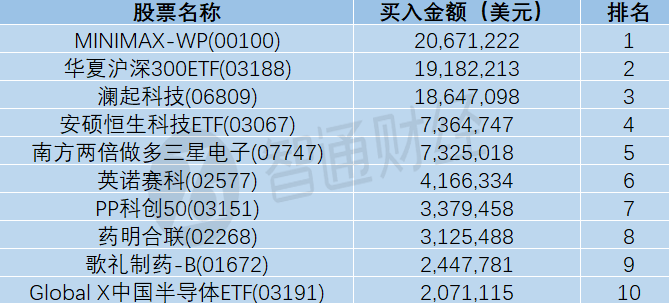
Group 1 - Korean investors have shown increasing enthusiasm for Chinese assets, with a total investment exceeding $88 million in the top ten stocks as of February 10, 2026 [3] - The top ten stocks purchased by Korean investors include MINIMAX-WP, Huaxia CSI 300 ETF, and Lanke Technology, with respective investments of $20.67 million, $19.18 million, and $18.64 million [1][2] - There is a noticeable shift in Korean investment focus towards emerging technology companies in China, compared to 2025, where the top investments were in companies like Xiaomi and Alibaba [4] Group 2 - The investment amounts for the top ten stocks in 2026 are as follows: MINIMAX-WP ($20.67 million), Huaxia CSI 300 ETF ($19.18 million), Lanke Technology ($18.64 million), and others, indicating a diverse interest in various sectors [2][4] - In 2025, the top investments were led by Xiaomi Group ($87.75 million) and Global X China Semiconductor ETF ($7.40 million), highlighting a different investment landscape compared to 2026 [5]

2月12日南向资金追踪:腾讯控股、小米集团-W、美团-W净买入额居前,分别为14.29亿港元、10.20亿港元、9.85亿港元
Jin Rong Jie· 2026-02-12 15:01
Market Overview - The Hang Seng Index fell by 0.86%, closing at 27,032.54 points, with a total market turnover of 238.705 billion HKD [1] Southbound Trading Data - Tencent Holdings, Xiaomi Group-W, and Meituan-W saw net purchases of 1.429 billion HKD, 1.020 billion HKD, and 0.985 billion HKD respectively [1][2] - WuXi Biologics, Zijin Mining, and Pop Mart experienced net sales of 0.392 billion HKD, 0.346 billion HKD, and 0.301 billion HKD respectively [1][2] Individual Stock Performance - Tencent Holdings had a trading volume of 12.026 billion HKD, with a net buy of 1.429 billion HKD, closing at 535.50 HKD, down by 2.28% [2] - Xiaomi Group-W recorded a trading volume of 27.46 billion HKD, with a net buy of 1.020 billion HKD, closing at 36.52 HKD, down by 1.56% [2] - Meituan-W had a trading volume of 38.31 billion HKD, with a net buy of 0.985 billion HKD, closing at 84.85 HKD, down by 4.50% [2] - Pop Mart had a trading volume of 21.899 billion HKD, with a net sell of 0.301 billion HKD, closing at 252.20 HKD, down by 1.10% [2] - WuXi Biologics had a trading volume of 6.99 billion HKD, with a net sell of 0.392 billion HKD, closing at 41.34 HKD, down by 0.14% [2] - Zijin Mining had a trading volume of 9.64 billion HKD, with a net sell of 0.346 billion HKD, closing at 45.02 HKD, up by 3.45% [2]
