
LENOVO GROUP(00992)

Search documents
联想(00992.HK)阿木:开放创新,联想阿木在WAIC 2025公布多项AI终端原生技术创新开启AI人机交互新纪元
Xin Lang Cai Jing· 2025-07-26 13:03
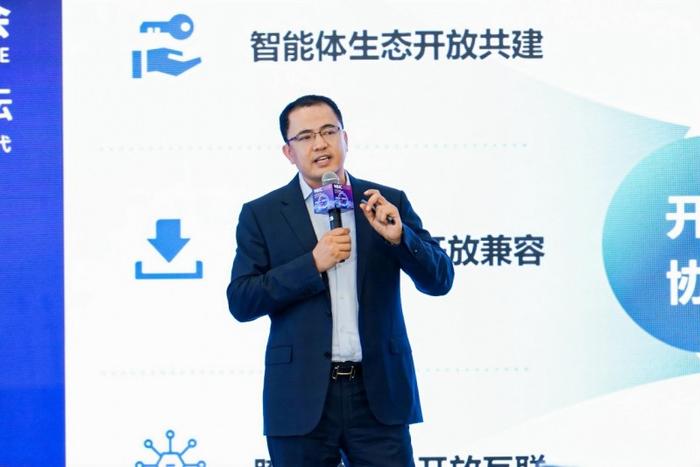
Core Insights - The 2025 World Artificial Intelligence Conference (WAIC 2025) commenced in Shanghai, highlighting the evolution of AI terminals as the third generational upgrade in the terminal industry, with personal super intelligent agents becoming the native human-machine interaction system [1][3] - Lenovo is leading the AI terminal market with its "one body, multiple ends" strategy, having launched the world's first AI PC and the first personal super intelligent agent, Tianxi, which integrates across various devices [3][4] Industry Developments - The AI terminal industry is undergoing significant transformation, moving from "functional terminals" and "internet terminals" to "AI terminals," which create a "silicon-based avatar" for users [4][5] - Key transformations in AI terminals include upgrades in interaction methods and innovations in computing architecture, with personal super intelligent agents offering proactive services through multimodal interaction and autonomous planning [4][5] Company Innovations - Lenovo's AI terminal strategy encompasses the Tianxi personal super intelligent agent, which serves as the "AI brain" for devices, and includes AI PCs, AI smartphones, AI tablets, and AIoT devices [4][7] - The Tianxi agent features four core capabilities: perception, cognition, execution, and security, operating in a seamless end-cloud integration [5][7] - Lenovo has defined five core characteristics for its AI PCs, which now account for over 20% of its total laptop sales, with a user net promoter score (NPS) exceeding 40 [7][8] Ecosystem Development - Lenovo is focused on building a prosperous AI terminal ecosystem, having established three main ecological systems: intelligent agents, models, and terminal systems, with over 2,000 developers participating in the Tianxi AI space [8][10] - The company emphasizes open collaboration and innovation to enhance the global competitiveness of China's AI terminal industry, advocating for cross-brand interoperability and innovative user experiences [10][11]


不足10人的团队,如何撬开华为生态?
Hu Xiu· 2025-07-26 01:05
Core Viewpoint - The article discusses the emergence of ChatExcel, an AI-powered office tool that simplifies Excel data processing through conversational input, highlighting its rapid adoption and the strategic vision of its CEO, Tang Dahuai, in navigating the competitive landscape of AI and SaaS [3][6][41]. Group 1: Product Overview - ChatExcel is an AI office assistant that allows users to interact with Excel through text commands, eliminating the need for manual formula entry [6][28]. - The product was launched in beta on February 28, 2023, and achieved a peak daily active user count of 150,000 within two weeks, with over 10 million unique visits [7][30]. - The tool is positioned as a "data intelligence agent," initially targeting consumer users (ToC) before expanding to business clients (ToB) [8][28]. Group 2: Market Strategy - The company aims to leverage the current AI wave by first establishing a consumer base before transitioning to enterprise solutions, believing that user demand for AI tools is strong [5][41]. - Tang Dahuai emphasizes the importance of understanding user needs and iterating the product based on feedback, which has led to a significant increase in enterprise interest since mid-2023 [31][41]. - The pricing strategy includes a monthly subscription of 25.9 yuan and an annual fee of 99 yuan for individual users [51]. Group 3: Competitive Landscape - The CEO argues that competition from larger companies does not deter their progress, as they have maintained growth despite the presence of established players [34][35]. - The company differentiates itself by focusing on a comprehensive data processing approach, addressing data security concerns, and ensuring that sensitive information remains within the user's network [27][45]. - The team believes that the current market environment favors innovative startups, as users are increasingly willing to adopt new AI solutions [37][63]. Group 4: Future Directions - The company is exploring international expansion, with plans to launch an English version of ChatExcel and test the product in North America and Europe [57][60]. - There is a focus on continuous product iteration and maintaining user engagement through regular updates and improvements [39][40]. - The team is also considering the development of edge models to enhance enterprise service capabilities while managing delivery costs effectively [54][56].


对话联想创投王光熙:具身智能行业估值有泡沫,需要一两年消化
Xin Lang Cai Jing· 2025-07-25 02:17
Core Insights - The field of embodied intelligence and robotics has become one of the hottest investment sectors in 2023, with significant interest from top investment firms and tech giants, leading to rapid valuation increases [1][5] - Investment events in the embodied intelligence and robotics sector reached 114 in the first five months of 2025, surpassing the total of 77 events in 2024, with total financing amounting to 232 billion yuan, exceeding the 209 billion yuan from the entirety of 2024 [1] - There are ongoing debates regarding the commercialization challenges within the robotics industry, with some investors expressing skepticism about the sustainability of high valuations [1][5] Investment Trends - Lenovo Ventures has been actively investing in the robotics sector for several years, focusing on various types of robots, including humanoid, multi-modal bipedal, medical, and industrial robots [2][9] - The firm acknowledges the presence of valuation bubbles in both primary and secondary markets, emphasizing that true business commercialization is necessary to address these bubbles over the next one to two years [5][7] Market Opportunities - The market for new scenarios in embodied intelligence is viewed as potentially vast, with estimates suggesting it could reach trillions or even tens of trillions in value [7][11] - Companies that have been in the robotics field for years are beginning to see the benefits of their investments as they expand into new applications and markets [7][11] Future Outlook - The next two to three years are expected to be crucial for companies in the embodied intelligence sector to demonstrate commercially viable products in controlled environments [11][12] - There is optimism about the potential for embodied intelligence to significantly reduce costs and improve efficiency across various industries, although the exact market share it will capture remains uncertain [12]
Counterpoint Research:二季度全球PC出货量同比增长8.4% 关税担忧加剧
智通财经网· 2025-07-24 01:23
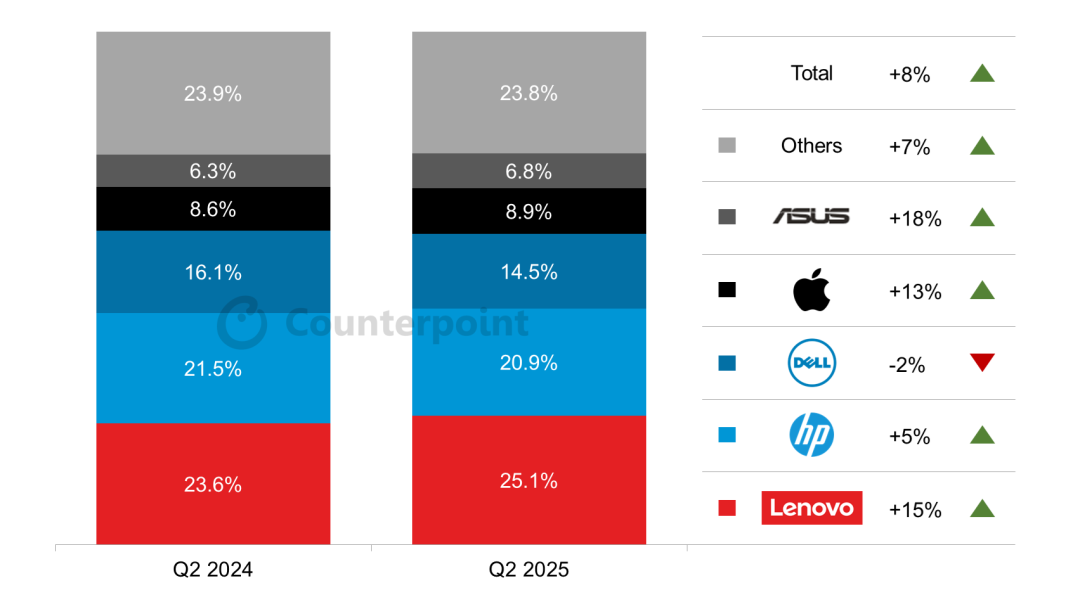
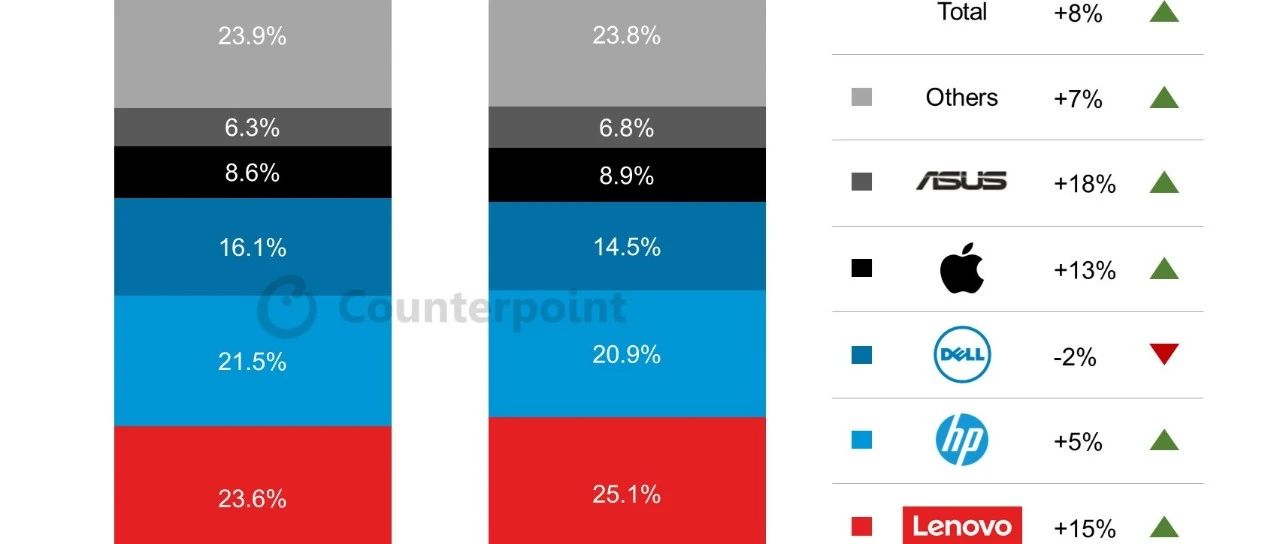
Group 1 - Global PC shipments are expected to grow by 8.4% year-on-year in Q2 2025, marking the largest increase since the peak demand during the pandemic in 2022 [1] - The growth is driven by the countdown to the end of Windows 10 support, the rise of AI PCs, and early inventory stocking in anticipation of back-to-school demand amid tariff policy uncertainties [1][4] - Business demand is a significant contributor to this quarter's growth, as large enterprises and public institutions accelerate device upgrades before the Windows 10 support deadline at the end of 2025 [1][4] Group 2 - Lenovo leads the global PC market with a 25% shipment share, benefiting from pre-tariff inventory adjustments and the replacement cycle of Windows 10 [4] - HP and Dell follow in second and third place, maintaining stable enterprise demand but facing price competition from smaller OEMs [4] - Apple’s MacBook sales remain steady, supported by the M4 series, although growth rates have slowed compared to previous quarters [4] Group 3 - Future PC shipment growth may slow in the second half of 2025 due to uncertainties surrounding U.S. tariff policies, but demand for AI PCs is expected to become a significant growth driver by 2026 [4][5] - Counterpoint predicts that over half of the laptops shipped after 2026 will be AI laptops [4][6] - Manufacturers are prioritizing the establishment of reliable and cost-effective supply chains for products aimed at the U.S. market to mitigate tariff impacts and reduce reliance on single-country manufacturing [5] Group 4 - The global PC industry is actively pursuing a diversification strategy in production layout to ensure stability and adaptability in the face of ongoing tariffs and trade uncertainties [5] - This strategic shift requires significant investment in factory infrastructure, employee training, and logistics, highlighting a major transformation in the global PC manufacturing landscape [5] - Companies that prepare in terms of price competitiveness and ecosystem readiness are expected to gain an advantage in the next wave of PC upgrades [6]

联想申请一种处理方法及电子设备专利,基于设定调度策略更新离群点特征通道索引集合
Jin Rong Jie· 2025-07-23 10:36
Group 1 - Lenovo (Beijing) Co., Ltd. applied for a patent titled "A Processing Method and Electronic Device," with publication number CN120354948A, and the application date is April 2025 [1] - The patent abstract reveals a processing method that includes obtaining current input data and processing it based on a target model to derive current input activation values for a preset layer [1] - The method involves separating a first target column with outlier features from a second target column, utilizing an index collection of outlier feature channels to identify at least one outlier feature channel from the input source layer [1] Group 2 - Lenovo (Beijing) Co., Ltd. was established in 1992 and is primarily engaged in the manufacturing of computers, communications, and other electronic devices [2] - The company has a registered capital of 565 million Hong Kong dollars and has invested in 107 enterprises, participated in 5,000 bidding projects, and holds 1,751 trademark records and 5,000 patent records [2] - Additionally, the company possesses 238 administrative licenses [2]
2025年第二季度全球PC出货量:增长加速,关税担忧加剧
Counterpoint Research· 2025-07-23 09:15
Core Viewpoint - The global PC shipment volume is expected to grow by 8.4% year-on-year in Q2 2025, marking the largest increase since the pandemic peak in 2022, driven by the end of Windows 10 support, the rise of AI PCs, and early procurement due to anticipated tariff changes [2][4]. Group 1: Market Dynamics - The growth in Q2 2025 is primarily driven by demand from the commercial sector, as large enterprises and public institutions accelerate device upgrades ahead of the Windows 10 support deadline [2][6]. - Lenovo, Apple, and Asus all saw shipment increases exceeding 10%, further solidifying their market leadership [2][4]. - The global PC manufacturing industry remains highly concentrated in China, posing significant challenges in reducing tariff risks in the short term [2][6]. Group 2: Future Outlook - PC shipment growth may slow in the second half of 2025 due to uncertainties surrounding U.S. tariff policies, but demand for AI PCs is expected to become a significant growth driver by 2026 [6][8]. - Counterpoint predicts that over half of the laptops shipped in 2026 will be AI laptops, indicating a shift in market dynamics [6][9]. - The ongoing geopolitical landscape is prompting PC suppliers and manufacturers to diversify production away from China, with countries like Vietnam, India, and Mexico emerging as alternative manufacturing hubs [6][9]. Group 3: Strategic Adjustments - Ensuring a reliable and cost-effective supply chain for products aimed at the U.S. market has become a top priority for PC manufacturers [9]. - The transition to manufacturing outside of China is a long-term process that requires significant investment in infrastructure, employee training, and logistics [9]. - The diversification of production bases is a strategic response to mitigate risks associated with trade disruptions and to enhance competitiveness in a rapidly changing environment [9].

做联想集团“科技瞭望塔”, 联想创投如何赋能初创企业?
2 1 Shi Ji Jing Ji Bao Dao· 2025-07-23 05:52
Core Insights - The event "Silicon Evolution, Coexistence of All Things" showcased Lenovo's investment achievements in AI over the past decade, highlighting the rapid evolution of silicon-based intelligence and its integration with human creativity [1][2] - Lenovo Capital's support for the "Hybrid AI Strategy" was evident, with nearly 30 invested companies collaborating with Lenovo Group, integrating cutting-edge technology into practical applications [2][4] - The commercialization of embodied intelligence is at a critical turning point, with significant advancements expected in various sectors, particularly in complex industrial environments like automotive manufacturing starting in 2025 [2][3] Investment and Ecosystem Development - Lenovo Capital has invested in over 280 tech companies in nine years, with 20 achieving successful IPOs and over 50 unicorns in niche markets [4] - The company has identified three major advantages in China's development of embodied intelligence: rich application scenarios, innovative core components, and vast overseas market potential [3][4] - Lenovo Capital's "Star Plan," "Bright Plan," and "Spark Plan" form a comprehensive support system for startups, enhancing collaboration across the entire value chain [5] Technological Advancements - The focus on disruptive computing architectures includes advancements in integrated computing, quantum computing, RISC-V, and brain-like computing technologies [5] - The emergence of digital employees and robots is expected to enhance human-machine collaboration, driving the evolution of the AI ecosystem [5] - The development of a comprehensive transportation blueprint explores innovations in autonomous driving and low-altitude economies, contributing to a future integrated transportation network [5]
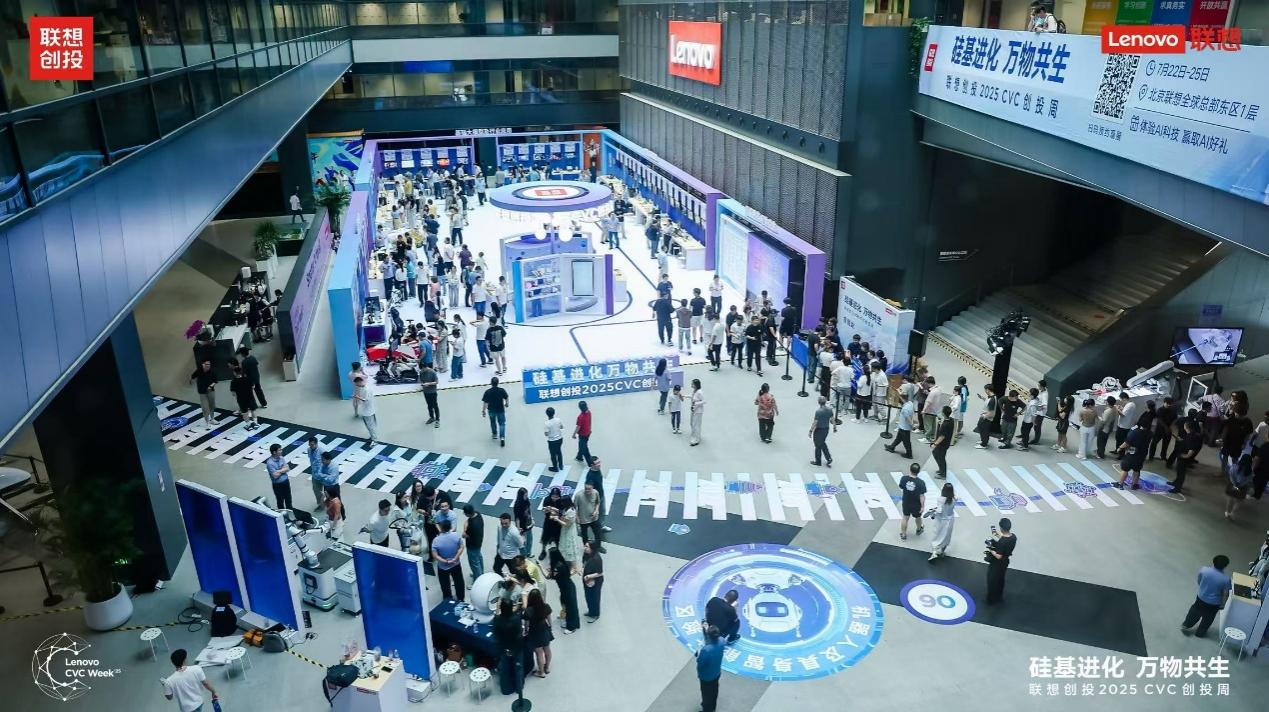
联想创投携手50余家被投企业晒“黑科技” 未来投资将聚焦三大关键领域
Zhong Guo Jin Rong Xin Xi Wang· 2025-07-22 09:53
Core Insights - Lenovo Ventures hosted the 2025 CVC Investment Week in Beijing, focusing on "Silicon-based Evolution and Symbiosis" and showcasing over 50 invested companies and their advancements in the silicon-based intelligent era [1][3] Group 1: Investment and Ecosystem - Lenovo Ventures has invested in over 280 technology companies in nine years, with 20 of them successfully going public and nurturing over 50 unicorns in niche sectors [7] - The CVC 2.0 model utilized by Lenovo Ventures leverages Lenovo's global brand influence, channel network, and efficient supply chain to create a robust business cooperation bridge between member companies and Lenovo Group [1][7] Group 2: AI and Technology Integration - The event featured immersive exhibition areas highlighting key segments of the silicon-based intelligent industry chain, including foundational computing power, innovative architectures, and upper-layer applications [3] - Lenovo Ventures has invested in over 50 AI-related companies over the past decade, showcasing top AI model companies and representative AI-native applications at the event [3] Group 3: Robotics and Intelligent Systems - The robotics and embodied intelligence exhibition area presented a diverse range of humanoid robots and advanced surgical robots, redefining the boundaries of precision medicine [5] - Companies like Xingdong Jiyuan and Kuawei Intelligent showcased humanoid robots, while other exhibitors presented various types of robots for industrial and medical applications [5] Group 4: Future Focus Areas - Lenovo Ventures will continue to focus on three key areas: the evolution of silicon-based intelligence to foster multi-agent ecosystems and AI application explosions, revolutionary computing architectures including integrated storage and computing, quantum computing, and brain-like computing, and the construction of a comprehensive transportation blueprint exploring autonomous driving and low-altitude economies [7]
8点1氪|肯德基回应老人占座打牌顾客站着;临期红色尖叫被炒到88元一瓶,农夫山泉回应;高铁一次性座椅套热销
3 6 Ke· 2025-07-22 00:12
Group 1 - Yushu Technology has initiated its IPO counseling with CITIC Securities as the advisory firm, aiming to submit its IPO application by October 2023 [2] - The capital competition in the embodied intelligence sector is intensifying, with multiple companies like Zhiyuan Robotics and others disclosing financing progress in July [2] - Goer Microelectronics has re-submitted its listing application to the Hong Kong Stock Exchange, with several financial institutions acting as joint sponsors [2] Group 2 - The first national standard for campus meal services will be implemented on December 1, 2023, aimed at enhancing food safety in schools [5] - Good Products has been involved in a share transfer dispute amounting to 996 million yuan, with the case currently accepted by the Guangzhou Intermediate People's Court [5] - JD.com has made significant investments in three robotics companies, indicating a focus on technological innovation in supply chain scenarios [6] Group 3 - The Chinese third-generation autonomous superconducting quantum computer "Benyuan Wukong" has been deployed in multiple locations, supporting major national research projects [6] - Xiaomi SU7 has achieved the highest one-year resale value among electric vehicles at 88.91%, indicating strong market performance [8] - The overseas market for online literature is projected to exceed 5 billion yuan in 2024, with a significant increase in overseas user numbers [9] Group 4 - Ant Group's AI health application AQ has launched on iOS and quickly topped the Apple App Store's medical category, indicating strong market interest [16] - Alibaba's Tongyi Qianwen has updated its flagship Qwen3 model, enhancing its capabilities for long text processing [17] - The number of generative AI services registered in China has reached 346, reflecting the rapid growth of AI applications [18] Group 5 - "Box Box Sharing" has completed over 100 million yuan in Series F financing, aimed at enhancing its industry capabilities [19] - "Jiliu Technology" has secured nearly 100 million yuan in A+ round financing, focusing on core technology development [20] - "Tongxin Medical" has completed over 100 million USD in strategic financing to accelerate its international expansion [21]




文远知行、联想首发车规级HPC 3.0计算平台 套件成本下降50%
news flash· 2025-07-21 12:40
Core Viewpoint - The collaboration between Wenyan Zhixing and Lenovo has led to the launch of the HPC 3.0 platform, which significantly reduces the cost of autonomous driving kits by 50% [1] Group 1: Product Launch - Wenyan Zhixing and Lenovo have officially introduced the HPC 3.0 platform [1] - The platform is first applied in the new generation Robotaxi GXR, making it the world's first Robotaxi equipped with the NVIDIA DRIVE Thor X chip [1] Group 2: Technical Specifications - The HPC 3.0 platform is built on Lenovo's L4-level autonomous driving domain controller AD1 [1] - It utilizes the NVIDIA DGX accelerated computing platform for training and features a dual-core NVIDIA DRIVE AGX Thor configuration [1] - The platform operates on the safety-certified DriveOS and provides 2,000 TOPS of AI computing power [1]
