LENOVO GROUP(00992)

Search documents
联想中国推“AI工厂”整体解决方案 促进“AI云超级工厂”中国落地
Zheng Quan Shi Bao Wang· 2026-01-21 07:15
Core Insights - Lenovo and NVIDIA announced a deepened collaboration in AI infrastructure, launching the "Lenovo AI Cloud Super Factory" to facilitate the transformation of data centers into efficient AI factories [1][2] - The "Lenovo AI Factory" solution aims to provide a comprehensive stack of AI technologies, enabling enterprises to transition from traditional computing centers to intelligent AI factories [1][2] - Lenovo's AI Factory framework includes a unified system architecture, three major CPU platforms, and partnerships with multiple GPU ecosystem players, combining global technology with localized service capabilities [1][2] Industry Context - The AI and computing market in China is experiencing unprecedented strategic opportunities, with the "Artificial Intelligence +" initiative promoting computing power as a fundamental public capability [2] - There is a growing demand for localized solutions that are efficient, compliant, and sustainable, as large models integrate deeply with various industries such as manufacturing, finance, and government [2] - The "Lenovo AI Factory" solution is designed to standardize and streamline the AI application development and deployment process, transforming complex tasks into a modern, efficient AI production line [2] Application in Healthcare - In the healthcare sector, Lenovo has developed a scenario-based smart medical "AI Factory" for Xunshang Medical, integrating AI large models, RPA, and an integrated platform [3] - This initiative helps hospitals consolidate and standardize data from various systems, creating a unified "360-degree patient holographic view" and enabling intelligent empowerment across multiple operational aspects [3]

来京东下单联想moto X70 Air Pro 享365天只换不修
Sou Hu Wang· 2026-01-21 06:25
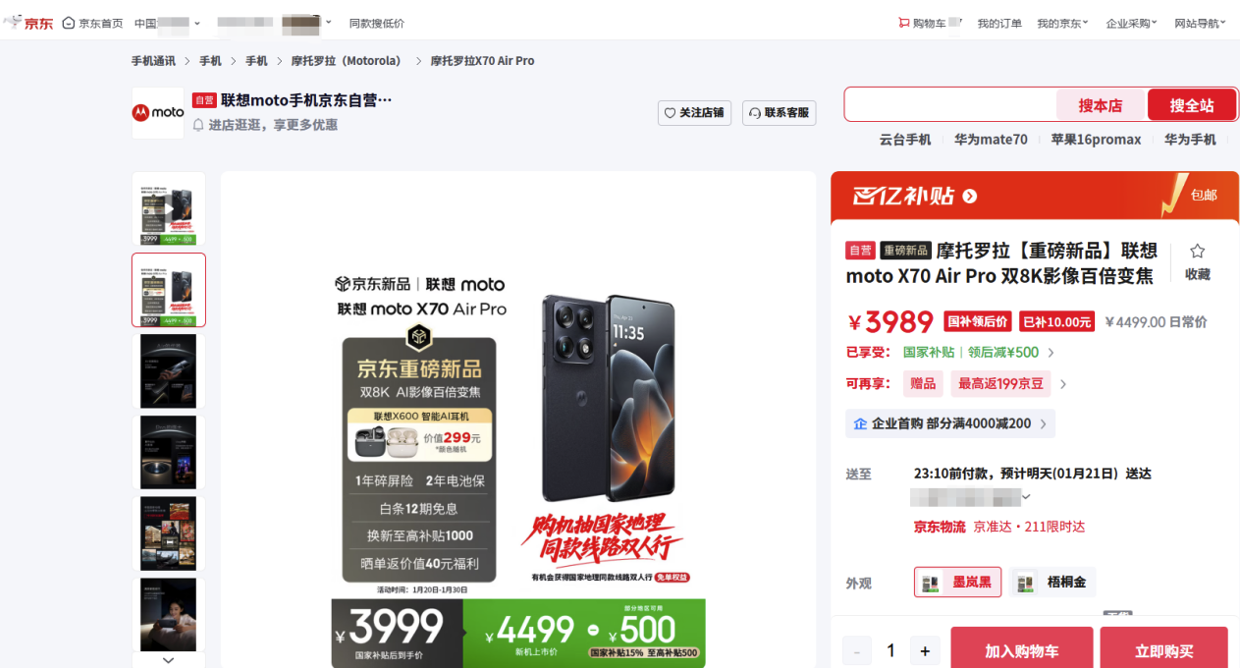
1月20日,联想moto X70 Air Pro正式发布,售价4499元起,现已开售。目前,京东已开售联想moto X70 Air Pro,享国补到手价3999元起,还可享12期免息、赠价值299元X600 AI耳机、1年免费换原厂屏+2年 电池换新服务、以旧换新至高补贴1300元(老用户指定机型换新得300元加补券)、365天只换不修、评价 晒单返40元红包/京豆等福利,限时下单参与抽奖有机会获得国家地理同款线路双人行免单权益,限时 购机并在京东酒旅购指定云南线路、在规定时间内用这款手机打卡拍摄指定景点可得千元红包。一直以 来,京东依托强大的供应链优势,持续携手联想moto等厂商深度合作,通过营销共创、差异化服务、 全渠道能力等给予新品首发助力,实现新品即爆品。 想要换新联想moto X70 Air Pro,那就快来京东下单吧。 联想moto X70 Air Pro搭载1.5K超亮等深屏,采用京东方Q10反光材料,搭配PANTONEⓇ肤色&色彩认 证,更具色彩张力;支持8T LTPO 1—165Hz超高刷新率、6200nits局部峰值亮度、杜比AI动态,画面清 晰;配置超暗模式,获得SGS低蓝光低拖影双认证 ...


联想与首都信息签署战略合作协议 加速协同创新
Zheng Quan Ri Bao· 2026-01-20 10:45
Group 1 - Lenovo Group Limited and Capital Information Development Co., Ltd. have established a strategic cooperation to promote the implementation of "Artificial Intelligence+" in China, focusing on big data, AI, cloud computing, and digital transformation [1][2] - A strategic cooperation committee will be formed to share market information, develop execution plans, and explore market opportunities together [1] - Lenovo's non-PC business now accounts for nearly 50% of its revenue, with its enterprise business reaching 90% of the most important clients in China [1] Group 2 - The collaboration aims to integrate technology, data, and market resources to explore innovative applications of AI in government, healthcare, and urban management [2] - Both parties recognize that the collaboration between state-owned enterprises and technology companies is crucial for driving innovation in China [2]
联想取得知识图谱摘要的确定方法及装置专利
Jin Rong Jie· 2026-01-20 05:48
Group 1 - Lenovo (Beijing) Co., Ltd. has obtained a patent for a method and device for determining a knowledge graph summary, with authorization announcement number CN113609300B, and the application date was June 2021 [1] - Lenovo (Beijing) Co., Ltd. was established in 1992 and is located in Beijing, primarily engaged in the manufacturing of computers, communications, and other electronic devices [1] - The registered capital of Lenovo (Beijing) Co., Ltd. is 565 million Hong Kong dollars [1] Group 2 - Lenovo (Beijing) Co., Ltd. has made investments in 107 companies and participated in 5,000 bidding projects [1] - The company has 1,744 trademark information entries and 5,000 patent information entries, along with 238 administrative licenses [1]
联想取得电子设备电池包控制专利
Jin Rong Jie· 2026-01-20 05:09
Group 1 - Lenovo (Beijing) Co., Ltd. has obtained a patent for "an electronic device," with authorization announcement number CN114421030B, applied for on December 2021 [1] - Lenovo (Beijing) Co., Ltd. was established in 1992 and is located in Beijing, primarily engaged in the manufacturing of computers, communications, and other electronic devices [1] - The registered capital of Lenovo (Beijing) Co., Ltd. is 565 million HKD [1] Group 2 - Lenovo (Beijing) Co., Ltd. has invested in 107 companies and participated in 5,000 bidding projects [1] - The company has 1,744 trademark information entries and 5,000 patent information entries [1] - Additionally, Lenovo (Beijing) Co., Ltd. holds 238 administrative licenses [1]
联想申请内存处理方法专利,以使得相机应用执行任务能够从缓存池中获得至少一个第一缓存区
Jin Rong Jie· 2026-01-20 05:02
Group 1 - Lenovo (Beijing) Co., Ltd. has applied for a patent titled "A Memory Processing Method, Device, and Electronic Equipment," with publication number CN121349648A, and the application date is August 2025 [1] - The patent abstract indicates that the application provides a memory processing method that includes monitoring the number of first cache areas available in a cache pool upon the activation of a camera application, and adjusting the number of cache areas in the cache pool based on this number [1] - Lenovo (Beijing) Co., Ltd. was established in 1992 and is located in Beijing, primarily engaged in the manufacturing of computers, communications, and other electronic devices, with a registered capital of 565 million Hong Kong dollars [1] Group 2 - According to Tianyancha data analysis, Lenovo (Beijing) Co., Ltd. has invested in 107 companies, participated in 5,000 bidding projects, and has 1,744 trademark records and 5,000 patent records [1] - The company also holds 238 administrative licenses [1]
联想取得充电方法及设备专利
Jin Rong Jie· 2026-01-20 01:24
Group 1 - Lenovo (Beijing) Co., Ltd. has obtained a patent for a "charging method and device," with authorization announcement number CN114944681B, applied for on May 2022 [1] - Lenovo (Beijing) Co., Ltd. was established in 1992 and is located in Beijing, primarily engaged in the manufacturing of computers, communications, and other electronic devices [1] - The company has a registered capital of 565 million HKD and has invested in 107 enterprises, participated in 5,000 bidding projects, and holds 1,744 trademark records and 5,000 patent records [1]
联想申请转轴机构及电子设备专利,实现第一支撑部件与基座在特定相对位置限位
Jin Rong Jie· 2026-01-20 01:24
Core Viewpoint - Lenovo (Beijing) Co., Ltd. has applied for a patent titled "Hinge Mechanism and Electronic Device," indicating ongoing innovation in its product offerings and potential advancements in technology [1]. Group 1: Patent Application Details - The patent application, published under CN121345893A, was filed on December 2025 [1]. - The patent describes a hinge mechanism that includes a base with a target support surface, a first support component that can switch between two relative positions, and a limiting mechanism to restrict the movement of the first support component [1]. - The limiting mechanism's projection area is partially outside the projection area of the base and/or the first support component, suggesting a unique design [1]. Group 2: Company Background - Lenovo (Beijing) Co., Ltd. was established in 1992 and is located in Beijing, primarily engaged in the manufacturing of computers, communications, and other electronic devices [1]. - The company has a registered capital of 565 million Hong Kong dollars and has invested in 107 enterprises, participated in 5,000 bidding projects, and holds 1,744 trademark records and 5,000 patent records [1]. - Additionally, Lenovo (Beijing) Co., Ltd. possesses 238 administrative licenses, indicating a robust operational framework [1].
联想申请连接装置及电子设备专利,电子设备包括第一模式和第二模式两种工作模式
Jin Rong Jie· 2026-01-20 00:57
Group 1 - Lenovo (Beijing) Co., Ltd. has applied for a patent titled "Connection Device and Electronic Equipment," with publication number CN121345890A, and the application date is November 2025 [1] - The patent abstract indicates that the application provides a connection device and electronic equipment, which includes a driving component that consists of a driving part and a first connecting piece, and operates in two modes [1] - The company was established in 1992 and is located in Beijing, primarily engaged in the manufacturing of computers, communications, and other electronic devices, with a registered capital of 565 million HKD [1] Group 2 - According to Tianyancha data, Lenovo (Beijing) Co., Ltd. has invested in 107 companies and participated in 5,000 bidding projects, with 1,744 trademark records and 5,000 patent records [1] - The company also holds 238 administrative licenses, indicating a significant presence in the market [1]
去年中国GDP增长5%,多家手机厂商下调出货预期 | 财经日日评
吴晓波频道· 2026-01-20 00:30
Economic Overview - In 2025, China's GDP reached 1401879 billion yuan, growing by 5% year-on-year, with quarterly growth rates of 5.4%, 5.2%, 4.8%, and 4.5% respectively [2] - The industrial added value increased by 5.9%, while the service sector grew by 5.4%. Retail sales totaled 501202 billion yuan, up by 3.7% [2] - Fixed asset investment decreased by 3.8%, with a notable decline in real estate investment [3] Trade and Investment - Canada has reduced the import tax on Chinese electric vehicles to 6.1%, allowing an annual quota of 49,000 vehicles, which is a significant policy shift aimed at filling market gaps [4][5] - The adjustment in tariffs is expected to enhance the competitiveness of Chinese electric vehicles in the Canadian market, which has seen a decline in sales due to high costs and tariffs [5] Real Estate Market - In December 2025, new home prices in first-tier cities fell by 0.3%, with a notable increase in Shanghai, while overall new home sales area decreased by 8.7% year-on-year [6] - The real estate market is still in a bottoming phase, with a significant reduction in new supply and ongoing inventory pressure [7] Mobile Phone Industry - Several smartphone manufacturers, including Xiaomi and OPPO, have lowered their annual shipment forecasts due to rising storage costs, with reductions exceeding 20% for some brands [8] - The impact of rising storage prices is uneven across manufacturers, with larger firms like Apple and Samsung less affected [9] Solar Industry - Nine leading solar companies, including LONGi Green Energy and Tongwei Co., have announced expected losses for 2025, with Tongwei projecting a loss of 90 to 100 billion yuan [10] - The solar industry is facing significant challenges, including high inventory levels and price competition, leading to a prolonged period of losses [11] Wealth Disparity - The global wealth of billionaires reached a record 18.3 trillion USD in 2025, with a 16% increase in total wealth, highlighting a growing wealth gap amid stagnant poverty reduction efforts [12][13] - The AI sector's growth has significantly contributed to the increase in billionaire wealth, while ordinary residents face declining purchasing power due to inflation [13] Space Tourism - A startup has announced the opening of reservations for the world's first lunar hotel, aiming to begin operations by 2032, although the feasibility of such a project remains uncertain [14][15]