LENOVO GROUP(00992)

Search documents
全网首发!CES官方发布AI趋势:硬件将成AI落地核心载体
Sou Hu Cai Jing· 2025-12-04 12:17
Core Insights - CES 2026, scheduled from January 6 to 9, 2026, in Las Vegas, is anticipated to focus heavily on AI as the central theme, marking a significant evolution in the consumer electronics landscape [3][5][34] - The event will showcase how AI technology integrates with various hardware products and industry scenarios, emphasizing user experience transformation for both individual consumers and enterprises [5][12] Industry Trends - AI will be the absolute focus of CES 2026, with major companies like OpenAI, Google, Microsoft, and others releasing information about AI hardware, highlighting the importance of hardware in AI implementation [3][5] - The CES Foundry, a new exhibition space, will feature immersive discussions and demonstrations on AI's future in various sectors, including manufacturing and infrastructure [5][8] Key Participants - Notable companies such as Siemens, Caterpillar, AMD, and NVIDIA will present at CES 2026, showcasing their advancements in AI and hardware integration [6][12][16] - Lenovo will host its highest-profile innovation conference during CES 2026, demonstrating how AI technology impacts various sectors, including sports and personalized consumer experiences [20][22] Product Innovations - The event will highlight a range of AI applications across multiple domains, including smart glasses, wearables, home appliances, and robotics, indicating a broad integration of AI in consumer products [8][12][34] - Companies like AMD and NVIDIA are expected to compete in building comprehensive AI platforms, showcasing new technologies and products that enhance AI capabilities [16][19] Emerging Technologies - CES 2026 will feature advancements in multimodal models, physical AI, and embodied intelligence, reflecting the latest trends in AI technology [9][12] - The event will also spotlight innovative AI hardware products, with a focus on new categories that may emerge as "native AI hardware" [24][34]




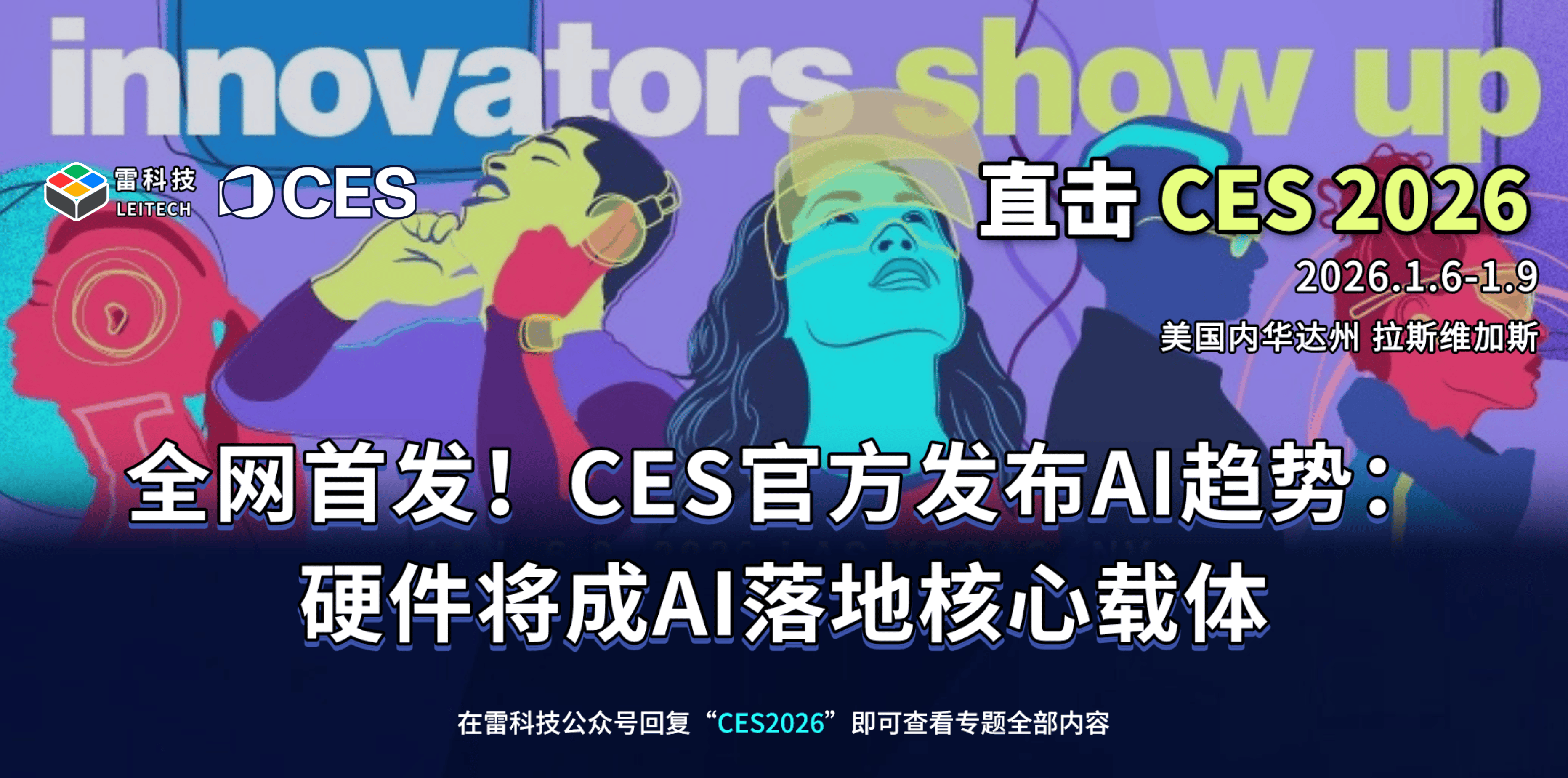
CES官方发布AI趋势:硬件将成AI落地核心载体
3 6 Ke· 2025-12-04 10:31
Core Insights - CES 2026, scheduled from January 6 to 9, 2026, in Las Vegas, will focus heavily on AI as the central theme, marking a significant evolution in the integration of AI with hardware products [1][3] - The event will feature a new exhibition area called "CES Foundry," dedicated to showcasing how AI technology can be integrated into various hardware products and industry scenarios, emphasizing user experience transformation [3][4] - Major companies like NVIDIA, AMD, and Siemens will present their latest AI innovations and strategies, highlighting the growing importance of AI in industrial applications and consumer electronics [11][14][17] Group 1: AI as the Central Theme - AI will be the absolute focus of CES 2026, moving beyond mere parameter comparisons of large models to practical applications in hardware [3][4] - The CES Foundry will host immersive discussions and demonstrations on the future of AI in various sectors, including manufacturing and infrastructure [3][6] - The event will showcase AI's integration across multiple domains, including smart glasses, PCs, mobile devices, and healthcare [6][7] Group 2: Key Industry Players and Innovations - Siemens will present its advancements in AI and digital twin technology, aiming to drive the large-scale implementation of industrial AI applications [11][13] - AMD will showcase its AI solutions and new products, including the Ryzen AI 400, which is expected to enhance AI computing capabilities in consumer devices [14][16] - Lenovo will host its innovation conference during CES 2026, highlighting AI's impact on various sectors, including sports and personalized consumer experiences [17][19] Group 3: Emerging Trends and Products - The event is expected to feature new AI hardware products, with companies like Insta360 and HOLLYLAND introducing innovative technologies [20][22] - AI applications in education, healthcare, and smart home technologies will be prominently displayed, reflecting the growing trend of AI integration in everyday products [32][39] - The CES 2026 will likely see a competitive landscape among major tech firms as they unveil their AI-driven hardware solutions, marking a pivotal moment in the AI hardware market [31][34]

下一个产业浪潮在哪里?
3 6 Ke· 2025-12-04 07:37
Core Insights - Lenovo's Eco Roadshow Season will launch in Hangzhou on December 10, collaborating with the Shangcheng District government to create a "green channel" for hard technology to access industrial centers [1][5] - The event aims to support innovation by providing a comprehensive support system for small and medium enterprises in the industry chain, facilitating the transition from technology validation to large-scale production [3][4] Group 1: Event Overview - The event will focus on AI PC edge intelligence, AI hardware and interaction, industry intelligence, and smart manufacturing, showcasing ten carefully selected high-quality projects [6] - Lenovo has prepared substantial support for outstanding projects, including investment opportunities up to 100 million yuan, PoC project validation resources, and access to Lenovo's factory production lines [6] Group 2: Regional Significance - Hangzhou is recognized as a benchmark city for digital economy and AI innovation, attracting top AI research talent and advanced industry clusters, creating a fertile ground for AI startups [5] - The "Hangzhou Six Little Dragons" represent successful AI-driven companies that have emerged from this innovative ecosystem, achieving breakthroughs in various fields such as large models, robotics, and brain-machine interfaces [5] Group 3: Partnership and Collaboration - Lenovo's Innovation Accelerator will sign a memorandum of cooperation with the Shangcheng District government, establishing a long-term mutual empowerment system centered in Hangzhou, extending to the Yangtze River Delta [5] - The partnership aims to provide continuous industrial connections, collaborative research and development, ecological openness, capital support, brand empowerment, and service empowerment for regional enterprises [5]
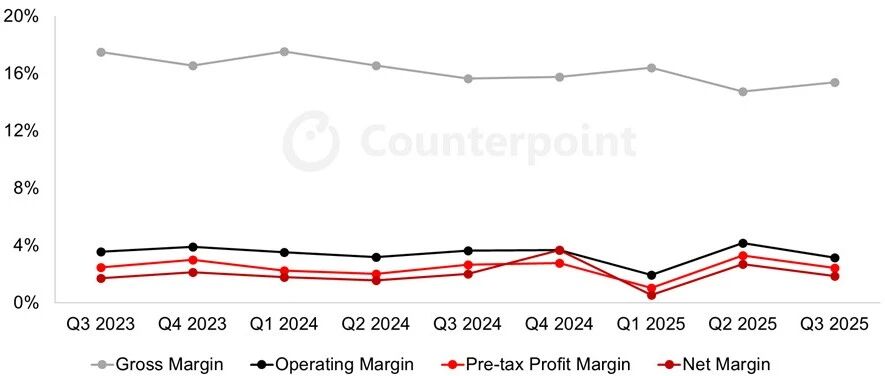
联想 2025 年 Q3 营收同比增长 15%;PC、智能手机和平板电脑推动 12% 增长
Counterpoint Research· 2025-12-04 01:03
Core Insights - Lenovo achieved revenue of $20.5 billion in Q2 of fiscal year 2026, marking a 15% year-over-year growth and a 9% quarter-over-quarter increase, continuing its recovery trend for the eighth consecutive quarter [4][5] - The company reported that AI PCs now account for over 33% of its total PC shipments, reflecting a significant acceleration in AI PC development [4][5] Financial Performance - Lenovo's net profit for the quarter was $380 million, a decrease of 25% quarter-over-quarter and a slight decline of 1% year-over-year, attributed to increased AI investments and seasonal cost increases [5][6] - The Intelligent Devices Group (IDG), which includes PCs, tablets, smartphones, and smart devices, saw a revenue increase of 12% year-over-year, with operating profit rising from $950 million to $1.1 billion [6][11] Regional Growth - Lenovo experienced double-digit growth across all regions, with the U.S. market growing by 13% and China by 24% [5][11] - The company maintained a PC market share of 25.6%, an increase of 1.8 percentage points year-over-year, and a Windows AI PC market share of 31.1%, up from 30.6% in the previous quarter [9][11] Business Segments - The Infrastructure Solutions Group (ISG) reported revenue of $4.1 billion, a 5% decline quarter-over-quarter but a 24% increase year-over-year [11] - The Solutions and Services Group (SSG) generated $2.6 billion in revenue, reflecting a 13% quarter-over-quarter growth and an 18% year-over-year increase [11] Future Outlook - Lenovo plans to deepen its "Hybrid AI for All" framework, integrating device intelligence, edge collaboration, and enterprise AI into a unified architecture [15] - The company aims to enhance personalized AI experiences across multiple devices and strengthen AI-driven solutions in digital office, hybrid cloud, and sustainable services [15][16]
智通港股通持股解析|12月4日
智通财经网· 2025-12-04 00:37
Core Insights - The top three companies by Hong Kong Stock Connect holding ratios are China Telecom (00728) at 72.68%, Green Power Environmental (01330) at 69.12%, and Da Zhong Public Utilities (01635) at 69.03% [1] - Alibaba-W (09988), Meituan-W (03690), and Pop Mart (09992) saw the largest increases in holding amounts over the last five trading days, with increases of +3.329 billion, +1.319 billion, and +1.060 billion respectively [1] - The largest decreases in holding amounts were observed in Zijin Mining (02899) at -861 million, SMIC (00981) at -815 million, and Lenovo Group (00992) at -430 million [1][2] Hong Kong Stock Connect Holding Ratios - China Telecom (00728): 100.87 billion shares, 72.68% holding ratio [1] - Green Power Environmental (01330): 2.80 billion shares, 69.12% holding ratio [1] - Da Zhong Public Utilities (01635): 3.68 billion shares, 69.03% holding ratio [1] - Other notable companies include Haotian International Construction Investment (01341) at 68.75% and China Shenhua (01088) at 67.00% [1] Recent Increases in Holdings (Last 5 Trading Days) - Alibaba-W (09988): +3.329 billion, +21.6752 million shares [1] - Meituan-W (03690): +1.319 billion, +13.7526 million shares [1] - Pop Mart (09992): +1.060 billion, +4.9058 million shares [1] - Other companies with significant increases include ZTE Corporation (00763) and China Merchants Bank (03968) [2] Recent Decreases in Holdings (Last 5 Trading Days) - Zijin Mining (02899): -861 million, -26.2640 million shares [2] - SMIC (00981): -815 million, -12.1252 million shares [2] - Lenovo Group (00992): -430 million, -43.6821 million shares [2] - Other companies with notable decreases include China Mobile (00941) and China Pacific Insurance (02328) [2]




L3级AI服务技术硬实力 联想百应智能体斩获36氪WISE2025 年度焦点产品
3 6 Ke· 2025-12-03 15:06
Core Insights - Lenovo's Baiying Intelligent Agent has been awarded the "WISE2025 Annual Focus Product (Enterprise Service Category)" for its technological breakthroughs in enterprise AI services and its ability to create industry value [2][4] - The recognition highlights Lenovo's L3-level AI service capabilities and sets a practical benchmark for the intelligent transformation of small and medium-sized enterprises (SMEs) [4][12] - Lenovo's evolution from a leader in IT services to a pioneer in AI services reflects its strategic alignment with technological changes and national policies [4][5] Product Development - Since its official launch in November 2024, Lenovo's Baiying has undergone continuous iterations, with the 2.0 version released in August 2025, which includes five core AI technologies and three application scenarios [5][6] - The product aims to redefine the boundaries of AI services for SMEs by addressing market demands and aligning with national policy directions [5][6] Financial Performance - Lenovo Group reported strong financial results for the second quarter of the 2025/26 fiscal year, showcasing the effectiveness of its AI service strategies [6] - The upgraded service model, termed "One Engine and Four Ships," integrates various AI solutions to provide comprehensive value chain services for enterprise clients [6] Technological Innovations - The Baiying Intelligent Agent features five core AI technologies that enhance its capabilities, allowing it to transition from a "responsive assistant" to a "collaborative partner" [7][9] - Key innovations include AI perception planning, context enhancement, multi-tool invocation, self-generation, and self-iteration, which collectively improve operational efficiency and user experience [9][10] User Experience and Functionality - The product has achieved significant improvements in user experience and ease of use, allowing users to interact with it using natural language commands [10][11] - It covers over 95% of core AI scenarios, providing solutions for IT troubleshooting, data decision-making, marketing material creation, and more, thereby empowering enterprise operations [11][12] Future Outlook - The recognition from the WISE2025 awards underscores Lenovo's commitment to "AI for All" and its focus on enhancing the capabilities of its intelligent agents to support the high-quality development of SMEs [12]
联想取得激活多个边缘服务器的方法专利
Jin Rong Jie· 2025-12-03 12:28
Core Insights - Lenovo (Beijing) Co., Ltd. has obtained a patent titled "Method for Activating Multiple Edge Servers," with authorization announcement number CN 115604259 B, applied for on August 2022 [1] Company Overview - Lenovo (Beijing) Co., Ltd. was established in 1992 and is located in Beijing, primarily engaged in the manufacturing of computers, communications, and other electronic devices [1] - The company has a registered capital of 5.65 billion HKD [1] - Lenovo (Beijing) Co., Ltd. has invested in 107 enterprises and participated in 5,000 bidding projects [1] - The company holds 1,751 trademark records and 5,000 patent records, along with 238 administrative licenses [1]
全球折叠屏手机Q3出货量创历史新高!联想(00992)摩托罗拉同比大涨16%
智通财经网· 2025-12-03 11:06
Core Insights - The global foldable smartphone shipment is expected to grow by 14% year-on-year in Q3 2025, reaching a historical high of 2.5% of total smartphone shipments [1][6] - Lenovo's Motorola has emerged as a key player in the clamshell foldable segment, with a 16% increase in shipments, securing a position among the top three globally [1][3] - Vivo has also seen a significant increase in shipments, rising by 67% [1] Company Performance - Lenovo's Motorola has effectively expanded its foldable smartphone user base through competitive pricing, strong channel partnerships, and positive product usability ratings [3] - In the US and European markets, Motorola has achieved a breakthrough in market share, competing effectively against established players like Samsung and Honor [3][6] - The Razr 60 model leads the market with a 15% share, and when combined with the Razr 50, the total share reaches approximately 27%, comparable to last year's champion model [5] Market Trends - The foldable smartphone market is projected to close 2025 with a stable growth rate of around 16% year-on-year, driven by high-end users seeking larger screens for productivity and durability [6] - The market is expected to enter a significant expansion phase in 2026, influenced by improvements in durability, thinner and lighter designs, optimized hinge and panel structures, and enhanced AI-driven software experiences [6] - Lenovo is actively promoting its "one body, multiple ends" strategy, launching various AI smartphone products to capture more market share, which will be crucial for competition in the foldable and overall smartphone markets [6]
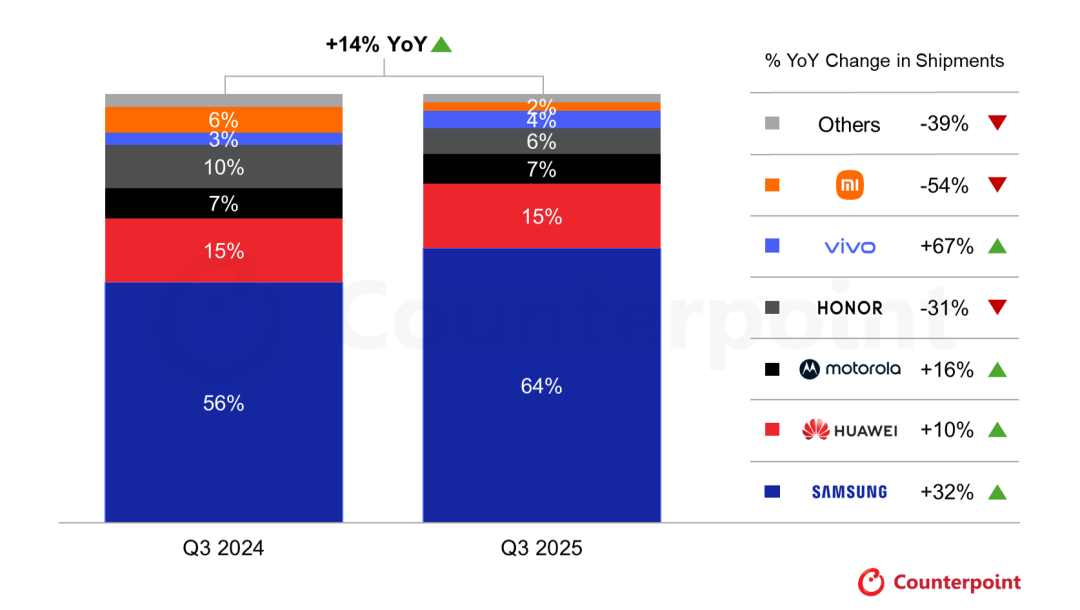
全球折叠屏手机Q3出货量创历史新高!联想摩托罗拉同比大涨16% 小米、荣耀大幅下跌
Ge Long Hui· 2025-12-03 10:55
Core Insights - The global foldable smartphone shipment is projected to grow by 14% year-on-year in Q3 2025, reaching a historical quarterly high, with a market share of 2.5% in global smartphone shipments [1] - Lenovo Motorola has emerged as a key player in the clamshell foldable segment, with a 16% year-on-year increase in shipments, securing a position among the top three globally [1][2] - Vivo has seen a significant increase in shipments by 67%, while Xiaomi and Honor experienced declines of 54% and 31%, respectively [1] Company Performance - Lenovo Motorola has effectively expanded its foldable smartphone user base through competitive pricing, strong channel partnerships, and excellent product usability ratings [2] - In the mainstream markets of the US and Europe, Motorola has achieved a breakthrough in market share, competing effectively against established players like Samsung and Honor [2][6] - The Razr series, particularly the Razr 60, has led the market with a 15% share in the first half of 2025, and combined with the Razr 50, the total share reaches approximately 27% [3] Market Trends - The foldable smartphone market is expected to close 2025 with a stable growth rate of around 16% year-on-year, driven by high-end users preferring larger screens for productivity and durability [6] - The market is anticipated to enter a significant expansion phase in 2026, fueled by improvements in durability, thinner and lighter designs, optimized hinge and panel structures, and enhanced AI-driven software experiences [6] - Lenovo is actively promoting its "one body, multiple ends" strategy, launching various AI smartphone products, which is expected to be a crucial competitive area in the foldable smartphone market and the overall smartphone industry [6]

从摩尔线程、沐曦上市,看AI投资“优等生”们的成功智慧
Sou Hu Cai Jing· 2025-12-03 10:08
Core Viewpoint - The domestic GPU industry is experiencing a wave of IPOs, driven by continuous investment in AI infrastructure and the increasing importance of self-sufficiency strategies, with companies like Moer Thread and Muxi Co., Ltd. leading the way [1][2] Group 1: Industry Trends - The surge in IPOs among AI chip companies, particularly GPUs, reflects the explosive demand for AI computing power and the acceleration of domestic alternatives [2] - Major companies like Google are significantly increasing their computing capacity, with a goal to double it every six months and achieve a thousandfold increase in four to five years [3] - The global computing market is entering a phase of unprecedented supply-demand imbalance, with domestic breakthroughs in chips, AI servers, and computing clusters supporting self-sufficiency [4] Group 2: Company Developments - Muxi Co., Ltd.'s first fully domestic general-purpose GPU, the C600, is designed to replace Nvidia's H20, showcasing the potential for domestic products in high-end AI computing scenarios [4] - Lenovo Group is a key player in the AI server market, with a projected global revenue ranking of third by Q1 2025 and a market share exceeding 35% in China [6] - Lenovo's collaboration with Muxi Co., Ltd. and Moer Thread has led to significant product and channel partnerships, enhancing its position in the rapidly growing AI computing market [7][10] Group 3: Investment Insights - Lenovo Group has successfully invested in all four companies of the "domestic GPU four dragons," demonstrating a high success rate in technology investments [11] - The company has invested in over 300 innovative tech firms, with a notable IPO success rate, indicating its strong investment strategy and market insight [11][13] - Lenovo's investment logic is rooted in its "hard technology" DNA, allowing it to identify and capitalize on investment opportunities in the AI sector early on [14] Group 4: Strategic Collaborations - Lenovo's partnerships with invested companies focus on resource sharing, technology co-development, and market expansion, enhancing both Lenovo's and its partners' capabilities [15][17] - The company has established a comprehensive support system for startups, enabling them to benefit from shared resources and collaborative technology development [17][18] - This "dual empowerment" strategy differentiates Lenovo from other firms that only engage in financial investments, providing a unique competitive advantage in the AI industry [19][21]