
CSEC,China Shenhua(01088)

Search documents
煤炭开采板块1月26日涨2.87%,中国神华领涨,主力资金净流入6.17亿元
Zheng Xing Xing Ye Ri Bao· 2026-01-26 09:41
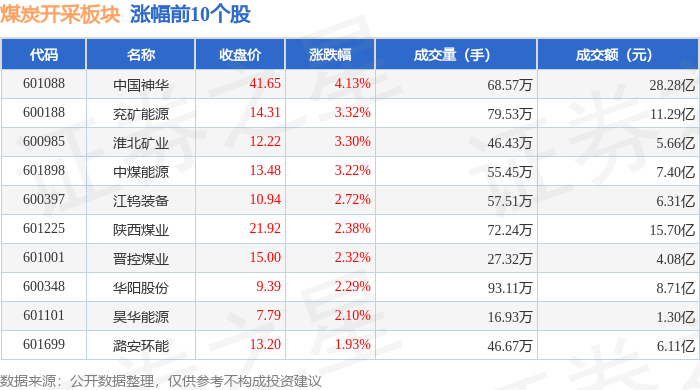
Core Viewpoint - The coal mining sector experienced a rise of 2.87% on January 26, with China Shenhua leading the gains, while the overall Shanghai Composite Index fell by 0.09% and the Shenzhen Component Index decreased by 0.85% [1] Group 1: Stock Performance - China Shenhua closed at 41.65, up 4.13%, with a trading volume of 685,700 shares and a transaction value of 2.828 billion [1] - Other notable performers included Tuokun Energy, which rose by 3.32% to 14.31, and Huai Bei Mining, which increased by 3.30% to 12.22 [1] - The coal mining sector's stocks showed a mixed performance, with some stocks experiencing declines, such as Zhengmei Electric, which fell by 4.81% to 4.35 [2] Group 2: Capital Flow - The coal mining sector saw a net inflow of 617 million in main funds, while retail investors experienced a net outflow of 656 million [2] - Major stocks like China Shenhua had a net inflow of 239 million from main funds, but a significant outflow of 203 million from retail investors [3] - Shaanxi Coal and Energy also reported a net inflow of 152 million from main funds, indicating strong institutional interest despite retail selling pressure [3]





三大指数表现不一 传统板块逆袭科技热点成新主线
Xin Lang Cai Jing· 2026-01-26 08:37
Market Performance - The Hong Kong stock market showed mixed performance with the Hang Seng Index up by 0.06% closing at 26,765.52 points, while the Tech Index fell by 1.24% to 5,725.99 points, and the National Enterprises Index decreased by 0.15% to 9,147.21 points [1][2]. Sector Performance - Traditional cyclical stocks such as oil, coal, and non-ferrous metals performed strongly, indicating a shift in market focus towards value assets. In contrast, previously popular sectors like commercial aerospace and brain-computer interface technologies experienced a pullback [2][11]. Oil Sector - Oil stocks saw significant gains, with China National Offshore Oil Corporation (CNOOC) rising by 4.01%, China Petroleum & Chemical Corporation (Sinopec) increasing by 3.68%, and China Oilfield Services Limited up by 3.23%. This strength is attributed to a recent extreme cold wave in North America, which caused a 63% spike in U.S. natural gas prices from January 20 to 22, subsequently boosting prices of light hydrocarbons and supporting domestic petrochemical prices [4][5]. Coal Sector - Coal stocks also showed robust performance, with Mongolian Energy up by 5.80%, China Shenhua Energy rising by 4.42%, and China Qinfa up by 3.74%. The increase in coal prices is linked to heightened demand due to cold weather, with daily coal output from the Bohai Rim ports averaging 1.682 million tons, a week-on-week increase of 14.2 tons or 9.19% [6][7]. Non-Ferrous Metals Sector - Non-ferrous metal stocks were active, with Rusal rising by 12.31%, China Nonferrous Mining increasing by 9.87%, and Chifeng Jilong Gold Mining up by 7.44%. Citigroup's report indicates a structural bull market in aluminum, predicting a 61,000-ton structural deficit by early 2026 and raising the price target for aluminum from $2,950 to $3,400 per ton [8][9]. Gold Market - Morgan Stanley's research indicates that gold prices have surpassed their forecast of $4,750 per ounce for the second half of the year, with expectations of further increases due to geopolitical risks, central bank purchases, and ETF inflows. A bullish scenario suggests a target price of $5,700 per ounce for the second half [10]. Weakness in Tech Sectors - Commercial aerospace stocks faced collective declines, with Asia Pacific Satellite down by 11.53%, Goldwind Technology down by 7.14%, and JunDa Co. down by 6.56%. This adjustment is attributed to short-term profit-taking pressures [11]. Brain-computer interface stocks also showed weakness, with Nanjing Panda Electronics down by 6.15% and Brainstorming Technology down by 5.35%, partly due to a recent share placement announcement [13][14]. Individual Stock Movements - Zhizhuo (02513.HK) surged by 13.02% following a significant increase in subscription service users after the launch of its flagship model GLM-4.7, indicating strong market interest in its AI capabilities [15]. Lao Pu Gold (06181.HK) rose by 7.80% due to increased customer traffic during a promotional event, with expectations of substantial revenue growth during the upcoming Spring Festival [16].




港股煤炭股多数上扬 中国神华涨超4%
Mei Ri Jing Ji Xin Wen· 2026-01-26 06:31
Group 1 - The coal stocks in the Hong Kong market are mostly rising, indicating a positive trend in the sector [1] - China Shenhua (01088.HK) increased by 4.13%, reaching HKD 42.38 [1] - Yanzhou Coal (01171.HK) rose by 2.79%, trading at HKD 11.43 [1] - China Coal Energy (01898.HK) saw a 2.55% increase, priced at HKD 11.28 [1] - China Qinfa (00866.HK) gained 1.56%, with a share price of HKD 3.26 [1]
港股异动 | 煤炭股多数上扬 中国神华(01088)涨超4% 机构看好现阶段煤炭配置机遇
智通财经网· 2026-01-26 06:20
Core Viewpoint - The coal sector is experiencing a rise in stock prices, driven by increased demand due to cold weather and tightening supply conditions, suggesting a favorable investment outlook for quality coal companies [1] Group 1: Stock Performance - Major coal stocks have seen significant gains, with China Shenhua up 4.13% to HKD 42.38, Yanzhou Coal up 2.79% to HKD 11.43, China Coal up 2.55% to HKD 11.28, and China Qinfa up 1.56% to HKD 3.26 [1] Group 2: Demand and Supply Dynamics - A cold wave has led to lower temperatures in central and eastern regions, contributing to increased coal demand [1] - The average daily coal output from the four ports in the Bohai Rim region reached 1.682 million tons, an increase of 142,000 tons (9.19%) from the previous week, although it represents a year-on-year decrease of 0.8% [1] - As of January 23, port inventories stood at 26.28 million tons, down 906,000 tons (3.33%) week-on-week, but up 3.48% year-on-year [1] Group 3: Future Outlook - The tightening supply-demand balance in the coal market is expected to persist over the next 3-5 years, with quality coal companies maintaining high barriers to entry, strong cash flow, and attractive dividends [1] - The recent price stabilization in coal is anticipated to reshape sector valuations, making coal investments appealing, especially after recent market corrections [1]
中国神华涨2.05%,成交额6.72亿元,主力资金净流入4872.68万元
Xin Lang Cai Jing· 2026-01-26 02:43
Group 1 - The core viewpoint of the news is that China Shenhua's stock has shown a slight increase, with a current price of 40.82 CNY per share and a market capitalization of 811.03 billion CNY, indicating a stable performance in the market [1] - As of January 26, the stock has seen a year-to-date increase of 0.79%, a 5-day increase of 0.29%, a 20-day increase of 1.72%, and a 60-day decrease of 2.95% [1] - The company primarily engages in coal and electricity production and sales, with coal accounting for 75.23% of its revenue, followed by electricity at 29.35% [1] Group 2 - As of September 30, the number of shareholders for China Shenhua reached 209,200, an increase of 29.69% from the previous period, while the average number of circulating shares per person decreased by 23.09% to 79,468 shares [2] - For the period from January to September 2025, China Shenhua reported a revenue of 213.15 billion CNY, a year-on-year decrease of 16.05%, and a net profit attributable to shareholders of 39.05 billion CNY, down 15.24% year-on-year [2] - The company has distributed a total of 480.47 billion CNY in dividends since its A-share listing, with 159.94 billion CNY distributed in the last three years [3]
加码绿电 筑牢能源安全网
Zhong Guo Zheng Quan Bao· 2026-01-25 21:06
Core Insights - The National Energy Group has established a solid energy supply foundation through supply assurance, price stability, green transformation, and innovative reforms, achieving significant milestones in coal production, wind power capacity, and market capitalization [1][2]. Energy Supply and Production - The company has stabilized its self-produced coal volume at 600 million tons and has achieved a wind power capacity exceeding 72 million kilowatts, contributing to a market capitalization surpassing 1 trillion yuan [1]. - The group aims to enhance effective investment and promote the transformation and upgrading of traditional industries while developing emerging industries on a large scale by 2026 [1]. Renewable Energy Development - During the 14th Five-Year Plan, the group has focused on expanding scale and optimizing layout, resulting in a threefold increase in renewable energy installed capacity compared to the end of the 13th Five-Year Plan [2]. - The company has developed large-scale wind and solar bases and launched the world's largest open offshore photovoltaic project, showcasing innovative integration of green energy and agriculture [2]. Energy Storage and Hydrogen Production - The group has made significant advancements in energy storage, with 195 new storage projects operational by the end of 2025, accounting for approximately 6% of the national new energy storage capacity [2]. - The hydrogen energy sector has been established with a production capacity of 6,000 tons per year, representing 5% of the national total, with various applications leading industry development [2]. Coal Power Upgrades - The company is focusing on upgrading coal power as a key transformation strategy, with four projects selected as national pilot projects for next-generation coal power [3]. - These upgrades are expected to reduce carbon emissions by 10% for certain coal power units by 2024 [3]. Energy Security and Supply Assurance - The National Energy Group has built a resilient supply assurance system, prioritizing supply stability and price control while enhancing emergency supply capabilities [3][4]. - The company has accelerated the release of high-quality coal production capacity, achieving significant operational metrics, including a stable self-produced coal volume and record daily power generation [3][4]. Transportation and Logistics - The group is improving its transportation network, with ongoing projects like the Huanghua Port Phase V and the Dongyue Railway, enhancing coal transportation efficiency [4]. - The company’s coal production and power generation metrics account for significant national shares, with annual coal production representing one-sixth of the national total [4]. Reform and Innovation - The company has implemented comprehensive reforms, completing 161 specific reform tasks to enhance governance and operational efficiency [5][6]. - The restructuring of assets has led to a significant increase in the market value of China Shenhua, with over 200 billion yuan in asset restructuring [6]. Future Outlook - By 2026, the company plans to strengthen its safety and supply responsibilities, enhance investment effectiveness, and promote high-quality development while focusing on carbon asset management and technological innovation [6].
煤炭开采:寒潮叠加空头回补共振,美国天然气期货价格快速上行
GOLDEN SUN SECURITIES· 2026-01-25 12:24
Investment Rating - The report recommends a "Buy" rating for several companies in the coal mining sector, including China Coal Energy (H+A), Yanzhou Coal Mining (H+A), China Shenhua Energy (H+A), and Shaanxi Coal and Chemical Industry [3][8]. Core Insights - The report highlights the significant increase in U.S. natural gas futures prices due to a polar cold wave and short covering, with prices rising by 25% to $4.875 per million British thermal units, marking the highest settlement price since December 8 [2]. - The report emphasizes the potential for coal consumption to increase as power producers may switch to coal to control fuel costs amid rising natural gas prices [3][8]. Summary by Sections Energy Price Overview - As of January 23, 2026, Brent crude oil futures settled at $65.88 per barrel, up $1.75 (+2.73%) from the previous week, while WTI crude oil futures settled at $61.07 per barrel, up $1.63 (+2.74%) [1]. - Natural gas prices also saw significant increases, with Northeast Asia LNG spot prices at $11.81 per million British thermal units (+4.04%) and U.S. HH natural gas futures at $5.35 per million British thermal units (+72.18%) [1][2]. Investment Recommendations - The report specifically recommends focusing on companies that are performing well, such as China Coal Energy, Yanzhou Coal Mining, China Shenhua Energy, and Shaanxi Coal, as well as companies involved in smart mining like Keda Control and those in recovery like China Qinfa [3][8]. - Additional companies to watch include Peabody (BTU), Jinkong Coal Industry, Lu'an Environmental Energy, and others that may see growth in the future [3]. Coal Market Dynamics - The report notes slight adjustments in coal prices, with Newcastle coal at $111.50 per ton, down $0.05 (-0.04%), while European ARA coal prices increased to $98.50 per ton, up $1.85 (+1.91%) [1][40]. - The overall coal market is expected to benefit from the rising natural gas prices, potentially leading to increased coal consumption in power generation [3].

寒潮叠加空头回补共振,美国天然气期货价格快速上行
GOLDEN SUN SECURITIES· 2026-01-25 11:22
Investment Rating - The report recommends a "Buy" rating for several companies in the coal mining sector, including China Coal Energy (H+A), Yanzhou Coal Mining (H+A), China Shenhua Energy (H+A), and Shaanxi Coal and Chemical Industry [3][9]. Core Insights - The report highlights the significant increase in U.S. natural gas futures prices due to a polar cold wave and short covering, with prices rising by 25% to $4.875 per million British thermal units, marking the highest settlement price since December 8 [2]. - The report emphasizes the potential for coal consumption to increase as power producers may switch to coal to control fuel costs amid rising natural gas prices [8]. - The report notes that the performance of coal mining companies is expected to improve as annual report disclosures approach, following the principle that "strong performance leads to strong stocks" [3]. Summary by Sections Energy Prices Overview - As of January 23, 2026, Brent crude oil futures settled at $65.88 per barrel, up $1.75 (+2.73%) from the previous week, while WTI crude oil futures settled at $61.07 per barrel, up $1.63 (+2.74%) [1]. - Natural gas prices have also seen significant increases, with Northeast Asia LNG spot prices at $11.81 per million British thermal units, up $0.46 (+4.04%) [1]. Key Companies and Recommendations - The report specifically recommends focusing on companies such as Keda Control Technology, which is advancing in smart mining, and China Qinfa, which is experiencing a turnaround [3]. - Additional companies to watch include Peabody (BTU), Jinkong Coal Industry, Lu'an Environmental Energy, and others that may see growth in the future [3]. Market Dynamics - The report discusses the impact of weather on natural gas production, particularly in the Marcellus shale region, which may face operational challenges due to snow [8]. - It also notes that the U.S. natural gas inventory surplus is rapidly decreasing, with expectations that it will fall below the five-year average by the end of March [8].
煤炭行业周报(2026年第4期):动力煤库存继续回落,焦煤价格稳中有升-20260125
GF SECURITIES· 2026-01-25 07:28
Core Insights - The coal industry is experiencing a slight increase in coking coal prices while thermal coal inventories continue to decline, indicating a potential stabilization in prices moving forward [7][85][87]. Market Dynamics - Thermal coal prices have shown a slight decrease, with the CCI5500 thermal coal index reported at 691 RMB/ton, down 11 RMB/ton week-on-week [13][86]. - The production capacity utilization rate for thermal coal mines is at 89.8%, reflecting a 1.2 percentage point increase week-on-week [23]. - Inventory levels at major ports have decreased, with a reported 6.939 million tons, down 2.4% week-on-week [23][30]. Industry Outlook - The coal industry is expected to see a significant improvement in profitability in 2026, with a projected total profit of 2.97 billion RMB in 2025, down 47% year-on-year [7][87]. - The supply side is anticipated to experience a substantial decrease in growth rates compared to previous years, with coal prices expected to gradually rise [7][87]. - The long-term contracts for coal supply in 2026 are expected to remain stable, with stricter safety regulations likely to limit production [88][89]. Key Companies - Notable companies with stable profit distributions include China Shenhua, Yanzhou Coal, and Shaanxi Coal, which are expected to benefit from the anticipated demand recovery and supply constraints [7][87]. - Companies with high elasticity benefiting from improved demand expectations include Huabei Mining and Shanxi Coking Coal [7][87]. - Long-term growth companies identified include Huayang Co., New Energy, and Baofeng Energy, which are expected to show significant growth potential [7][87].

中国神华(01088) - 2026年第一次临时股东会之投票结果
2026-01-23 13:59
香港交易及結算所有限公司及香港聯合交易所有限公司對本公告的內 容 概 不 負 責,對 其 準 確 性 或 完 整 性 亦 不 發 表 任 何 聲 明,並 明 確 表 示,概 不對因本公告全部或任何部分內容而產生或因依賴該等內容而引致的 任 何 損 失 承 擔 任 何 責 任。 2026年第一次臨時股東會之投票結果 本公司於2026年1月23日(星期五)下午二時三十分在中華人民共和國北 京市朝陽區鼓樓外大街19號歌華開元大酒店二層和廳舉行2026年第一 次 臨 時 股 東 會。本 公 司 董 事 會 欣 然 宣 佈,上 述 臨 時 股 東 會 之 通 告 所 載 全 部 決 議 案 已 獲 正 式 通 過。 本公司於2025年12月24日 在香港聯合交易所有限公司網站及於 2025年12月25日 在《中國證券報》、《上海證券報》、《證券時報》、《證券日報》 和 上 海 證 券 交 易 所 網 站 刊 發 了 臨 時 股 東 會 通 告。 於 臨 時 股 東 會 日 期,本 公 司 已 發 行 股 份 為19,868,519,955股,其 中 包 含H股 股份3,377,482,000股及A股股份16,491,0 ...