SINO BIOPHARM(01177)

Search documents
小核酸药物:治疗潜力显现,蕴藏BD机遇
Orient Securities· 2025-07-27 09:44
Investment Rating - The report maintains a "Positive" outlook for the pharmaceutical and biotechnology industry in China [6]. Core Insights - Small nucleic acid drugs are expected to become the third major class of drugs after small molecules and antibodies, with unique advantages such as broad targets, strong specificity, high development efficiency, and long dosing intervals [9][38]. - The commercialization of rare diseases is maturing, and the long-term advantages for chronic diseases are becoming evident, with significant sales growth for products like Spinraza and Leqivo [9][60]. - There is a notable increase in business development (BD) activities, highlighting the potential of early-stage chronic disease pipelines [9]. Summary by Sections 1. Small Nucleic Acids: Potential as a New Drug Class - Small nucleic acid drugs, including ASO, siRNA, and Aptamer, interact with mRNA to regulate gene expression, offering a new technological pathway for drug development [13]. - The global market for small nucleic acid drugs has grown from $1.04 billion in 2017 to $5.09 billion in 2024, with a CAGR of 25.5% [60]. 2. Milestones in Overseas and Domestic Markets - In the overseas market, significant developments are expected in the TTR field and cardiovascular diseases, with drugs like Vutrisiran and Pelacarsen showing promise [9]. - In China, new therapies for chronic hepatitis B and competitive advancements in cardiovascular drugs are emerging, with several companies making progress in their pipelines [9][60]. 3. Investment Recommendations and Targets - The report suggests focusing on high-quality domestic companies involved in the development of small nucleic acid drugs targeting chronic hepatitis B and cardiovascular diseases, such as HengRui Medicine, China National Pharmaceutical Group, and others [9].




中国生物制药(01177.HK):创新药占比有望不断提升 看好公司价值重估
Ge Long Hui· 2025-07-26 03:35
Core Viewpoint - China National Pharmaceutical Group is a leading innovative research and R&D-driven pharmaceutical group in China, with a focus on both generic and innovative drug development [1][2][3] Group 1: Financial Performance - Revenue is projected to grow from 23.647 billion yuan in 2020 to 28.866 billion yuan in 2024, while net profit remains stable due to increased investment in innovative drug R&D [1] - The revenue from chemical generics is expected to recover to 16.81 billion yuan in 2024, reflecting a growth of 3.1%, with the tenth batch of centralized procurement products accounting for only 1% of total revenue [1] Group 2: Innovation and Product Pipeline - The company has significantly increased its R&D pipeline, with the number of innovative products launched rising from 3 to 18 since 2022, including 9 innovative drugs [2] - The proportion of revenue from innovative products has increased from 12% in 2018 to 41.8% in 2024, with expectations to exceed 50% in 2025 and reach 60% by 2027 [2] Group 3: Strategic Goals and Market Position - The company aims to establish a strong global competitive position in oncology, respiratory, liver disease, and surgical/pain management, with plans for business development transactions to become a regular source of income starting in 2025 [3] - The projected revenues for 2025, 2026, and 2027 are 34.062 billion yuan, 36.602 billion yuan, and 39.674 billion yuan, respectively, with corresponding net profits of 3.932 billion yuan, 4.288 billion yuan, and 4.743 billion yuan [3]

中国生物制药(01177):深度研究报告:创新药占比有望不断提升,看好公司价值重估
Huachuang Securities· 2025-07-25 05:01
Investment Rating - The report assigns a "Buy" rating for China Biopharmaceutical (01177.HK) with a target price of HKD 9.35, compared to the current price of HKD 6.71 [3][11]. Core Views - The company is expected to see a continuous increase in the proportion of innovative drugs, leading to a potential revaluation of its value [6][11]. - The company has a robust pipeline with over 90 innovative molecules in development, indicating significant growth potential [40][46]. - The transition from generic to innovative products is anticipated to enhance the company's revenue structure, with innovative product revenue expected to exceed 50% by 2025 and 60% by 2027 [9][11]. Financial Summary - Total revenue projections for 2024A, 2025E, 2026E, and 2027E are HKD 28,866 million, HKD 34,062 million, HKD 36,602 million, and HKD 39,674 million respectively, with year-on-year growth rates of 50.1%, 12.3%, 9.1%, and 10.6% [2]. - Net profit attributable to shareholders is projected to be HKD 3,500 million, HKD 3,932 million, HKD 4,288 million, and HKD 4,743 million for the same years, with corresponding growth rates of 50.1%, 12.3%, 9.1%, and 10.6% [2]. - The company’s earnings per share (EPS) is expected to increase from HKD 0.19 in 2024 to HKD 0.25 in 2027 [2]. Company Overview - China Biopharmaceutical is a leading innovative research and development-driven pharmaceutical group in China, with a history of being recognized among the top 50 global pharmaceutical companies [6][15]. - The company has successfully transitioned to a focus on innovation since 2018, increasing its number of innovative products from 3 to 18, including 9 innovative drugs [23][40]. - The company’s revenue from innovative products has significantly increased, from 12% in 2018 to 41.8% in 2024, with plans to further increase this proportion in the coming years [9][25]. Pipeline and Product Development - The company has a rich pipeline with over 90 innovative molecules, with plans to launch an average of 5 innovative products annually over the next three years [40][41]. - The company’s innovative products are expected to have global competitiveness, with a focus on areas such as oncology, respiratory diseases, liver diseases, and pain management [10][40]. - The company aims to establish out-licensing as a key strategic goal starting in 2025, which is expected to become a recurring source of income and profit [10][46].
中国生物制药:LM-350「CDH17 ADC」获美国FDA IND批件
news flash· 2025-07-24 08:33
Core Viewpoint - The company has received FDA approval for clinical trials of its self-developed anti-tumor drug LM-350 "CDH17ADC," which targets the mechanism of CDH17 in tumors, aiming to provide more effective treatment options for patients [1] Group 1 - The drug LM-350 "CDH17ADC" is designed to address the role of CDH17 in tumors [1] - The FDA's IND approval marks a significant milestone for the company's research and development efforts [1] - The new drug aims to enhance treatment efficacy for patients suffering from cancer [1]
港股创新药ETF(159567)涨1.95%,成交额25.04亿元
Xin Lang Cai Jing· 2025-07-24 07:14
Core Insights - The Hong Kong Innovative Drug ETF (159567) closed with a gain of 1.95% on July 24, with a trading volume of 2.504 billion yuan [1] - The fund was established on January 3, 2024, with an annual management fee of 0.50% and a custody fee of 0.10% [1] - As of July 23, 2024, the fund's shares totaled 2.166 billion, with a total size of 3.863 billion yuan, reflecting a year-to-date increase of 447.94% in shares and 922.49% in size [1] Fund Performance - The current fund manager, Ma Jun, has managed the fund since its inception, achieving a return of 78.32% during the management period [2] - The fund's recent trading activity shows a cumulative trading amount of 41.889 billion yuan over the last 20 trading days, with an average daily trading amount of 2.094 billion yuan [1] - Year-to-date, the cumulative trading amount is 125.021 billion yuan, with an average daily trading amount of 0.926 billion yuan [1] Holdings Overview - Major holdings in the fund include: - Innovent Biologics (9.52% holding, 26 million yuan market value) - WuXi Biologics (9.47% holding, 25.8 million yuan market value) - BeiGene (8.73% holding, 23.8 million yuan market value) - CanSino Biologics (7.62% holding, 20.8 million yuan market value) - China National Pharmaceutical Group (7.17% holding, 19.6 million yuan market value) [2] - Other significant holdings include CSPC Pharmaceutical Group (6.34% holding) and Ascletis Pharma (2.86% holding) [2]

女博士把公司卖了,20余家VC顺利退出
投中网· 2025-07-23 06:15
Core Viewpoint - The article emphasizes that mergers and acquisitions (M&A) have become a viable exit strategy for biotech companies, highlighting a recent acquisition of Lixin Pharmaceutical by China Biologic Products for up to $951 million, which allows over 20 venture capital firms to successfully exit their investments [2][6][12]. Group 1: Acquisition Details - China Biologic Products announced the acquisition of Lixin Pharmaceutical for a total consideration of up to $951 million (approximately 6.8 billion RMB), with a net payment of about $500 million (approximately 3.6 billion RMB) after accounting for Lixin's estimated cash and bank deposits of $450 million [2][6]. - The acquisition is strategically significant for China Biologic Products, as Lixin Pharmaceutical has strong research capabilities in dual antibodies and ADC (antibody-drug conjugates), and has received international recognition from major pharmaceutical companies like Merck and AstraZeneca [5][6]. Group 2: Market Impact and Company Performance - Following the announcement of the acquisition, China Biologic Products' stock price rose, reflecting a market capitalization close to 130 billion HKD, which supports the credibility of the transaction [2][4]. - Lixin Pharmaceutical reported a revenue of 4.218 billion RMB and a net profit of 1.685 billion RMB for the first half of 2025, indicating a strong financial position that adds value to the acquisition [6]. Group 3: Venture Capital Exit - The acquisition allowed over 20 venture capital firms, including Qiming Venture Partners and others, to exit their investments successfully, with Qiming being the largest external shareholder [2][8]. - Notably, Tiger Med, which invested 10 million RMB in Lixin Pharmaceutical in 2020, sold its entire stake for approximately $34.11 million, achieving a return multiple of over 20 times [9]. Group 4: Industry Trends - The article notes that this acquisition is part of a broader trend in the biotech sector, where M&A has become a common exit strategy for venture capitalists, especially in light of increased competition and challenges in achieving independent IPOs [12][13]. - Successful M&A cases in the industry, such as Mindray Medical's acquisition of Huatai Medical, illustrate the importance of having leading positions in niche markets to attract buyers [12][13].


中生制药“抄底”礼新,但弹冠相庆还太早
3 6 Ke· 2025-07-23 00:02
Group 1 - China National Pharmaceutical Group (China Biopharma) announced the acquisition of 95.09% of Shanghai Lixin Pharmaceutical for a total consideration of $950.9 million, which, after accounting for Lixin's $450 million cash, effectively values the acquisition at $500 million [1] - Lixin Pharmaceutical has rapidly grown into a unicorn valued at approximately $4.29 billion within three years, reflecting the significant influence of capital in the biotech sector [3][4] - The acquisition price represents a 2.5 times return on the initial investment for early investors, indicating a favorable exit opportunity despite the perceived low valuation [4] Group 2 - The founder of Lixin Pharmaceutical, Qin Ying, supports the sale, influenced by her husband's previous experience with Tianjing Biopharma, which faced challenges post-IPO [5][6] - Qin Ying's decision reflects a pragmatic approach, focusing on research breakthroughs and partnerships rather than solely pursuing an IPO, which can carry significant risks [6] - The acquisition allows Qin Ying to realize approximately $190 million from her 20% stake while continuing to lead the research team at China Biopharma, balancing personal financial goals with professional commitments [6] Group 3 - Despite the acquisition being viewed as a win for China Biopharma, the company assumes all future research risks associated with Lixin's pipeline, which includes eight clinical-stage assets [7][8] - The market's cautious response to the acquisition is evident as China Biopharma's stock did not experience a significant increase, indicating skepticism about the immediate value creation from the deal [8]
格隆汇公告精选(港股)︱南山铝业国际(02610.HK)盈喜:预期中期净利润约2.25亿美元至2.65亿美元
Ge Long Hui· 2025-07-22 15:16
Group 1 - Nanshan Aluminum International (02610.HK) expects a mid-term net profit of approximately $225 million to $265 million for the six months ending June 30, 2025, compared to a net profit of about $159 million for the same period ending June 30, 2024 [1] - The increase in net profit is primarily attributed to an improvement in gross margin, driven by higher alumina prices and relatively stable unit production costs [1] - The average selling price of the company's products for the first half of 2025 is expected to be around $530 per ton, up from approximately $387 per ton in the first half of 2024, but lower than $561 per ton in the second half of 2024 [1] Group 2 - TCL Electronics (01070.HK) anticipates a year-on-year adjusted net profit growth of approximately 45% to 65% for the first half of 2025 [2] - Renrui Talent (06919.HK) expects a mid-term profit attributable to equity holders to increase by 66.7% to 94.1% [2] - China Rare Earth Holdings (03788.HK) reports an increase in total gold resources to 5.07 million ounces [2]

中国生物制药:1类创新药注射用TQB6411(EGFR/c-MET双抗ADC)完成首例受试者给药
news flash· 2025-07-22 08:44
Core Viewpoint - The announcement highlights the progress of China's biopharmaceutical company in the development of innovative drugs, particularly the completion of the first dosing of TQB6411, an EGFR/c-MET dual antibody ADC [1] Group 1: Drug Development Progress - The first subject has been dosed with TQB6411, an innovative drug targeting EGFR and c-MET [1] - In addition to TQB6411, the company has several other ADC projects in various clinical stages: TQB2102 (HER2 dual antibody ADC) is in Phase III, LM-302 (CLDN18.2 ADC) is also in Phase III, and LM-305 (GPRC5D ADC) is in Phase I/II [1] - TQB2101 (ROR1 ADC) is currently in Phase I, and numerous ADC projects are in preclinical development, expected to enter clinical stages in the next 1-2 years [1]
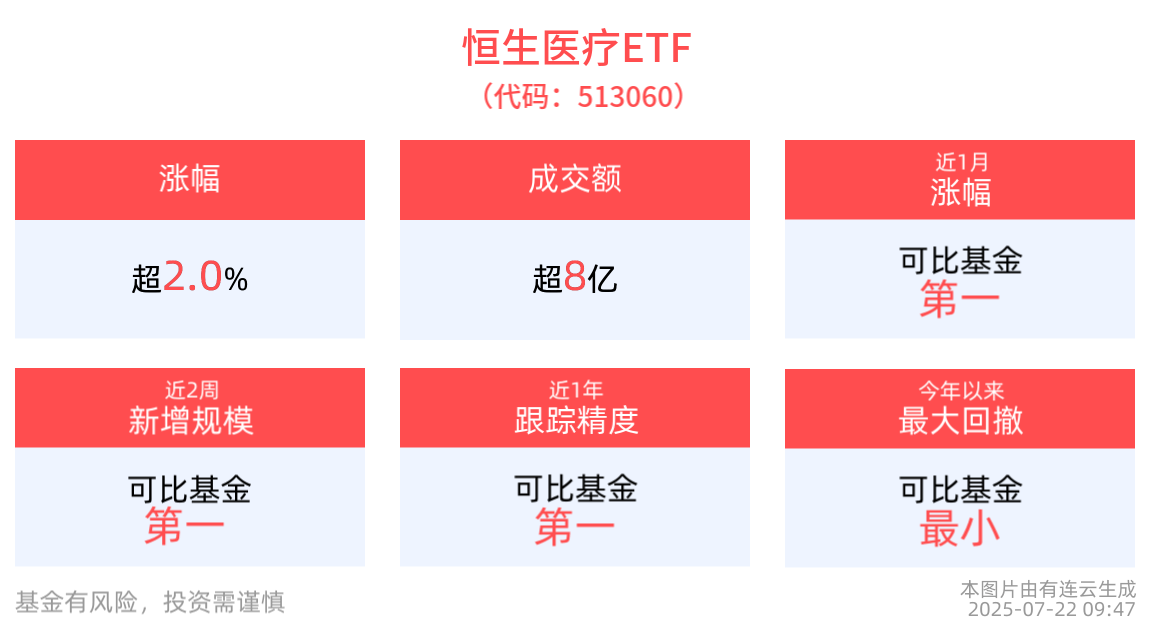
恒生医疗ETF(513060)拉升涨超2%,政策支持下,创新药企有望加速实现价值兑现
Sou Hu Cai Jing· 2025-07-22 02:06
Group 1 - The Hang Seng Healthcare Index (HSHCI) has shown a strong increase of 2.14%, with notable gains from stocks such as Livzon Pharmaceutical (up 11.57%) and United Laboratories (up 7.00) [3] - The Hang Seng Healthcare ETF (513060) has risen by 2.02%, with a recent price of 0.66 yuan, and has accumulated an 8.95% increase over the past week, ranking in the top third among comparable funds [3] - The trading activity of the Hang Seng Healthcare ETF is robust, with a turnover rate of 10.09% and a transaction volume of 840 million yuan, indicating active market participation [3] Group 2 - The 11th batch of national drug procurement has officially launched, involving 55 varieties, signaling a positive shift in procurement policies favoring innovative drugs [4] - The procurement policy emphasizes "no procurement for new drugs" and optimizes selection criteria, enhancing protection for innovative drugs and promoting a healthier market ecosystem for generic drugs [4] - The stable operation of the national medical insurance fund, projected to reach total revenue of 34,913.37 billion yuan by the end of 2024, supports the accessibility and market demand for innovative drugs [5] Group 3 - The Hang Seng Healthcare ETF has seen a significant growth in scale, increasing by 221 million yuan over the past two weeks, ranking in the top third among comparable funds [5] - The ETF's financing activities are notable, with a latest financing purchase amount of 160 million yuan and a financing balance of 231 million yuan [5] - The ETF has achieved a net value increase of 30.39% over the past two years, with a maximum monthly return of 28.34% since inception [5] Group 4 - The Hang Seng Healthcare ETF has a Sharpe ratio of 2.22 over the past year, indicating strong risk-adjusted returns [6] - The ETF has the lowest relative drawdown among comparable funds, with a drawdown of 0.52% year-to-date [6] - The ETF's management fee is 0.50%, and its tracking error is 0.060%, the highest tracking precision among comparable funds [6] Group 5 - The top ten weighted stocks in the Hang Seng Healthcare Index account for 60.73% of the index, including companies like BeiGene and WuXi Biologics [7]