
BYD(01211)

Search documents
3月19-20日 常州!2026锂电关键材料及应用市场高峰论坛
鑫椤储能· 2026-02-04 06:25
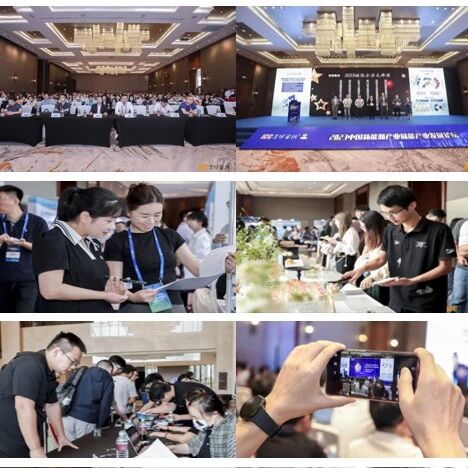
Core Viewpoint - The lithium battery industry is expected to experience a significant growth wave in 2026, characterized by strong demand recovery, accelerated global expansion, and disruptive technological iterations, leading to a spiral growth pattern of "increased volume and price + technological leap" [3]. Group 1: Market Predictions - By 2025, global lithium battery production is projected to reach 2297 GWh, with a growth rate of 34.6% in 2026. The shipment growth rate for energy storage cells is anticipated to reach 70%, driven by both domestic and international demand [5]. - There is a notable supply gap in the effective production capacity of battery cells and various materials, making supply chain stability and efficiency crucial for capitalizing on this growth opportunity [5]. Group 2: Conference Details - The 2026 Lithium Key Materials and Application Market Summit will be held on March 19-20, 2026, in Changzhou, Jiangsu, organized by Xinluo Information [4]. - The summit will focus on two main topics: in-depth discussions on cutting-edge technologies and market supply-demand dynamics, and B2B procurement matchmaking to connect top battery manufacturers and material suppliers [6]. Group 3: Key Topics and Participants - The conference will feature specialized sessions on lithium carbonate futures, market volatility responses from lithium battery companies, and the potential of global lithium resources in 2026 [7][8]. - Notable participants include leading battery companies like CATL and BYD, as well as material suppliers covering the entire supply chain, including positive and negative materials, electrolytes, and separators [6].





3月19-20日 常州!2026锂电关键材料及应用市场高峰论坛
鑫椤锂电· 2026-02-04 06:16
Core Viewpoint - The lithium battery industry is poised for a significant growth cycle starting in 2026, characterized by strong demand recovery, accelerated global expansion, and disruptive technological advancements, leading to a "spiral rise" in both volume and price [3]. Group 1: Market Predictions - Global lithium battery production is expected to reach 2297 GWh by 2025, with a growth rate of 34.6% in 2026. The shipment growth rate for energy storage cells is projected to be as high as 70%, driven by dual domestic and international demand [5]. - There exists a notable supply gap in battery cells and various materials, necessitating a focus on ensuring a stable and efficient supply chain to capitalize on this growth opportunity [5]. Group 2: Conference Details - The 2026 Lithium Key Materials and Applications Market Summit will be held on March 19-20, 2026, in Changzhou, Jiangsu, organized by Xinluo Information [4]. - The summit will focus on two main topics: in-depth discussions on cutting-edge technologies and market supply-demand dynamics, and B2B procurement matchmaking to connect top battery manufacturers and material suppliers [6]. Group 3: Key Topics and Participants - The conference will feature specialized sessions on lithium carbonate futures, market volatility responses from lithium battery companies, and the potential of global lithium resources [7][8]. - Notable participants include leading battery companies like CATL and BYD, as well as material suppliers covering the entire supply chain, including cathode materials, anode materials, electrolytes, and separators [6]. Group 4: Industry Trends and Strategic Insights - The lithium battery industry is expected to play a crucial role in energy transition and carbon neutrality goals as it enters a new planning phase [6]. - The summit aims to provide authoritative data releases, benchmark company rankings, and deep industry connections to facilitate high-quality development in the lithium battery sector [6].

比亚迪(002594):1月销量承压 海外和技术双驱动
Ge Long Hui· 2026-02-04 04:34
Core Viewpoint - BYD's January sales report indicates a significant decline in domestic sales due to demand front-loading and proactive inventory reduction, while export sales show strong growth, positioning the company for future advancements in new technologies and models [1][2]. Domestic Sales - In January, BYD's total passenger car sales reached 210,000 units, representing a year-on-year decrease of 30% and a month-on-month decrease of 50% [1]. - The sales breakdown by brand shows the Dynasty and Ocean series sold 178,000 units, while other models like the Fangchengbao, Tengshi, and Yangwang had varying performances, with some experiencing significant growth [1]. - The decline in domestic sales is attributed to a combination of demand-side pressures, including a 5% increase in new energy vehicle purchase tax in 2026, leading to early demand release in late 2025, and a delay in local replacement subsidy applications [1][2]. Supply Chain and Inventory Management - BYD proactively reduced inventory by approximately 50,000 units in January, anticipating the launch of new models with extended range and fast-charging capabilities [2]. - The company aims to create space for new vehicle distribution to dealers, indicating a strategic shift during the off-season to prepare for upcoming product launches [2]. Export Performance - January exports reached 100,000 units, marking a year-on-year increase of 51%, with expectations for continued growth in overseas markets [2]. - BYD's overseas production capacity is expanding, with factories in Thailand, Brazil, and Hungary contributing to a projected total overseas capacity of over 800,000 units by 2026 [2]. Technological Advancements - BYD is focusing on enhancing vehicle range and charging capabilities, with plans to implement "universal long-range" strategies across new and updated models [2]. - The company has accumulated significant data from its assisted driving systems, which may enhance user experience and engagement [2]. Financial Projections - Revenue forecasts for 2025-2027 have been slightly adjusted, with expected revenues of 820 billion, 955.3 billion, and 1.11 trillion yuan respectively, and net profit estimates of 35 billion, 46.6 billion, and 56.7 billion yuan [3]. - The estimated earnings per share (EPS) for the automotive business in 2026 is projected at 4.24 yuan, with a target price adjustment to 130.63 yuan, maintaining a "buy" rating [3].
比亚迪(002594):2026M1国内外销量显著分化 关注新品周期
Ge Long Hui· 2026-02-04 04:34
从企业自身产品节奏来看:2025 年底申报的新品集中在2026 年初上市,1月尚未形成销量贡献,产品迭 代衔接出现短期断层;国内渠道优化尚未完成,部分区域经销商布局调整影响终端销售。 投资建议:2026 年1 月份销量下滑既有行业因素,也有公司本身产品节奏因素,公司目前仍是国内基本 面最优秀的车企之一(自产电池是最大差异化),看好2026 年新品周期提供新动能,一季度股价有望 触底,后续随着新品释放及行业企稳,股价具备上行潜力。预计2025、2026、2027 年分别实现归母净 利润346.98、364.92、388.72 亿元,分别对应22.9、21.7、20.4 X PE,继续强烈推荐! 风险提示:1、新品需求不及预期;2、海外布局不及预期。 高端品牌销量有所分化: 1 月高端品牌阵营表现分化,方程豹品牌实现爆发式增长,销量达2.16 万辆, 同比激增247%,成为高端品牌的核心增长引擎。 腾势品牌则表现疲软,当月销量仅6002 辆,同比下滑48.79%,主要受高端MPV 市场竞争加剧影响,竞 品车型持续迭代,导致销量下滑明显。 从行业背景来看:1 月销量双降具备一定行业普遍性:一方面,2025 年底新能 ...
王朝首款B级纯电SUV路透曝光 比亚迪宋Ultra EV正式亮相
Feng Huang Wang· 2026-02-04 04:17
Core Viewpoint - BYD officially announces the launch of its first B-class pure electric SUV, the Song Ultra EV, aimed at filling the gap in the 200,000 to 250,000 yuan market for mid-sized electric SUVs [1] Group 1: Product Details - The Song Ultra EV is positioned as the flagship model of the family, showcasing significant advantages in size with dimensions of 4850mm in length, 1910mm in width, and 1670mm in height, along with a wheelbase of 2840mm [1] - Compared to the Song L DM, which measures 4780mm in length, 1898mm in width, and 1670mm in height with a wheelbase of 2782mm, the Song Ultra EV demonstrates notable increases in length, width, and wheelbase [1] Group 2: Design Features - The exterior design of the Song Ultra EV continues the classic "Dragon Face" aesthetic of BYD's Dynasty series, featuring a closed grille and a continuous light strip [1] - The front bumper design includes significantly enlarged air ducts on both sides, enhancing the vehicle's aerodynamic performance [1]

胡润发布2025汽车品牌价值榜:特斯拉居首,问界进前三
Feng Huang Wang· 2026-02-04 02:43
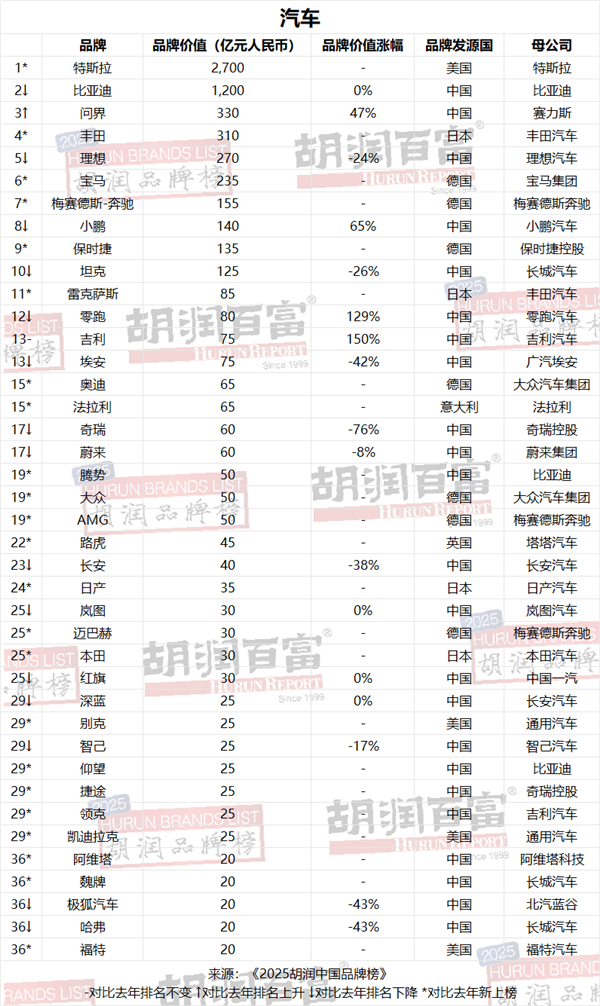
Core Insights - The 2025 Hurun China Brand List has been released, highlighting the automotive brand value rankings, with Tesla leading at a brand value of 270 billion RMB [1] Brand Value Rankings - Tesla ranks first with a brand value of 2700 million RMB and projected sales of 627,200 units in China for 2025 [1] - BYD follows in second place with a brand value of 1200 million RMB and cumulative sales expected to exceed 4.6 million units by 2025 [1] - Aito (问界) ranks third with a brand value of 330 million RMB, showing the highest growth rate of 47% among the top five brands [1][2] - Toyota and Li Auto are in fourth and fifth places with brand values of 310 million RMB and 270 million RMB, respectively [1] - The sixth to tenth positions are occupied by BMW, Mercedes-Benz, Xpeng, Porsche, and Tank, with Xpeng showing a significant brand value increase of 65% [1][2] Notable Changes - Leap Motor (零跑汽车) has the fastest brand value increase at 129%, reaching 80 million RMB [2] - Chery (奇瑞) experienced the most significant decline in brand value, dropping by 76% [2]



比亚迪:2026年1月销量点评-20260204
Huachuang Securities· 2026-02-04 02:30
Investment Rating - The report maintains a "Strong Buy" rating for the company, expecting it to outperform the benchmark index by over 20% in the next six months [4][17]. Core Views - The company is experiencing a significant adjustment in wholesale sales, with a total wholesale volume of 210,000 vehicles in January, representing a year-on-year decline of 30% and a month-on-month decline of 50% [4][7]. - Despite the current challenges in demand and rising costs, the company is expected to leverage its strong competitive position and product innovation to expand its global market share, aiming for sales to exceed 5 million vehicles in 2026, with overseas sales projected to reach 1.5 million vehicles [4][7]. - The report highlights the company's robust financial performance, with projected total revenue of 943.6 billion yuan in 2026, reflecting a year-on-year growth of 17.1% [2][8]. Financial Summary - **Revenue Projections**: - 2024A: 777.1 billion yuan - 2025E: 805.6 billion yuan - 2026E: 943.6 billion yuan - 2027E: 1,070.5 billion yuan - Year-on-year growth rates: 29.0% (2024A), 3.7% (2025E), 17.1% (2026E), 13.5% (2027E) [2][8]. - **Net Profit Projections**: - 2024A: 40.3 billion yuan - 2025E: 35.2 billion yuan - 2026E: 47.0 billion yuan - 2027E: 60.0 billion yuan - Year-on-year growth rates: 34.0% (2024A), -12.5% (2025E), 33.6% (2026E), 27.5% (2027E) [2][8]. - **Earnings Per Share (EPS)**: - 2024A: 4.42 yuan - 2025E: 3.86 yuan - 2026E: 5.16 yuan - 2027E: 6.58 yuan [2][8]. - **Valuation Ratios**: - Price-to-Earnings (P/E) ratio: 20 (2024A), 23 (2025E), 17 (2026E), 13 (2027E) - Price-to-Book (P/B) ratio: 4.3 (2024A), 3.1 (2025E), 2.7 (2026E), 2.3 (2027E) [2][8].
2月3日华宝港股通恒生中国(香港上市)30ETF(520560)遭净赎回369.86万元
Xin Lang Cai Jing· 2026-02-04 02:22
Group 1 - The core point of the article highlights the net redemptions of the Hua Bao Hong Kong Stock Connect Hang Seng China (Hong Kong Listed) 30 ETF (520560), which faced a net outflow of 3.6986 million yuan on February 3, ranking 40th out of 212 in cross-border ETF net outflows [1] - As of February 3, the latest scale of the Hua Bao Hong Kong Stock Connect Hang Seng China (Hong Kong Listed) 30 ETF is 755 million yuan, down from 766 million yuan the previous day, indicating a net outflow of 0.48% relative to the previous day's scale [1] - Over the past 5 days, the fund experienced net redemptions totaling 35.4312 million yuan, ranking 25th out of 212 in cross-border ETF net outflows [1] - The fund's scale has decreased by 7.60% and its assets by 7.01% since the beginning of the year, with the latest share count at 814 million [2] Group 2 - The fund's management fee is 0.50% annually, and the custody fee is 0.10% annually [2] - The fund is managed by Zhang Fang and Jiang Junyang, both of whom have recorded a return of -7.27% since the fund's inception on September 24, 2025 [3] - The top holdings of the fund include Tencent Holdings (14.92%), Alibaba-W (13.98%), and China Construction Bank (7.23%), among others, with significant investments in major Chinese companies [3]





未知机构:瑞银看好南瑞科技因电网资本支出上行周期超出市场预期将其加入最佳投资组-20260204
未知机构· 2026-02-04 02:15
Summary of Conference Call Records Company and Industry Involved - **Company**: 南瑞科技 (NARI Technology) - **Industry**: Power Grid and Energy Storage Key Points and Arguments NARI Technology and Power Grid Capital Expenditure - UBS is optimistic about NARI Technology due to the expected upward cycle in power grid capital expenditure from 2026 to 2030, with a projected compound annual growth rate (CAGR) of 7%, exceeding market expectations [1] - UBS's utility team considers the 7% CAGR a conservative baseline, suggesting that the actual CAGR could reach 11% due to accelerated construction of backbone and distribution networks [1][2] - Historically, NARI Technology's growth rate has been approximately double that of the national grid capital expenditure growth rate, and UBS believes this trend will continue during the current upward cycle [2] BYD and Export Growth - UBS reaffirms BYD's position in the "Best Investment Portfolio" due to strong export growth and the potential for its energy storage business [2] - Despite weak domestic sales in January, BYD's exports increased by over 50% year-on-year, nearly matching domestic sales [2] Energy Storage and Capacity Pricing Mechanism - The National Development and Reform Commission (NDRC) introduced a capacity pricing mechanism for independent energy storage projects, significantly enhancing their economic viability [3] - Under this framework, energy storage projects included in provincial project lists can receive capacity price compensation based on local coal power capacity prices, expected to be around 165 yuan/kW/year by 2026 [3] - This mechanism acknowledges the system reliability and capacity value of energy storage, improving the internal rate of return (IRR) for storage projects from approximately 3% to 8%, surpassing the 7% investment threshold for most state-owned enterprises [3] Industrial Green Microgrid Development - The Ministry of Industry and Information Technology (MIIT) and other departments released guidelines for the construction and application of industrial green microgrids from 2026 to 2030, clarifying applicable technologies and deployment models [4] - The guidelines position microgrids as active participants in the power system, capable of providing peak shaving, demand response, and ancillary services, transitioning from pilot concepts to scalable, policy-supported solutions [4] Green Power Direct Connection Policy - The National Energy Administration (NEA) has prioritized multi-user green power "direct connection" as a policy focus for 2026, targeting applications in data centers, semiconductor manufacturing, aluminum industry, and zero-carbon industrial parks [5] - This initiative enhances the traceability of green power, supporting exporters' Scope 2 emissions disclosures and potentially alleviating pressures from carbon border adjustment mechanisms (CBAM) [5] - From a system perspective, "direct connection" and microgrid architecture can help alleviate local grid congestion by shifting some incremental load growth behind the meter, complementing rather than replacing broader grid investments [5]
多国销量超越特斯拉!比亚迪登顶全球纯电销量冠军,重构新能源汽车格局
Xin Lang Cai Jing· 2026-02-04 01:56
Core Insights - In 2025, BYD achieved a historic milestone by surpassing Tesla with annual sales of 2.257 million pure electric vehicles, becoming the global leader in the electric vehicle market [1][4] - This achievement is attributed to BYD's systematic innovation and strategic globalization, positioning Chinese automotive brands at the forefront of the global automotive industry [1][4] Group 1: Technological Advancements - BYD's success is built on a robust technological moat established over the years, featuring innovations like the "Heavenly Eye" driver assistance system and the "Super e-platform" for rapid charging [1][4] - The company's vertically integrated supply chain model ensures rapid iteration of technology and products, creating a competitive edge that is difficult to replicate [1][4] Group 2: Market Performance - In Europe, BYD transitioned from a single product focus to a comprehensive breakthrough, with sales in the UK exceeding 50,000 units, a staggering increase of 485% year-on-year [2][5] - In traditional automotive markets like Germany, Spain, and Italy, annual sales surpassed 20,000 units, reflecting the recognition of product quality and the effectiveness of localized sales and service networks [2][5] - In the Asia-Pacific region, BYD's dominance is evident, with annual sales reaching 45,000 units in Turkey and 41,000 units in Thailand, bolstered by the establishment of local manufacturing facilities [2][5] Group 3: Global Expansion Strategy - BYD's dual strategy of "going global" and "localization" has been pivotal, with its electric vehicles now present in 119 countries and regions, achieving overseas sales exceeding one million units in 2025 [3][6] - The company is expanding its production footprint internationally, with factories in Thailand, Brazil, and Uzbekistan already operational, and a facility in Hungary set to commence operations soon [3][6] - This localization strategy not only addresses complex external environments but also shortens delivery times and aligns with market demands, marking a significant shift from "product trade" to "industry rootedness" [3][6]