
NCI(01336)

Search documents
“保险系”私募基金扎堆设立,钱都会投向哪里?
Di Yi Cai Jing· 2025-06-17 12:40
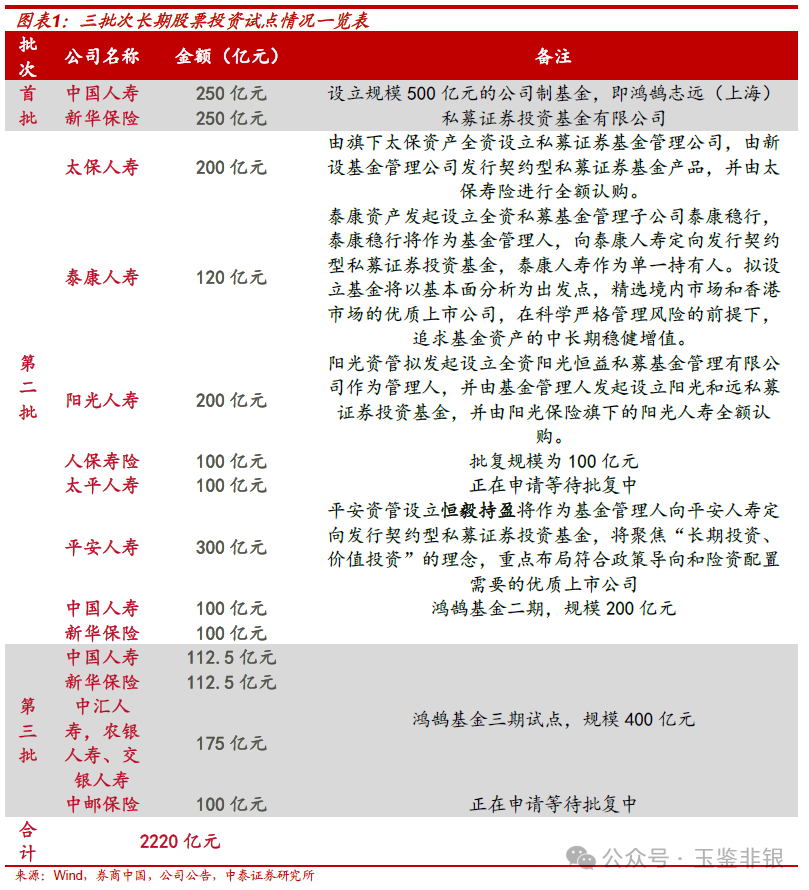
Core Viewpoint - The establishment of "insurance系" private equity funds is driven by regulatory guidance for long-term capital market entry and the actual needs of insurance companies to adapt to a low-interest-rate environment [1][2]. Group 1: Fund Establishment and Scale - Xinhua Insurance plans to invest up to 15 billion yuan in the Honghu III private equity fund, co-established by Xinhua Asset and China Life Asset [2][3]. - Since May, at least seven "insurance系" private equity funds or products have been established, indicating a surge in activity among insurance companies [3][4]. - The Honghu III fund has a total scale of 22.5 billion yuan, with Xinhua Insurance and China Life each contributing 11.25 billion yuan [3]. Group 2: Long-term Investment Strategy - The establishment of these private equity funds reflects the results of the insurance capital's "long money long investment" strategy, driven by policy support and the need for better asset allocation in a declining interest rate environment [5]. - The long-term investment pilot program initiated in 2023 allows insurance companies to set up private equity funds primarily targeting the secondary market stocks for long-term holding [5][6]. Group 3: Investment Focus and Trends - The investment focus of these funds is expected to be on high-dividend, low-volatility stable assets, with an emphasis on companies with strong governance and good business models [10][11]. - The first phase of the Honghu fund primarily invested in key industries related to national interests, while the second phase is set to focus on large-cap A+H shares [10][11]. - Other insurance companies are also expected to follow similar investment strategies, focusing on stable, high-quality listed companies [11][12]. Group 4: Regulatory and Market Context - The pilot program for long-term investment is expected to expand by 2025, with several insurance companies already approved to participate [6][7]. - The total approved scale for the three batches of long-term investment reform trials is estimated to reach 222 billion yuan, with expectations for further increases in approved scales [7].




非银周观点:地缘风险冲突加剧,市场风偏或受压制-20250617
Great Wall Securities· 2025-06-17 08:01
Investment Rating - The industry investment rating is "Outperform the Market" [3][21]. Core Viewpoints - The report highlights that geopolitical risks and market volatility are increasing, particularly due to the ongoing Israel-Iran conflict and U.S.-China trade negotiations, which may suppress market risk appetite [1][9]. - The non-bank financial sector, excluding insurance, has shown relative stagnation, while the banking sector has experienced significant volatility [1][9]. - The report suggests that financial weight sectors may benefit from an increase in market risk appetite and related policies, with a focus on the upcoming political bureau meeting in July [1][9]. Summary by Sections 1. Main Points - The report covers the performance of major indices, with the CSI 300 Index at 3864.18 points (-0.25%), the insurance index at 1229.00 points (2.06%), and the brokerage index at 6189.87 points (0.82%) [7]. - The insurance sector's investment scale is expected to grow steadily, with a notable increase in bond and stock allocations [2][10]. 2. Key Investment Portfolio 2.1 Insurance Sector - The insurance sector is currently undervalued, presenting opportunities for valuation recovery. Recommended stocks include China Ping An, China Pacific Insurance, and New China Life Insurance [11]. 2.2 Brokerage Sector - Focus on mid-sized securities firms benefiting from innovation and market conditions, such as East Money and Zheshang Securities. Large firms like Huatai Securities and China International Capital Corporation are also recommended due to their strong performance and low valuations [12].




新华保险43亿入局杭银的野望
Hua Er Jie Jian Wen· 2025-06-16 13:49
Core Viewpoint - The recent transfer of shares from Commonwealth Bank of Australia to New China Life Insurance marks a significant shift in the shareholder structure of Hangzhou Bank, with New China Life now holding over 5% of the bank's shares, positioning itself as the fourth largest shareholder [1][4]. Group 1: Shareholder Changes - Commonwealth Bank of Australia has completely divested its stake in Hangzhou Bank, transferring 330 million shares to New China Life Insurance, which now holds a total of 5.09% of the bank's shares [1][2]. - The transaction price of 13.1 yuan per share for New China Life is significantly lower than Hangzhou Bank's closing price of 16.56 yuan on June 16, indicating a strategic long-term investment rather than a short-term profit [2][12]. - New China Life's acquisition aligns with its strategy to enhance its long-term investment portfolio and optimize its asset structure amid increasing competition for investment opportunities [2][16]. Group 2: Strategic Intentions - New China Life's investment in Hangzhou Bank is not only aimed at increasing dividend assets but also at leveraging the bank's extensive network in the Yangtze River Delta region to expand its market presence [3][24]. - The bank has established a comprehensive service network in Zhejiang province, which is crucial for New China Life as it seeks to tap into the region's high growth potential [3][24]. - The collaboration between New China Life and Hangzhou Bank could lead to enhanced synergies in various business areas, particularly in insurance and banking services [4][26]. Group 3: Historical Context and Performance - Commonwealth Bank of Australia has been a shareholder in Hangzhou Bank for 20 years, witnessing significant growth in the bank's asset size from under 50 billion yuan to over 2.11 trillion yuan by the end of 2024 [7][10]. - The bank's net profit growth of 18.07% in 2024, alongside stable asset quality metrics, reflects its resilience in a challenging market environment [7][8]. - The exit of Commonwealth Bank is part of a broader trend where foreign banks are reducing their stakes in Chinese financial institutions due to rising compliance costs and a strategic focus on domestic markets [10][11]. Group 4: Investment Trends - The current environment of asset scarcity and regulatory encouragement for insurance capital to enter the market has led to a growing preference among insurance companies for long-term dividend assets [17][19]. - New accounting standards have facilitated this trend, allowing insurance firms to classify bank stocks as long-term investments, which aligns with New China Life's strategy to enhance its long-term equity investment base [18][19]. - New China Life's OCI account for equity investments has seen substantial growth, indicating a strategic shift towards high-dividend assets [19].

保险行业估值驱动主要来自资产端
Xiangcai Securities· 2025-06-16 06:42
Investment Rating - The report maintains an "Overweight" rating for the insurance industry, indicating a positive outlook for investment opportunities in the sector [82]. Core Insights - The adjustment of predetermined interest rates is expected to enhance the value of new business, with a projected decrease in the rate to 2% in the third quarter, which will lower the rigid cost of liabilities and improve product profitability [8][12]. - The expansion of long-term stock investment trials is anticipated to increase the flexibility of the asset side, with insurance companies actively seeking higher-yield risk assets to mitigate the pressure from interest rate spreads [20][27]. - There is a need for further optimization in asset-liability matching, as mismatches in duration can lead to fluctuations in net assets, particularly under the IFRS 17 standards [42][50]. - The valuation of insurance companies is primarily driven by improvements in the asset side, with the current PEV valuation level at 0.70, indicating that market valuations are below the intrinsic value of the companies [59][67]. Summary by Sections 1. Adjustment of Predetermined Interest Rates - The upper limit for the predetermined interest rate for ordinary life insurance is currently set at 2.5%, with a projected decrease to 2% in the upcoming quarter, which is expected to enhance the new business value [8][12]. - The insurance premium income for life insurance is showing signs of recovery, with a cumulative growth of 1.3% as of April 2025, marking a positive shift in the market [12][14]. 2. Expansion of Long-term Stock Investment Trials - The total scale of long-term stock investment trials has reached 222 billion, with several major insurance companies participating [25]. - The demand for high-yield risk assets is increasing as insurance companies seek to cover the rigid costs associated with liabilities [27][33]. 3. Need for Optimization in Asset-Liability Matching - The mismatch in asset and liability durations is causing volatility in net assets, necessitating better alignment to mitigate risks associated with interest rate changes [42][50]. - The average net investment yield for listed insurance companies remains around 4%, which poses challenges for long-term asset yield stabilization [50][56]. 4. Valuation Driven by Asset Side Improvements - The contribution of insurance contract services to profits is significant, with new business value expected to enhance overall performance [59][61]. - The current average PB valuation for five A-share insurance companies is 1.6, indicating a moderate valuation level compared to historical data [67][71].


新华保险112.5亿认购鸿鹄三期推“长钱”入市 投资收益飙升前5月保费收入991亿增26%
Chang Jiang Shang Bao· 2025-06-16 01:20
保险资金长期投资改革试点又取得新进展。 6月12日,新华保险(601336.SH、01336.HK)公告称,此次投资标的为国丰兴华鸿鹄志远三期私募证券投 资基金1号(下称"鸿鹄三期"),规模达225亿元,新华保险与中国人寿拟各出资112.5亿元认购私募基金份 额,主要投向中证A500指数成分股中符合条件的大型上市公司A+H股。 新华保险表示,本次投资符合国家推动长期资金入市的相关政策。 长江商报记者注意到,一季度,随着资本市场活跃,新华保险的投资收益实现97.72亿元,同比飙升超 百亿,推动公司一季度业绩双增。去年同期,公司的投资收益为-17.19亿元。 保险业务方面,今年前5个月,公司实现保费收入990.86亿元,同比增长26%。 112.5亿认购鸿鹄三期50%份额 根据新华保险公告,为进一步响应国家推动中长期资金入市的政策,公司拟出资不超过150亿元认购由 国丰兴华(北京)私募基金管理有限公司(下称"国丰兴华")发起设立并管理的私募基金的份额。 此次投资标的为鸿鹄三期,存续期限为10年,按约定履行变更手续后,私募基金存续期限可相应延长。 据了解,该基金成立规模达225亿元,新华保险与中国人寿拟各出资112 ...
积极配置非银板块优质红马,持续关注业绩高弹性个股
Changjiang Securities· 2025-06-15 15:16
Investment Rating - The report maintains a "Positive" investment rating for the non-bank financial sector, highlighting the attractiveness of quality stocks in this area [7]. Core Insights - The second quarter shows a stable improvement in policy and market trading trends, suggesting that high-quality non-bank stocks remain a good investment choice based on profitability and dividend stability [2][4]. - Recommended stocks include Jiangsu Jinzheng, China Ping An, and China Pacific Insurance for their stable earnings and high dividend yields. Additionally, stocks like New China Life, China Life, Hong Kong Exchanges, CITIC Securities, Dongfang Wealth, Tonghuashun, and Jiufang Zhitu Holdings are recommended based on their earnings elasticity and valuation levels [2][4]. Summary by Sections Market Performance - The non-bank financial index increased by 1.2%, outperforming the CSI 300 by 1.4% this week, ranking 6th out of 31 sectors. Year-to-date, the non-bank financial index is down 4.2%, underperforming the CSI 300 by 2.4%, ranking 25th out of 31 [5]. Policy and Regulatory Updates - The Ministry of Finance issued a notice to further implement the new insurance contract accounting standards, which is expected to increase the demand for equity assets among some insurance companies during the transition [4][61]. Company Announcements - Guosen Securities announced a cash dividend of 3.50 yuan per 10 shares, totaling 3.364 billion yuan [6]. Insurance Sector Insights - In April 2025, the cumulative insurance premium income reached 259.54 billion yuan, a year-on-year increase of 2.25%. Property insurance income was 64.86 billion yuan, up 5.19%, while life insurance income was 194.69 billion yuan, up 1.31% [22][23]. Investment Business Trends - The report notes a recovery in market activity, with average daily trading volume reaching 1.3717 trillion yuan, up 13.47% week-on-week. The margin financing balance also increased to 1.82 trillion yuan, up 0.53% [40][47]. Financing Activities - In May 2025, equity financing decreased to 16.795 billion yuan, down 32.2% month-on-month, while bond financing was 72.7 billion yuan, down 7.3% [49][51].

非银行金融行业周报:券商并购重组主题持续发酵,保险股价值重估行情延续-20250615
SINOLINK SECURITIES· 2025-06-15 14:16
Investment Rating - The report suggests a focus on four main lines of investment opportunities in the securities sector, indicating a positive outlook for the industry [2]. Core Insights - The report highlights that the main drivers for the brokerage market this week are the easing of US-China negotiations and the ongoing theme of mergers and acquisitions in the industry [2]. - It emphasizes the expected improvement in the performance of the brokerage sector in the first half of 2025, with a notable mismatch between high profitability and low valuations, suggesting a good cost-performance ratio for investments [2]. - The report also notes the potential for significant improvements in the combined ratio (COR) for non-auto insurance due to the implementation of mandatory insurance policies and the introduction of standard clauses for liability insurance [3][4]. Summary by Sections Securities Sector - The report mentions that the China Securities Regulatory Commission approved the Central Huijin Investment to become the actual controller of eight financial institutions, including Changcheng Guorui Securities [2]. - It discusses the upcoming review of the acquisition of Wanhe Securities by Guosen Securities, which is expected to enhance the theme of mergers and acquisitions in the brokerage sector [2]. - The report recommends focusing on the following investment lines: 1. Hong Kong Stock Exchange: Anticipated growth in Average Daily Turnover (ADT) [2]. 2. Sichuan Shuangma: Potential benefits from policy catalysts in the venture capital industry [2]. 3. Brokerage firms with expected performance exceeding expectations in H1 2025 [2]. 4. Multi-financial entities with strong growth certainty, such as Shengye and Jiufang Zhitu [2]. Insurance Sector - The report outlines the introduction of mandatory liability insurance for high-risk industries, which is expected to improve the COR for non-auto insurance significantly [3]. - It details the core content of the new liability insurance standard clauses, including strict insurance responsibilities and fixed medical expense limits [3]. - The report suggests that the insurance sector is likely to undergo a value reassessment, with a focus on low valuations and companies expected to perform well in Q2 [4]. - It highlights the ongoing trend of insurance funds increasing their holdings in high-dividend stocks, particularly in the banking sector [32][33].


非银行业周报20250615:蚂蚁有望入局稳定币业务探索非银金融新边界-20250615
Minsheng Securities· 2025-06-15 12:12
Investment Rating - The report maintains a positive investment rating for the non-bank financial sector, highlighting potential growth opportunities due to regulatory changes and market dynamics [4][37]. Core Insights - Ant Group is expected to apply for stablecoin issuance qualifications, which could expand the participation of non-bank financial institutions in various financial services, including custody, cross-border payments, and supply chain finance [1]. - China Pacific Insurance and New China Life Insurance reported robust premium growth in the life insurance sector, with China Pacific's life insurance premiums increasing by 10.2% year-on-year to CNY 134.79 billion in the first five months of 2025 [2]. - The monetary data for May shows that M1 and M2 growth rates remain high, indicating a potential economic recovery that could support stable capital market operations [3]. Summary by Sections Market Review - Major indices experienced fluctuations, with the non-bank financial index showing a gain of 1.16% [7]. - Key stocks in the brokerage and insurance sectors, such as China Galaxy and New China Life, saw positive performance, with increases of 2.22% and 2.80% respectively [7]. Securities Sector - The total trading volume in the A-share market reached CNY 7.85 trillion, with a daily average of CNY 1.31 trillion, reflecting a significant year-on-year increase of 76.18% [14]. - The IPO underwriting scale for the year reached CNY 338.80 billion, while refinancing underwriting totaled CNY 2,478.79 billion [14]. Insurance Sector - China Pacific Insurance reported a total premium income of CNY 2,271.69 billion for the first five months, up 6.0% year-on-year, while New China Life's premiums surged by 26.1% to CNY 990.86 billion [2][35]. - The life insurance sector continues to show strong growth, with both companies maintaining a positive outlook for the remainder of the year [2]. Liquidity Tracking - The central bank's operations included a net withdrawal of CNY 727 billion, with various interest rates showing mixed trends [27]. - Government bond yields decreased, indicating a supportive environment for capital market stability [27]. Investment Recommendations - The report suggests focusing on key insurance companies such as China Pacific, New China Life, and major brokerages like China Galaxy and CITIC Securities for potential investment opportunities [4][38]. - Non-bank financial institutions are expected to benefit from the implementation of stablecoin regulations, with companies like ZhongAn Online and Hong Kong Exchanges being highlighted as potential investment targets [4][38].

非银金融行业周报(2025/6/9-2025/6/13):港股回深等政策持续落地,中长期资金入市再进一步-20250615
Shenwan Hongyuan Securities· 2025-06-15 06:30
Investment Rating - The report maintains a positive outlook on the non-bank financial sector, indicating a favorable investment rating for the industry [2]. Core Insights - The report highlights that the "H+A" policy is expected to introduce new capital into the A-share market, benefiting brokerage firms as intermediaries. The recent policy allows companies listed in Hong Kong to return to the Shenzhen Stock Exchange, which could enhance trading activity and expand the market capitalization of A-shares [2][3]. - The upcoming Lujiazui Forum is anticipated to announce significant financial policies, which could further impact the capital market positively [2]. - The report emphasizes the ongoing mergers and acquisitions in the industry, suggesting that active trading and increased client deposits will drive brokerage firms' performance in the first half of 2025 [2]. Summary by Sections Market Review - The Shanghai Composite Index closed at 3,864.18 with a slight decline of 0.25%, while the non-bank index rose by 1.16% to 1,787.09. The brokerage, insurance, and diversified financial sectors reported increases of 0.82%, 2.06%, and 0.43%, respectively [5][6]. Non-Bank Industry Insights - The report notes that the insurance sector is seeing a rise in stock investments, with companies like Xinhua Insurance planning to invest up to 15 billion RMB in a private equity fund, indicating a growing interest in long-term stock investments [2][3]. - The report suggests that the insurance sector's performance is expected to improve in the second quarter of 2025, with new business performance likely to recover [2]. Individual Stock Highlights - In the insurance sector, notable stock performances include China Life (+1.17%), Ping An (+2.00%), and Xinhua Insurance (+2.80%) in A-shares, while in H-shares, China Re (+6.67%) and China Pacific (+10.36%) showed significant gains [7]. - For the brokerage sector, the top performers included Xinda Securities (+9.67%) and Xiangcai Securities (+7.57%) [7]. Important Data - As of June 13, 2025, the average daily stock trading volume was 12,994.85 billion RMB, reflecting a 1.33% increase from the previous month [48]. - The margin trading balance stood at 18,213.25 billion RMB, indicating a year-on-year increase of 15.9% [52]. Policy Developments - The report discusses recent policy initiatives aimed at enhancing cooperation between state-owned and private enterprises, which could lead to increased investment opportunities in various sectors [17]. - The Hong Kong Securities and Futures Commission is actively working to attract diverse companies to list in Hong Kong, which may enhance market efficiency and competitiveness [18]. Recommendations - The report recommends focusing on leading brokerage firms with strong competitive positions, such as GF Securities, CITIC Securities, and Haitong Securities, as well as insurance companies like Xinhua Insurance and China Life [2].



保险资金长期投资改革试点加速推进 新增225亿元即将到位
Zheng Quan Ri Bao· 2025-06-13 16:13
Core Viewpoint - The recent progress in the long-term investment reform pilot for insurance funds in China is marked by the joint investment of 225 billion yuan by New China Life Insurance and China Life Insurance in the Honghu Zhiyuan Phase III private equity fund, indicating a significant influx of long-term investment funds into the capital market [1][2][3]. Group 1: Investment Details - New China Life Insurance and China Life Insurance each plan to invest 11.25 billion yuan in the Honghu Zhiyuan Phase III fund, which has a total investment of 225 billion yuan [1][2]. - The Honghu Zhiyuan Phase III fund has a duration of 10 years, with the possibility of extension based on contractual agreements [2]. - This investment marks the third collaboration between New China Life and China Life in private equity funds, following previous investments in Honghu Zhiyuan Phase I and II [3]. Group 2: Reform Pilot Expansion - Since the pilot program began in 2023, the scale of long-term investment reform for insurance funds has been expanding, with a total approved scale expected to reach 222 billion yuan upon the completion of the third batch of 600 billion yuan [1]. - The pilot program allows insurance companies to establish private equity funds primarily targeting the secondary market for stocks, promoting a long-term holding strategy [4]. Group 3: Fund Structure and Taxation - The structure of private equity funds is diversifying, with the first fund being a company-type fund and subsequent funds being contract-type funds, which are easier to manage and do not require corporate governance mechanisms [4][5]. - Contract-type funds avoid double taxation issues that company-type funds face, as the tax burden is borne by the fund's shareholders rather than the fund itself [5][6]. Group 4: Market Impact and Future Outlook - The long-term investment reform pilot is expected to help insurance institutions optimize asset allocation, increase equity investment ratios, and act as a stabilizing force in the capital market [6]. - The establishment of private equity funds by insurance institutions is anticipated to enhance their participation in the capital market, potentially leading to a larger scale of funds and institutions involved in the pilot program in the future [6].