
PICC(01339)

Search documents
风险减量、信贷支持、及时理赔,山东金融精准护航“三秋”生产
Qi Lu Wan Bao· 2025-10-16 14:01
Core Viewpoint - The article highlights the proactive measures taken by financial institutions in Shandong Province to support farmers during the critical autumn harvest season, particularly in response to adverse weather conditions that have affected crop yields [1][3][14]. Financial Support and Risk Mitigation - Financial institutions are increasing disaster reduction funding and providing specialized financial products to support farmers in their autumn harvest and planting efforts [1][3][12]. - Insurance companies are utilizing technology such as drones and remote sensing to enhance damage assessment efficiency and expedite claims processing [14][15][17]. - The Shandong Provincial Financial Office has organized local financial systems to provide efficient services and support for autumn grain harvesting [3][12]. Agricultural Operations and Equipment - Various financial institutions are coordinating the use of agricultural machinery, such as tracked harvesters and mobile dryers, to assist in the timely harvesting and drying of crops [3][4][7]. - Specific initiatives include the establishment of agricultural machinery reserves and the donation of equipment to enhance drainage capabilities in affected areas [8][4]. Credit and Loan Initiatives - Agricultural banks have been actively providing loans to grain customers, with a reported total of 120.68 billion yuan in loans issued to 11,300 clients this year [11][13]. - The Industrial and Commercial Bank of China has introduced over 40 specialized financing products to meet the diverse needs of farmers during the autumn harvest [12][13]. Technology in Insurance and Claims Processing - Insurance companies are employing drones and remote sensing technology to quickly assess crop damage, with some companies reporting a 50% reduction in the time required for damage assessments [14][15]. - The use of a "green channel" for claims processing has been established to ensure rapid compensation for farmers, with some claims being paid within 24 hours of assessment [14][17]. Community and Volunteer Support - Insurance company volunteers are actively assisting farmers in harvesting crops, demonstrating a community-oriented approach to support during challenging weather conditions [5][7]. - Local financial institutions are also engaging in community outreach to ensure that farmers are aware of available resources and support [11][12].





中国人保_电话会议要点_2025 年第三季度综合成本率(CoR)显著改善;因增加成长股敞口,投资前景更乐观
2025-10-16 13:07
Summary of PICC Group 3Q25 Conference Call Company Overview - **Company**: PICC Group (1339.HK) - **Industry**: Insurance Key Takeaways 1. Premium Growth and CoR Improvement - In 3Q25, PICC's premium growth was steady at +4% year-over-year, consistent with 1H25 growth [2] - Auto premium growth aligned with industry levels, while agricultural, commercial properties, and liability lines showed muted growth [2] - CoR (Cost of Risk) improved significantly year-over-year due to reduced NAT CAT losses, attributed to enhanced risk prevention measures by the government and PICC [2] 2. Future CoR Expectations - Management anticipates further CoR improvements driven by: - Continued regulatory strengthening in the auto insurance sector with stricter expense monitoring starting in 2025 [2] - Gradual relaxation of NEV pricing factors launched in mid-September 2025 [2] - Expense rationalization in non-auto businesses commencing November 1, 2025, starting with commercial property and employer liability lines [2] 3. Life Insurance Growth - Bancassurance remained the primary growth driver in 3Q25, with regular premium growth increasing from approximately 50% year-over-year in 1H25 [3] - Focus on long-term products with premium payment terms of 5 to 10 years, shifting towards par/universal products [3] - Improvement in NBV (New Business Value) margin year-over-year noted [3] 4. Health Insurance Opportunities - Management is exploring the establishment of medicine catalogs for various health insurance tiers, particularly targeting middle-end health insurance [4] - The introduction of innovative drugs in catalog B is expected to enhance market potential and allow for higher pricing [4] 5. Investment Performance - In 3Q25, management reported that net assets increased quarter-over-quarter, driven by improved equity returns, particularly from growth-style stocks [5] - The broad-based growth stock index rose by 24% in 3Q25 compared to 16% in 3Q24, benefiting PICC's investment strategy [7] 6. Valuation and Target Price - Target price set at HK$7.50, based on a sum-of-the-parts (SOTP) approach, reflecting a 0.72x 2026E P/EV multiple [8] - Market capitalization reported at HK$299.839 billion (approximately US$38.528 billion) [5] 7. Risks - Key downside risks include: - Prolonged downturn in the P&C (Property and Casualty) sector [9] - A-share market slump [9] - Strengthened regulations in the life insurance industry [9] - Deterioration of the macroeconomic environment [9] 8. Upside Risks - Potential upside risks that could lead to stock trading above target price include: - Accelerated recovery in the P&C sector post-auto insurance reform [11] - A-share market rally [11] - Regulatory relaxation in the life insurance sector [11] - Improved macroeconomic conditions [11] This summary encapsulates the essential insights from the PICC Group's 3Q25 conference call, highlighting the company's performance, strategic outlook, and associated risks.

3000美元险资下场买黄金,年内浮盈达40%,长期战略配置或超550吨
Hua Xia Shi Bao· 2025-10-16 11:55
Core Viewpoint - The article highlights the significant increase in gold prices and the strategic investments made by Chinese insurance companies in gold, which have yielded substantial returns since their initial purchases earlier this year [2][3]. Group 1: Investment Actions and Returns - In March 2023, major Chinese insurance companies purchased gold when international prices were around $3,000 per ounce, and as of October 16, 2023, gold prices have risen to over $4,200 per ounce, resulting in a floating profit of approximately 40% for these investments [2][4]. - The first transactions by these insurance companies included various types of gold contracts on the Shanghai Gold Exchange, marking a significant entry into the gold market [4][5]. Group 2: Regulatory Environment - The National Financial Regulatory Administration issued a notice in February 2023 allowing insurance funds to invest in gold, aiming to optimize asset allocation and improve asset-liability management [3][4]. - Ten insurance institutions were designated as pilot entities for this initiative, which includes major players like China Life and Ping An [3]. Group 3: Future Projections and Market Impact - Analysts predict that insurance companies could potentially hold between 208 tons to 555 tons of gold in the medium to long term, which would represent a manageable increase in global gold demand [8]. - The potential for insurance companies to increase their gold holdings significantly could lead to a substantial impact on gold prices, with estimates suggesting that if insurance funds were to fully utilize their investment capacity, it could lead to price increases of up to 66.23% [7][8]. Group 4: Strategic Importance of Gold - Gold is viewed as a crucial asset for insurance companies to hedge against inflation and economic downturns, providing a stable investment option in a low-interest-rate environment [9]. - The long-term support for gold prices is expected to stem from global geopolitical tensions and inflationary pressures, making it an attractive asset for insurance firms [9].


中国人保:截至2025年6月30日,公司A股股东125534户
Zheng Quan Ri Bao· 2025-10-16 11:27
Group 1 - The core point of the article is that China Life Insurance reported its shareholder numbers as of June 30, 2025, with 125,534 A-share shareholders and 4,881 H-share shareholders [2] Group 2 - The company engaged with investors through an interactive platform to provide updates on shareholder statistics [2] - The article mentions the formation of a MACD golden cross signal, indicating positive momentum for certain stocks [2]
@保险,重要改革!238家机构,监管大调整
Zheng Quan Shi Bao Wang· 2025-10-16 08:59
Core Viewpoint - The recent adjustment in the regulatory responsibilities of insurance institutions in China indicates a shift towards localized supervision, with a significant increase in the number of insurance entities under local regulatory bodies, while the Financial Regulatory Authority focuses primarily on insurance groups and their subsidiaries [1][2][3]. Group 1: Regulatory Changes - As of June 30, 2025, the number of insurance entities regulated by the Financial Regulatory Authority decreased from 116 to 65, primarily focusing on insurance groups and their subsidiaries [2]. - The adjustment reflects a broader trend of localizing regulatory responsibilities, with local regulatory bodies now overseeing a larger number of insurance institutions [4][5]. - The Financial Regulatory Authority convened a special meeting with local regulatory agencies to discuss these changes [1]. Group 2: Impact on Local Regulatory Bodies - Local regulatory bodies, particularly in major cities like Beijing and Shanghai, have seen a significant increase in the number of insurance entities they oversee, with Beijing's count rising from 24 to 39 and Shanghai's from 24 to 36 [4][5]. - The increase in regulatory responsibilities has led to heightened pressure on local regulatory bodies, necessitating stronger management accountability from insurance company executives [5]. Group 3: Specific Changes in Insurance Institutions - The total number of insurance institutions listed as of June 30, 2025, is 238, a decrease of one from the end of 2024, with notable changes including the removal of Tianan Insurance and the addition of Suzhou Dongwu Insurance [6]. - Several types of insurance institutions, such as insurance asset management companies and health insurance companies, have shifted from being regulated by the Financial Regulatory Authority to local regulatory bodies [6][7]. - A total of 21 out of 35 insurance asset management companies have transitioned to local regulatory oversight, while 14 remain under the Financial Regulatory Authority [7].


中国人民保险集团(01339.HK)拟10月30日举行董事会会议审批季度业绩
Ge Long Hui· 2025-10-16 08:50
格隆汇10月16日丨中国人民保险集团(01339.HK)发布公告,谨定于2025年10月30日(星期四)举行董事 会会议,以审议及批准本公司及其附属公司截至2025年9月30日止九个月的第三季度未经审核业绩及其 刊发,并处理任何其他事项。 ...
国泰海通:预计25Q3险企利润增长提速 多元渠道驱动NBV高增
智通财经网· 2025-10-16 08:33
智通财经APP获悉,国泰海通发布研报称,25Q3权益市场整体向好,叠加保险公司优化资产结构提升 权益资产配置,预计投资收益显著提振,预测25年前三季度上市险企净利润在2024年同期高增长基础上 继续同比大幅增长,且较25年半年度的利润增长进一步提速。25年1-8月寿险保费增长景气,预计得益 于上市险企把握定价利率下调前窗口期推动新单集中销售,银保渠道日益成为价值增长的重要贡献来 源。财险方面,预计车险综改持续深化以及非车险"报行合一"导向下行业保费增长逐步由追求规模、速 度向追求质量、效益转变。 国泰海通主要观点如下: 预计财险保费缓慢增长,巨灾赔付提升不改COR改善趋势 预计车险综改持续深化以及非车险"报行合一"导向下行业保费增长逐步由追求规模、速度向追求质量、 效益转变。受制于25Q3台风等自然灾害仍然频发,预计赔付率仍有一定压力,得益于风险减量持续显 效预计对COR负面影响相对有限;另一方面,得益于上市险企严格落实监管"报行合一"强化费用管控, 预计费用率持续改善。预计25年前三季度上市险企COR延续改善态势,分别为:中国财险(96.1%,同 比-2.1pt)、平安财险(96.6%,同比-1.2pt)、 ...


收盘丨A股三大指数冲高回落,全市场成交额不足2万亿元
Di Yi Cai Jing· 2025-10-16 07:18
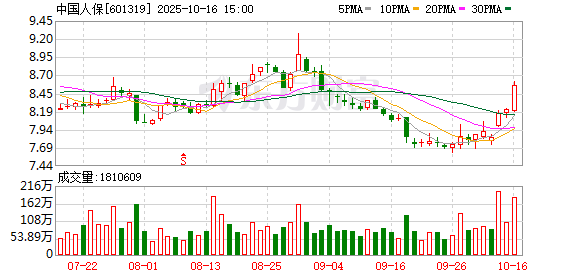
Market Overview - The A-share market showed mixed performance on October 16, with the Shanghai Composite Index up by 0.1%, the Shenzhen Component down by 0.25%, and the ChiNext Index up by 0.38% [1][2] - The total trading volume in the Shanghai and Shenzhen markets was 1.93 trillion yuan, a decrease of 141.7 billion yuan compared to the previous trading day, with nearly 4,200 stocks declining [1][2] Sector Performance - The coal sector experienced significant gains, with major companies like Dayou Energy and Antai Group hitting the daily limit up, while China Coal Energy and Zhengzhou Coal Electricity also saw substantial increases [2] - Financial stocks, including insurance and banking, performed strongly, with China Life Insurance rising over 5% and China Pacific Insurance up by 4% [2] Capital Flow - Main capital inflows were observed in the automotive, communication equipment, and banking sectors, with notable net inflows into Chang'an Automobile, Changshan Beiming, and ZTE [4] - Conversely, significant net outflows were recorded in software development, non-ferrous metals, and home appliances, with Zijin Mining and Sanhua Intelligent Control facing the largest sell-offs [4] Institutional Insights - Everbright Securities predicts that the market will likely maintain a volatile and consolidating trend in October [6] - Guodu Securities notes that the Shanghai Composite Index has recovered above the five-day moving average and returned to the 3,900-point level, indicating a decrease in short-term market risks, although trading volume remains low [6] - CITIC Securities highlights a reduction in market risk appetite, suggesting a rotation between high and low-performing sectors [6]



临沂监管分局同意中国人保财险蒙阴支公司变更营业场所
Jin Tou Wang· 2025-10-16 05:41
2025年10月9日,国家金融监督管理总局临沂监管分局发布批复称,《关于中国人民财产保险股份有限 公司蒙阴支公司营业场所变更的请示》(临人保财险发〔2025〕98号)收悉,经审核,现批复如下: 二、中国人民财产保险股份有限公司应按照有关规定及时办理变更及许可证换领事宜。 一、同意中国人民财产保险股份有限公司蒙阴支公司将营业场所变更为:山东省临沂市蒙阴县云蒙路 145号1号楼101。 ...
玉米收入险让种植户吃下“定心丸”
Qi Huo Ri Bao Wang· 2025-10-15 19:36
Core Viewpoint - The introduction of the "Dalian Commodity Exchange Farmers' Income Protection Plan" in Fumeng County has significantly improved agricultural production stability and farmer confidence through innovative insurance mechanisms that combine price and yield protection [1][2]. Group 1: Project Overview - The "Dalian Commodity Exchange Farmers' Income Protection Plan" was implemented in Fumeng County in 2024, providing a safety net for local farmers facing unpredictable weather and market prices [1][2]. - The project covers 100,000 acres of corn and employs a dual protection mechanism of "price + yield," with a target yield of 0.565 tons per acre and a target price of 2,500 yuan per ton, creating a risk protection wall of 120 million yuan [2]. - The total premium for the project is 7.2 million yuan, with farmers contributing only 14.3%, making it more accessible for farmers to insure their crops [2][3]. Group 2: Impact on Farmers - A total of 3,684 insured farmers received 2.35 million yuan in compensation, averaging an increase of 364.27 yuan per acre, which has positively impacted their income [2]. - The project has led to a shift in farmers' perceptions, with increased participation and interest in insurance and futures products, indicating a growing awareness of risk management tools [4][5]. Group 3: Government and Institutional Support - The project has received strong support from local government agencies, including the Liaoning Provincial Department of Agriculture and Rural Affairs, which has promoted the initiative across various townships [6]. - The success of the corn income insurance project has encouraged the adoption of similar models in other agricultural sectors, such as livestock, where 18,200 pigs have been insured, resulting in compensation of 1.2359 million yuan [7]. Group 4: Future Prospects - The "insurance + futures" model is recognized as an innovative financial service that addresses both production risks and market price volatility, filling a gap in agricultural risk management [7]. - The project aims to promote the high-quality development of agriculture in Fumeng County, with plans for more farmer-friendly initiatives in the future [8].