
HUA HONG SEMI(01347)

Search documents
港股收评:恒指涨0.74%,半导体飙升,有色金属活跃
Ge Long Hui· 2025-10-24 08:48
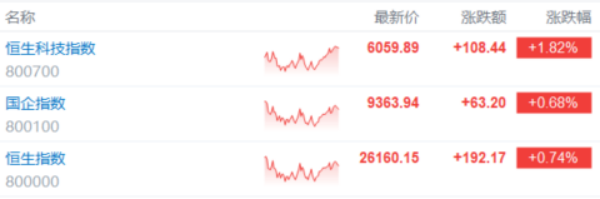
Market Overview - On October 24, Hong Kong's three major indices collectively rose, with the Hang Seng Tech Index leading with a gain of 1.82%, while the Hang Seng Index increased by 0.74%, recovering the 26,000-point mark, and the State-Owned Enterprises Index rose by 0.68% [1][2] - Large technology stocks generally saw increases, with Alibaba and Kuaishou rising over 2%, and Baidu and NetEase up over 1% [1][2] Sector Performance - Semiconductor stocks performed notably well, with Hua Hong Semiconductor surging nearly 14% [1][4] - Military stocks were active, with significant gains in Chinese brokerage stocks in the afternoon session [1] - Precious metals and non-ferrous metals sectors saw collective gains, while water utilities, nuclear power, new consumption concept stocks, domestic real estate, gas, and coal sectors mostly underperformed [1] Company News - Alibaba launched its first self-developed Quark AI glasses on October 24, featuring dual flagship chips from Qualcomm and Hengxuan [3] - The Central Committee of the Communist Party of China emphasized the importance of technological modernization to support China's development during a press conference on October 24 [5] Individual Stock Movements - Hua Hong Semiconductor led the semiconductor sector with a 13.73% increase, followed by ASMPT and Center International with gains of 8.11% and 8.04%, respectively [4][6] - Military-related stocks like AVIC and Aerospace Holdings also saw increases, with AVIC rising over 4% [8] - The non-ferrous metals sector was active, with Jiangxi Copper and Luoyang Molybdenum both rising over 6% [10] Investment Trends - Southbound funds recorded a net inflow of 3.414 billion HKD, indicating strong interest in Hong Kong stocks [18] - Analysts from Guotai Junan Securities believe that if market concerns are alleviated, Hong Kong tech stocks will benefit from current industry trends, particularly with the potential return of foreign capital due to anticipated interest rate cuts by the Federal Reserve [20]


恒生指数收涨0.74% 华虹半导体涨超13%
Zheng Quan Shi Bao Wang· 2025-10-24 08:29
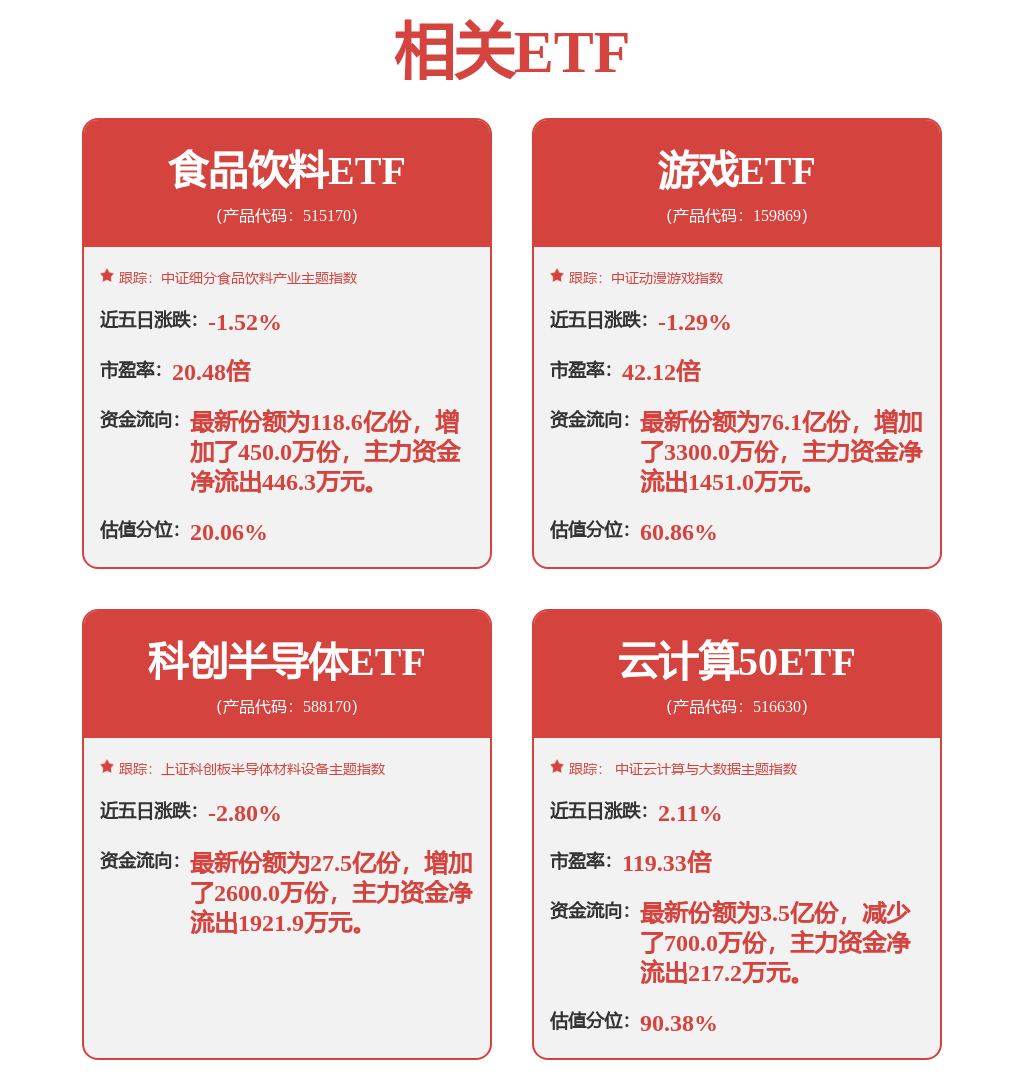
Group 1 - The Hang Seng Index rose by 0.74%, while the Hang Seng Tech Index increased by 1.82% [1] - Hua Hong Semiconductor surged over 13%, SMIC rose over 8%, and Horizon Robotics gained over 6% [1] Group 2 - Food and Beverage ETF (Code: 515170) experienced a decline of 1.52% over the past five days, with a PE ratio of 20.48 times and a net outflow of 446.3 thousand [3] - Gaming ETF (Code: 159869) saw a decrease of 1.29% in the last five days, with a PE ratio of 42.12 times and a net outflow of 1,451 thousand [3] - Sci-Tech Semiconductor ETF (Code: 588170) dropped by 2.80% in the past five days, with a net outflow of 1,921.9 thousand [3] - Cloud Computing 50 ETF (Code: 516630) increased by 2.11% over the last five days, with a PE ratio of 119.33 times and a net outflow of 217.2 thousand [4]

港股午盘|恒指涨0.59% 华虹半导体涨超11%
Di Yi Cai Jing· 2025-10-24 06:00
Group 1 - The Hang Seng Index rose by 0.59%, while the Hang Seng Tech Index increased by 1.22% [1] - Semiconductor stocks experienced significant gains, with Hua Hong Semiconductor rising over 11% and both SMIC and Shanghai Fudan increasing by more than 5% [1] - Apple-related stocks also saw an uptick, with Weishi Jiajie and Hong Teng Precision both rising over 5% [1]
港股半导体板块延续强势,华虹半导体涨幅扩大至超12%
Mei Ri Jing Ji Xin Wen· 2025-10-24 05:32
Group 1 - The semiconductor sector in Hong Kong continues to show strong performance, with Hua Hong Semiconductor's stock price increasing by over 12% [1] - Telecommunications and network infrastructure concepts are also experiencing significant gains, with Huiju Technology's stock price rising by over 12% [1]
北水成交净买入53.45亿 欧美加码制裁俄油 北水加仓中海油近10亿港元
Zhi Tong Cai Jing· 2025-10-24 05:30
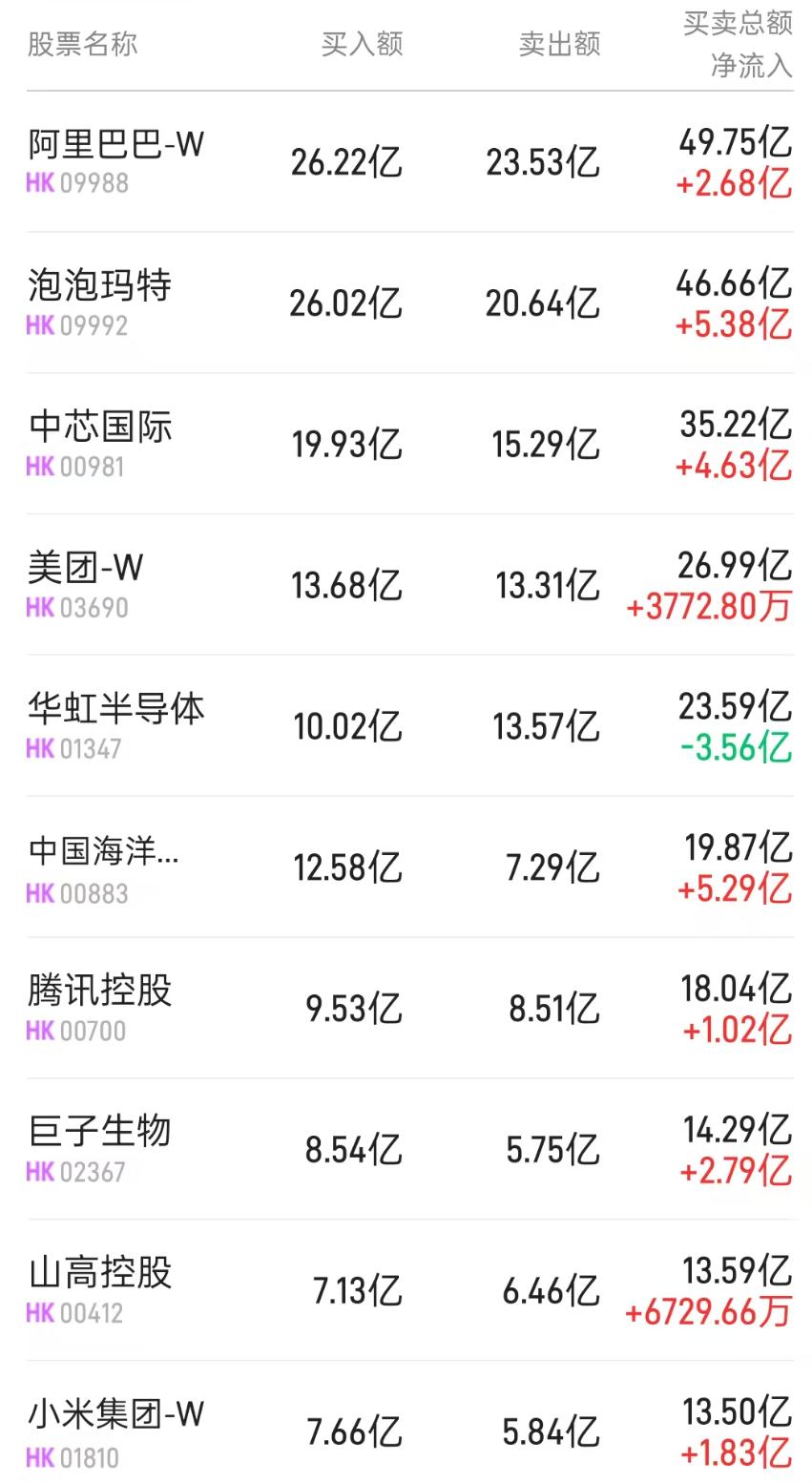
Group 1: Market Overview - On October 23, the Hong Kong stock market saw a net inflow of 5.345 billion HKD from northbound trading, with 4.77 billion HKD from Shanghai and 575 million HKD from Shenzhen [2] - The most bought stocks included China National Offshore Oil Corporation (00883), Pop Mart (09992), and Meituan-W (03690), while the most sold stocks were Hua Hong Semiconductor (01347), Innovent Biologics (01801), and Xiaomi Group-W (01810) [2] Group 2: Individual Stock Performance - Alibaba-W (09988) had a net inflow of 2.68 billion HKD, with total trading volume of 4.975 billion HKD [3] - Pop Mart (09992) recorded a net inflow of 5.38 billion HKD, with total trading volume of 4.666 billion HKD [3] - Semiconductor stocks showed divergence, with SMIC (00981) receiving a net inflow of 4.25 billion HKD, while Hua Hong Semiconductor (01347) faced a net outflow of 10.14 billion HKD [7] Group 3: Company-Specific News - China National Offshore Oil Corporation (00883) received a net inflow of 9.79 billion HKD, driven by rising international oil prices due to sanctions on Russian oil companies [6] - Pop Mart (09992) saw a net inflow of 7.93 billion HKD, with Morgan Stanley reporting a sales growth of 245% to 250% in Q3, exceeding expectations [6] - Meituan-W (03690) had a net inflow of 5.24 billion HKD, with strategic moves to enhance its overseas business [7] - SMIC (00981) is expected to benefit from increased demand for advanced wafer foundry services due to the growth of AI applications, leading to an upgrade in its rating and target price by Morgan Stanley [7] - Innovent Biologics (01801) and Xiaomi Group-W (01810) faced net outflows of 140 million HKD and 57.32 million HKD, respectively [8]



“科技自立自强”含量大幅提升!半导体板块全面上攻,规模最大的芯片ETF涨3.7%,科创半导体ETF近20日净流入超30亿元
Ge Long Hui A P P· 2025-10-24 05:22
Group 1 - The A-share market saw a strong performance in semiconductor stocks, with notable gains including a 20% limit up for Purun Co., over 11% increase for Shenkong Co., and over 10% rise for Huahong Group, leading to a 3.82% and 3.7% increase in the Sci-Tech Semiconductor ETF and Chip ETF respectively [1] - The "14th Five-Year Plan" emphasizes significantly enhancing technological self-reliance and strength, aiming to "lead the development of new quality productivity" and explicitly stating the need to "seize the high ground in technological development" [1] - The Minister of Science and Technology, Yin Hejun, announced the acceleration of innovation in artificial intelligence and digital technologies, focusing on enhancing the supply of computing power, algorithms, and data through the comprehensive implementation of the "AI+" initiative [1] - The consumer electronics market is experiencing a surge in new product releases, driven by demand from AI, data centers, and terminal storage, leading to a continuous rise in the storage market, with major manufacturers like Samsung and SK Hynix announcing a 30% price increase for memory [1] - Google has made a breakthrough in quantum computing with the launch of the "Willow" chip [1] - Financial reports from Cambrian, TSMC, and ASML indicate that the semiconductor industry is still in an upward cycle, with AI being a significant growth driver for the sector [1] Group 2 - The Sci-Tech Semiconductor ETF (588170) has seen a total net inflow of 3.13 billion yuan over the past 20 days, with constituent stocks covering domestic replacement equipment and materials, including companies like Zhongwei Co. (etching equipment), Tuojing Technology (thin film deposition equipment), and Huahai Qingke (CMP equipment) [2] - The largest chip industry ETF, Chip ETF (159995), has a current scale of 28.6 billion yuan, with a net inflow of 2.886 billion yuan over the past 20 days, covering the entire semiconductor industry chain including leading companies like SMIC, Cambrian, Changdian Technology, and Northern Huachuang [1]


港股午评|恒生指数早盘涨0.59% 芯片板块涨幅领先
智通财经网· 2025-10-24 04:06
Market Overview - The Hang Seng Index rose by 0.59%, gaining 154 points to close at 26,122 points, while the Hang Seng Tech Index increased by 1.22%. The early trading volume in Hong Kong stocks reached HKD 122.9 billion [1] Semiconductor Sector - The "14th Five-Year Plan" emphasizes the development of emerging pillar industries, accelerating the domestic self-sufficiency process in the semiconductor sector. Chip stocks saw significant gains, with Hua Hong Semiconductor (01347) rising over 11% and SMIC (00981) increasing by over 5% [1] Lithium Battery Sector - Lithium battery stocks collectively surged due to market news driving lithium prices higher, with the main contract for lithium carbonate returning above 80,000 CNY. Ganfeng Lithium (01772) rose by 3.27%, and Tianqi Lithium (09696) increased by 3.9% [1] Optical and AI Sector - Conant Optical (02276) saw a rise of over 5%, benefiting from the increasing demand for AI glasses as new products are frequently launched by the company [1] Technology Sector - Zhi Zi Cheng Technology (09911) increased by 8.3%, reporting nearly CNY 5 billion in revenue for the first three quarters, with innovative business growth of approximately 70% [2] Rare Earth Sector - Jinli Permanent Magnet (06680) rose nearly 6%, with significant improvements in profitability and a strategic focus on rare earth resources [3] Gaming and Hospitality Sector - Sands China (01928) increased by 2%, with Citigroup forecasting a recovery in EBITDA to continue into Q4 of this year and next year [4] Consumer Goods Sector - Shangmei Co., Ltd. (02145) rose by over 5%, with strong performance during the Double Eleven shopping festival, indicating the effectiveness of the company's strategic initiatives [5] Aerospace Sector - AVIC Industry (02357) increased by 4%, showcasing its future aircraft concept at the Airshow China, with business operations spanning the entire aviation industry chain [6] Media and Entertainment Sector - Yuewen Group (00772) rose by 4.6%, launching four major initiatives to develop its comic and drama ecosystem, actively promoting IP commercialization [7] Financial Sector - Zhengli New Energy (03677) fell by 9%, experiencing a decline of over 25% in the past six trading days, recently announcing a placement to raise over HKD 500 million [8]
异动盘点1023|阅文集团涨超4%,芯片股涨幅居前;特斯拉涨超2%,禾赛涨近4%
贝塔投资智库· 2025-10-24 04:00
Group 1: Hong Kong Stocks - Yuewen Group (00772) rose over 4% as the company launched four major initiatives to develop its comic-drama ecosystem and actively promote IP commercialization [1] - ASMPT (00522) increased by over 7% after Morgan Stanley reported a recovery in mainstream semiconductor demand and continuous growth in the advanced packaging market, estimating that ASMPT's third-quarter order shipment ratio will remain above 1 [1] - Sands China (01928) rose over 1% as Citigroup expects its EBITDA recovery to continue in Q4 this year and into next year [1] - Jinli Permanent Magnet (06680) saw an increase of over 5% due to significant improvement in profitability and the strategic importance of rare earth resources [1] - AVIC Aircraft (02357) rose over 4% as its Zihuo future aircraft concept model was showcased at the Airshow, with business spanning the aviation industry chain [1] - Minmetals Resources (01208) increased by over 2% with a reported 11% year-on-year growth in total copper production in Q3, and institutions are optimistic about the performance of the Las Bambas mine [1] - Semiconductor stocks led the gains, with Huahong Semiconductor (01347) up over 10%, Shanghai Fudan (01385) up over 4%, SMIC (00981) up over 5%, and Jingmen Semiconductor (02878) up over 6%. Galaxy Securities noted that semiconductor equipment is a critical support sector in the tech war [1] - Horizon Robotics-W (09660) rose over 3% as it gained favor from domestic and international car manufacturers, with HSD already designated by multiple automakers [1][2] Group 2: US Stocks - Tesla (TSLA.US) rose 2.28% with Q3 2025 revenue at $28.095 billion, a 12% year-on-year increase, exceeding analyst expectations [3] - IBM (IBM.US) fell 0.87% as its Q3 hybrid cloud division revenue growth slowed and fell short of expectations [3] - Micron Technology (MU.US) increased by 4.15% as it officially samples the 192GB SOCAMM2 to customers, actively expanding low-power memory applications in AI data centers [3] - NIO (NIO.US) rose 0.73% with over 10,000 deliveries last week, including a record high of over 3,500 for the L90 model [3] - Hesai (HSAI.US) increased by 3.95% after announcing a strategic partnership with Guanghetong to jointly release a multi-modal perception and control solution based on lidar and dual-vision technology [3] - Baidu (BIDU.US) rose 2.95% as it partnered with Swiss Post's subsidiary PostBus to launch autonomous taxi road tests in Switzerland in December [3] - Futu Holdings (FUTU.US) increased by 3.65% after CICC raised its target price by 6% to $230, maintaining an "outperform" rating [3] - Alibaba (BABA.US) rose 3.64% as its Quark AI glasses are set to launch for pre-sale on the 24th [4] - Southwest Airlines (LUV.US) fell 6.25% despite a 1.1% year-on-year revenue increase to $6.95 billion in Q3, exceeding market expectations [4] - Intel (INTC.US) rose 3.36% with Q3 revenue at $13.65 billion, a 2.8% year-on-year increase [5]


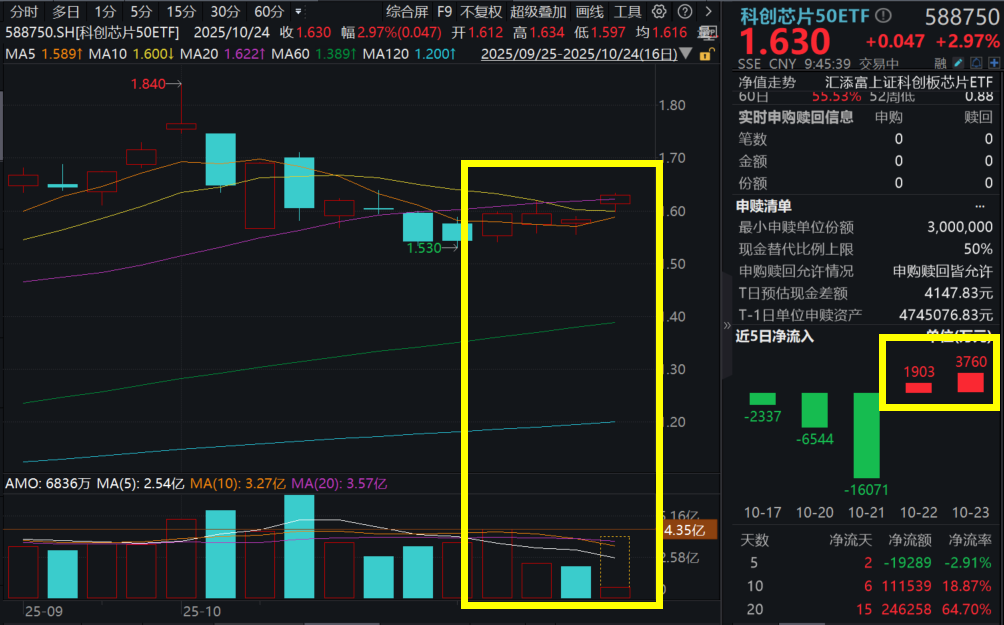
存储芯片爆发!华虹公司涨超7%,科创芯片50ETF(588750)放量涨2%,资金连续2日涌入!全球芯片共振,英特尔业绩超预期,AI引爆需求
Xin Lang Cai Jing· 2025-10-24 02:56
Core Viewpoint - The global chip supercycle is emerging, with significant inflows into the A-share technology innovation chip sector, particularly the Science and Technology Innovation Board's chip ETF, which saw a rise of over 2% on October 24, 2023, with cumulative net inflows exceeding 50 million yuan [1][3]. Market Performance - The Science and Technology Innovation Chip 50 ETF (588750) saw nearly all component stocks surge, with notable increases in storage chip concepts, including Bawei Storage up over 5%, Huahong Semiconductor up over 7%, and others like Lanke Technology and Chipone Technology also showing gains of over 5% [3][4]. - As of 9:47 AM, major memory suppliers like Samsung and SK Hynix are expected to raise DRAM and NAND flash prices by up to 30% in Q4 2023 due to surging AI-driven storage chip demand [5]. Supply and Demand Dynamics - The storage chip sector is anticipated to experience both volume and price increases due to a combination of supply shortages and growing AI demand, with the semiconductor sector's overall health being bolstered by these trends [6]. - The ongoing trade tensions and supply chain disruptions are exacerbating the shortage of storage chips, leading to a tightening supply situation and further price increases across various applications, including servers, mobile devices, and PCs [7]. Index Characteristics - The Science and Technology Innovation Chip Index focuses on high-end upstream and midstream segments of the chip industry, with a core segment representation of 95%, which is higher than other indices [9][10]. - The index is designed to reflect the performance of the chip industry, with a strong emphasis on companies listed on the Science and Technology Innovation Board, which has seen over 90% of chip companies choose this platform for listing in the past three years [8][12]. Growth Potential - The Science and Technology Innovation Chip Index is projected to have a net profit growth rate of 71% in the first half of 2025 and an annual growth rate of 100%, significantly outpacing similar indices [12]. - The index has demonstrated strong upward elasticity, with a maximum increase of 186.5% since September 2023, indicating robust performance relative to peers [13][14].


重磅会议定调科技自立自强,芯片股早盘表现强劲,华虹半导体一度涨超10%
Mei Ri Jing Ji Xin Wen· 2025-10-24 02:55
Core Insights - The article highlights a significant recovery in both Hong Kong and A-share markets, particularly in the semiconductor sector, driven by strong performances from companies like Hua Hong Semiconductor and SMIC [1] - A recent important meeting held from October 20 to 23 in Beijing emphasized the strategic goal of accelerating high-level technological self-reliance, marking a notable increase in the mention of "technology" from 2 to 10 times compared to the previous session [1] - The meeting's core spirit focuses on using technological innovation to overcome structural bottlenecks, efficiency reforms to counteract internal competition, and achieving long-term stable growth through high-quality development [1] Market Performance - In the Hong Kong market, semiconductor stocks showed significant strength, with Hua Hong Semiconductor rising over 10% [1] - In the A-share market, storage chip concepts were active, with stocks like Jiangbolong and Lanke Technology collectively rising [1] - Mainstream ETFs such as the Science and Technology Innovation 50 ETF and the Hang Seng Technology Index ETF all experienced increases [1] Strategic Implications - The recent meeting is seen as a starting point for re-evaluating industrial structures and a strategic window for long-term technology growth and high-end manufacturing sectors [1] - The focus on technology self-reliance and innovation is expected to reshape investment strategies in the capital market [1] Related ETFs - In the Hong Kong market, the Hang Seng Technology Index ETF supports T+0 trading and is driven by a dual focus on "hard technology + new consumption" [2] - In the A-share market, the Science and Technology Innovation 50 ETF targets high elasticity with a focus on leading companies in the dual innovation sector [2]